Henney Kilowatt: The Electric Car Born from the Renault Dauphine
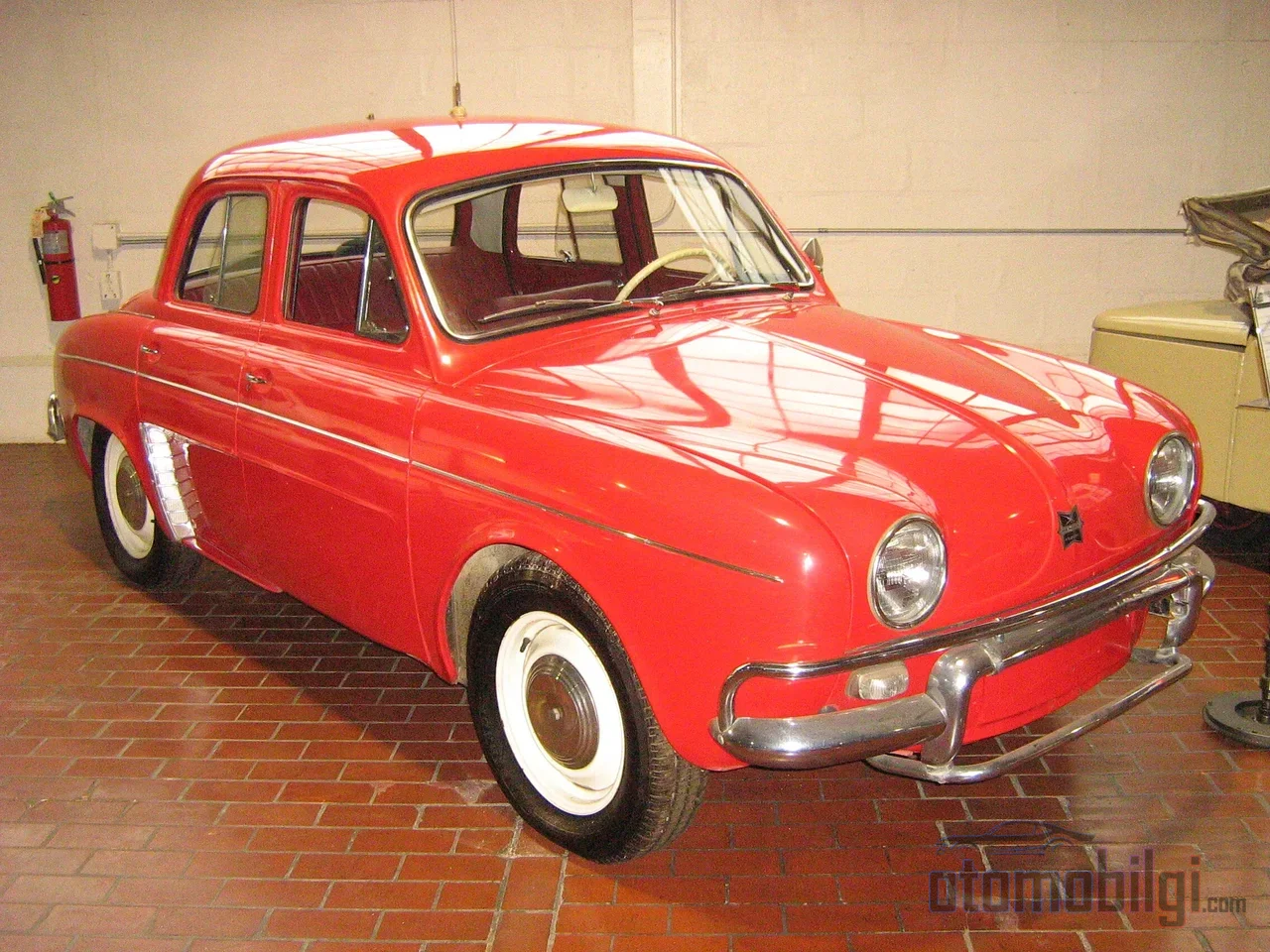
In the autumn of 1959, hardly anyone was talking about it yet, but a car was quietly setting off on the road: no engine noise, no exhaust, and no gasoline pump either. Its body came out of the molds of a Renault Dauphine, and its heart was eighteen lead-acid batteries and a 7-horsepower DC motor. Its name was the Henney Kilowatt, and fully half a century before the lithium-ion revolution, it was one of the most serious attempts at the idea of a mass-produced electric car. So how did a coachbuilder and a French subcompact car come together in this project, and why did the story last only three model years?
An Electric Car Project from a Coachbuilding Master: Whose Work Was the Henney?
The story of the Henney Kilowatt begins with one of the most unexpected actors in the automotive world. The Henney Motor Company had been producing custom coachwork since 1868; known for its ties with Packard and Ford, the company had produced thousands of limousines, ambulances, and hearses over the years. In other words, developing an electric people's car was a dream far outside this workshop's classic line of business.
The real driving force behind the project, however, was the umbrella over Henney: the National Union Electric Company. This group encompassed Emerson Radio, the Henney Motor Company, and Eureka Williams, and as a critical detail, it was also the maker of Exide batteries. The architect of the project was C. Russell Feldmann, president of National Union Electric and Eureka Williams; the goal was to shift the focus of American automaking from fossil fuels to lead-acid batteries. On the Exide side, Morrison McMullan Jr. was part of the project. The technical team was no coincidence either.
The technical team is no coincidence either. The drive system was developed under the consultancy of Victor Wouk, an electrical engineer from Caltech. Wouk was a name who would later be remembered as one of the pioneers of hybrid vehicles; He also brought Caltech president Lee DuBridge into the project. Wouk designed the speed controller, and its production was undertaken by Curtis Instruments. The design and production of the electrical system, on the other hand, belonged to Eureka Williams, a vacuum cleaner manufacturer based in Bloomington, Illinois.
Why the Renault Dauphine? The Chassis's Journey
The most practical decision of the project was to choose a ready-made solution instead of developing the body and chassis from scratch. The choice fell on the Renault Dauphine, a small, light, and economical French car. Henney bought the Dauphines without the engine, fuel tank, and radiator; the chassis was rebuilt at the Henney Coachworks workshops using molds and parts purchased from Renault.
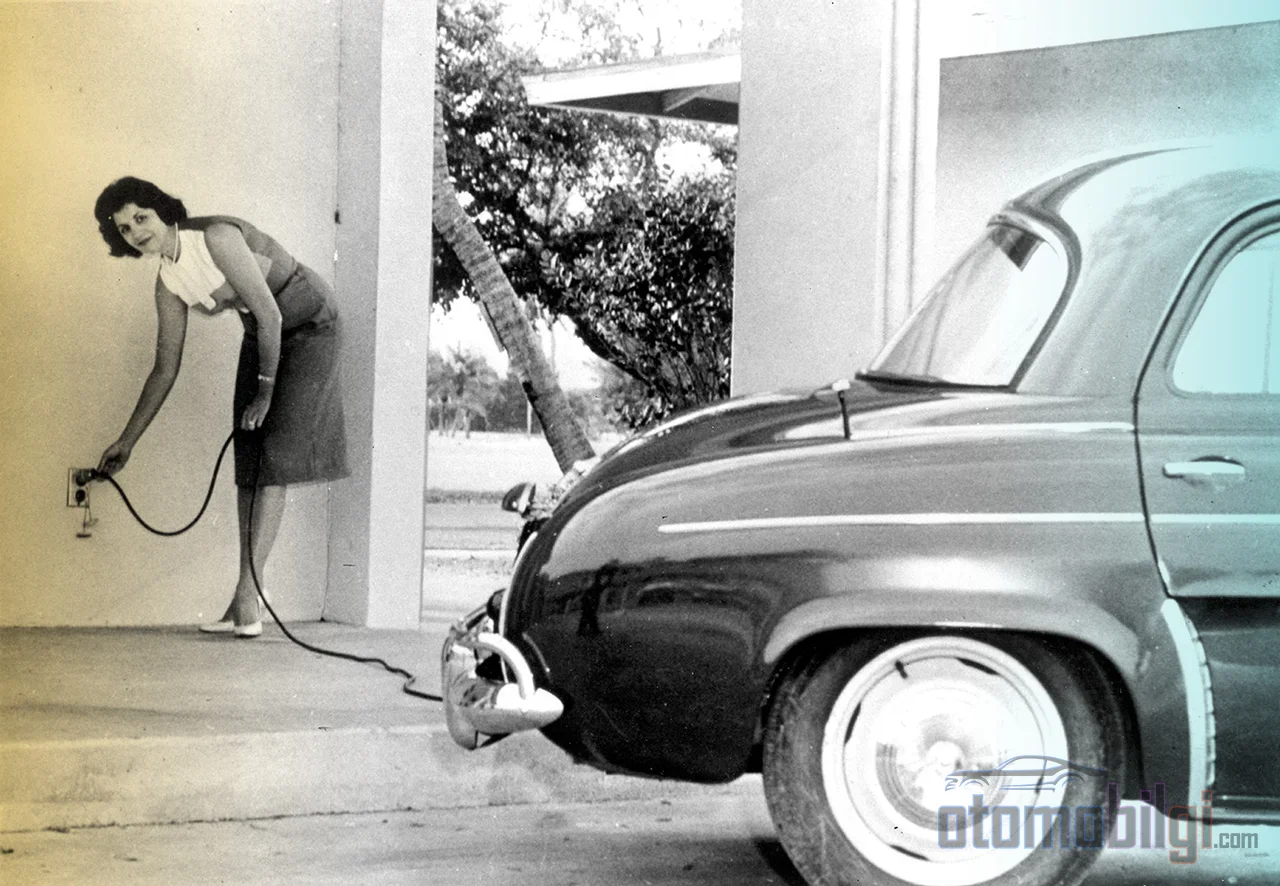
The result was a car that looked like an ordinary Dauphine from the outside but carried a completely different world under its hood. The batteries were divided between the front and rear compartments, adding approximately 363 kg of extra weight to the vehicle. For charging, a standard 120 V outlet and an 7.6-meter extension cord stored in the garage cabinet were sufficient; a full charge took 8 hours, and the driver was provided with a voltmeter and ammeter on the dashboard.
Technical Specifications: The Difference Between 36 Volts and 72 Volts
The Kilowatt was produced in two versions, and the difference between the two clearly reveals all the limits of the electric vehicle engineering of that era:
| Feature | 1959 (36 V) | 1960 (72 V) |
|---|---|---|
| Battery configuration | 18 2-volt batteries | 12 6-volt batteries |
| Top speed | 64 km/h | ~96 km/h |
| Range | ~64 km | Over 97 km |
| Weight | 907 kg | 968 kg |
The motor was the same in both versions: a General Electric direct current motor delivering 5.2 kW (7 hp). The drivetrain used a three-speed manual gearbox. The shared dimensions were as follows: wheelbase 2,261 mm, overall length 3,937 mm.
When it comes to the controller, the popular narrative needs to be slightly tempered. The Kilowatt is often called the world's first transistorized electric car; in reality, the controller used a combination of relays and diodes. In the language of the day it was close to this "solid-state" approach and a step ahead of the classic solutions with mechanical resistance speeds, but it was not full transistor control.
Highlights
- Introduced in 1959; chassis built at Henney Coachworks from Renault Dauphine tooling
- the 36 V version reached a top speed of 64 km/h, the 72 V version ~96 km/h
- the 72 V system offered a range of over 97 km on a single charge
- List price of $3,600: nearly twice that of the gasoline Dauphine
- About 100 units were built, of which only 47 were sold
How Did the Kilowatt Perform? Comparison with the Gasoline Dauphine
Putting the numbers side by side shows at once both how ambitious and how limited the Kilowatt was. The gasoline Dauphine had 27 hp and a top speed of around 70 mph (approximately 113 km/h). The 72 V Kilowatt came close to that speed; the 36 V version remained a notch above city use. The real bottleneck was range: continuous use of no more than an hour on a single charge kept the car from being a truly everyday vehicle.
This picture was no accident. Lead-acid battery technology was half a century behind on the energy storage side; the expected breakthrough in battery technology had not yet arrived. The Kilowatt's engineers were trying to push beyond what the chemistry at hand allowed, and with every volt and every kilogram they hit the physical limits of the system.
Production, Sales and the End in 1961
Production took place in the 1959-1960 model years, and sales continued until 1961. Figures for total production vary within a narrow range: corporate records show that approximately 100 units were produced, of which 47 were sold; a museum collection counts production at around 120. The overwhelming majority of those sold went not to the public but to electric companies: it was documented in 1967 that 35 units were sold to electric utilities as promotional and meter-reader vehicles; of these, 24 were the 1959 36 V model and 8 were the 1960 72 V model. The number of cars sold to the public remained below 15.
So why did it end? The answer was more commercial than technical. Despite being clearly superior to the previous system, the 72 V system could not be produced cheaply and quickly enough by Eureka Williams to reach the targeted $3,600 selling price. In 1961 the company tried to collect advance orders in the hope of finishing the chassis components already built; very few sales were made and the project was quietly shelved.
The Price Reality: Why Did No One Want to Buy It?
To understand the Kilowatt's commercial failure, it is enough to remember American prices in 1959. The Kilowatt's list price was around $3,600; that figure was almost twice the price of a standard gasoline Dauphine at $1,645 and approached that of a new Oldsmobile. Even a resistance element such as the cabin heater cost an extra $400. The press of the day reported that a new gasoline car sold for around $1,600; in other words, the Kilowatt was selling its buyer a slower, shorter-range vehicle at twice the price.
That price difference came not from the battery itself but from hand labor. The economics of series production were never reached; each vehicle, like a workshop product, emerged with a high cost per unit. The Kilowatt was already demonstrating in 1959 the dilemma a modern electric car puts before us - that economies of scale are essential to making the technology truly accessible.
Survivors and Today's Collection Value
Surviving examples of the Kilowatt are extremely rare. Of the documented production, it is estimated that between 4 and 8 vehicles still exist. The most valuable pieces are the first car with chassis number 0001 and the prototype labeled "EXPERIMENTAL": executives kept them stored for years, they were sold to a private US collector in the early 2000s, and both have mileage of under 500 miles. At least two documented examples are still being used periodically today; a Kilowatt is on display in the Lane Motor Museum collection.
It is difficult to give a clear market figure for collection value; the rarity is certain, but there is no frequency of liquid transactions. The only reference point for comparison is classic car valuation data for the 1959 gasoline Dauphine. What separates the Kilowatt's value from the Dauphine's is its historical importance: being one of the few documented and surviving examples produced during the electric car's decades-long period of silence.
The Long Shadow of the Electric-Gasoline Rivalry
To understand the Kilowatt, one must look far back before 1959. The idea of the electric vehicle goes back to 1827, to Ányos Jedlik's first electric motor; the first electric automobile in the United States was developed by William Morrison. In 1897, Pope Manufacturing's Columbia Motor Carriage was America's best-selling vehicle - and it was electric. In 1900, about a third of the vehicles on US roads were electric, and for several years their sales surpassed those of gasoline cars; by the end of the century, about 40 percent of American vehicles were electric.
The advantages of electric power were convincing even then: no vibration, no smell, no noise, no laborious hand-crank starting. Gasoline had pulled ahead earlier because the equation had three components: around 1912, the electric starter made gasoline cars easier to use, petroleum became cheap, and gas station infrastructure spread rapidly. The price gap was also large; that year, a gasoline car cost $650, while an electric roadster cost $1,750. Afterwards, although companies like Detroit Electric and Milburn produced thousands of vehicles a year in the early 20th century, the concept fell out of fashion toward the 1920s, and during the 1930-1990 period, which could be called the middle era, interest in electric vehicles remained very low.
The Chain from Kilowatt to the EV1 and Tesla Roadster
The Kilowatt was not a quirk of its era, but a link in a long chain of intermediate experiments. The process gained momentum with California's air pollution regulations in 1990, and took concrete shape between 1996 and 1999 when General Motors produced its two-seater EV1 coupé: GM produced 1,117 units and offered them to users through leasing. According to the Smithsonian, this was the first modern electric car designed for the mass market; yet GM allowed only about 40 of the vehicles whose lease terms had ended to go to museums and institutions, and destroyed the rest.
The real transformation came when battery chemistry changed. The Nissan Altra EV became the first electric vehicle with a lithium-ion battery that was legal to use on the highway; and the Tesla Roadster, introduced in 2006 and produced in 2008, hit the market as the first highway-legal series-production fully electric car built with lithium-ion cells. The dream trapped in the Kilowatt's lead-acid cells half a century earlier finally turned into a product at scale with this technology; today, the Kilowatt is rightly remembered as the distant ancestor of modern electric cars.
Conclusion: Ahead of Its Time, Half a Century Too Early
The story of the Henney Kilowatt is the story not of a car, but of an equation: a ready chassis, a serious engineering team, and the ambitions of the era's most powerful battery manufacturer came together, but battery chemistry and production scale were lacking. Even with a top speed of over 96 km/h, the Kilowatt was too costly to sell at twice the price, and with a driving time of less than an hour, it was too limited to be a real everyday vehicle.
Still, this brief attempt was not made in vain. The Kilowatt stands as a measurable step in the chain of intermediate experiments of the mid-20th century, just before the links contributed by the GM EV1 and the Tesla Roadster. To answer the question clearly: The Henney Kilowatt is an electric car built on the Renault Dauphine chassis between 1959 and 1961, offering a range of 64-97 km with 36- and 72-volt lead-acid systems - the first serious attempt at a series-production electric car, made half a century before the lithium-ion revolution; its failure stemmed not from the technology, but from battery energy density and production economics not yet having matured.
Sources
- Henney Kilowatt
- Another EV Too Soon: The 1959 Henney Kilowatt
- Renault Dauphine Henney - 1959
- What Was The Henney Kilowatt?
- The Henney Kilowatt: Tesla Model 3's long lost ancestor
- The History of the Electric Car
- History of the electric vehicle
- EV1 Electric Car - National Museum of American History
- Tesla Roadster (first generation)