Ford and Edison's Abandoned Electric Car Dream
Share This Page
Henry Ford and Thomas Edison signed on to a joint project in the early 1910s to develop a cheap and practical electric car; the vehicle made it as far as the prototype stage, but never went into production. Behind the project's failure lies neither an oil conspiracy nor a historic fire: the culprit is the point where the high internal resistance of Edison's nickel-iron battery intersected with Ford's stubbornness in refusing any other battery. Below is the engineering account of why this project, which could have strengthened the electric car's hand against gasoline vehicles during its first golden age, failed, and the legacy it left behind.
Key Highlights
- In 1900, 28% of vehicles in the USA were electric; 1,575 electric cars were produced in 1899.
- Ford invested 1.5 million dollars (approximately 31.5 million dollars in today's value) in the project.
- In project rumors, the price was 500-750 dollars, and the range target was discussed as 50-100 miles per charge.
- In 1912, the gasoline car had reached 650 dollars, while the electric roadster had reached 1,750 dollars.
- Just before the cancellation, Ford came close to buying 100,000 batteries from Edison.
Why Did the Electric Car Once Have the Upper Hand?
The history of the electric car is much older than most people think. Thomas Davenport developed the first American electric motor in 1834; William Morrison built the first working electric car in 1891. In 1897, Pope Manufacturing Company became America's first electric car manufacturer and seller, and that same year the first electric taxi service in London was carrying passengers. So Ford and Edison's project was born not out of a void, but out of a mature market.
The numbers confirm this: by 1900, 28% of the vehicles on American roads were electric, and some calculations put this share slightly above one-third. The 1899 US census alone recorded the production of 1,575 electric cars. At that time, the technical case for the electric car was clear: the vehicle was quiet, there was no exhaust smell or vibration, no hand-crank hassle, and it was easy to use. For short urban distances, it was a more sensible solution from an engineering standpoint than the gasoline car.
The weak point, however, was concentrated in a single component: the battery. Range was limited, speed usually stayed below 20 miles per hour, and batteries were both heavy and expensive to maintain. This triple constraint was the very equation that would later determine the fate of the Ford-Edison project as well.
Why Did Ford and Edison Choose the Electric Car?
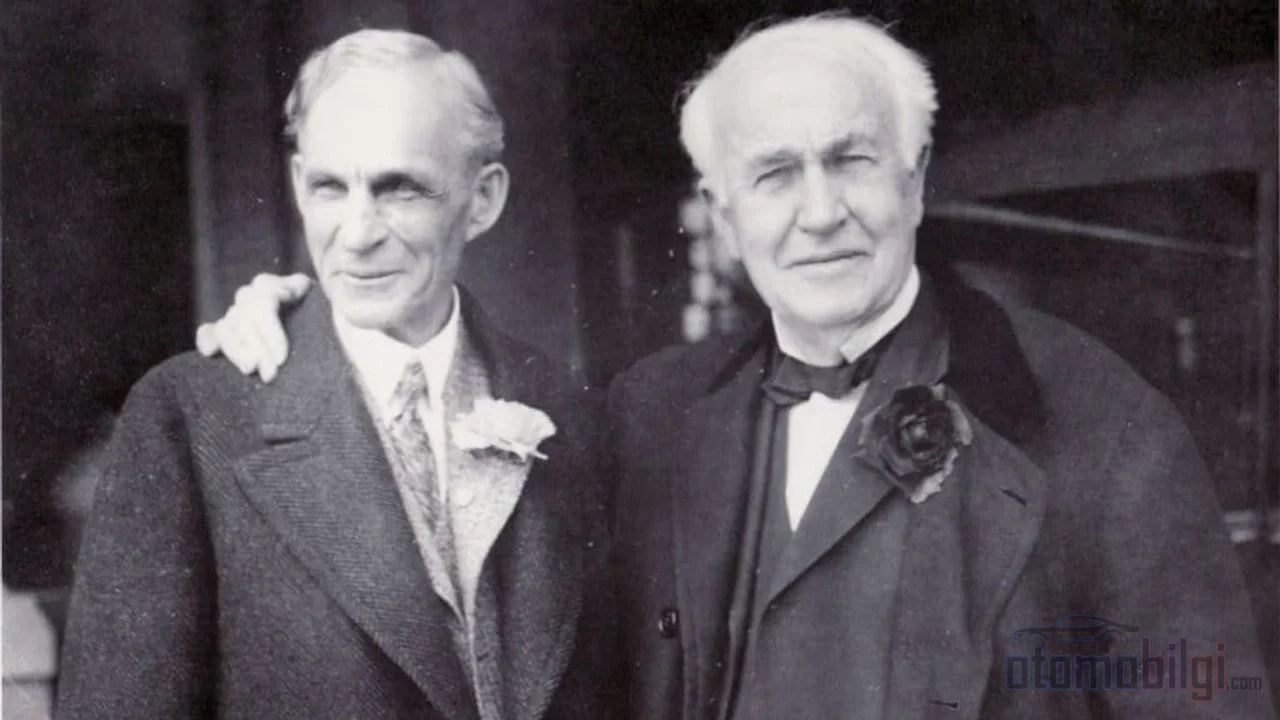
The paths of the two men crossed in 1891: that year, Ford began working as an engineer at the Edison Illuminating Company. In 1896, when Ford introduced his self-built Quadricycle to Edison, Edison encouraged him to continue with his gasoline car and told him these words:
Young man, that's the thing! Your car is self-sufficient.
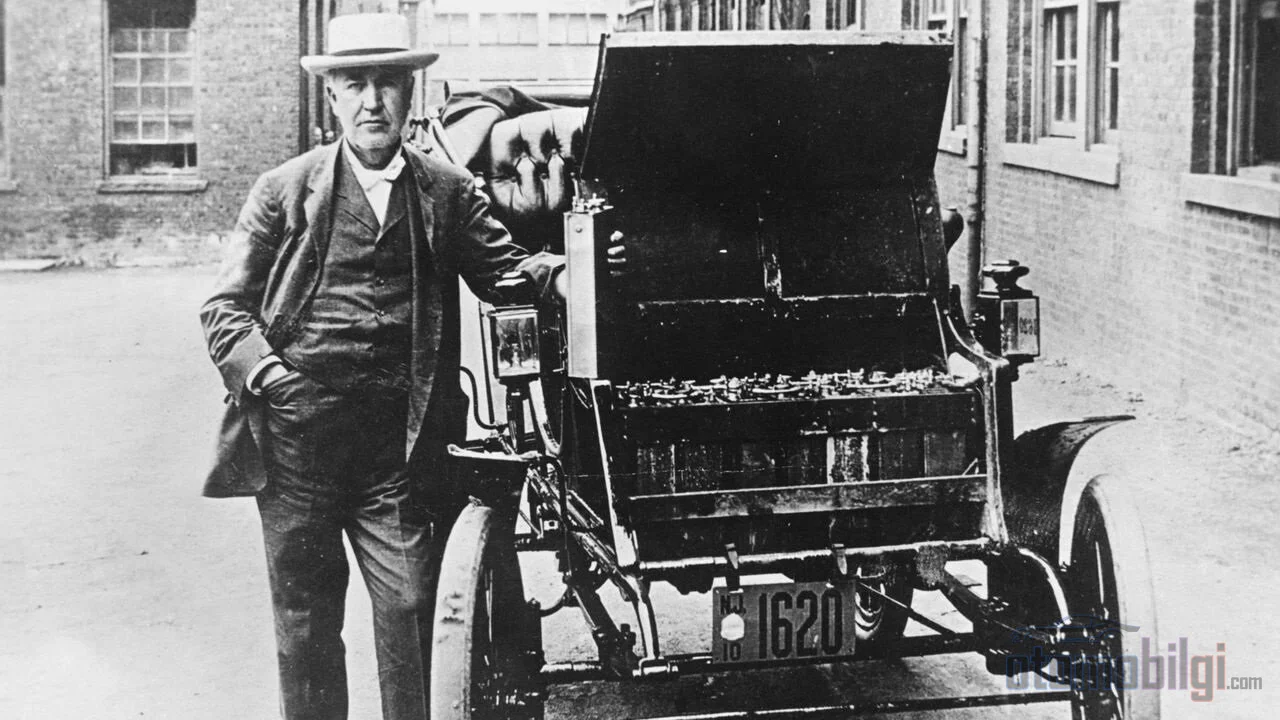
This incentive may seem strange, because Edison himself was championing the electric side. He had built his first battery-powered electric car in 1895, and from 1899 onward he began developing an alkaline, that is nickel-iron, storage battery for vehicles. He tested his batteries on journeys of 100 miles per day up to 5,000 miles, and the nickel-iron battery was offered commercially in 1903. In 1912, Edison built three vehicles with his own electric car patent; these too never reached the production stage.
Ford's motive was the same economic logic behind the Model T. The Model T had been introduced in 1908 at a price of 850 dollars; Ford wanted to apply to the electric car the same pricing logic as the gasoline car made cheap by mass production. Edison's concerns about clean air and his views on limited fossil fuel reserves gave the project an ideological foundation beyond a mere technical goal. What the two men shared was simple: the electric vehicle was a good idea, the only problem was a cheap and reliable battery - and that was exactly what Edison was working on.
Anatomy of the Prototype: The 1913-1914 Experiments
The moment the project took concrete shape was January 11, 1914: Ford confirmed the project and announced that he had been working with Edison for years on a cheap and practical electric car. Two prototypes were then produced. The first prototype was photographed in 1913 outside the Highland Park plant: it was a tiller-steered design, and the batteries were placed under the seat. The motor design was handled by electrical engineer Fred Allison, the electrical system and overall design by Gray & Davis vice president Alexander Churchward, and the general mechanical work by former Cadillac man Samuel Wilson.
The second prototype in 1914 was more pragmatic: it used the Model T chassis, suspension and front axle, the Model T steering and a worm-gear rear axle; the architect of the chassis was Eugene Farkas. This was an engineering-wise clever move - only the drivetrain was being changed on a proven chassis. One source describes the prototype as weighing 1,100 pounds, or about 500 kilograms, adding that 405 pounds of that, almost half, was battery equipment. Even the weight distribution foreshadowed the project's most critical question.
| Feature | Value |
|---|---|
| Total weight | 1,100 pounds (about 500 kg) |
| Battery equipment weight | 405 pounds |
| Targeted price | 500-750 dollars |
| Targeted range | 50-100 miles per charge |
| Project investment | 1.5 million dollars |
Rumor-level details show just how serious the project was: it was claimed that Edsel Ford was put in charge of the project, that a power plant at Niagara Falls and a production area on Woodward Avenue had been purchased. The price target, equivalent to a range of 10,000-15,000 dollars in today's money, proves that an attempt was being made to turn the electric car into a mass-market vehicle.
The Technical Flaw That Sank the Project: High Internal Resistance
Up to this point the story unfolds like an engineer's dream; then electrochemistry enters the picture. Ford insisted that the vehicle run only on Edison's nickel-iron batteries. However, nickel-iron cells had very high internal resistance and, in most practical situations, could not power an electric automobile. The term can be explained simply: as a battery's internal resistance rises, more energy is wasted as heat within it, and the usable power that can be transferred from the cell to the wheels drops. Edison's battery was durable, but it was the wrong electrochemical choice for an automobile's sudden power demands.
After Ford, more conventional lead-acid batteries were also tried; they worked electrically, but the vehicle became so heavy that it turned into a cumbersome structure. When Ford learned of the situation, his reaction was harsh and the project was cancelled. Both prototypes worked; what ended the project was the fact that no battery could be both lightweight and high-powered. Just before giving up, Ford had come close to buying 100,000 batteries from Edison - meaning the cancellation was not weakness, but a material failure at the most critical link of the supply chain.
There is a frequently asked question: did the fire that consumed Edison's laboratory and factory in West Orange, New Jersey, on December 9, 1914, end the project? The answer is no. For 67-year-old Edison, the fire, which caused damage far beyond what insurance could cover, was tragic, but the electric vehicle work was in Dearborn, Michigan; newspapers of the era also wrote that the fire skipped the two buildings that could have been relevant to the electric vehicle. Edison had the facility rebuilt by the following spring. Conspiracy theories tying the fire to oil cartels cannot stand against location and chronology data.
How Gasoline Won: A Three-Factor Equation
The collapse of the Ford-Edison project was part of the broader rupture that the general competition between electric and gasoline cars experienced in the same period. The three factors that determined the winner can be read clearly in numbers:
- Price: By 1912, a gasoline automobile cost 650 dollars while an electric roadster cost 1,750 dollars. Ford's mass production widened this gap even further.
- Performance and range: Gasoline vehicles began to travel farther and faster; when they neutralized the electric car's urban advantages, they seized superiority.
- Ease of use: The gasoline car's biggest pain point was the hand-cranked starter; the electric starter motor and lighting systems that became widespread around 1912 completely eliminated this disadvantage.
An ironic detail concerns the actors of this last factor: when Ford adopted the electric starter and lighting for his gasoline cars in 1919, it was precisely Churchward and Allison, who had worked on the electric prototype, who were influential in this transition. The expertise gained in electric vehicle design produced the component that completed the gasoline car's victory. As summarized in the Smithsonian's exhibition, by this point the gasoline engine had become as easy to use as the electric one, even easier to start and drive than steam; versatility, speed, range, and sportiness proved decisive.
Evidence Left in the Field: Edison's Garage and Detroit Electric
After the project, the rivalry continued even with the vehicles at the two men's homes. Ford chose a 4-cylinder, 20 hp version of the 1916 Model T he gifted to Edison, one that could also run on kerosene; the vehicle reached about 45 mph. Meanwhile, in Edison's garage stands a 1908 home-type charging station - the oldest known in-garage charging station in existence today. In other words, the family tree of the home charging concept goes back a century.
Edison's wife's 1914 Detroit Electric Model 47 Brougham was advertised with an 80-mile range at 20 mph; it was the model Ford bought for his wife, and a charging station was installed at the home as well. These examples show that the electric car was not a completely dead technology in the 1910s; it had merely lost the mass-market price competition. In fact, President Woodrow Wilson and his security detail are recorded to have toured in electric vehicles.
From 1914 to 2008: The EV1, Lithium-ion, and the Tesla Roadster
The electric car's second attempt at life came at the end of the 20th century. GM's EV1, introduced in 1996, is described as the first modern mass-produced, purpose-built electric car, and its production continued until 1999. In 2003, GM ended the program, ignoring customer objections; the cars were taken back from their owners and the owners protested. Behind the scenes was the fact that the anticipated strict emissions regulations never came. The cancellation remains one of the most controversial decisions in automotive history; the 2006 documentary "Who Killed the Electric Car?" brought this process to a wide audience. A nuance worth noting: GM did not completely abandon electrics; the program's legacy paved the way for fuel cell work, and the brand launched the Volt hybrid in 2010.
The real breakthrough came with the solution of the component that was missing in 1914: the battery. Introduced in 2008, the Tesla Roadster became the world's first series-produced electric sports car powered by lithium-ion battery technology. The Roadster's battery pack was one of the largest and most technically advanced lithium-ion packs of its time; Tesla deliberately chose a widely used standard cell format in order to share the cost reduction with the entire industry. Moving from a nickel-iron cell struggling with high internal resistance to cells with an order of magnitude higher energy density meant that the equation that sank the project 94 years earlier had finally been reversed.
The story closed on Ford's side too: in 2010 the brand announced a 135 million dollar electric vehicle investment and targeted having 10-25% of its fleet electric by 2020. The name of the electric development program was also symbolic: "Team Edison". The name of the idea Edison embraced in 1914 was officially written into Ford's program a century later.
The Return of the Forgotten Battery
In early 2026, scientists are re-evaluating Edison's nickel-iron battery; technology news features headlines about "the return of the forgotten battery". Its creditable side is clear: the battery is extremely long-lasting - Edison's electric car still works - and this quality makes it advantageous for stationary energy storage stations. Its weaknesses are equally concrete: a structure that is still heavy, slow to charge, and low in energy density; it releases hydrogen gas during use and loses capacity at low temperatures.
This picture is the data that best summarizes the legacy of the Ford-Edison project. The technology was not wrong; it was simply forced into the wrong application - a car with high power demands. The same electrochemistry is regaining value a century later in stationary applications that do not require wheel power. A lesson frequently seen in engineering history: a component's success comes not from itself, but from the task assigned to it.
Conclusion: The Opportunity Lost 94 Years Ago
Ford and Edison's project is proof not of the electric car's impossibility, but that the right battery was sought before its time. Two prototypes were built, 1.5 million dollars was invested, and the project reached the gate of a supply capacity of 100,000 batteries - but high internal resistance, weight, and Ford's insistence on a single supplier combined to collapse the project. Gasoline filled this gap with its price and starter motor, and won nearly a century. In 2008, the lithium-ion-equipped Tesla Roadster finally made real the range and price logic targeted in 1914, while Edison's name was written into Ford's electric program. Sometimes the losing idea is simply the one born too early.
Sources
- Ford, Edison and the Cheap EV That Almost Was - WIRED
- Edison's Historical Garage - Thomas Edison Innovation Foundation
- Thomas Edison Built his own Electric Car in 1912 - IMSA
- Ford & Edison's Electric Car Influence in America 1890-1914
- History of the electric vehicle - Wikipedia
- The History of the Electric Car - U.S. Department of Energy
- Technological Choices - Smithsonian
- EVs Were Outselling Gas Cars 100 Years Ago - TomTom
- Electric vs Gasoline Cars - MotorTrend
- Edison Battery - 1903 - National MagLab
- A forgotten battery design from Thomas Edison - TechXplore
- General Motors EV1 - Wikipedia
- Driving the future, then and now: the story of the EV1 - GM News
- Mythbusting: The truth about the GM EV1 - Hagerty
- Tesla Roadster: The Seismic Shift - Green Car Journal
- The Tesla Roadster Battery System - Stanford
- Who Killed the Electric Car? - Wikipedia
- Electric Cars Were a Big Deal Over a Hundred Years Ago - The New York Times