Faster Than Petrol: La Jamais Contente and Electricity's Early Triumph
Share This Page
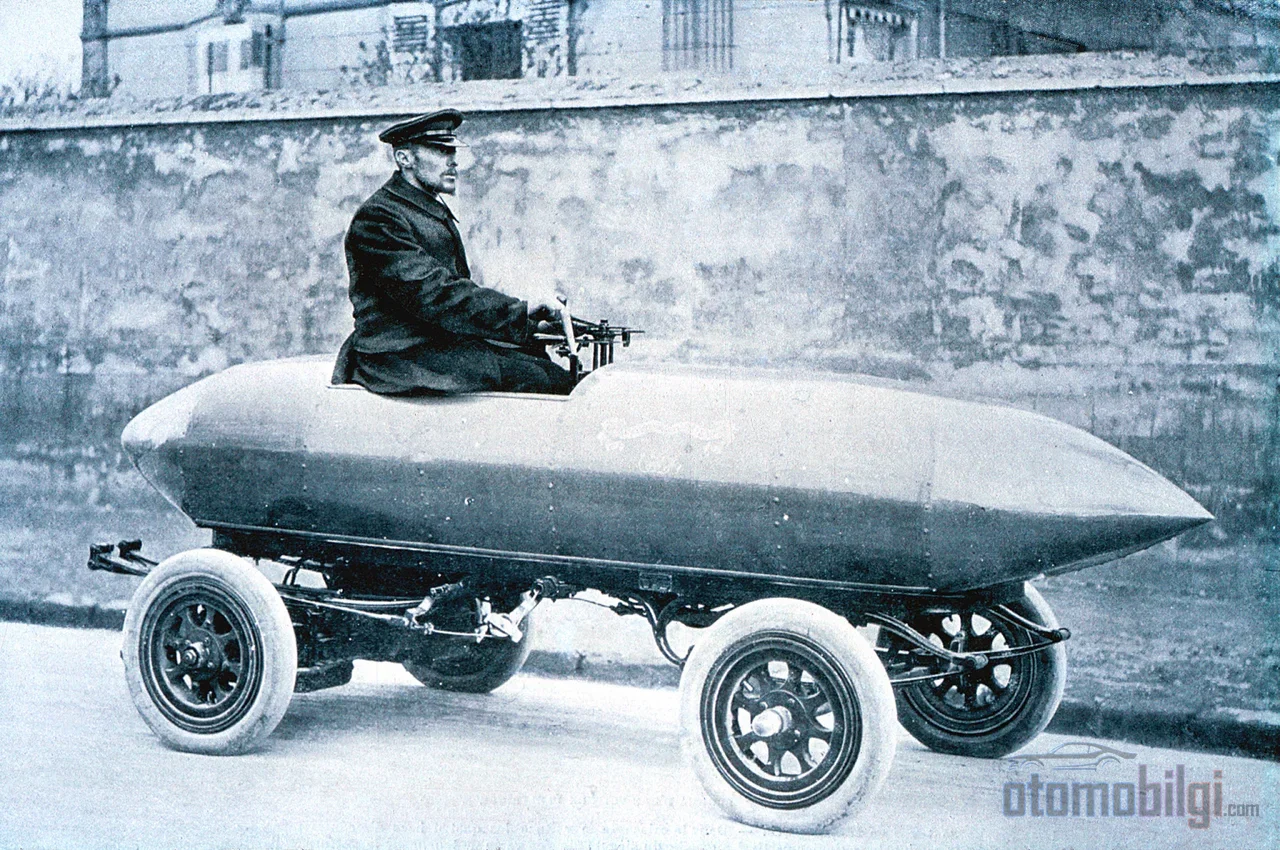
The first land vehicle to exceed the 100 km/h barrier was not gasoline-powered, but electric: La Jamais Contente, driven by Belgian engineer Camille Jenatzy, on April 29, 1899 at Achères near Paris reached a certified speed of 105.882 km/h . This cigar-shaped aluminum alloy torpedo became both proof and symbol of the early dominance of electric motors.
Highlights
- First official land speed record: December 18, 1898, the electric Jeantaud, 63.13 km/h
- La Jamais Contente: two 25 kW motors, approximately 68 hp of total power, 1,450 kg chassis weight
- Record speed: 105.882 km/h, in the "flying kilometer" format at Achères
- A gasoline car broke the record in 1902, reaching 120 km/h reached
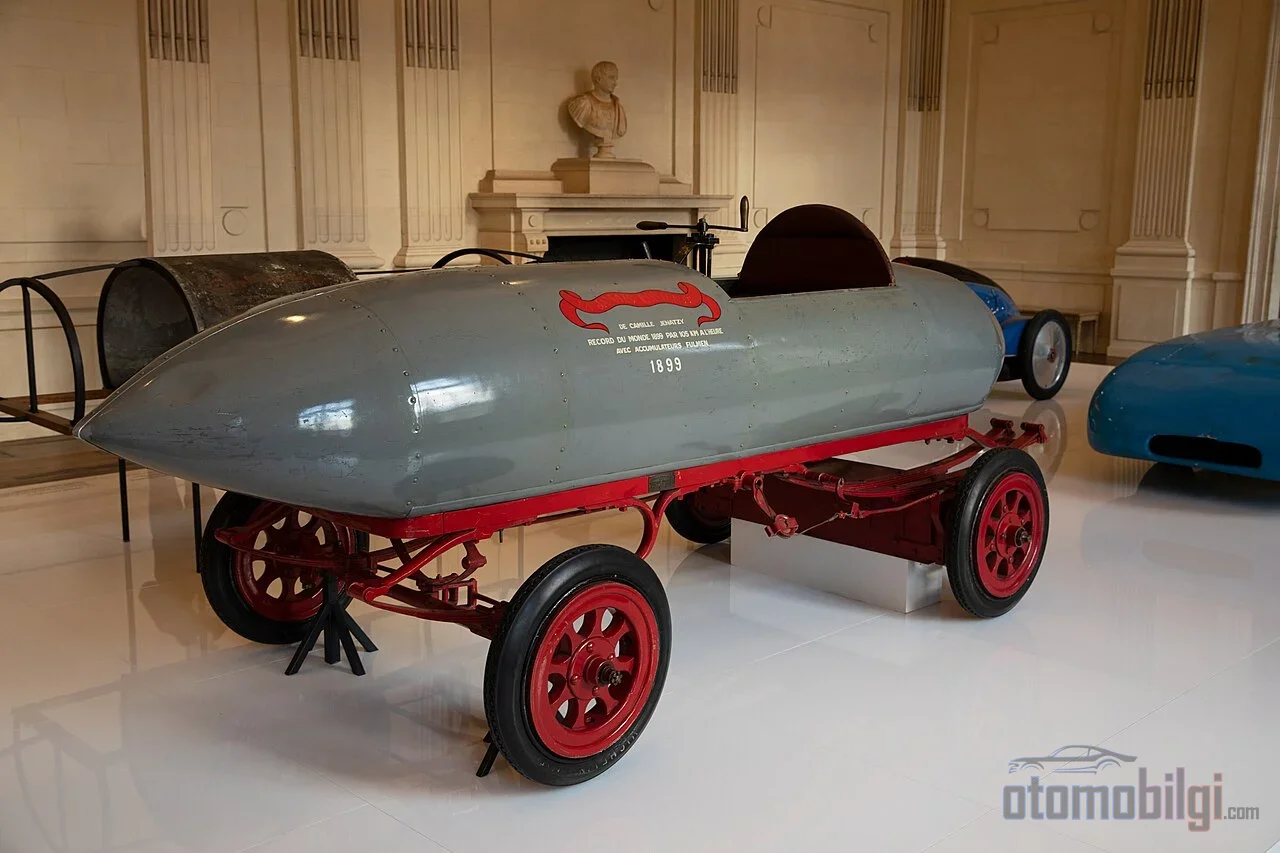
- The original vehicle is exhibited today at the National Car and Tourism Museum in Compiègne
Why Was the First 100 km/h Record Broken by an Electric Vehicle?
The answer to this question, which goes against today's habits, lies in the technological balance of the late 19th century. An electric motor delivers its power from zero with full torque; despite the weight of lead-acid batteries, this feature was a decisive advantage in short-distance speed attempts. In contrast, the internal combustion engines of the era produced low torque, vibrated, smelled and were noisy; they were viewed with suspicion in terms of performance. In short, the speed record coming from an electric vehicle in 1899 was a paradox for no one: it was the most natural outcome from an engineering logic perspective.
The setting in which the record was broken was no coincidence either. In 1898, France Automobile organized "flying kilometer" competitions to measure steam, electric and gasoline technologies against the same standard. This format, measured over a fixed distance, eliminated the range - the weak point of electric vehicles that could carry only a limited number of batteries - while highlighting the motor's instant power. La Jamais Contente took the stage in exactly this picture.
The Record That Changed Hands Between Jenatzy and Chasseloup-Laubat
The record actually began as a personal duel between two men. Belgian Camille Jenatzy was the son of tire manufacturer Constant Jenatzy; he had received an engineering education and had established a factory in Paris to produce electric cars and trucks. Because of his red beard - and his speed - the nickname given by the press was "Le Diable Rouge", meaning the Red Devil. His rival, Count Gaston de Chasseloup-Laubat, was using the electric car of carriage manufacturer Jeantaud. Jenatzy was a manufacturer wanting to enter the market with his own designs; Chasseloup-Laubat was an ambassador of a brand defending its product. The record was, in effect, a public relations war.
The chronology shows how tight the competition was:
- December 18, 1898: Chasseloup-Laubat, with the Jeantaud, broke the first official automotive land speed record: 63.13 km/h
- January 17, 1899: Jenatzy took the lead with the CGA Dogcart at 66.66 km/h ; the record changed hands the same day
- January 27, 1899: Jenatzy rose to 80.35 km/h
- March 4, 1899: Chasseloup-Laubat responded: 92.78 km/h
- April 29, 1899: Jenatzy, with the La Jamais Contente, 105.882 km/h - and this time the record was not closed off
The general picture was this: Jenatzy set the record three times, Chasseloup-Laubat took it back twice. But the mark of 105.882 km/h established on 29 April climbed above every number the rival could reach, and as an electric vehicle it remained untouched for three years.
Technical Anatomy of the Torpedo Body
It was not only engine power but also shape that explains La Jamais Contente's speed. The body was made from an alloy called partinium - a mix of aluminum, tungsten and magnesium - in a torpedo form, in other words a low-drag shell in today's terms. Length 3.80 m, width 1.56 m, height 1.40 m; chassis weight 1,450 kg or so, and about half of that weight came from the batteries. Drive came from two Postel-Vinay motors connected to the rear axle by chain: each drew 124 A at 200 V, and together they delivered roughly 68 hp of total power. The tires were signed by Michelin.
| Specification | Value |
|---|---|
| Year of production | 1899 |
| Body | Partinium (aluminum-tungsten-magnesium), torpedo form |
| Dimensions | 3.80 m × 1.56 m × 1.40 m |
| Chassis weight | 1,450 kg |
| Motor | 2 × Postel-Vinay 25 kW, chain-driven to the rear axle |
| Electricity | 200 V, 124 A per motor |
| Total power | Approximately 68 hp |
| Record speed | 105.882 km/h (29 April 1899) |
The car had a steering tiller rather than a steering wheel, and a manual throttle lever rather than a brake pedal. And the limits of the shape were visible too: the driver's high, exposed position and the sections of the chassis protruding outward had largely neutralized the aerodynamic gain. So the 100 km/h barrier was broken not with perfect aerodynamics, but with sufficient power, an acceptable form, and great courage.
Why Electricity Led Early, and Why It Fell Behind
In the early period, a strong preference for electric
At the end of the 1890s, the question of which power source would drive the automobile's future was openly debated: steam, electricity, or gasoline? The Smithsonian's automotive history exhibition describes this period as a selection process in which steam, electric and internal combustion vehicles competed until a standard design emerged. Electric vehicles were doing their best in this contest: no vibration, no smell, little noise; the motors performed well from the start in power, speed, torque and efficiency. Estimates that around 40 percent of American automobiles at the end of the era were electric show just how real a market share we are talking about - even though exact figures vary between sources, it was common ground that electric held a serious position.
The physical ceiling of the battery
The reason the advantage did not last was hidden in the same engineering logic. The lead-acid battery stored energy very inefficiently per unit of weight: roughly half of La Jamais Contente's 1,450 kilograms was already battery, yet that mass was only enough for a record attempt of a few kilometers. Gasoline, by contrast, allowed far more energy to be carried in the tank than the battery could. The disadvantages working against electric vehicles were clear: high cost, short range, long charging times, and low top speed.
Economics also contributed to this picture. The arrival of the Ford Model T in 1908 defined the mass-market, affordable automobile; in the following years, cheap and abundant Texas oil combined with the continuously improving internal combustion engine, and the space left for the electric vehicle shrank. From the 1920s through 1935, as roads improved, the range problem became more visible, and by 1935 the electric car market had effectively vanished.
The Record's Shift to Gasoline
The electric record held for three years; in 1902 a gasoline-powered vehicle first matched, then surpassed that speed, reaching 120 km/h From that point on, the ownership of speed records became clear: the superiority of the internal combustion engine went unquestioned for a century. After 1902 the record changed hands frequently - names like Henri Fournier, Maurice Augieres, and Arthur Duray raised the bar one after another; from 1963 onward, jet and rocket propulsion closed the era of wheel-driven vehicles. The overall land speed record today stands at 1,227.986 km/h measured on October 15, 1997.
The transition also appears in Jenatzy's own story: in 1903 he won the Gordon Bennett Cup with a gasoline-powered Mercedes. The pioneer of electric vehicles was a figure who accepted gasoline's future in his racing career - this can be considered the most honest summary of the engineering climate of the era. Jenatzy lost his life in 1913 when he was shot in a hunting accident.
The Vehicle's Legacy: From the Museum to a Hundred and Twenty Years Later
The original La Jamais Contente is on display today at the National Car and Tourism Museum in Compiègne, at the Château de Compiègne; since the vehicle, with chassis number 25, was too fragile to be moved, students at the University of Technology of Compiègne produced an exact replica in 1993, with more than 3,000 hours of work over three years. The replica was transferred, with a donation from Lions Clubs, to the Cité de l'Automobile in Mulhouse and was restored in 2017. The tradition of the electric speed record also continued with a legacy bearing the vehicle's name: the Buckeye Bullet (2004), Keio University's Eliica (2004), and the Venturi Jamais Contente (2010) are counted among the electric land speed record vehicles.
Perhaps the most meaningful farewell took place on April 29, 2019, in the 120th year of the record: Guillaume Sébileau, with a convoy of several modern electric vehicles in Achères, crossed the same 100 km/h threshold - this time in the lithium-ion era, without the lead-acid mass that carried the original. That is why the story of La Jamais Contente remains instructive today: the answer to the question of which solution technology's "natural" winner is changes with the physical limits of batteries and energy storage at any given moment. At that limit in 1899, electricity won; the following century chose gasoline. As long as the formula stays the same, the picture can change.
Sources
- La Jamais Contente
- Camille Jenatzy
- La Jamais Contente
- History, technique, and style JAMAIS CONTENTE
- La Jamais Contente: The Crazy Story of an Electric Car
- The Jeantaud Electric Car Land Speed Record
- Camille Jenatzy - Driver Bio
- History of the electric vehicle
- The History of the Electric Car
- Technological Choices - National Museum of American History
- List of land speed records
- 1899 La Jamais Contente