Milk-Delivery Vehicles That Quietly Roamed the Cities Were Electricity's Forgotten Fleet
Share This Page
The electric milk delivery vehicle, known in Britain as the milk float, is a distribution vehicle specifically designed to carry fresh milk to people's doorsteps, almost entirely battery-powered electric. 20. Throughout the century, these vehicles formed the largest and most stable fleet of electric road vehicles in the world; they were the only branch of the electric car's history to achieve uninterrupted commercial success. The need for silent deliveries before dawn was tailor-made for electric propulsion, and for decades these vehicles won the case in a field no one else bothered to look at.
Highlights
- The year 1889 is given for the first electric milk float; before that came the era of horse-drawn carts.
- In August 1967, Britain had more battery-powered electric vehicles on its roads than the rest of the world combined.
- The typical milk float speed was in the range of 16-26 km/h; quietness was one of the factors that sped up delivery.
- Wales & Edwards received an order for 1,500 vehicles from United Dairies.
- A modern fully electric milk float is being introduced with a 213-mile range and a 880 kg payload capacity.
Why Were Milk Floats Electric? The Engineering Advantage of Silence
The timing of milk delivery was fixed: milk left at the door was a product that needed to be in the home before sunrise. Milk stayed cool outside overnight and was found fresh at breakfast. This meant a delivery fleet had to begin operations in residential neighborhoods hours ahead, while everyone was still asleep. For a petrol or diesel vehicle, this was the worst possible scenario: the sound of the engine, the characteristic rattle of its rear and its exhaust were a hammer that opened thousands of windows at once in a half-asleep neighborhood.
The electric motor was technically unrivaled here. It produced no sound other than the hum of a bearing-mounted rotor and the clinking of glass bottles. There was no vibration, no smell, no waiting time to warm up a cold engine. Moreover, the usage profile was a perfect match: fixed, short routes; an operator stepping down at every stop; a return to the depot in the passing daylight hours. The battery would drain on the way back to the depot and charge at night, during the grid's quietest hours.
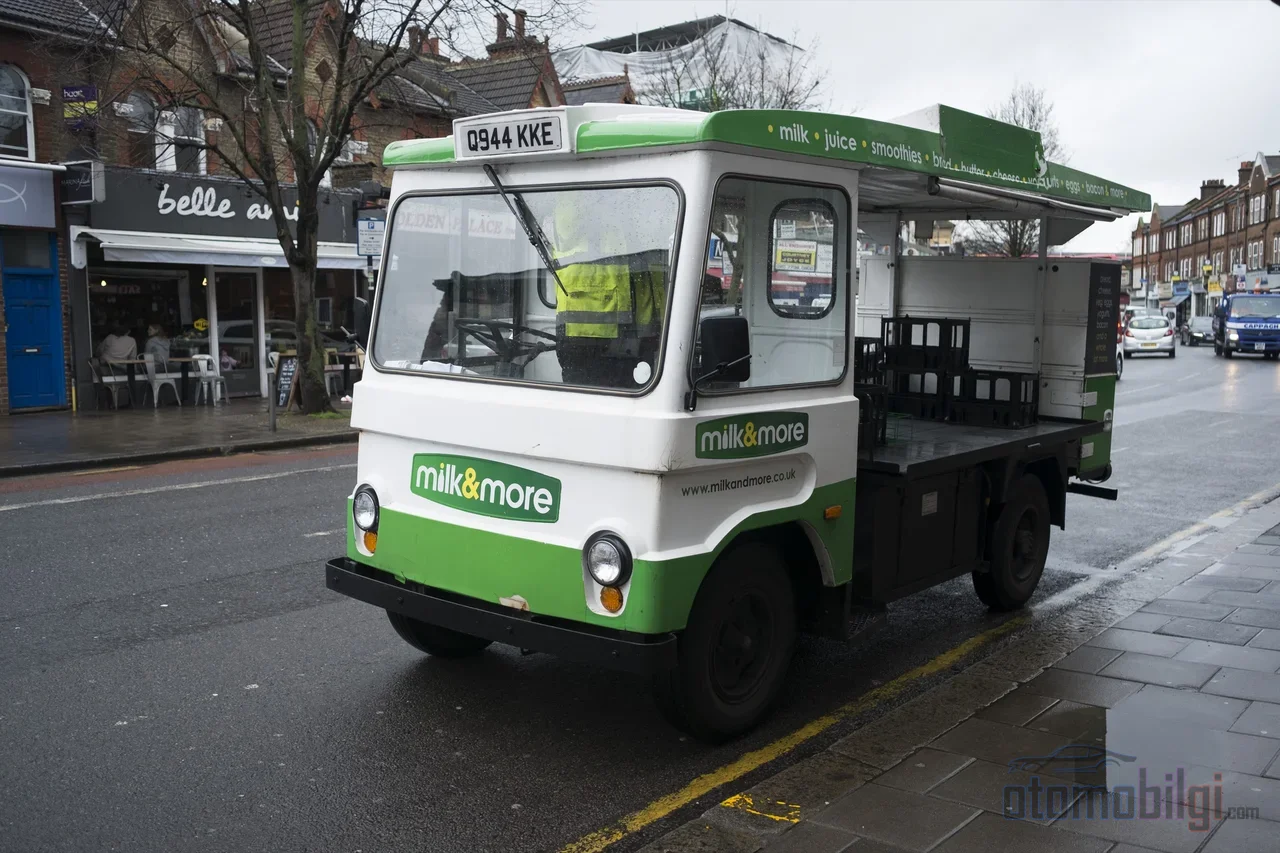
The vehicle itself was also designed for this job. Milk floats are slow; with low-power electric motors, the typical speed stayed in the range of 16-26 km/h, and this was more than enough for doors stopped at every 50 meters. In these vehicles with sliding doors or completely open bodies, the operator would step off before the vehicle fully stopped and complete the delivery on foot. So quietness was not merely a courtesy feature; it was part of operational efficiency: the vehicle could keep moving without stopping, and the driver could finish the job without running.
From Horse-Drawn Cart to Electricity: A Line Stretching from 1889 to the Summit
Milk delivery to the doorstep was done with horse-drawn carts from the late 19th century onward, and this tradition continued into the 1950s. The year 1889 is given for the first electric milk float; this shows that milk delivery encountered electricity while the electric car was still in its infancy. An ironic detail: the history of electric cars began before Henry Ford's Model T, and in the early 1900s they were competing with serious advantages over their gasoline rivals. There was no crank handle, no smell and no vibration; but the faster acceleration of gasoline vehicles, the emergence of innovations such as the electric starter motor, and the cheapening of gasoline eventually reversed the balance.
In Britain, milk delivery went in a different direction from this general retreat. Express Dairy Company was the first company to experiment with a small fleet of GV electric vehicles in London in 1932 and succeed. TH Lewis had been building milk floats for Express Dairies since 1873; the first electric vehicle he designed for Express entered service in 1934: it was a pedestrian-controlled, three-wheeled vehicle capable of carrying 180 kg. Around the same time, AE Morrison and Sons built its first battery-electric vehicle in 1933, and from 1942 onwards its products were marketed under the Morrison-Electricar name.
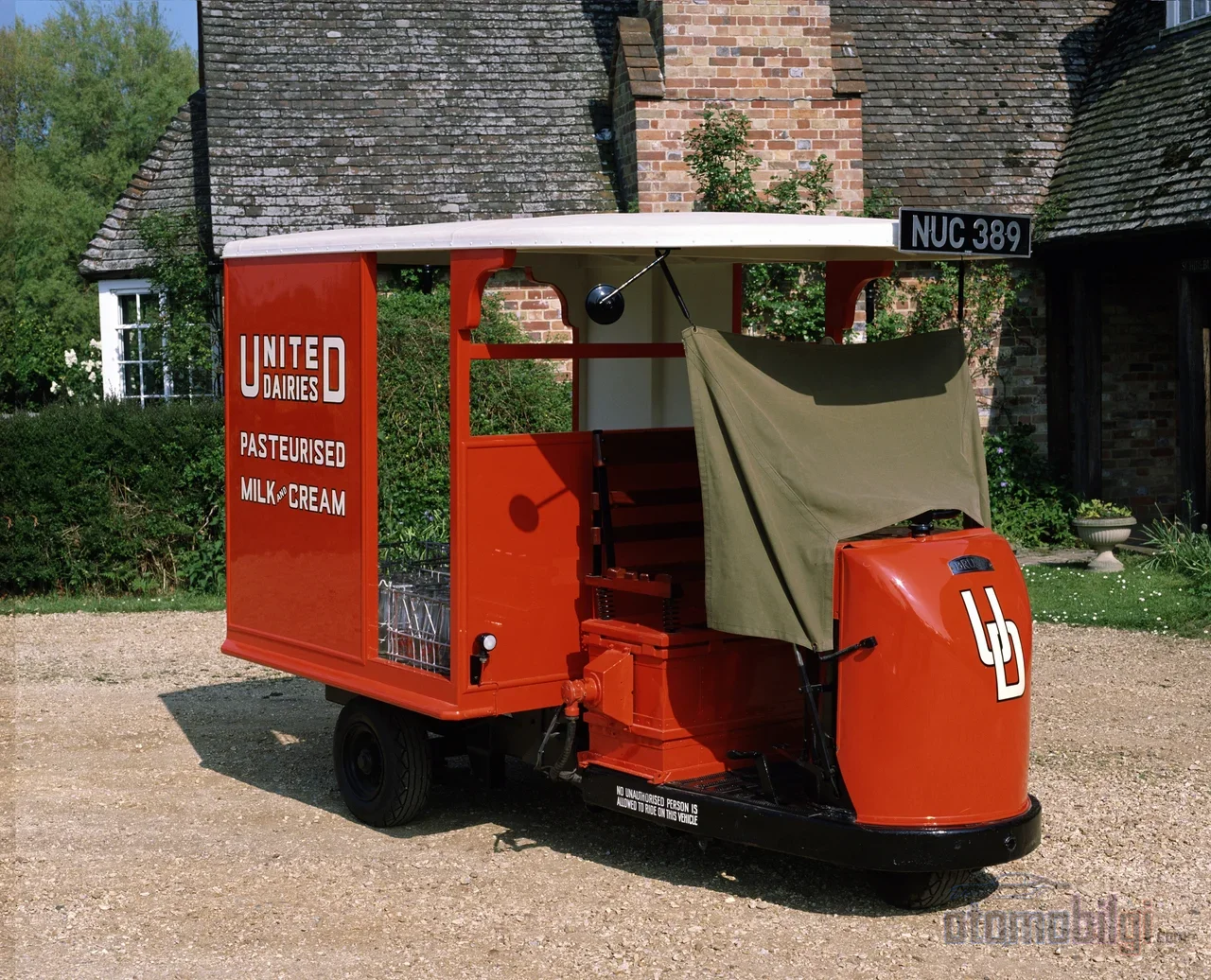
This market created its own economy. Brush Electrical Engineering Company was an established veteran manufacturer, founded in 1889 and producing electric cars between 1901–1905; in 1940 it ordered a three-wheeled electric tractor design from Morrison, in 1941 it shipped a large order to Russia, and in 1945 it bought the design and production rights from Metrovick, entering the battery-electric road vehicle business. This three-wheeled model was marketed as the Brush Pony; an early example from 1947, retired from the United Dairies fleet, is still on display today.
Why Was the World's Largest Electric Fleet in Britain?
Here begins one of the least-told paragraphs of electric vehicle history: By the 1950s, Britain had more electric road vehicles than anywhere else in the world, and almost all of them were milk floats. This claim is not hearsay, but a finding recorded in the archives. In August 1967, the UK Electric Vehicle Association announced that Britain had more battery-electric vehicles on its roads than the rest of the world combined; and a closer look at the subject revealed that almost all of the licensed battery vehicles in the United Kingdom were milk floats. So decades before the GM EV1, the Tesla Roadster and the lithium-ion revolution, electric propulsion was already doing work on tens of thousands of routes every day - only nobody was calling it an electric car revolution.
Manufacturer orders also confirm the scale of the fleet. Wales & Edwards received an order for 1,500 vehicles from United Dairies and set up a new production facility at Harlescott near Shrewsbury; from 1961 onwards it began producing open milk floats with 5 wheels capable of carrying 2,000 kg. Competing manufacturers complete the same picture: In 1941, Morrison-Electricar standardized three body types that would form the basis of thousands of postwar milk floats. The example grew beyond Britain as well; In Ireland, Premier Dairies operated a fleet of 380 electric vehicles, and between 1946 and 1992 approximately 1,600 battery-electric delivery vehicles were at work in the field. Harbilt's pedestrian-controlled Model 551 found success in Switzerland; approximately 2,000 vehicles were shipped to the Swiss Post Office and Swiss hotels.
Battery Practice in the Lead-Acid Age: Charging, Range, Limits
At the heart of the milk float were lead-acid batteries - a chemistry lacking all the energy density of modern lithium-ion, heavy but cheap and well understood in terms of maintenance. The technical specifications of a Morrison milk delivery vehicle dated 1971 summarize this era well: battery capacity of 234/378 ampere-hours, gross vehicle weight of 3.75 tons, payload capacity of 31/24 cwt, top speed on flat roads of 15 mph and a range of 27-50 miles. The range was limited, but routes were fixed and short; this limitation posed no problem in practice.
| Parameter | Morrison milk float (1971) |
|---|---|
| Battery capacity | 234 / 378 ampere-hours |
| Gross vehicle weight | 3.75 tons |
| Payload capacity | 31 / 24 cwt |
| Top speed on flat roads | 15 mph (approximately 24 km/h) |
| Range | 27 / 50 miles |
| Typical model | A1 van - 8.5 feet in length, 875 kg unladen weight |
The charging infrastructure was also designed around the delivery rhythm. Wilson Electric vehicles were charged with Davenset three-phase group chargers; special offers made for fleets of six vehicles in 1939 show that companies charged the whole fleet overnight in the same depot. Small details reveal the engineering ingenuity of the era: The Morrison-Electricar A1 van was only 8.5 feet long and used Austin Mini's 10-inch wheels - reducing cost with existing series parts is an approach that still holds true today.
Anatomy of a Market: Manufacturers and Price Wars
In the 20th century, there were dozens of milk float manufacturers in the United Kingdom. The names were varied enough to please any machine engineer's customer: Brush, Electricars (1919, Birmingham), Graiseley (Wolverhampton), Harbilt (Market Harborough), Lewis Electruks (Watford), Metrovick, Midland Electric (Leamington Spa), Morrison-Electricars, Victor Electrics, Wales & Edwards, Wilson Electrics, Smith, Osborne and Bedford. This competition was reflected in the product as well: Graiseley's pedestrian-controlled Models 60, 75 and 90 carried the number of milk gallons they could transport directly in the model name; the company, which sold a large number of vehicles to United Dairies between 1948 and 1952, went into liquidation in 1960.
The market's battle with petrol vehicles never ended either. In February 1949, Brush tried to increase its competitiveness against petrol rivals by cutting the prices of its electric vehicles by approximately 25% - the discount reached £124. Production, meanwhile, moved under economic pressures: Following Board of Trade pressure, Morrison production moved to Tredegar in Wales in 1968, Morrison-Electricar production ended in 1983, and the business was taken over by M&M Electric Vehicles (Atherstone). By 2003, although companies still delivering milk to the door remained, not a single new milk float manufacturer was left; Bluebird Automotive, trying to fill the gap, went bankrupt in 2007 after selling two vehicles to Golden Vale Dairies and one to Express Dairies.
Why Has It No Place in the Grand Narrative? The Fleet Forgotten by Electric Car History
The popular history of the electric car loves drama: the golden age of the early 1900s, the triumph of gasoline, decades of stubborn attempts at a comeback, and finally the awakening lithium-ion brought with Tesla. Why is there no place for the milk float in this narrative? The answer has three layers. First, the milk float was never defeated, and stories of defeat sell; it, 20. century and as the first truly successful last-mile delivery electric vehicle. Second, the vehicle did not belong to car culture: it promised no speed, design, or performance; it carried bottles at 16-26 km/h. Third, its success was embedded in the daily routine of a country and a product - the fresh bottle on the breakfast table never reminded anyone of the rarity of the technology beneath it.
Over time, the market itself changed too. Modern refrigeration and pasteurization eliminated the necessity of daily deliveries; the spread of supermarkets and gas stations weakened home milk delivery; as routes expanded and became sparser, limited range and speed became a real problem. Some dairies had to replace electric vehicles with internal combustion vehicles to speed up delivery. When doorstep milk delivery ended, the electric vehicle's longest-lasting everyday triumph was quietly buried in history.
Yet the story did not end. Glasgow has one of the largest working milk float fleets in the United Kingdom; most vehicles operate from the Grandtully Depot in Kelvindale. Milk & More ordered 200 electric milk delivery vehicles from StreetScooters in 2018 and continued electrification that same year by purchasing 159 fully electric vehicles; it later grew its fleet to more than 350 fully electric vehicles and is described as the company with the largest electric fleet in the United Kingdom, with over 500 electric vehicles. A modern Maxus fully electric milk float is advertised with a 213-mile range and an 880 kg payload - compared with the 27-50 miles of the lead-acid era, it becomes easy to measure just how overdue the revolution was. Even that old detail in the seat belt legislation tells the story of the era's character: The British law only required seatbelt use when fitted, and the 2005 amendment limited the exemption to deliveries made at 50-meter intervals.
Today, most of the old vehicles are still at work: as working vehicles in factories, pleasure vehicles in the countryside, or in rental fleets. The Transport Museum in Wythall has a collection of 29 milk floats and battery-electric vehicles produced between 1935–1982 from 14 different manufacturers; while the Ipswich Transport Museum has five battery-electric road vehicles, one of which is a 1948 Smiths. This fleet, overlooked but never defeated, reminds us every morning with its rattle that electric propulsion was never an engineering problem; the problem was the market, the infrastructure, and the narrative.
Sources
- Milk float
- The milk float was the first truly successful last-mile delivery EV
- Brush Pony electric milk float
- British electric vehicles, model by model - Commercial Motor archive, 9 July 1971
- Electric Milk Trucks Still Working in Jolly Old England
- Electric vehicles have a rich past - and a richer future
- History of the electric vehicle
- Early Electric Cars in America
- Charging Milk & More's Electric Milk Floats
- Milk and More return to their electric roots
- Electric Adventures: Milk & More
- Tag: milk float