Forgotten in the Gasoline Era: Why Didn't the Electric Cars of the '70s Catch On?
Share This Page
Why didn't the electric cars of the 1970s catch on? The short answer: the temporary nature of the oil crisis, the physical ceiling of lead-acid batteries, and the safety/quality gap all kicked in at once. Vehicles like the CitiCar paired a sound idea with an immature battery technology and a market where gasoline was becoming cheap again; the result was a generation forgotten until the lithium-ion revolution.
Highlights
- With the 1973 embargo, oil prices rose by approximately 350% ; gasoline queues made the electric car visible again.
- Sebring-Vanguard CitiCar: Between 1974 and 1977, around 2,300 units, and 4,444 units were produced with all variants. Range was roughly
- 64 km , top speed in the 36V version 25–28 mph , in the 48V version 34–38 mph . The CitiCar was
- until the Nissan Leaf surpassed it in 2011, the best-selling electric car in post-war North America.
Opportunity Born from Gas Lines: The 1973 Oil Crisis
In October 1973, OAPEC imposed an oil embargo on countries that supported Israel in the Yom Kippur War. Prices hit historic peaks, gas stations ran dry, and with the OPEC embargo the price of crude oil rose by approximately 350% . The energy crisis sat at the center of the 1970s economic downturn, and federal energy policy became a major political priority for the first time.
The automotive industry was right in the middle of this shock. Sales of high-performance vehicles collapsed, and some manufacturers went under. But as in every crisis, gaps opened up: a series of entrepreneurial companies emerged to produce small, simple, electric vehicles. A dealer-turned-entrepreneur's fiberglass wedge profile in Florida, a design house's micromobile approach in Italy, and half-scale laboratory prototypes in Detroit were all born from the same wave.
The problem is that all of these attempts had to advance through the same narrow physical corridor: the only reasonable way to store energy was still the lead-acid battery. The mass of lead and sulfuric acid needed for adequate range was more than the vehicle could carry. The crisis had opened up a market for these ideas; but the technology could not yet bear the weight to keep them standing.
Sebring-Vanguard CitiCar: From Golf Cart Roots to Record Sales
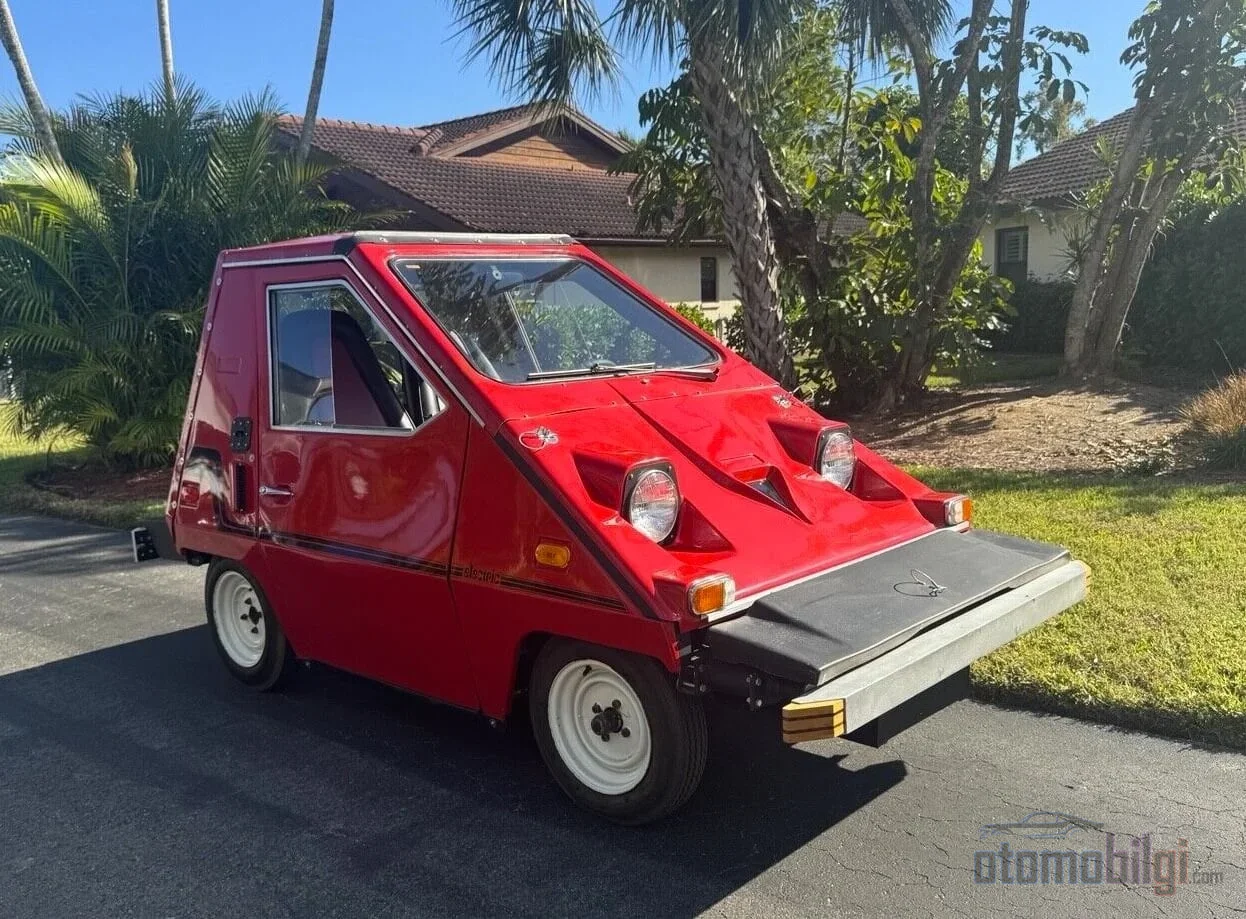
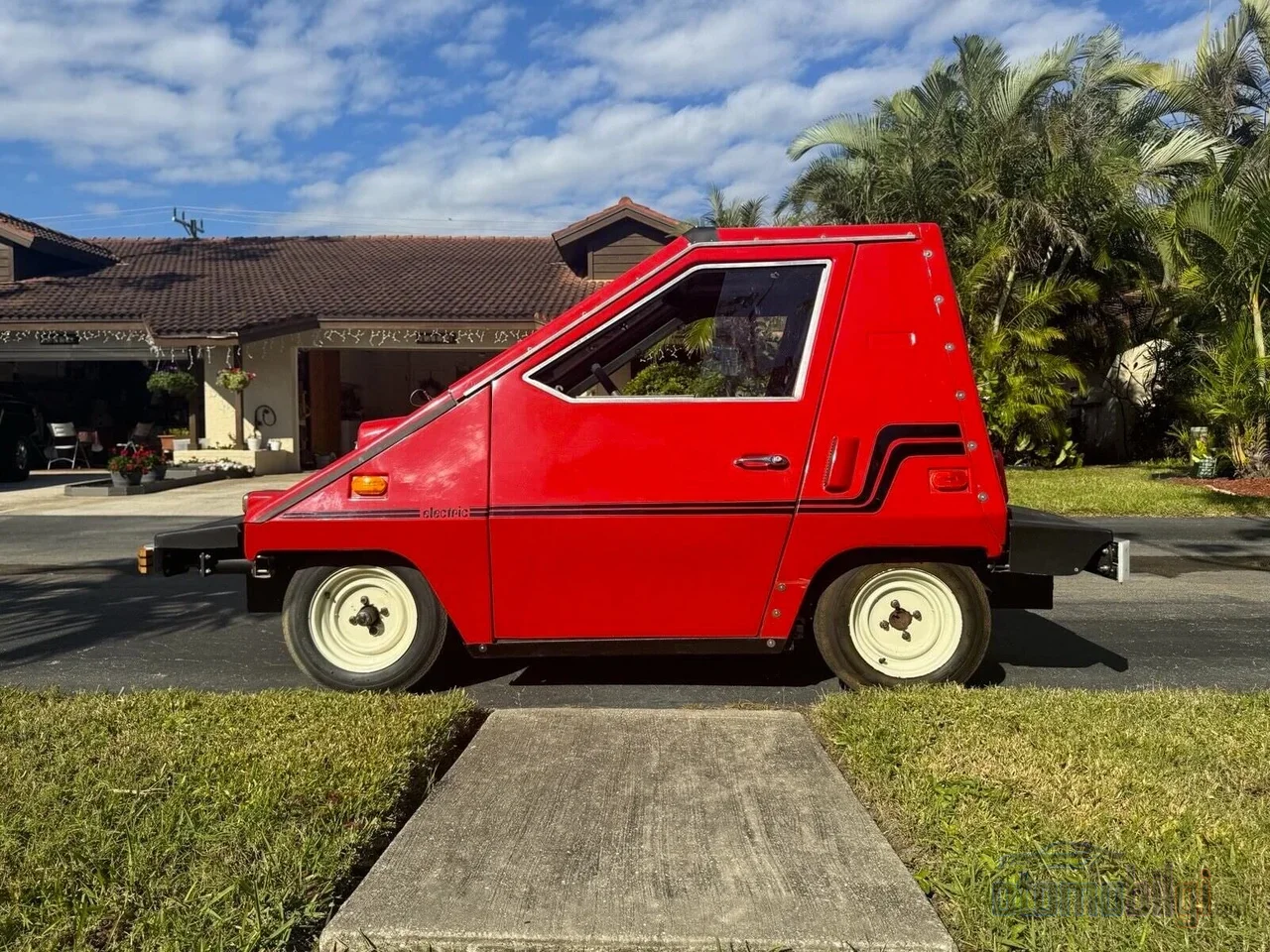
Robert G. "Bob" Beaumont, who created the CitiCar, was a car salesman and built the idea on commercial instinct. The design was inspired by Jim Muir's small, wedge-profiled Club Car golf cart; Cycolac, i.e. ABS plastic panels, sat on a welded aircraft-grade aluminum tube frame. Flat glass, two seats, zero embellishment. The first vehicle came out in 1974
under the name Vanguard Coupe, and when sales remained weak it was repositioned that same year under the CitiCar name.
| Spec | SV-36 (early) | SV-48 (after December 1974) |
|---|---|---|
| Motor | 2.5 hp series DC (GE/Baldor) | 3.5 hp GE series DC |
| Battery | 36V (6x6V lead-acid) | 48V (8x6V lead-acid) |
| Top speed | 25–28 mph | 34–38 mph |
| Range | Approximately 40 miles (64 km) | |
| 0–25 mph | 6.2 seconds | |
| Dry weight | Approximately 591 kg | |
| Length | Approximately 2,437 mm | |
Despite this, the sales figures were surprising. Until 1977, approximately 2,300 CitiCars were produced; all variants including the Comuta-Car reached a total of 4,444 units. Pricing was set to compete with the Volkswagen Beetle, and in 1976 Sebring-Vanguard was counted as America's sixth-largest automaker after GM, Ford, Chrysler, AMC and Checker Motors - ahead of Excalibur and Avanti.
Why Didn't the CitiCar Catch On? The Intersection of Three Separate Failures
Build quality and safety deficiency
The car's image problem was carved in stone with a one-word summary: at one point, the CitiCar was seen as a golf cart turned into a car. The more tangible problem was the body. According to an assessment in the press of the time, the car had, in terms of crash safety, "the crush resistance of a beer can." had.
The CitiCar had the crush resistance of a beer can.
In a two-seater, 591-kilogram, plastic-bodied vehicle, safety concerns were not merely a matter of perception; the fact that extra frame supports had to be added to the later Comuta-Car to approach DOT standards shows how far behind it was.
The lead-acid ceiling
The technically limiting factor was clear: lead-acid batteries were heavy, had low energy density and limited lifespan. Range was 50 miles on a good day, dropping below 40 miles in typical use; speed stayed below 45 mph in most cases, and the motors were often sourced from golf carts. The mass of lead and acid required to store energy ate into the car's range and carrying capacity at the same time. This was not an arrangement that could be solved with engineering, but a ceiling requiring a change in chemistry.
The return of gasoline
Perhaps the most fatal blow came from the price chart: when gasoline prices fell after the crisis, sales interest was almost instantly extinguished. The company never managed to sell more than 5,000 vehicles. The final CitiCar successor was produced only in 1982 by a successor firm. Vehicles purchased with a short-term economic motivation lost their market once the motivation disappeared.
Zagato Zele: The Electric Detour of a Design Legend
The European leg of the same experiment came from Italy. Zagato, known for beauty and performance, at the 1972 Geneva Motor Show introduced the Zele 1000 as "a city car with zero environmental impact"; production began in 1974 and lasted from 1974 to 1976. This was an extraordinary departure from the company's tradition: at 77 inches (about 2 meters) in length, the Zele was a micromobility vehicle even below the CitiCar.
Of the Zele, sold in the US market under the name Elcar, only a total of ~500 units were produced. Offered from 1975 onward, the Zele 2000 promised an extra 10 mph of speed and offered a 50-mile range - meaning the basic equation never changed: lead-acid pack, short range, city speeds. The Zagato example made one thing clear: design genius could not compensate for the battery's energy density.
Detroit's Experiments and NASA Tests
The big players didn't sit idle either, but they never came close to the production line. In the early and mid-1960s, GM produced the Corvair-based Electrovair I and Electrovair II prototypes; electric vehicle development work was carried out at General Electric throughout the 1970s. Still, a decade of progress largely stagnated - more than 80% of vehicles produced in the US had V8 engines.
The most systematic evaluation of the era came from NASA: the report published in October 1976 documented the basic test results of the EVA Metro Sedan, Citi-Car, JET Industries Electra-Van, CDA Town Car, and Otis P-500 Van. In other words, the proto-EV generation became a test data database - instead of covering roads, they were put under measurement.
Comuta-Car: The Last Breath and the Postal Service Variant
Commuter Vehicles, which bought Sebring-Vanguard, renamed the design as the Comuta-Car and started production in 1979. The vehicle was about 16 inches (410 mm) longer than the CitiCar, the batteries were moved from under the seats to boxes behind the bumper, and additional frame supports were added for DOT standards. Between 1979 and 1982, an estimated an estimated 2,144 Comuta-Cars and Vans were produced.
The most interesting derivative was the right-hand-drive Postal Comuta-Van produced for the US Postal Service: 142 inches in length, a 12 hp motor, a 72V battery, and a 3-speed transmission. Fixed route, short distance, and overnight charging - that was exactly the only usage profile lead-acid could handle. The last known factory-built vehicle, a special-order 72V DC pick-up without a serial number, left the line in 1986. was launched.
The Road to the EV1: The Foundation Prepared by Failure
The 70s generation died in the market but lived on as knowledge. Starting in 1996, GM produced the EV1, which it developed with AeroVironment - the first modern electric car designed for the mass market. Of the total 1,117 units produced, most were leased. The EV1 team had to invent from scratch many of the technologies common in today's EVs; in other words, the failures documented by the CitiCar generation - thermal management, range, control electronics - had become a direct engineering agenda.
The end of the EV1 was also instructive: high production and maintenance costs, battery costs, and the failure of the expected strict emission regulations to arrive ended the program; GM destroyed the vehicles on the grounds of spare parts supply. The real breakthrough came in chemistry: in 2008, the Tesla Roadster offered a range of over 200 miles as the first highway-legal, series-production fully electric car using lithium-ion cells - the ceiling that lead-acid had imposed for decades was lifted at once with the cell change. The CitiCar's wedge profile, electric drivetrain, and minimalist interior, however, were considered an "evolutionary dead end"; no one brought these three criteria back in a single vehicle until 2019.
The Engineering Lesson to Be Drawn from the Dark Age
The failure of the proto-EVs of the '70s cannot be reduced to a single reason, and this is the most important part of the story. Build quality and safety flaws eroded demand; the cheapening of gasoline wiped out the motivation to buy; but none of these would have killed the car without the energy density ceiling of the lead-acid battery. A 40-mile range was an engineering problem, not a chemistry problem.
Looking back today, this generation left behind two things: a measured database and a market lesson - an electric vehicle survives not on temporary incentives like energy prices, but on the permanent change of the range and cost equation. When lithium-ion changed that equation, the road to the EV1 was opened.
Sources
- CitiCar - Wikipedia
- 1974 Vanguard-Sebring CitiCar - The History of the Electric Car, TIME
- The First Cybertruck? A 100% Electric 1980 "CitiCar" - Silodrome
- The Henry Ford - CitiCar
- Zagato Zele - Wikipedia
- The story of the Zagato Zele - Below The Radar
- General Motors EV1 - Wikipedia
- EV1 Electric Car - National Museum of American History
- Energy Crisis - National Museum of American History
- The Legacy of the 1970s Energy Crisis - US National Archives
- Why Early Electric Cars Lost the Race - UPS Battery Center
- Electric Cars Engineering & History - Edison Tech Center
- What happened to the GM EV1 - OPB
- Driving the future, then and now: the story of the EV1 - GM News
- Tesla Roadster (first generation) - Wikipedia