Why Did the Alfa Romeo 33 Ibrida Never Reach Series Production?
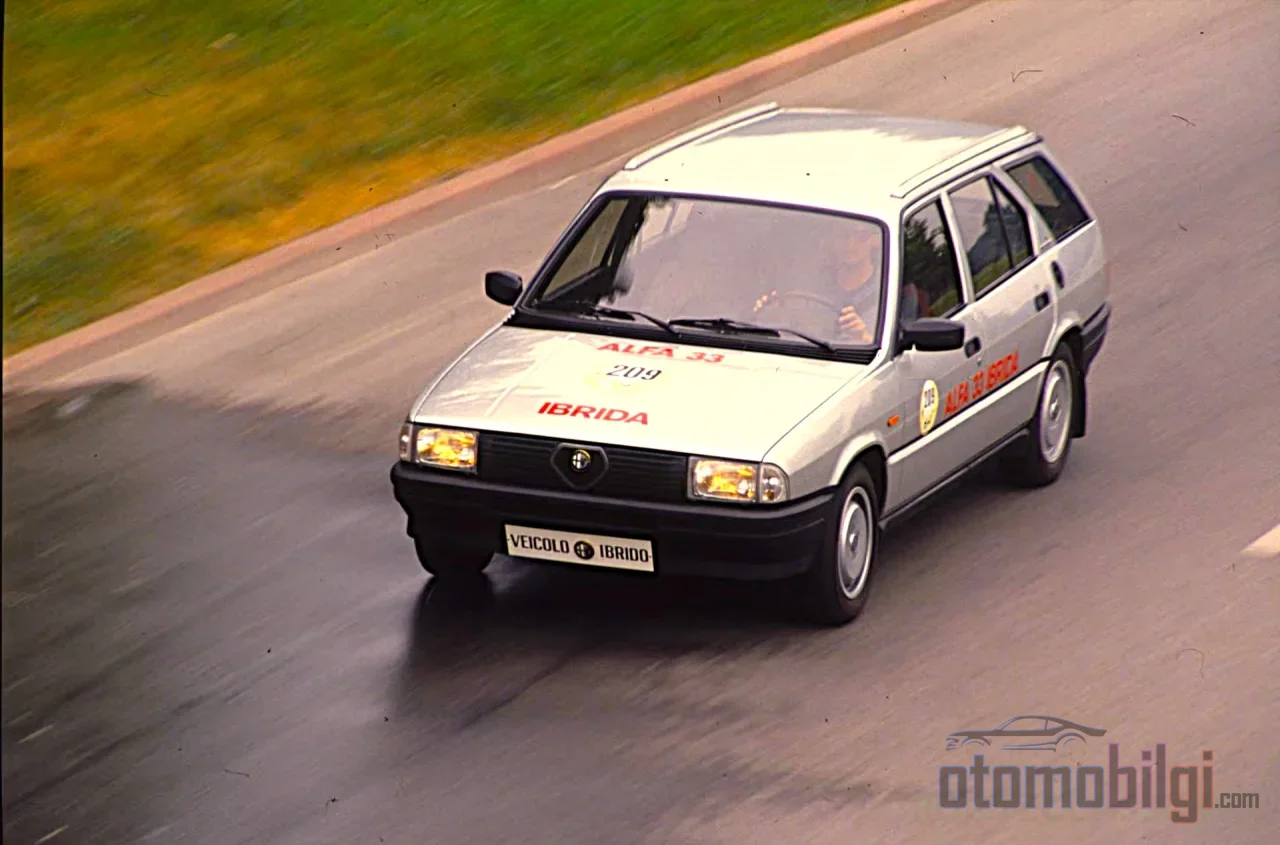
In mid-1988, a highly unusual test vehicle was taking to the roads from the engineering department in Arese: a prototype carrying the body of the 1.5 Sport Wagon of the 33 family, but housing unconventional components in the engine bay and trunk. A three-phase asynchronous electric motor had been added alongside the petrol Boxer engine, and the vehicle's transmission was connected to this second motor via a toothed belt. There were still nine years to go before the Toyota Prius rolled off the series production line. So why couldn't Alfa Romeo carry a working hybrid car, at such an early date, all the way to the end of the road?
On this page, we will cover the technical solution of the 33 Ibrida prototype, the drive modes that were tested, and the circumstances of the era behind the project stalling at the threshold of series production. A comparison with the 1979 Fiat 131 Ibrida, another early example of the same story in Italian automotive, will also be part of the page.
How did the Alfa Romeo 33 Ibrida prototype work?
For the project, the 1.5 Sport Wagon version of the Alfa Romeo 33 family was chosen as the base vehicle. This choice was no coincidence: the station wagon body was a more suitable platform than a compact hatchback for accommodating space-demanding components such as the battery and power electronics. The 33 was already the brand's volume model of that era; approximately 1 million units were produced between 1983 and 1995 at the Pomigliano d'Arco factory.
The architecture of the hybrid conversion was as follows: the vehicle's standard 1.5-liter naturally aspirated petrol engine was left in place, but a three-phase asynchronous electric motor was integrated into the transmission via a toothed belt. Thanks to this setup, the vehicle could operate in three different drive modes: with the petrol engine only, with the electric motor only, or in hybrid drive where both motors worked together. The second-motor architecture connected to the transmission via a belt corresponds to what today's terminology calls a parallel hybrid layout; the electric motor is not an independent drive-line element separate from the petrol engine operating as a generator, but a component that shares the drive.
Engine and electric drive: the architecture in numbers
On the petrol side, the 33 had its 1.5-liter unit from 1986-1990: a four-cylinder Boxer engine with a displacement of 1,490 cc and two twin-choke carburetors, producing 105 PS (103 hp) at 5,800 rpm and 133 Nm of torque at 4,000 rpm. On the electric side, a three-phase asynchronous motor delivering 16 hp was at work. According to a secondary source, this motor's torque was 6.1 kgm, roughly 60 Nm, and the motor was supplied by Ansaldo of Genoa; these two details are reported with caution, as they could not be verified as cross-checked primary data.
Highlights
- The 33 Ibrida prototype was tested in 1988, approximately 10 years before the Prius
- Electric motor: 16 hp; pure electric range 5 km, top speed 60 km/h
- The hybrid conversion added a total of 150 kg of weight to the body (110 kg battery, 20 kg motor, 10 kg power electronics)
- A total of 3 vehicles were produced; series production never materialized
The electric-only usage range was limited: the vehicle offered only a 5 km range with its electric motor and could reach a top speed of 60 km/h. These figures show that the prototype's design goal was not electric daily use like today's plug-in hybrids, but rather disabling the gasoline engine in low-speed urban sections. The prototype's total system output, total torque, 0-100 km/h acceleration, and fuel consumption were never disclosed by the manufacturer.
Weight balance: The price of 150 kilograms
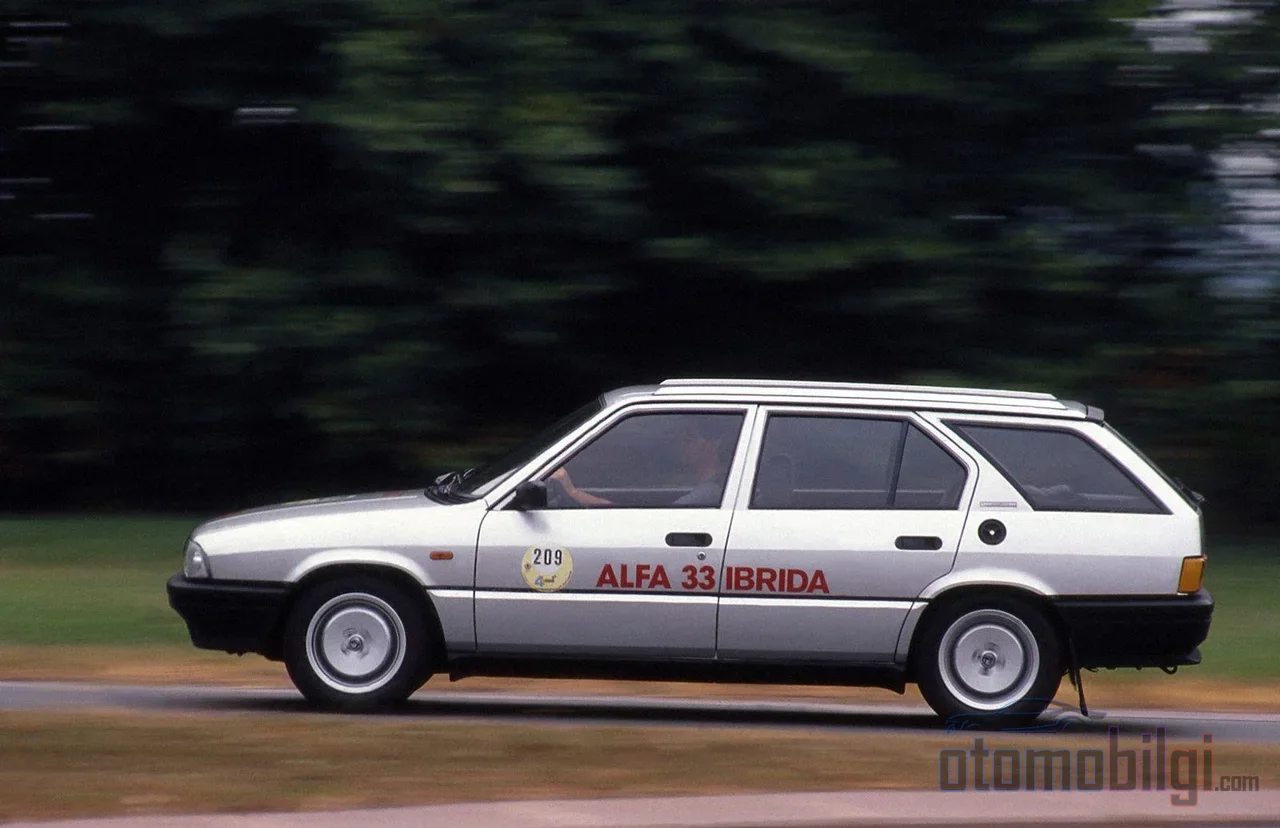
The prototype's most striking engineering figure is its weight breakdown. Although body modifications were kept minimal, the hybrid components added a total of 150 kg to the vehicle: a 110 kg battery pack, a 20 kg electric motor, and 10 kg of power electronics. The donor vehicle was a compact car of its era with a curb weight in the 890-1,070 kg range; the 150 kg addition meant an increase of over 15 percent relative to the base vehicle's mass baseline. With the lead-acid based energy storage technology available in the late 1980s, this trade-off was inevitable; it would be more than a decade before lithium-ion batteries entered the automobile.
Weight increase is a parameter that directly affects not only performance, but also consumption and the load on the braking system. The 1.5-liter, 105 PS engine was already an average unit for this class on its own, and now had to carry a body with an added 150 kg. Whether the hybrid system delivered a net gain in fuel economy cannot be grounded in measurable terms today, since no test data was disclosed.
Was the hybrid idea new in 1988? A brief historical perspective
Alfa Romeo's experiment does not stand alone in the historical line of the hybrid concept. In the early 1900s, Ferdinand Porsche had combined hub-motor electric drive with a gasoline engine in the Lohner-Porsche vehicles he developed with the Viennese vehicle manufacturer Jacob Lohner; the Mixte version, introduced for sale in 1901, was a series hybrid arrangement in which the gasoline engine only powered the generator. These vehicles are considered both the first hybrid electric vehicle and the first commercial hub-motor vehicle. Henri Pieper's 1905 vehicle with an electric motor, battery, and small gasoline engine was also among the experiments of the same period.
In the 1970s, the 1970 Clean Air Act and the 1973 oil embargo revived efficiency-focused drivetrain research. In 1979, Exxon and Toyota signed a joint technology agreement, and a hybrid Cressida prototype came to the agenda. In 1982, the computer-controlled HTV-1 was built at GE's research laboratory; the parallel hybrid concept, regarded as the ancestor of today's commercial hybrids, took concrete form in this vehicle. The 33 Ibrida is precisely the link in this chain that came with Italian involvement in the late 1980s.
Comparison with the Fiat 131 Ibrida
Italian automaking's first serious inclination toward hybrids did not come from Alfa Romeo. In 1979, Fiat had presented an experimental hybrid prototype based on the 131; the small 903 cc engine taken from the Fiat 127, detuned to 33 hp (24 kW), ran with electric assistance in this car. What the two projects had in common was that both were based on an existing series-production model and complemented a small gasoline engine with electric support. The difference lay in the simplicity of the approach: In Fiat's solution, engine power had been deliberately restricted, while Alfa Romeo kept the gasoline engine at full power and placed the electric motor into the drivetrain as an additional component. Detailed data such as the electric motor power of Fiat's prototype is unfortunately not documented.
Why did it not go into series production?
Honesty is required here: no project-specific, official cancellation reason appears in the records. What is known is that the 33 Ibrida remained limited to a total of 3 vehicles and never moved to series production at any stage. However, when the conditions of the era are examined, the logic chain behind the decision can be read alongside the technical data.
The first factor is the financial picture. Throughout the 1980s, Alfa Romeo was struggling with serious financial difficulties; the brand's financial troubles in the post-war period had previously prevented some projects from entering production as well. Series production of a hybrid 33 would have required high volume to reduce the unit cost of the battery pack and power electronics; that volume simply did not exist in the market of the day.
The second factor was the market. In 1988, demand for hybrid cars in Europe was close to zero; gasoline was cheap, emissions regulations were far from today's levels, and customers saw no reason to pay for a 33 that was 150 kg heavier and significantly more expensive. The third factor was the maturity of the technology: a 5 km electric range was confined to a very narrow space in terms of practical use, and battery technology - even by the late 1990s, the first Prius only reached nickel-metal hydride cells - was far from the efficiency level needed to turn the solutions of 1988 into a commercial product. This assessment is an analysis based on reading the conditions of the era together with the technical data; it is not an official statement from the manufacturer.
Why is the Alfa Romeo 33 Ibrida an important link in hybrid history?
The short and clear answer is this: In 1988, roughly a decade before the Toyota Prius, the 33 Ibrida went out on road tests as a prototype with a parallel hybrid architecture operating in three drive modes (gasoline, electric, hybrid); however, once the 150 kg weight penalty, battery cost and unprepared market conditions for hybrids combined, it remained at just 3 vehicles.
The value of the project comes not from its failure to reach production, but from its timing. The Prius went on sale in Japan in December 1997 as the world's first series-production hybrid car, and entered the US market in 2000 with a combined 97 hp. The Honda Insight, meanwhile, became the first hybrid model sold in North America in 1999. Alfa Romeo's attempt was a working piece of hardware roughly a decade ahead of these milestones. When evaluated together with examples such as the Audi Duo from the pre-1997 period, the 33 Ibrida is the earliest concrete step in hybrid history on the Italian peninsula.
The modern revival of the 33 name
There is also a development that looks like a historical repetition: Alfa Romeo revived the 33 Stradale name in 2024-2025. Alongside a version with a 620 hp twin-turbocharged 3.0-liter V6 engine and an 8-speed dual-clutch transmission, a three-motor fully electric version exceeding 750 hp was also offered; only 33 units were produced. The brand also returned to the hybrid market with the Junior Ibrida, and that model's production quickly surpassed 500,000 units. No direct technical continuity can be claimed between the 1988 prototype and today's models; but the 33 name's renewed intersection with the concepts of hybridization and electrification can be read as a symbolic closure of the experiment left unfinished more than thirty years ago.
Conclusion: the right idea, the wrong decade
The story of the 33 Ibrida is a textbook example of what happens when an engineering-wise correct solution does not coincide with the market and technology cycle. The 16 hp asynchronous motor, the parallel architecture with a geared belt, and the three-mode operation are a set of mature design decisions for 1988. But the 110 kg battery, a weight increase of nearly 15 percent, and the absence of a customer base willing to pay the hybrid premium could not tip this equation in favor of series production. A decade later, when battery technology and emission regulations matured, Toyota carried the same idea into series production. The difference lay not in the idea itself, but in the timing.
| Feature | Value |
|---|---|
| Base vehicle | Alfa Romeo 33 1.5 Sport Wagon |
| Gasoline engine | 1,490 cc Boxer Engine, 105 PS (103 hp), 133 Nm |
| Electric motor | Three-phase asynchronous, 16 hp |
| Electric motor torque | Approximately 60 Nm (6.1 kgm, secondary source) |
| Electric-only range | 5 km (up to 60 km/h) |
| Weight of the hybrid conversion | 150 kg (110 battery, 20 motor, 10 power electronics) |
| Units produced | 3 prototypes |
| Total system power / 0-100 km/h | Not disclosed by the manufacturer |