Honda Gaselle and Sarabjit Gandhi's Intercontinental Hybrid Test
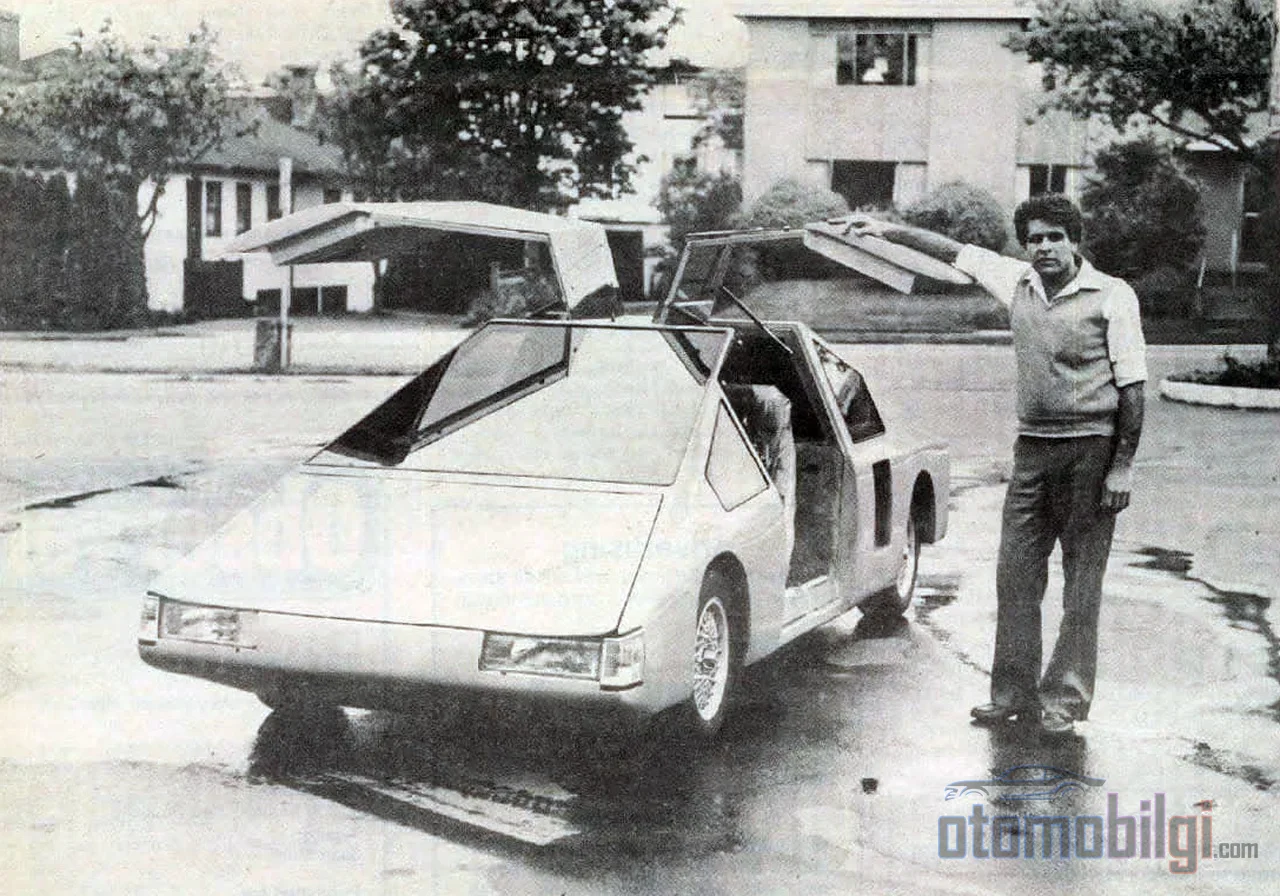
In the summer of 1986, a single automobile drove itself onto the Expo 86 fairgrounds in Vancouver, Canada, powered by its own means and an unusual drive system: A hybrid prototype called the Gaselle, hand-built by an engineer named Sarabjit Gandhi, setting off from New York. The odometer read 8,050 km, a distance covered in 16 days. At that time, the hybrid automobile existed only as an engineering dream in manufacturers' secret laboratories; it would be another eleven years before a mass-produced hybrid reached the roads. That is precisely why this vehicle, which an amateur engineer drove across the continent with a Goldwing motorcycle engine, is one of the most intriguing way stations in the history of the hybrid automobile.
So what exactly was the Gaselle, what did it achieve, and did it truly deserve the title of "the world's first hybrid car"? On this page, we will explore both the vehicle's story and its place in the timeline of hybrid technology, stretching from Porsche's earliest attempts to the Prius.
What Is the Gaselle and Who Built It?
The Gaselle is a gasoline-electric hybrid vehicle built by Sarabjit Gandhi for Expo 1986. Driven from New York to Vancouver as the sole automobile participant of an event called the World Energy Autocross, the vehicle was built entirely by hand as Gandhi's personal project. Gandhi is the owner of a fuel station and entrepreneurial groups in Victoria, British Columbia, and a figure from within the automotive and energy world.
On the gasoline side, the vehicle used a Honda Goldwing motorcycle engine. The choice of the Goldwing engine was no coincidence: Produced since 1975, this engine is liquid-cooled, long-lasting, and compact in design; the first-generation GL1000, with a displacement of 999 cc, produces roughly 80 hp of power and 61 lb-ft (approximately 83 Nm) of torque. Such an engine is a rational choice for a power package to be fitted into a lightweight automobile chassis. The engineering details of the electric side, however, were never documented; there is no verified information about which motors, batteries, and control systems were used.
Key Highlights
- The Gaselle is a gasoline-electric hybrid prototype built entirely by hand by Sarabjit Gandhi in 1986.
- The vehicle reached Expo 86 by covering 8,050 km in 16 days from New York to Vancouver.
- On the gasoline side, a Honda Goldwing motorcycle engine was used; the electric system was never documented.
- The journey is claimed to be the first intercontinental journey made by a hybrid automobile.
- The Gaselle is still running today in Gandhi's garage in Victoria, BC.
8,050 km in 16 Days: The World Energy Autocross Journey
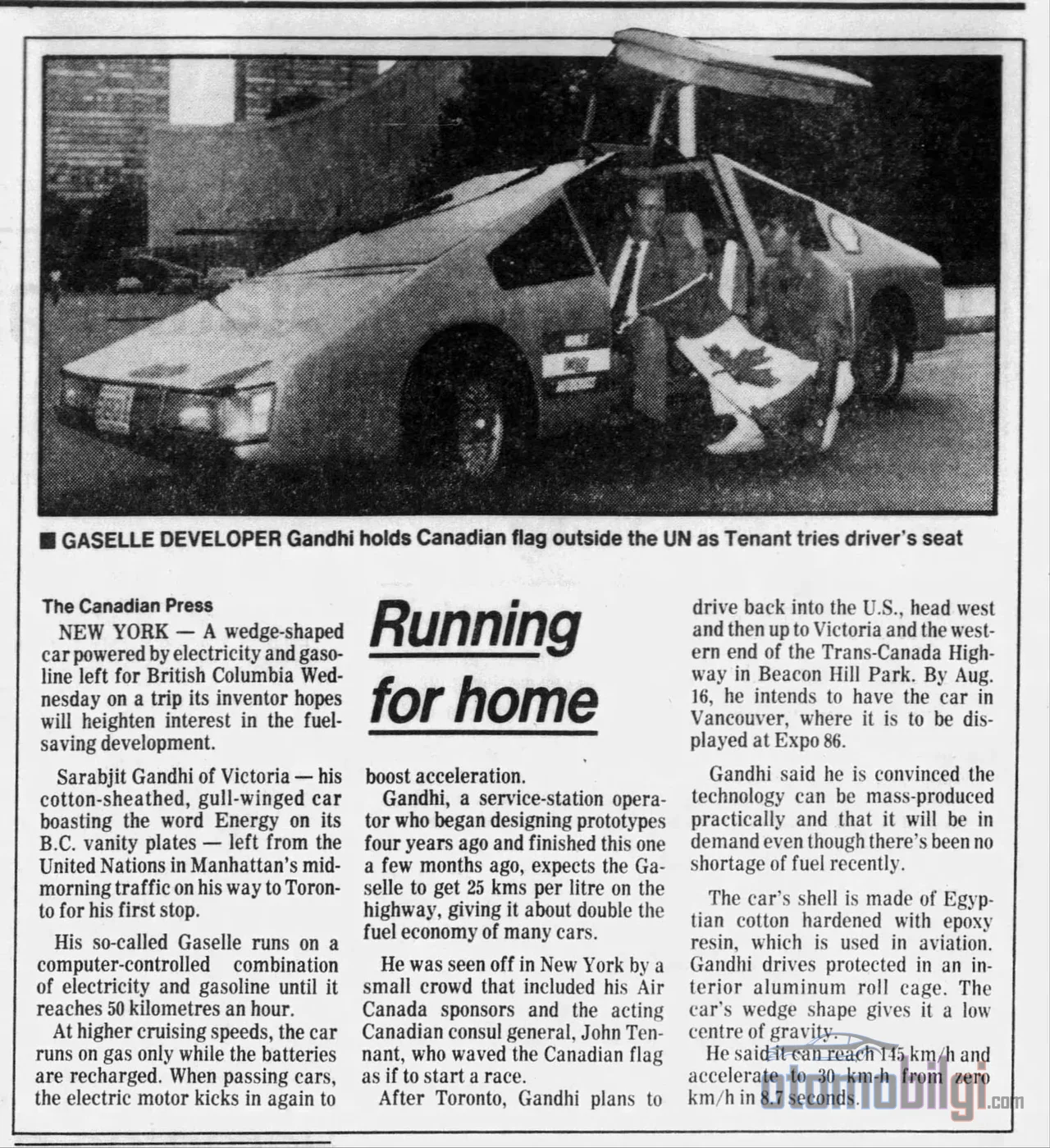
Gandhi drove the vehicle from New York to Vancouver, British Columbia, to reach the fair. The route was a long journey of approximately 8,050 kilometers crossing the North American continent from end to end, and the vehicle covered this distance in 16 days. Upon arrival at the fairgrounds, the odometer displayed the figure that revealed the entire journey.
This journey was not merely a story of arrival; it was a field test for the vehicle itself. As the only automobile participating in the World Energy Autocross, the Gaselle had to operate with both gasoline and electric propulsion in real road conditions, over real distances, with a real risk of breakdown. According to Gandhi, this was the first intercontinental journey ever completed by a hybrid automobile. A decade before production hybrids would routinely cover such distances, one of the few working hybrid automobiles had crossed the continent this way.
In numerical terms, that means an average of roughly 500 km per day; which shows the car was not merely a fairground novelty, but an engineering effort worth driving. The only performance figure reported about the vehicle, mentioned in forum sources and lacking primary verification, is that it weighed approximately 750 kg and could reach 60 mph (about 96 km/h); exact power, torque, acceleration and consumption figures appear in no official record.
Was the Gaselle Really the First Hybrid Car?
No, and this distinction matters for technical history. The idea of the hybrid car emerged nearly ninety years before the Gaselle, in the earliest period of motor vehicle history. The Gaselle's true originality lies not in being "the first hybrid," but in being one of the rare amateur experiments that took a hybrid car off the shelves and onto real-world roads.
Lohner-Porsche: The Birth of the Hybrid Idea
Ferdinand Porsche, as a young engineer, built the Lohner Electric Chaise in 1898, considered the world's first front-wheel-drive vehicle. Around 1899-1900, the first hybrid vehicle combining an electric motor with a gasoline engine was developed: the Lohner-Porsche series with hub motors and the Mixte model. The Semper Vivus prototype, introduced in 1900, whose Latin name means "always alive," became the symbol of the hybrid concept; the Mixte went on sale in 1901. So gasoline-electric propulsion was not a far older idea than the internal combustion engine itself, but it was nearly the same age.
Other Pioneers Before the Gaselle
Before the Toyota Prius entered series production in December 1997, dozens of prototypes attempted to embody the hybrid idea. American engineer H. Piper patented the idea of an electric motor assisting a gasoline engine. Victor Wouk, known as "the godfather of the hybrid," developed and financed the first full-size example of the modern hybrid car in the 1970s; the Buick Skylark he converted in the 1972-74 period achieved a consumption of roughly 12.8 km per liter (30 mpg). Other notable attempts can be listed as follows:
- 1969: the GM XP-883 hybrid concept prototype.
- 1979: the Fiat 131 Ibrida, with a 903 cc gasoline engine and a 24 kW DC electric motor.
- 1980: the Daihatsu Charmant Hybrid, with a 550 cc two-cylinder generator engine and two DC motors.
- 1980: Briggs & Stratton's six-wheeled hybrid prototype.
- 1982: the HTV-1, developed at GE and considered the precursor of the parallel hybrid layout.
- 1986: The Gazelle and the Twike, a human-electric hybrid built by Swiss students, introduced at the same Vancouver fair.
This picture clearly shows that the Gazelle was not working in an empty field. On the other hand, in 1986 no manufacturer was coming close to putting a hybrid car on a series production line; therefore Gandhi's vehicle was one of the few working examples keeping the concept alive.
The Difference Between an Amateur Prototype and an Industrial Prototype
What fundamentally sets the Gazelle apart from GM's or GE's engineering programs is resources and method. Corporate prototypes are developed with a budget, a test track, a qualified team and measurement infrastructure, and the results are reported. Gandhi's car, however, came about through a single person's material choices, handiwork and local means; for this reason, neither verified power-torque data nor systematic test results are available.
In return, it did what none of the industrial prototypes could: it filled the tank, drove from coast to coast and arrived without breaking down. The critical problem of the hybrid idea was never the efficiency on paper, but whether the components could withstand real road conditions. With its 16-day marathon, the Gazelle produced an answer to precisely this question. The contribution of amateur engineering lies here: demonstrating, on a small scale, at low cost and with bold simplifications, the feasibility of an idea at field level.
From the Gazelle to the Prius: The Revolution Eleven Years Later
After the Gazelle reached Vancouver, the fate of the hybrid car passed into the hands of the manufacturers. In 1993, the US Department of Energy's Hybrid Propulsion Program accelerated hybrid development; in December 1997 the Toyota Prius came to market in Japan as the world's first series-production hybrid passenger car, and reached the US for the 2000 model year with 97 hp of combined power. The Honda Insight became the first series-production hybrid sold in the US in 1999 as a light hybrid with a parallel system, achieving a consumption figure of 3.4 L/100 km.
Battery technology also matured rapidly: In 2009, the Mercedes S400 BlueHybrid became the first hybrid with a lithium-ion battery, and the Hyundai Elantra LPI Hybrid the first hybrid with a lithium-polymer battery. In 2010, the Chevrolet Volt went on the road as the first commercial plug-in hybrid; before that, in 2008, the BYD F3DM plug-in hybrid had been offered for sale in the Chinese market. The energy storage problem in Gandhi's vehicle, most likely carried with classic lead-acid setups, was solved with lithium chemistries and plug-in infrastructure.
The Gazelle's Legacy and Its Current State
So what is the summary of the Gazelle's story? The Gazelle was not the world's first hybrid car; that title belongs to the Lohner-Porsche work of around 1900. What the Gazelle did was to prove that a hybrid car could, in 1986, by the handiwork of a single engineer, cover 8,050 km in 16 days. In this respect, it is one of the most impressive proofs of concept from outside industry on the road to the Prius.
The fact that the BBC news-reported the car as early as 1988 shows that the project attracted interest even after the fair ended. Today the car is neither scrap nor a museum exhibit; It is waiting, in working condition, in Gandhi's garage in Victoria, British Columbia. A 1970 Lotus sits alongside it. The fact that it was still running long after the newspaper headlines is perhaps this car's best technical reference: true engineering is measured by its durability in the field.