Why Do Driver Changes in GT Endurance Take All Night Long?

Share This Page
In 24-hour races, the driver change is a team choreography that happens in the seconds the car sits in its pit box, shaped by a shift schedule stretching from day into night and by the physical realities of the cockpit: the car is shared by 2 to 4 drivers, and everyone takes their turn according to a rest schedule and the rules. So why is a change rehearsed with such meticulous care? Because the fate of the race is often decided in those 30-37 seconds.
Highlights
- A driver change takes about 10-37 seconds; a full pit stop averages around 30 seconds
- A stint typically ranges between 45 minutes and 4 hours
- At the Rolex 24, a driver can spend a maximum of 13 hours in total behind the wheel, and no more than 4 hours at a time
- In the Bathurst 12 Hour Pro-Am class, the crew must include two Bronze drivers, each of whom must drive for one hour
- At the Spa 24 Hours, a team was penalized in the 30th minute of the race for not making a driver change
Why is the driver change the heart of 24-hour races?
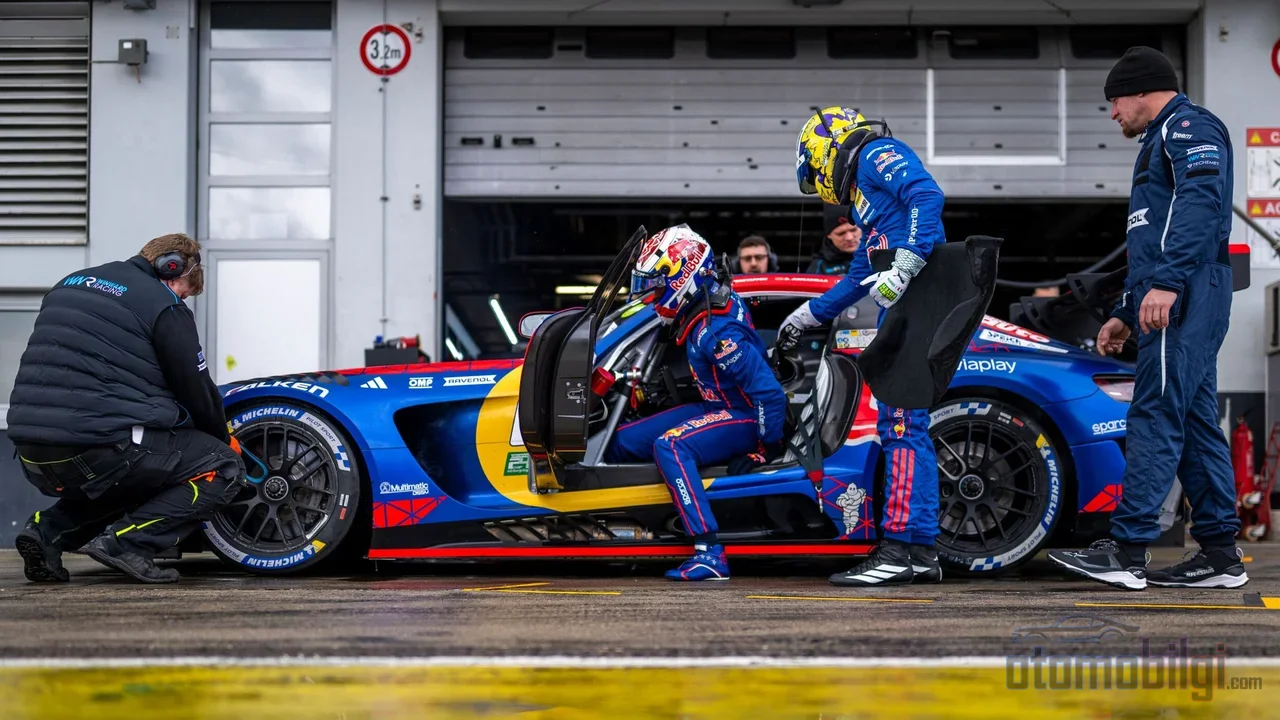
In a sprint race, one driver gets in, goes to the flag, and it's over. In an endurance race, things are entirely different: a single car is shared by 2 to 4 drivers, and fuel, tires, and driver changes are handled together in planned pit stops. The winner is not the car that spends the least time, but the one that covers the greatest distance in 24 hours. In other words, it is not the single second in front of you that matters, but the total of the 24 hours you stack on top of one another.
That is why the moment of change is not just a technical procedure, but like a heartbeat that sets the rhythm of an entire race. Every entry into the pit box is a small theater stage where several jobs run simultaneously: taking on fuel, dropping off the exiting driver, bringing in the new one, and perhaps changing the tires. The roles are set: every movement of the tire changers, the fuel crew, and the jack operators is choreographed in advance. Even a single moment of hesitation burns seconds.
The shift schedule: day, night, and double night shifts
Above all, teams have a rotation schedule. This schedule actually starts being prepared weeks before the race, even months in advance: who will drive in which time slot, who will sleep when, and who will command the night. Think of it like a cafeteria shift schedule, but a version where you cannot sleep for 24 hours and a single mistake costs millions.
Driving blocks, which we call stints, typically range between 45 minutes and 4 hours. Three things determine this duration: fuel, rules, and fatigue. A fuel tank generally lasts 40-45 minutes (as in the examples at Daytona), and drivers can usually do 3-4 of these back to back. To stretch the fuel, they lift off the throttle early and shift up early. On the rules side, the limit is clearer: At the Rolex 24, a driver can drive a maximum of 13 hours over the course of the race, and no more than 4 hours at a time. Teams build their rotation around these limits.
Why is night driving the most dangerous shift?
Hot days, muddy dew, race heat; but at night the job changes. Visibility drops, temperatures fall, and fatigue becomes a real safety factor. Double night stints are given to experienced drivers who adapt best to night conditions. The strongest endurance programs invest in driver rotation and rest schedules just as much as they invest in the car.
There are also interesting methods for fatigue management: drivers use light therapy lamps to stay awake, and they prepare their bodies with exercise bikes and warm-up routines before getting into the car. A night driver must get several uninterrupted hours of sleep before their stint. Food, water and sleep planning is actually an area of engineering as serious as tire selection.
Getting in and out of the cockpit with second-level discipline
Here comes the most cinematic part of the job. The moment the car comes to a complete stop in the pit box, the cockpit door opens, a team member physically pulls the exiting driver out (harness, steering wheel, adjustments... getting out is more of an ordeal than you'd think) and the new driver slides in. In one recorded example, this operation was completed in 37 seconds. The pit stop itself is usually around 30 seconds. So the change makes up the body of the stop.
For comparison: In F1, pit stops can go down to as little as 2 seconds. But there only the tires are changed and there is a single driver. In endurance racing, fuel, tires and a human being are all transferred at the same time, so the seconds carry a different meaning. Still, considering that every stop can completely change the race result, you realize how precious those 37 seconds are.
Why is seat adjustment everything?
Right after the change, the new driver sits behind the wheel, but sitting isn't enough; they must be fully seated. In a GT3 car, driver fit is everything: seat positioning is adjusted for control, comfort, safety and performance. In endurance racing, the seat has to be adjustable, because 2-4 people of different heights will use the same cockpit. That's why GT cars use heavy-duty rail seats that lock on both sides. For drivers heading out on long stints, racing seats with increased padding and cushioning are preferred.
Teams don't leave this transition to chance: they rehearse driver changes with an in-cockpit camera, drilling every single movement. Think of it like a dance rehearsal in a korometrics hall; when the music (pit signals) starts, everyone must know their part by heart, so that even when a wire snaps on stage, what comes out is poetry, not comedy.
Pro-Am lineups: the balance of amateur and professional
In most 24-hour races, the lineups include both professionals and amateurs. The whole logic of the Pro-Am classes is to establish this balance: the strongest driver combination a team can field is limited. According to the Bathurst 12 Hour Pro-Am rule, the lineup must include two Bronze-rated drivers, and each of these drivers must complete one hour of driving time. The goal is similar in the Asian Le Mans Series as well: Preventing fully factory line-ups in the Hypercar class and introducing limits similar to the LMP2 Pro-Am model.
Teams build the strategy of this balance according to the rules: experienced drivers are assigned to the toughest conditions, meaning rain and night; the strengths of the 3-4 drivers are balanced as evenly as possible throughout the crew. CrowdStrike Racing (George Kurtz, Alex Quinn, Laurin Heinrich), winner of the LMP2 Pro/Am championship at the 2026 24 Hours of Le Mans, is an example of a crew that managed this balance every lap for 24 hours.
Stint philosophy: long stints, or short and frequent changes?
This is a topic teams debate even among themselves. Winning-focused crews prefer to run stints up to the fuel limit of 2-2.5 hours, while entertainment-oriented teams settle for short stints of 45-90 minutes. A double stint, meaning two stints back to back on the same set of tires, can be optimal if wear is moderate; but the performance drop of those tires needs to be factored into the strategy. The opposing view is that every change is a risk.
There is also the human factor that should not be forgotten: endurance per driver varies significantly from person to person. Some go 2 hours comfortably, while others start making mistakes within 1 hour. Heat and cooling vests extend this time. Teams monitor lap times at the end of each stint and bring in a slowing driver early for safety. Long stints reduce the number of stops but increase the risk; each stop means roughly 10 minutes of lost laps. That is why everyone should gradually get used to marathon stints, and physical fitness should be seen as part of safety.
Rule conditions and the moments when the pit stop decides the race
However solid the plan is, 24 hours do not respect a plan. Sudden rain, safety car periods and the loss of daylight require instant changes to the strategy. Making the changes at the right time ensures the car always returns with a fresh and sharp driver; a badly timed change, on the contrary, can leave a tired driver in the cockpit.
Breaking the rules is not free of charge either. At the Spa 24 Hours, one team received a penalty in the 30th minute of the race for not making a driver change; normally, the change is made approximately every 60 minutes. So being fast alone is not enough; sticking to the rule schedule is also part of the race. A good change pushes the race forward, while a bad one can wipe out hours of effort in a second.
Final word: The weight of 37 seconds
In a 24-hour race, the brightest moment may be that 30-37 second choreography performed in the pit box. The driver who best suits the cockpit, the team that carries the night duty most evenly, the crew that makes the changes most flawlessly ends up on the winning side. Next time you watch an endurance race, pay special attention to the pit entries; when the car stops, nobody breathes, because everyone knows: the race is being rewritten right there.
Sources
- Art of the Driver Change: Poetry (or Comedy) in Motion - IMSA
- How long can a Rolex 24 driver drive at Daytona? - The Daytona Beach News-Journal
- 24 Hours of Le Mans - How do drivers cope with tiredness? - 24h-lemans.com
- Endurance Racing Explained: Why the 24-Hour Format Is Motorsport's Toughest Test - Yahoo! Sports
- Bathurst 12 Hour Pro-Am, Silver, Bronze, GT4 & Invitational Class Preview - DailySportscar
- Hypercar Driver Lineup Rules to Mirror LMP2 Pro-Am - Sportscar365
- Driver Changes and Fuel Management - Sarah Moore Racing
- Anatomy of a pit stop - Formula1.com
- The Science Behind Pit Stops - New Hampshire Motor Speedway
- Stints - How Long? - 24 Hours of Lemons Forums
- 24 Hours of Le Mans - Wikipedia
- Pit stop - Wikipedia