24 Hours at the Nordschleife: What Makes the Nürburgring GT's Toughest Test?
Share This Page
The 24 Hours of Nürburgring is the toughest exam in world GT racing, because on the 20.8-kilometer Nordschleife, more than 170 corners, weather conditions that change within a single lap, traffic created by more than 200 cars, and speed differences between classes all come into play at the same time. At Spa, Daytona, or Bathurst, a good car and a good crew are enough; here, the track itself is also your rival. That is why this race, which has earned the nickname "Green Hell," tests both machines and people at their limits for 24 hours.
Highlights
- Track: per lap 25.3 km, of which 20.8 km Nordschleife
- In 2026, 159 cars took the start, with more than 20 classes racing at the same time
- Almost no section of the Nordschleife's surface counts as straight; most of the more than 100 corners are blind
- Most successful manufacturer: BMW, most successful team: Manthey Racing
- 2026 race: May 14-17, with an entry of 161 cars, the largest since 2014
Why Is the Nordschleife Called the 'Green Hell'?
The nickname's story dates back to the 1968 German Grand Prix. That weekend, the Nordschleife was almost invisible due to rain and fog; Jackie Stewart embraced victory in this foggy hell. While describing these grueling conditions, he gave the track the nickname "Green Hell," and the name has stuck ever since. It essentially sums up this green corridor, surrounded by trees and passing right through the middle of the forest, in a single phrase.
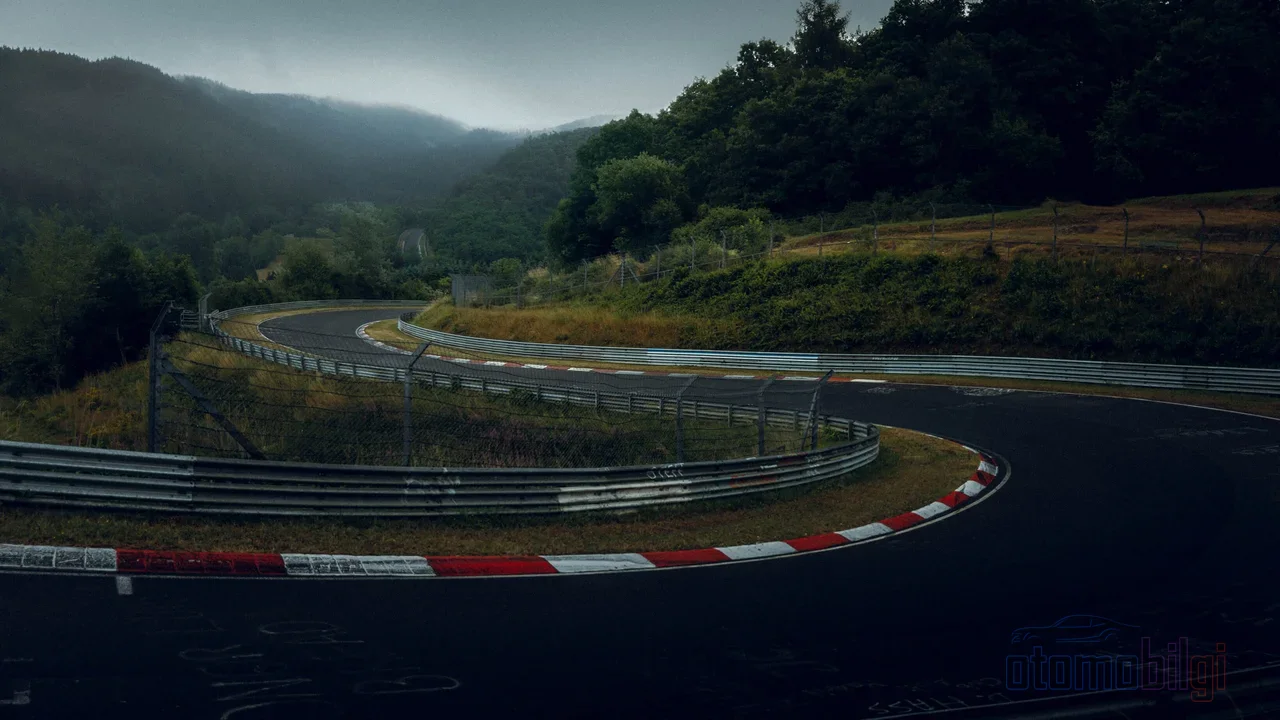
The track was designed in the 1920s and still carries the track philosophy of that era: part of it consists of old public roads. In other words, the wide run-off areas, flat virtual lines, and easily memorized corner sequences of modern circuits do not exist here. On the Nordschleife, every lap hides a surprise; that is why drivers do not merely learn the track, they practically build a relationship with it.
Track Layout: Length, Corners, and the Challenges It Imposes on Drivers
The most fundamental feature that sets the Nordschleife apart from other tracks is its length: per lap 25.3 kilometers , of which 20.8 kilometers is the classic Nordschleife section. This length is nearly five times an ordinary circuit lap. Moreover, even the track's widest section is only approximately 8.5 meters wide; meaning two cars passing side by side is often a fantasy.
Not even 1% of the surface is truly straight; drivers constantly make small input corrections even on the straights. Most of the more than 100 corners are blind, meaning you brake without being able to see what's behind them. This makes every lap on the track feel like an exam: the margin for error is close to zero, and the chance of recovery depends on the track's next kilometers.
Weather: Four Seasons in a Single Lap
The weather in the Eifel region is as unpredictable as the track itself. On a massive 25-kilometer circuit, the weather can change completely between different sections of the track within a single lap: while the sun shines over the Döttinger Höhe straight, it may be raining at the Karussell. Drivers and teams must adapt to these variables instantly. In 2016, extreme weather conditions even led to the race being stopped with a red flag; in the Nürburgring 24, the weather is not just a factor but an active rival.
Traffic: An Asphalt Shared by 200 Cars
In the 2026 race 161 cars entered, and 159 of them took the start. This massive participation is made possible by the length of the track; fitting this many cars into the same area at Spa or Le Mans would be nearly impossible. But the length advantage also brings the speed-difference disadvantage: GT3s alongside GT4s, TCR cars, and even factory-supported Toyota GR Yarises on the same asphalt at the same time. A GT3, with its speed advantage, must quickly work its way past slower traffic; which means constant risk. Accidents between classes have become a side effect of this race so common that it is nearly a tradition.
Classes and BoP: More Than 20 Categories Racing at Once
The 24 Hours of Le Mans has three classes. In the Nürburgring 24, the number exceeds 20: SP9 (GT3), SP10 (GT4), SP8, SP7, TCR, Cup classes, and a long list like this. Each class is racing for its own championship, but they all share the track at the same time. The GT3 class, SP9, features the fastest FIA-homologated cars; on the Döttinger Höhe they reach speeds of around 265-270 km/h .
BoP, or the balance of performance system, plays a critical role here as well. Parameters such as minimum weight, fuel capacity, air restrictor diameter, turbo pressure, and wing angle are adjusted to keep the cars of different manufacturers close to one another. For 2026, the SP9 minimum weights were set in the range of 1300-1365 kg ; the biggest weight increase before the race went to BMW. Even four-time F1 champion Max Verstappen, racing in SP9 with Mercedes-AMG this year, carries a BoP weight penalty of around 35 kg due to his driver ranking. So even the fastest name becomes part of the track's effort to stay fair.
| Comparison | Nürburgring 24 | Le Mans / Spa / Daytona |
|---|---|---|
| Lap length | 25.3 km | Usually 4-7 km |
| Number of classes | More than 20 | 3 at Le Mans |
| 2026 car count | 159 took the start | Significantly fewer |
| Amateur participation | Open, accessible to everyone | More restricted, professional-focused |
| Weather variability | Can change even within a single lap | Generally more homogeneous along the track |
Pit Strategy: Why Is It Different from Other 24-Hour Races?
The pit lane is not designed for 160 cars; up to six cars can be accommodated per garage. Refueling is done through ordinary commercial pumps; even top-tier teams such as Manthey and Rowe Racing use these pumps. Because the number of pumps is limited, in the early hours teams make strategic off-cycle stops, meaning not everyone pits at the same time.
Minimum stop times for top-tier teams are above 2.5 minutes; fuel capacity is also limited by class. Toward the end of the race these restrictions loosen and fast "splash and go" stops are allowed. Another important detail: unlike almost all GT3 series, Nürburgring teams are free to choose their tire supplier and can run intermediates with more than one compound. Combined with the unpredictability of the weather, this turns tire strategy here into practically an art form.
What Are GT3 Cars Tested With on This Track?
The Nordschleife is a rare place that tests every aspect of a GT3 car at once. Braking performance while overtaking slow cars in traffic, aero balance in blind corners, suspension durability over the bumps on the straights, and engine and gearbox fatigue over 24 hours are all evaluated in the same exam. In other words, winning here means proving that the car can survive even in the wildest conditions; for manufacturers, the marketing value of this is considerable.
The 2026 race also turned into a technology testing ground: Manthey's Porsche 911 GT3 Cup running on e-methanol, the Four Motors car using fuel with 60% biogenic content, factory Toyota GR Yaris, Hyundai Elantra N1s and a Subaru WRX competed in the alternative fuel classes. These trials reinforce the race's identity as an engineering laboratory.
Common Traits of the Teams That Win the Race
Since 2003, only factory teams or factory-backed squads have won the race. The reason is simple: surviving 24 hours requires flawless teamwork, durability, adaptability and a bit of luck; only factory-backed teams have the resources to deliver all of these at once. With seven victories, Manthey Racing is the most successful team, while BMW, with 21 victories, is the most successful manufacturer.
The 2025 race showed how fragile this balance is: leader Manthey Porsche received a 100-second penalty after a collision with a late-running GT4 Aston Martin and could not recover from it; Rowe Racing's BMW M4 GT3 managed to win. In 2026, Abt finished second but was retrospectively disqualified due to a technical infringement. In other words, speed alone is not enough here; you must bow to the rules, the odds and luck all at the same time.
How Do Amateurs Enter This Race?
One of the most beloved aspects of the Nürburgring 24 is its openness to everyone: factory-backed GT3s race on the same track as amateur teams arriving with an open trailer and a minibus. But while the door is open to everyone, the entry fee is experience. The Nordschleife permit license is mandatory; for that, you must complete a two-day track school and run at least two VLN races, which in practice means a minimum of three trips to Germany. Driver categorization is also strict: roster averages across bronze, silver, gold, and platinum categories determine class assignments.
Final Word: This Is Why the Nürburgring 24 Is the Toughest Test
Le Mans traditionally holds the title of "the toughest race," and Spa, Daytona, and Bathurst each carry their own challenges. But the Nürburgring 24 is the only race where track conditions, weather variability, traffic, and class chaos are all in play at once. This event, which combines driving skill, vehicle durability, strategy, and luck all in one place, continues to be the true test of GT racing. The next time you watch the 24-hour marathon, you can now watch with an informed eye: every lap is a battle with the track itself.
Sources
- Guide to the Nürburgring 24 Hours classes
- Nürburgring 24 Hours
- 2026 24 Hours of Nürburgring
- 6 reasons why the Nürburgring 24 is the greatest endurance race
- Everything you need to know about the Nürburgring 24 Hours
- Nürburgring 24 Entry Increases to 161 Cars
- BMW Gets Pre-Race BoP Hit; Lambo, Porsche Also Impacted
- Verstappen Still Carries 77-Lb BoP Weight Penalty for N24
- ADAC RAVENOL 24h Nürburgring - Das Vollgas-Festival
- Extreme weather halts Nürburgring 24 Hours
- Nürburgring
- Nürburgring Nordschleife - The Green Hell Circuit Guide
- Why The Nürburgring Is Called 'The Green Hell'
- Facing the Green Hell