Why Do OLED Tail Lights Glow Like a Thin Film?
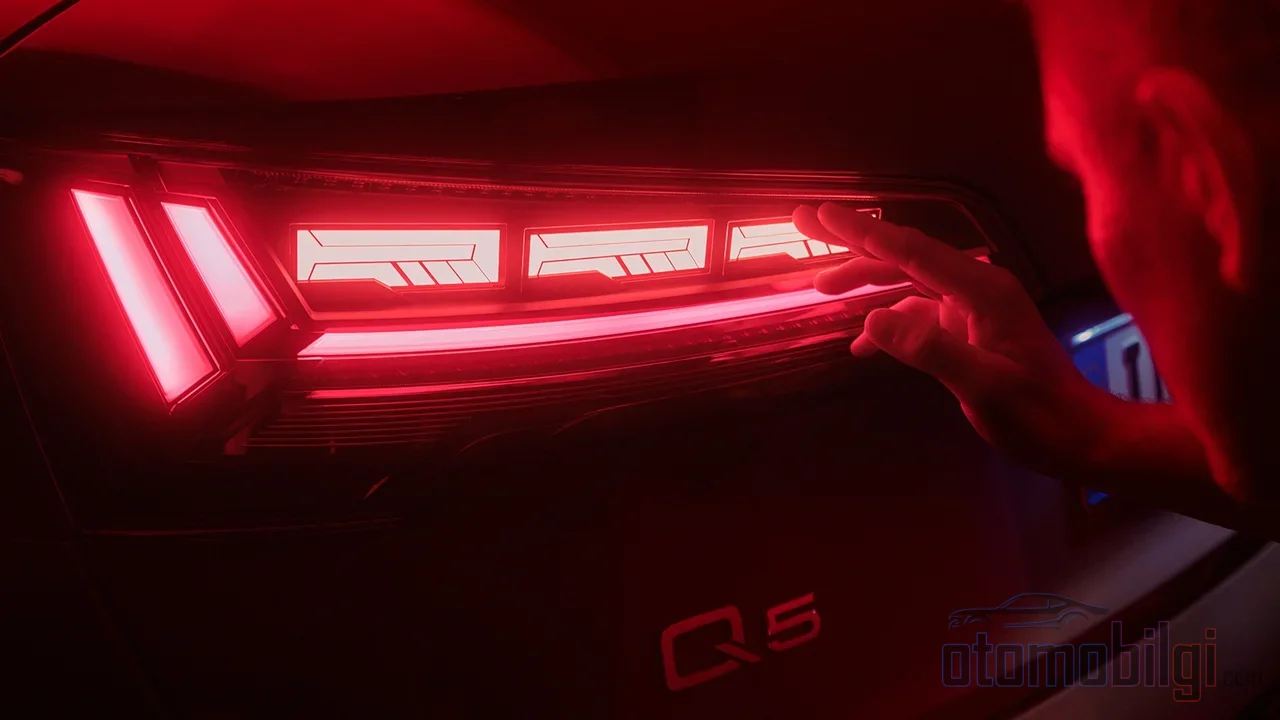
Have you ever stopped to look at the brake light of a vehicle following you at night? Most taillights consist of lots of tiny LED dots or a single bright bar. But on some new models, the brake light glows like one huge panel, so uniformly that it's as if a thin film has been laid over the rear body panel. No dots, no lines, no dark gaps - a continuous, smooth surface of light. So how does this work? The answer lies in OLED taillight technology, the organic cousin of LEDs, and I promise you: this is way cooler than you think.
Highlights
- OLED produces light with a layer of organic compound film placed between two electrodes; it is completely different from crystalline LEDs
- OLEDs emit directly from the surface, without lenses or light guides; that's why they provide homogeneous brightness
- The panel can be divided into segments to produce different taillight patterns
- OLED taillights have been used in mass-production vehicles since 2016
- OLED panels are being developed to meet the automotive industry's demanding -40°C to +85°C temperature requirements
What Exactly Is OLED? How Is It Different from LED?
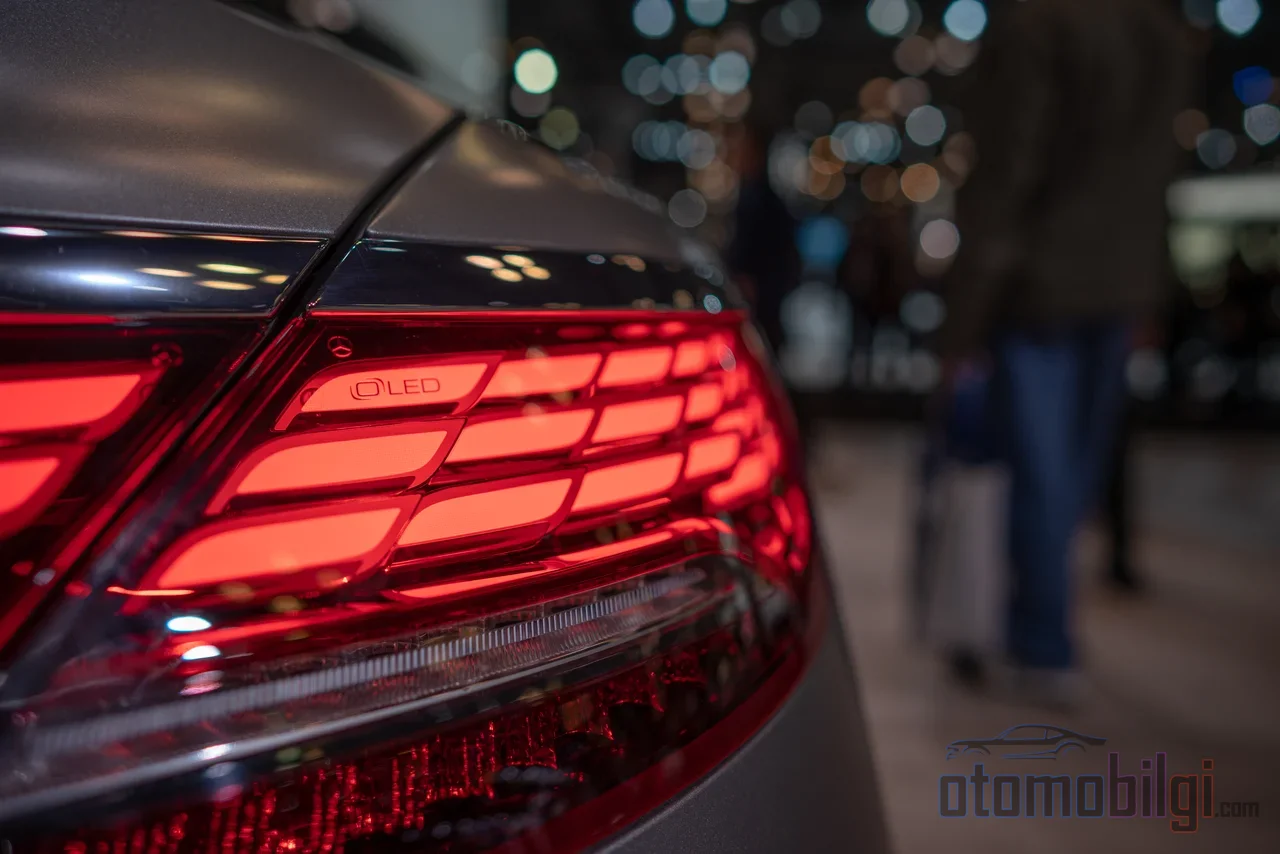
OLED, or organic light-emitting diode, is a type of LED that produces light in response to electric current. But that "LED" part in the name is misleading; because their internal structures are nothing alike. The LED we know is built on an inorganic p-n diode with a crystalline structure. In OLED, however, there is no such thing as a crystal: the light-emitting layer is a thin film made of organic compounds.
Let me give you a simple analogy. Think of an LED as a flashlight: it shoots a strong, focused beam from a single point. Now think of OLED as a lighted poster - the entire surface glows by itself. This difference is not just an aesthetic detail; it is a fundamental engineering distinction that determines from the start how the taillight will be designed, how it will be cooled, and even what kind of signature the rear of the vehicle will create.
The Layer Stack Inside: Anatomy of an OLED Panel
You can think of an OLED panel as a layer kebab stacked on top of itself - sorry, but it really is like that. Everything sits on a substrate (a carrier base), which can be plastic, glass, or metal foil. On top of it, in order, are the anode, hole injection layer (HIL), hole transport layer (HTL), emission layer (EML), a blocking layer, electron transport layer (ETL), and cathode. At least one electrode must be transparent, otherwise the light produced cannot escape.
The heart of this stack is, as the name suggests, the emission layer. Color is determined in this layer: the light-emitting molecules are doped into a host material, and this is exactly where electrical energy is directly converted into light. This doping process is used both to increase radiative efficiency and to tune the wavelength of the emitted photon, in other words, its color. So an OLED glowing red as a brake light is no coincidence; it is a deliberate material choice within the layer.
How does electricity turn into light?
When voltage is applied to the panel, holes and electrons move from the electrodes into the organic thin films. These two carriers collide and recombine in the emission zone, creating an energetic state called an exciton. As excitons relax to a lower energy level, they release their energy in two ways: either electroluminescence, meaning light, or unwanted heat. The job of engineering is to tip this balance in favor of light as much as possible. Meanwhile, a little historical note: The first practical OLED device was developed at Eastman Kodak in 1987 with a two-layer structure featuring separate hole and electron transport layers - this structure lowered the operating voltage and significantly increased efficiency. But its turn for taillights came in 2016.
The Secret of "Burning Like a Thin Film": Being a Surface Source
Now let's get to the real question: Why do OLED taillights glow so evenly, so seamlessly? The answer is very clear: because OLED is a surface light source. A conventional LED, on the other hand, is a point light source. With a lamp made from LEDs, you need to spread the light from those points across a wide area; for this, lenses or channels called light guides that carry the light along a surface are used. Even light distribution, meaning the absence of dark spots, depends on how well these intermediate layers work.
In OLED, this entire intermediate stage is absent. The panel emits light directly from its own thin surface; it needs neither a lens nor a light guide. The result? A smooth, shadow-free, perfectly uniform brightness. That's why, when you look at it from behind, the lamp feels like a part of the vehicle body - as if the brake signal is gushing out of the vehicle's surface itself. What's more, surface sources can be extremely thin; getting rid of light guide and lens layers opens the door to very slim lamp housings for designers. This transition from point source to surface source was even examined in an academic journal in 2019 under the heading "the OLED taillight revolution" - so this is not marketing talk, but a real turning point in lighting engineering.
Segmentation: One Panel, Hundreds of Possible Patterns
OLED's ability to do the real work at the rear is the digital control capability that comes along with its uniformity. The panel can be divided into small segments, and the brightness of each segment can be controlled individually. You can think of it as dividing an illuminated poster into thousands of tiny cells and switching each cell on and off with its own button. By combining cells that remain dark, an arrow, a line, or any shape can be drawn.
What is this good for? The rear lamp is no longer just "a brake light that switches on and off," transforming into a communication tool. In models like the Audi Q8, digital OLED taillights offer four different rear lamp designs that the driver can choose from. Audi announced a digitally curved OLED panel for the Q9 as a first, stating that the panel's uniform surface light sources enable three-dimensional lighting scenarios. On the other hand, the Audi Q5's digital OLED 2.0 rear lights are equipped with OLEDWorks' Atala digital technology; these panels offer real-time personalization with customizable signatures and dynamic animations. So seeing the car behind you draw its own light signature when braking is not a distant dream at all.
Does OLED Heat Up? Heat Management and the Automotive Durability Test
When you hear "organic material," you're probably wondering, "does this panel lose its mind in the summer heat?" It's a fair question, because OLEDs do genuinely generate heat while operating. But no panic: OLED panels generally run cooler than many conventional display technologies. In single-panel designs, heat management is usually solved through direct heat dissipation, and integrating aluminum into the system is a common approach.
The real heavy lifting is on the automotive side: a rear light has to operate at -40°C in winter and withstand +85°C in summer. This window is a serious test for the durability of OLED material; structures like tandem OLED are being developed precisely to meet these temperature requirements. And here's the interesting part: increased brightness doesn't just shorten the panels' lifespan - in a way, it extends it. In other words, automotive OLED panels operating at high brightness can become more durable and reliable in the long run. You can think of it as "the fast-running horse lives longer": the logic seems odd, but that's exactly how the technology is progressing.
OLED or LED? Advantages, Disadvantages, and the Realistic Picture
You're asking, "If OLED is so cool, why doesn't every car come with OLED rear lights?", right? Let me draw an honest picture. First, the pros: OLEDs have a faster response time than LEDs - a lamp that signals braking to those behind more quickly is a tangible gain in terms of safety. Since it's a surface light source, it produces a homogeneous, smooth field of light, can be thin and lightweight, and even transparent and color-adjustable versions are possible. In rear combination lamps, LED and OLED have been in the leading role for decades thanks to high efficiency, long life, reliability, fast response, and design flexibility.
Now for the cons. LED panels are generally brighter than OLEDs - this is a significant advantage especially in daylight conditions with very strong ambient light. That's why even the question "Then why does the OLED side claim the brightest automotive OLED?" is a contentious area: the comparison changes depending on what is being compared with what, because measurement definitions differ. Another issue is the nature of the organic material: in small-molecule OLED materials, fluorescence decay, crystallization, high production costs, and stability and lifespan issues are known engineering constraints. This also explains why automotive use only became widespread from 2016 onwards - only recently has the technology reached a level where it can meet the demanding lifespan expectations of lamps.
| Feature | LED | OLED |
|---|---|---|
| Material structure | Crystalline, inorganic p-n diode | Organic thin film, amorphous |
| Light source type | Point source | Surface source |
| What is needed for homogeneous light | Lens / light guide | Not required, direct surface emission |
| Response time | Fast | Faster than LED |
| Brightness | Generally higher | Comparatively lower |
| Pattern creation | Limited | Multiple patterns and animation via segmentation |
A Decade of Experience: Where Are We Today?
OLED taillights are no longer a laboratory toy. Audi has left a decade behind in automotive OLED lighting; this decade of experience also reveals that suppliers must demonstrate that decorative features can meet the same demanding lifespan and warranty expectations as conventional rear lamps. So the technology has matured, but the durability-feature tension is not entirely over: the lamp must work like day one for ten years, just as much as it must look elegant. OLEDWorks and Marelli winning the 2025 AutoTech Collaborative Partnership Award with Digital OLED 2.0 taillights shows that ultra-thin, customizable and highly durable panels have also been approved by the industry. With advances in organic technology, OLED lifespan is also increasing; panels are becoming long-lasting and low-maintenance.
So what is the one-sentence answer to why it glows like that thin film?
Here is the direct answer you were curious about: OLED taillights glow homogeneously like a thin film because they emit light not from a point source, but directly from the entire surface of the organic thin film layer. Since no lens or light guide is needed, the light comes out with equal intensity everywhere on the surface; no dark spots, bright points or harsh lines are formed. When segmentation is added, this homogeneous surface turns into a light canvas that can draw different patterns and dynamic signatures. This technology, which combines the speed and efficiency of LED with an organic film, turns the rear lamp from a mere safety component into the car's nighttime signature. I think it's worth checking on your next night journey by looking back - which brand will you see with which technology, let's see?
Sources
- Organic Light Emitting Diodes (OLEDs)
- OLEDs
- An OLED Taillight Revolution: From Point Light Sources to Surface Emitters
- A world first on the Audi Q9: digital OLED panel with a curved design
- OLEDWorks and Marelli Win 2025 AutoTech Collaborative Partnership Award
- Audi Q5's Intelligent Digital OLED 2.0 Rear Lights Equipped with Atala Digital Technology
- OLED vs LED | The Science of the Pros and Cons
- Rear Combination Light Solutions for Automotive
- Tandem OLED vs single OLED for automotive temperature requirements
- A Decade of OLED Rear Lights: Audi's Experiment