Why Does a Flat-Plane Crankshaft Love High Revs?
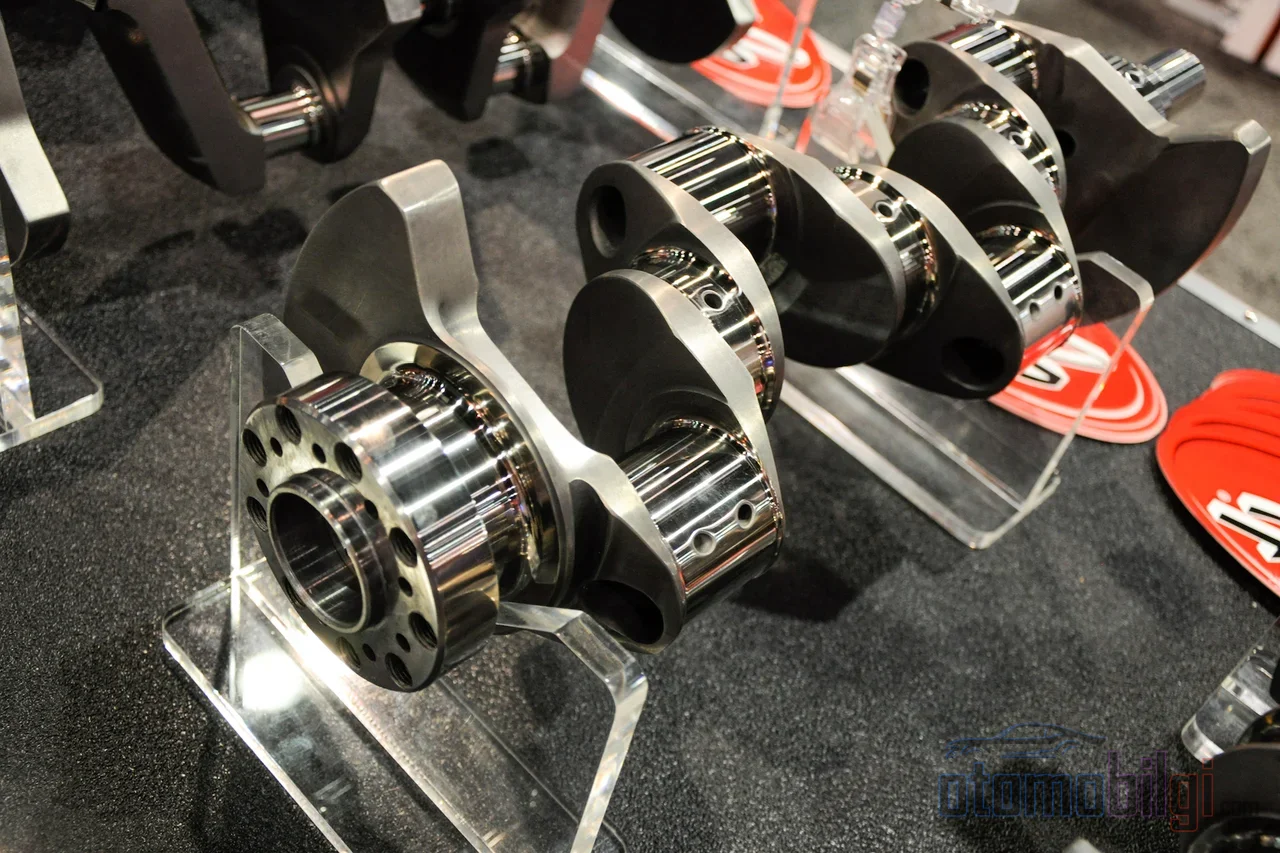
Put the same two 4.0-liter V8 engines side by side: one runs velvet-smooth at idle and speaks with a deep growl; the other practically leaps the moment you first touch the throttle and turns into a sharp shriek toward the top of the tachometer. Cylinder count, displacement, and even the power figures can be nearly identical. Most of the difference comes from a part spinning inside the engine block that most drivers do not even know the name of: the crankshaft. And the throws of this part can be arranged in two different layouts: cross-plane or flat-plane.
The flat-plane crank's love of high revs is not a coincidence or a stylistic choice, but a direct consequence of geometry and mass balance. In this article, we will step through that geometry, the physics of vibration, and the chain of consequences that extends all the way to the exhaust note.
Crank Throw Layout: 90 Degrees or 180 Degrees?
The crankshaft of a V8 engine has four crank pins, and the angular arrangement of these pins determines the engine's entire character. In the cross-plane layout, the pins sit in two separate planes, spaced 90 degrees apart; when you look at the shaft from the end, the four pins draw a plus sign or an X. In the flat-plane layout, all four pins sit in a single plane: two pins face up, two face down, and the pins are spaced 180 degrees apart.
This seemingly small difference radically changes the synchronization of piston movement. A flat-plane V8 actually behaves like two inline four-cylinder engines joined on the same shaft; each cylinder bank carries a complete four-cylinder rhythm within itself. In a cross-plane, both banks sustain their rhythm with a firing order broken into 90-degree stagger.
What is historically interesting is this: most early V8 engines used flat-plane cranks, but the reason was not performance - it was ease of manufacturing. A flat-plane crank is a simpler part, requiring less effort to cast and machine.
Vibration Balance: Why Is Cross-Plane So Smooth?
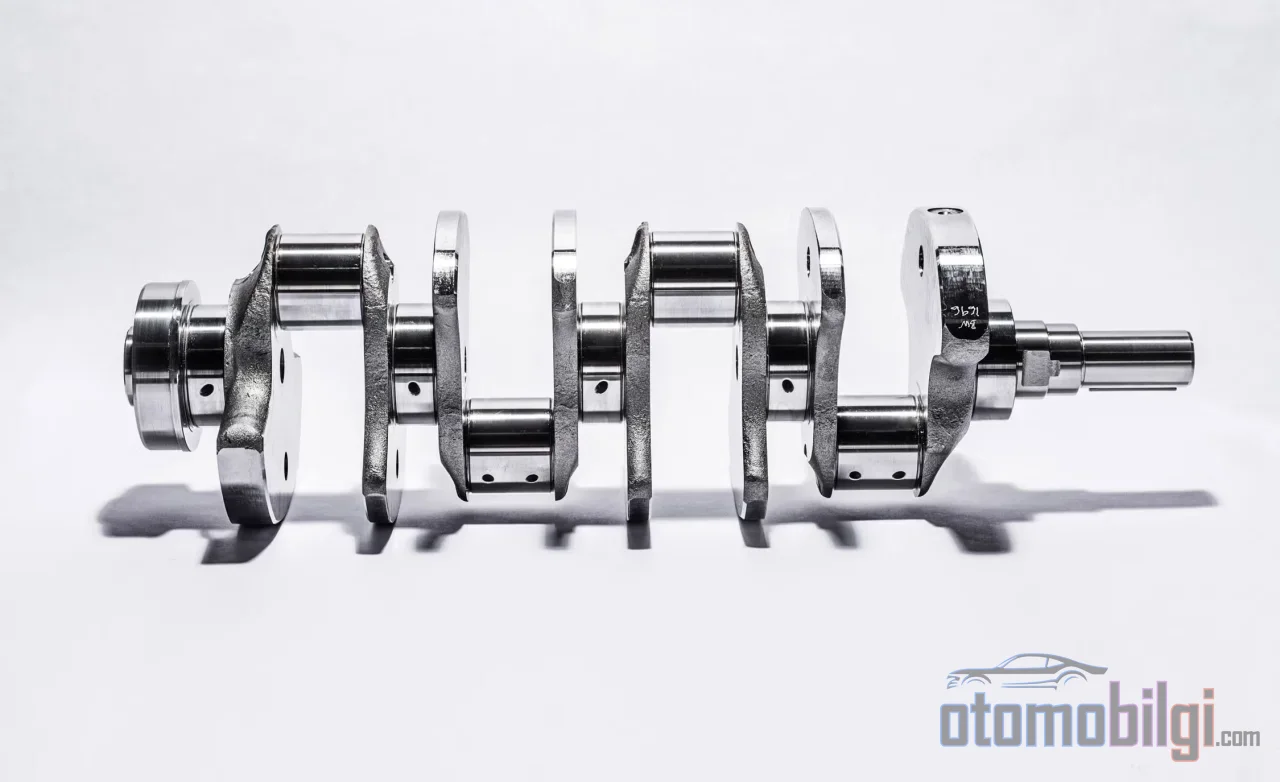
The flat-plane crank's weak point is second-order vibrations. These vibrations, which appear at twice the crankshaft speed frequency, arise in the flat-plane layout from the four pistons standing up and coming down together. The primary forces are balanced; the real problem lies in these higher-frequency oscillations, which are generally felt in the cabin as vibration and a drone.
In the early 1920s, Roland Hutchinson, a mathematician working at General Motors, brought a systematic solution to this problem: he designed a quarter-arranged crank, placing the crank throws 90 degrees apart so that the piston forces largely cancel each other out. This layout has been the standard practice of the American V8 ever since, and it laid the foundation for the characteristic smoothness of the cross-plane V8.
But this smoothness comes at a price: large counterweights must be added to the crankshaft to complete the force balance. A counterweight means rotating mass; when mass is added, rotational inertia increases, and both the engine's rev ceiling and its throttle response shrink together. For this reason, a cross-plane crankshaft is inherently a heavier component that revs more slowly. It is also difficult to manufacture; it requires complex forging processes in which the pins are twisted into place.
Highlights
- In a flat-plane crank, the four crank pins are arranged in a single plane, spaced 180 degrees apart; in a cross-plane, the pins sit in two planes spaced 90 degrees apart.
- Since a flat-plane crank does not need heavy counterweights, it is lighter and reaches much higher revs.
- The redline of the LT6 engine in the Corvette Z06 is 8,600 rpm; the previous-generation supercharged LT4 was limited to just 6,500 rpm.
- In a flat-plane V8, firing always alternates between the two cylinder banks, and each bank sees an exhaust pulse every 180 degrees.
Why Is the Flat-Plane Crank Light and Why Does It Rev Quickly?
Here is the core of the matter: the primary forces of a flat-plane crank are balanced by its own geometry, so it needs almost none of the large counterweights required by a cross-plane. The absence of counterweight masses makes the crank noticeably lighter and reduces its rotational inertia. The result is two concrete advantages:
- The engine responds to the throttle almost instantly; a rotating mass with low inertia needs less energy to accelerate.
- Revs that would be mechanically risky in a heavier rotating assembly become possible; the redline is raised.
A numerical example clarifies the situation. The 5.5-liter LT6 engine used in the Chevrolet Corvette Z06 reaches a redline of 8,600 rpm thanks to its flat-plane crank; the supercharged 6.2-liter LT4 in the previous-generation Z06 was limited to 6,500 rpm. The 2,100-rpm difference between them is a concrete measure showing only the contribution of the crank architecture's rev capability. This engine's short stroke and large bore (oversquare) cylinder geometry also serve the same purpose: a short stroke keeps piston speeds controllable at high revs.
So what happens to the flat-plane's second-order vibration? Instead of eliminating this problem, modern engineering chooses to manage it: stiff engine mounts, harmonic dampers, and active engine mount systems reduce the vibration to a level that cannot be felt in the cabin. In a sports car application, this is seen as an acceptable trade-off: low inertia and high revs in exchange for a bit of vibration.
Firing Interval and the Physics of Exhaust Sound
The 180-Degree Arrangement: The Self-Cleaning Exhaust
Crank geometry determines the firing order and the firing interval within each cylinder bank; the exhaust sound is born from this, too. In a flat-plane V8, combustion events always alternate between the left and right banks. Each bank, just like an inline four-cylinder engine, sees an exhaust pulse exactly every 180 degrees.
This even spacing is extremely valuable for the efficiency of the exhaust system: one exhaust pulse clears the manifold and pipe before the next pulse arrives, back pressure drops, and flow efficiency increases. This is called the scavenging effect and it is one of the core reasons flat-plane V8s produce more power per liter and have higher rev limits. Moreover, since cross-bank manifolds are not needed, the exhaust system is designed more simply; this was one of the reasons for the first interest in flat-plane cranks in the racing world.
Where Does the Cross-Plane's Rumble Come From?
In a cross-plane, since the pins are arranged 90 degrees apart, the firing interval becomes irregular. Two cylinders in the same bank can fire back to back with only 90 degrees of crank rotation; in the LT2 engine of the standard Corvette Stingray, the third cylinder in the left bank fires immediately after the first cylinder and only 90 degrees later. These closely spaced overlapping pulses in the manifold increase back pressure and weaken the scavenging effect; cross manifolds, which complicate exhaust design, are the solution to this problem.
The sound character is also fed by the same irregularity. The cross-plane V8's characteristic, rhythmic, and deep rumble is a direct product of the irregular firing pattern between the banks. The flat-plane, since it fires evenly and consistently, carries a regular rhythm in its sound as well: a continuous, high-pitched scream whose tone sharpens as the revs rise. The familiar sound signature of European high-revving sports engines is precisely the acoustic reflection of this 180-degree arrangement.
Flat-Plane and Turbocharging: The Advantage of Even Pulses
In forced-induction engines, another advantage of flat-plane geometry comes to the fore. In a twin-turbo setup, each turbo receives evenly spaced exhaust pulses from its own four cylinders; this feeds the turbine with a consistent flow of energy, allowing it to spool more evenly and efficiently. An irregular pulse interval, on the other hand, gives the turbine alternating high and low energy inputs; efficiency drops and turbo lag increases.
The twin-turbo LT7 engine in the Corvette ZR1 is a current example of this architecture: the engine using the same flat-plane architecture produces 1,064 hp of power and 828 lb-ft of torque; its redline is 8,000 rpm and peak power is at 7,000 rpm. The crankshaft has been specially reinforced to withstand turbo pressure; so the flat-plane architecture, reinforced out of engineering necessity, can also be carried over to forced-induction applications.
Which Is Better? A Choice That Depends on the Job Description
Crank geometry is an engineering choice that shapes the character of the engine from start to finish, and there is no single right answer in this choice. The same 5.5-liter displacement can serve two completely different philosophies: While the Corvette Z06's LT6 climbs to 8,600 rpm with a flat-plane crank, the engine of Cadillac's V-Series.R prototype developed for endurance racing is deliberately a 5.5-liter V8 with a cross-plane crank. Race engineers here preferred smooth power delivery, consistent torque across a wide rev range, and long-distance durability.
| Feature | Flat-Plane | Cross-Plane |
|---|---|---|
| Pin arrangement | Single plane, 180 degrees | Two planes, 90 degrees |
| Mass and inertia | Light, low inertia | Heavy counterweights |
| Rev capability | High (e.g. 8,600 rpm) | Lower (e.g. 6,500 rpm) |
| Vibration | Second-order vibration, requires management | Balanced, smooth operation |
| Exhaust character | High-pitched, sharp scream | Deep, rhythmic rumble |
| Typical use | High-revving sport engines | Comfort and durability-focused V8s |
Conclusion: The Engineering Roots of the Love of Revs
The flat-plane crank loves high revs because this behavior follows necessarily from its geometry: the 180-degree pin arrangement in a single plane balances the primary forces, eliminates the need for heavy counterweights, and reduces the crankshaft's rotational inertia. Low inertia allows the engine to respond instantly to the throttle and safely reach very high revs. The same geometry, with equal exhaust pulses arriving every 180 degrees, produces both a more efficient exhaust flow and the characteristic high-pitched sound. The price is second-order vibration that must be managed; the reward is an athletic engine character. Cross-plane represents durability and smoothness, flat-plane revs and response. The answer to the question of which one is right lies hidden in a single place: the engine's mission definition.
Sources
- Difference Between Cross-Plane and Flat-Plane Cranks
- Flat-Plane vs. Cross-Plane: The Gemini V8 Legacy
- Flat-plane crank - Wikipedia
- Crossplane - Wikipedia
- The Difference Between Cross-Plane And Flat-Plane Cranks
- The Reason Why Flat-Plane Crank V8 Engines Sound So Different
- Pros And Cons Of The Flat-Plane V8 Engine