Why Did the Wankel Engine Fail to Survive in Mass Production?
An engine technology that won the 24 Hours of Le Mans in 1991, exulted above 9,000 rpm, and breathed in rpm regions piston engines could never touch has today been almost entirely erased from the hoods of production cars. The rotary engine, also known as the Wankel engine, got everything right on paper: few parts, low weight, high revs, almost no vibration. So why did it fail to survive in series production despite track victories and legendary sports cars? The answer is not a single fault; it is an efficiency problem embedded in the geometry itself.
How Does a Rotary Engine Work? Comparison with the Piston Cycle
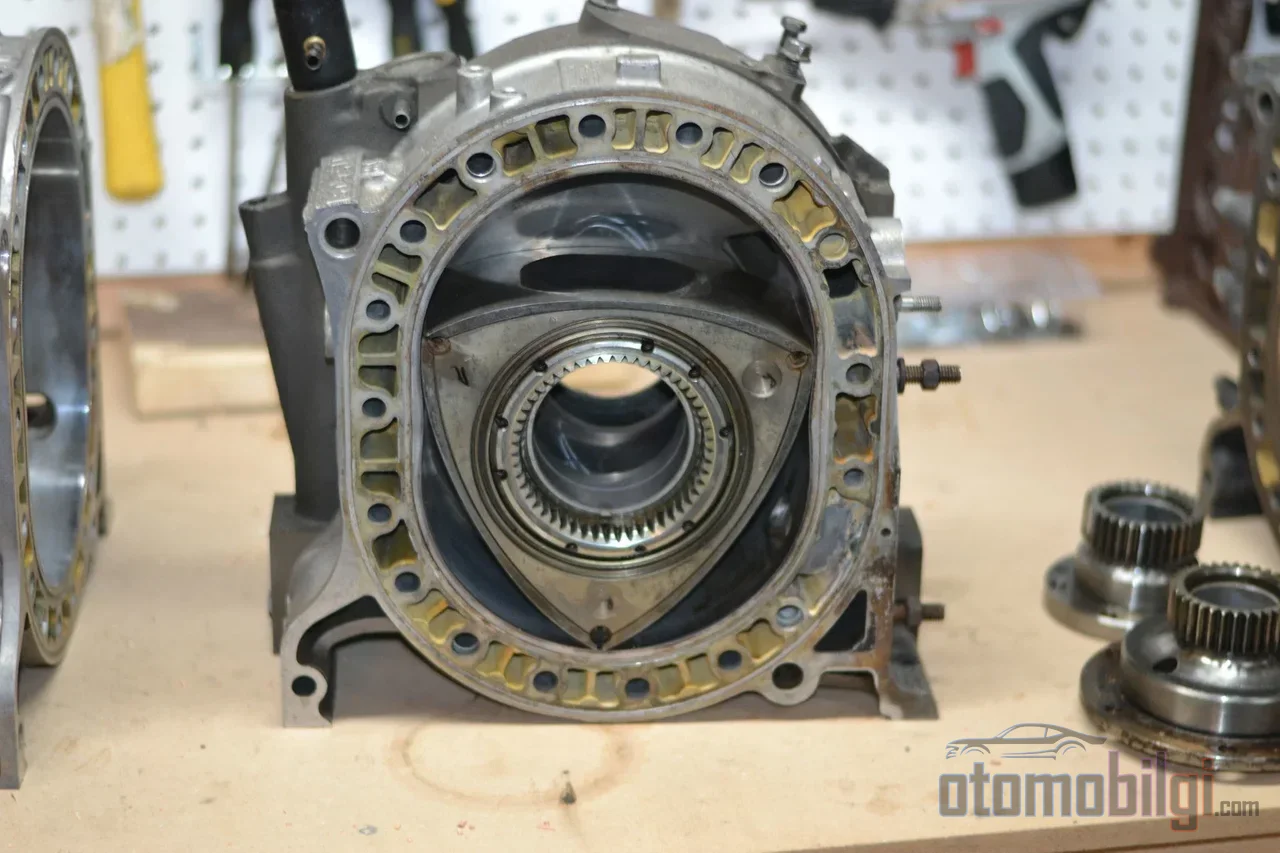
The rotary engine is an internal combustion engine with an eccentric design that converts pressure directly into rotary motion. It differs from the piston engine in three fundamental ways: it has no pistons, no valves, and runs almost vibration-free. A three-sided rotor rotates eccentrically inside an epitrochoid (peanut-shaped) housing that roughly resembles the figure 8. The rotor's three apexes remain in constant contact with the housing walls, and this contact creates three independently moving chambers.
This is where the second major departure from the piston engine comes into play: all four stages of intake, compression, combustion and exhaust occur simultaneously, in different regions of the engine, and uninterrupted. As the rotor turns, it opens and closes the intake and exhaust ports machined into the walls itself; geometry takes over the valve's job. In a piston engine, each stroke is completed within the crankshaft's 180-degree rotation, and the full cycle takes 720 degrees, i.e. two crank revolutions. In a rotary engine, however, each stroke is 270 degrees and the full cycle continues for 1080 degrees, over three crank revolutions.
Advantages: Why Engineers Fell in Love with This Design
The timing difference is not a minor detail; it is the fundamental data that defines the design's character. The rotary engine has 1.5 times more milliseconds per stroke than the piston engine; this allows it to breathe more freely at high revs and makes more effective use of power time. Each full rotor revolution produces twice the power strokes of a single-cylinder piston engine; a 1.3-liter rotary produces roughly 1.5 times the power and torque of a piston engine of similar displacement, and is in practice considered equivalent to a 2.0-liter engine. A two-rotor rotary has the same number of firing pulses as a four-cylinder engine; it runs more smoothly thanks to the overlap of pulse durations.
Few moving parts means an extremely compact and light structure, very high rev capability, and vibration-free operation. The high power-to-weight ratio earned the Mazda RX series sports cars their fame, and the same trait found the rotary engine a place in light aircraft as well.
Highlights
- In the rotary engine, the full cycle takes 1080 degrees; in the piston engine, 720 degrees.
- The 1.3-liter rotary produced specific power of 212.3 hp per liter (RX-7 Series 8).
- Mazda 787B's 2.6-liter four-rotor R26B engine produced approximately 700 PS at Le Mans in 1991.
- The long combustion chamber geometry reduces thermal efficiency and results in high fuel consumption.
- Mazda brought the rotary engine back in the MX-30 R-EV as a range extender for the electric vehicle.
The Root of Poor Combustion: Thermal Efficiency and Combustion Chamber Geometry
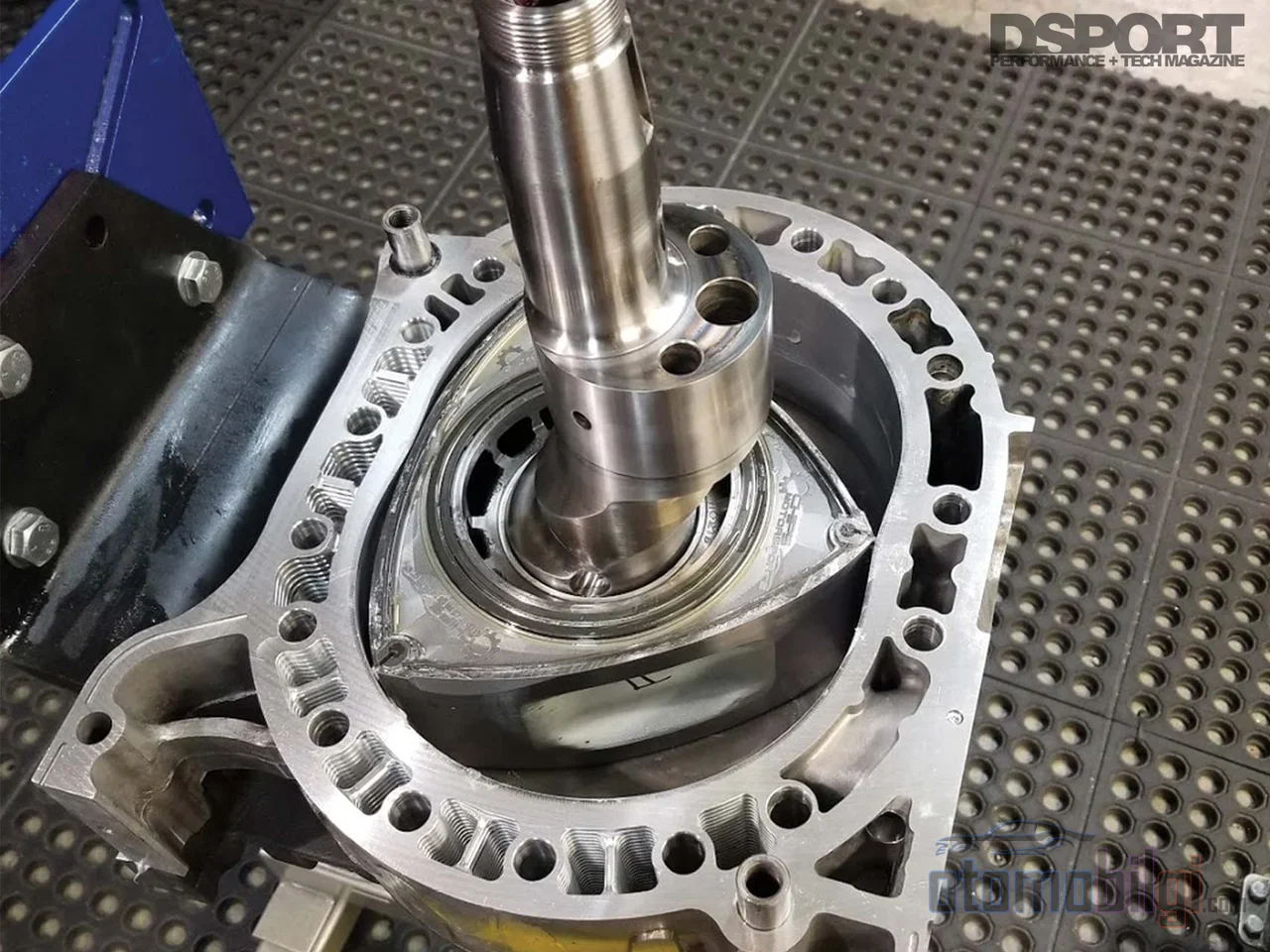
What sealed the rotary engine's fate is the very same geometry that provides its advantages. In a piston engine, the combustion chamber is roughly a cube; in a rotary engine, it is a long, narrow and elongated chamber. This long, narrow combustion chamber leads to inefficient fuel combustion, increased unburned hydrocarbons and lower thermal efficiency. The intake mixture travels a winding path approximately 20 inches long from combustion to the exhaust; along this path, heat is continuously transferred from the large surfaces it contacts. A significant portion of the heat the engine produces escapes through these surfaces into the oil and coolant, meaning it is lost without being converted into work. The price of always having a duration 1.5 times longer than a piston engine is that heat is also transferred to oil and water 1.5 times more slowly.
The compression ratio is also a victim of the geometry. In a rotary engine, it is not knock that determines the practical maximum compression ratio, but the burning mixture's ability to pass through the rotor grooves. If the groove is too small, pressure builds up at the trailing spark plug, negative work occurs, power drops and heat is again transferred to oil and water. The leading spark plug must be operated with very cold spark plugs because it remains surrounded by the burning mixture for roughly 70 percent of the cycle duration. In addition, dead zones form in the corners of the combustion chamber where the air-fuel mixture gets trapped and can escape the combustion process. The result is lower thermal efficiency and higher exhaust emissions compared to a piston engine of similar basic form. Fuel economy has been the rotary engine's most controversial aspect; consumption figures vary over a very wide range depending on usage conditions.
Apex Seal: The Rotary Engine's Most Fragile Part
The sealing elements at the three corners of the rotor are called apex seals, and they rub by scraping along the entire working surface of the housing. Lubrication of this friction surface is essential; therefore, the rotary engine deliberately burns oil. Lubricating oil is delivered to the seal area via an oil injection system, and this oil inevitably enters the combustion chamber and burns. The result is oil consumption at a problematic level compared to a piston engine.
There are two main causes of apex seal failures: lack of lubrication and knock. If sufficient oil is supplied to the seal surfaces, they can last relatively long; on the other hand, in the case of knock, the rotary engine is far more prone to complete failure than a piston engine, and the main cause of burned apex seal cases is explosion (detonation). The most common symptom of a failed apex seal is loss of compression. In short, the rotary engine is far less forgiving than a piston engine when it comes to maintenance discipline and proper lubrication.
Milestones: NSU Ro 80, Mazda 787B and the RX Series
The technology's journey to mass production was not easy. Despite winning the European Car of the Year award and its futuristic design, the NSU Ro 80 was remembered for major reliability problems caused by engine construction defects, apex seal failures, and poor fuel economy. The irony is this: NSU engineers largely solved the apex seal problem in 1970 by switching to a very durable titanium-carbide alloy, and seven Ro 80s managed to cross the Sahara Desert. But the reputation had long been damaged; dealers were so wary of the new technology that more than 35 percent of the engines brought in for service on grounds of being faulty turned out to be flawless.
The pinnacle of the rotary engine is the 1991 24 Hours of Le Mans victory. The R26B at the heart of the Mazda 787B is a naturally aspirated 2.6-liter four-rotor engine; its four 654 cc rotors are equipped with variable intake trumpets and three spark plugs per rotor. The engine produces approximately 700 PS in racing trim and operates above 9,000-10,000 rpm. The engineering goal documented by SAE is clear: a durability run of full power, uninterrupted, for 24 hours and 5,000 km.
On the series-production side, the RX series became the carrier of the technology. The first RX-7 engines offered around 100-115 hp and a 7,000 rpm redline. The RX-7 Series 8's 1.3-liter twin-turbocharged (supercharged) Wankel engine produced 276 hp; that means a remarkable specific output of 212.3 hp per liter. In the RX-8's Renesis engine, the manual transmission version produced 232 hp at 8500 rpm; outputs ranging from 189 hp to 210 hp were also available in different markets and versions, with torque starting at 222 Nm.
Why Did the Wankel Engine Fail to Survive in Series Production? The Clear Answer
When we bring all this background together, the answer becomes clear: The Wankel engine failed to survive in series production because the elongated combustion chamber geometry reduced thermal efficiency; high fuel and oil consumption, apex seal wear, and weak low-rpm torque made it uncompetitive in the face of increasingly strict emissions legislation and fuel economy expectations. It is not the fault of a single part, but an imbalance inherent in the architecture itself: the geometry grants high rpm and high specific power, but exacts a price on thermal efficiency and emissions.
It should be noted that the debate shifts depending on what is emphasized. Some see apex seal life and oil consumption as the main cause; others point to thermal efficiency and emissions legislation. From an engineering standpoint, the two are two sides of the same coin: the seal problems damaged its reliability reputation, while thermal efficiency and emissions made the business model unsustainable.
A Comeback as a Range Extender
The story did not fully close. Mazda revived the single-rotor rotary engine as an electric vehicle range extender in the MX-30 R-EV; the small engine charges the battery when needed, extends the range, and carries the flexibility of being able to burn different fuels. This application remained limited to the Japanese market and did not come to the US market. Company management had clearly stated that the rotary development would be used as a range extender in electric vehicles.
An even more interesting development came in 2026: It is reported that Mazda is conducting research on a hybrid powertrain in which the rotary engine could actually drive the wheels. Unlike the MX-30 R-EV, this setup may not be merely a range extender. The reasoning is sound too: when used as a generator running at a constant speed, the problems of variable-speed performance and partial-load efficiency, which are the rotary engine's weakest points, are partially neutralized; the engine can be kept at its most efficient operating point. On the other hand, much of this optimism still rests on forum and blog-level assessments; the part supported by official data is the range extender implementation in the MX-30 R-EV and the ongoing research.
The story of the rotary engine is the story of a technology redefining itself. During the period when it competed with the piston engine, it hit the wall of thermal efficiency and emissions; today, inside electric powertrains, it is seeking a new identity as a generator. The geometric disadvantage of the elongated combustion chamber remains constant, but when the use case changes, the weight of that disadvantage changes too. A principle that failed to survive in mass production may, for the first time, have found a role in which it does not have to compete with the piston engine.
Sources
- Wankel engine
- Rotary vs Piston
- What is the difference between a Wankel engine and a rotary engine?
- Mazda 4-Rotor Rotary Engine for the Le Mans 24-Hour (SAE)
- Pros And Cons Of The Rotary Engine
- Why Rotary Apex Seals Fail
- Mazda rotary engine returns as EV range extender in MX-30
- Mazda's Next Rotary Could Actually Drive The Wheels
- How Rotary Engines Work