How Do Bore and Stroke Determine Engine Character?
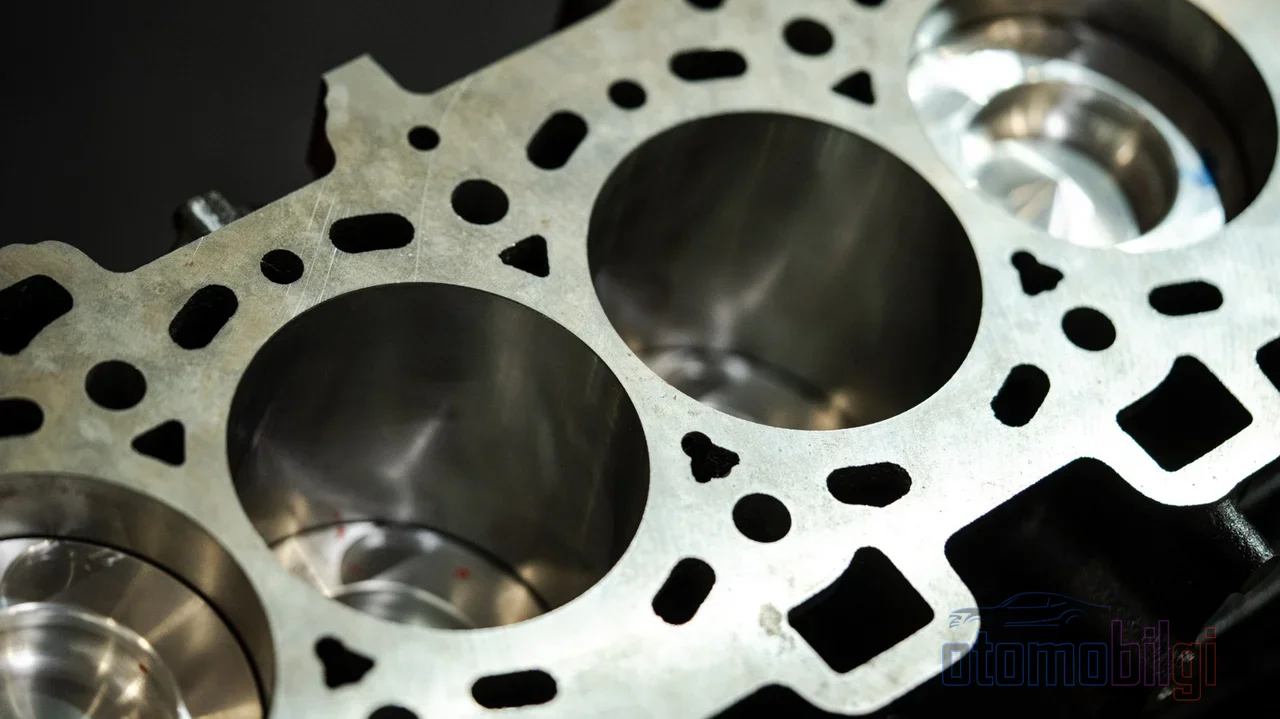
Let's consider two engines of the same displacement: one cuts out at 4,000 rpm but pushes the moment you press the throttle, while the other revs to 9,000 rpm but feels lifeless at low rpm. The origin of the difference often lies not in the valves, the turbo, or the electronics, but directly in the geometry of the cylinder. Bore and stroke are the two most fundamental measurements in an engine's technical identity, and the ratio of these two values largely shapes where the engine will deliver its torque, at what rpm it will relax, and even where its redline will be. On this page, we will cover this ratio and its connection to engine character from start to finish, at a basic level.
What Are Bore and Stroke?
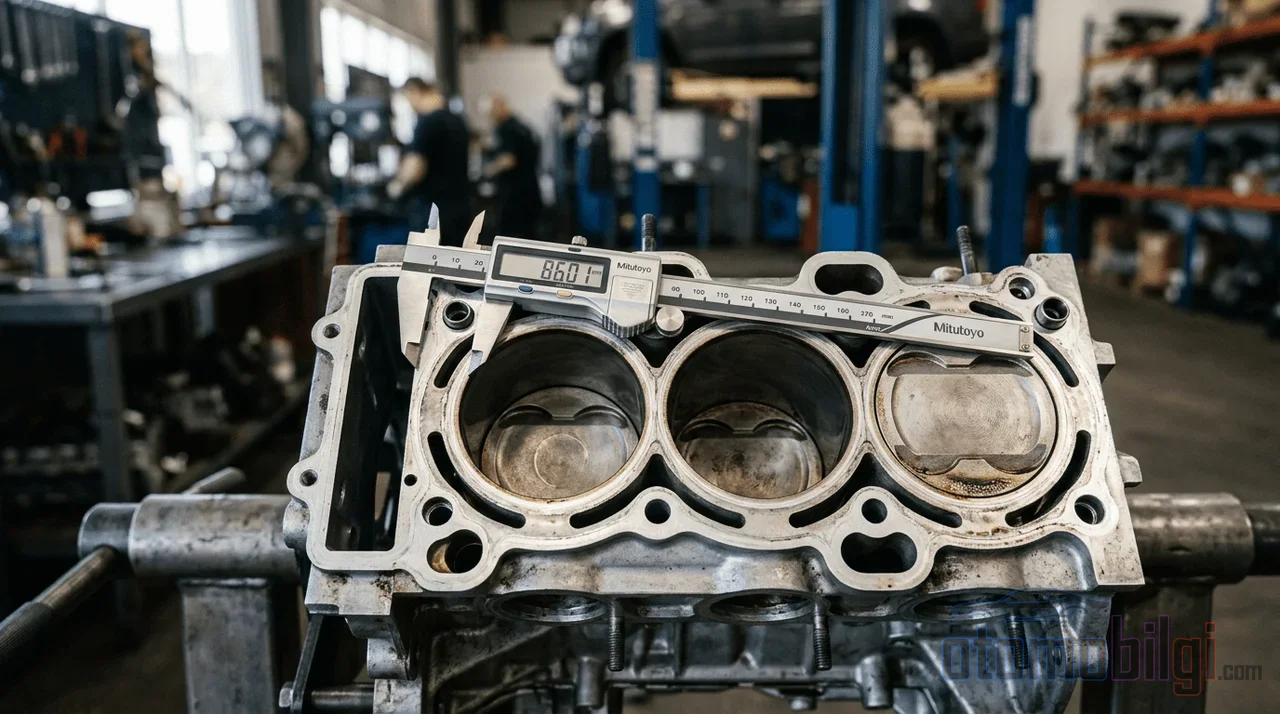
Bore is the internal diameter of the cylinder; stroke is the distance the piston travels between top dead center, its highest position, and bottom dead center, its lowest position. In technical documents, these two values are usually listed in the form bore x stroke, mostly in millimeters, with bore coming first; US sources may use inches. The conversion is fixed: 1 inch equals exactly 25.4 mm, and 1 cubic inch equals approximately 16.387 cc.
When these two measurements combine, the engine displacement emerges. The formula is simple: displacement equals pi times the square of half the bore, times the stroke, times the number of cylinders. The critical detail in the formula is that the bore appears squared. When the same amount of increase is applied to the bore rather than the stroke, the displacement grows more. That's why manufacturers usually tackle the diameter first when they want to increase displacement.
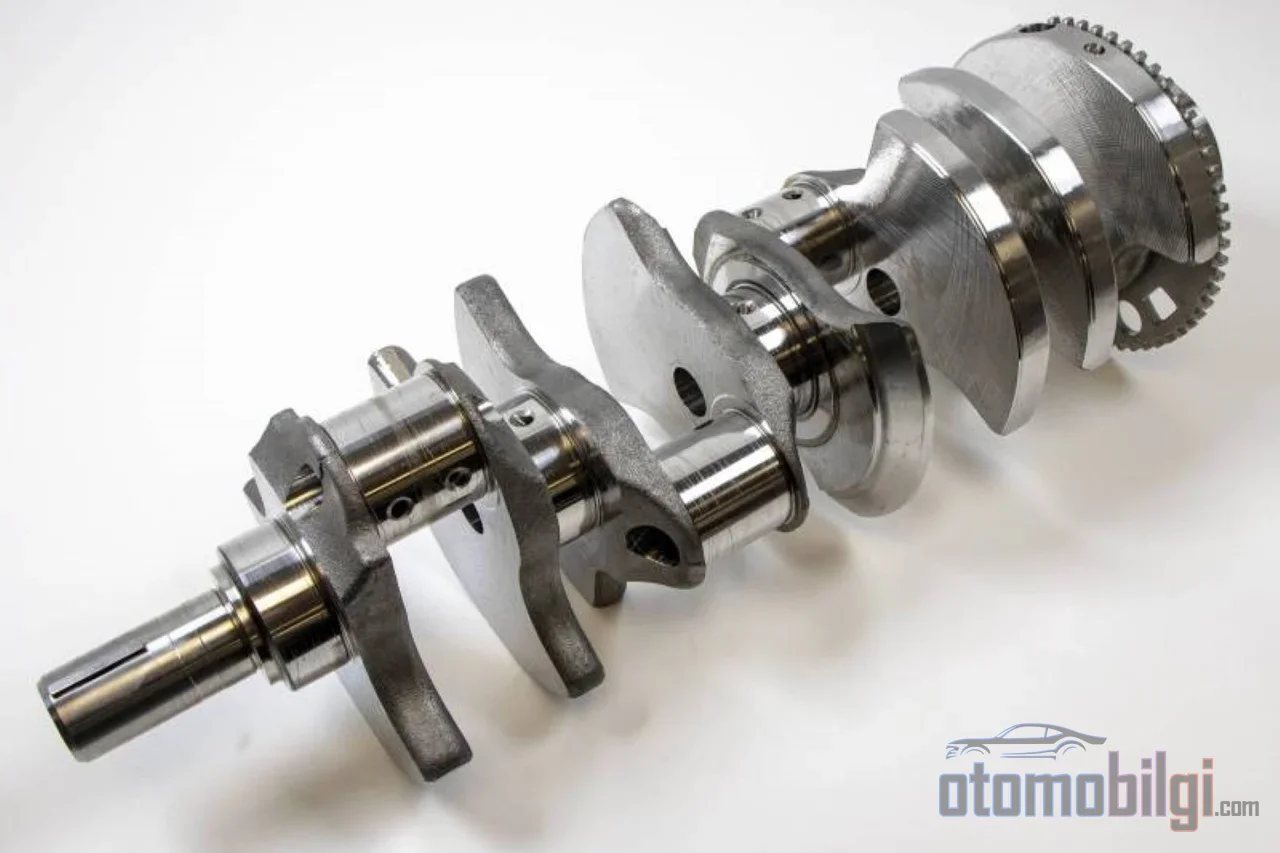
The physical source of the stroke is the crankshaft: the distance the piston travels is determined by the distance between the crankshaft's connecting rod pin centerline and the main bearing centerline. As the distance between the two centers grows, the stroke increases. There is also a practical warning: factory service manuals may give the bore as a range including a service limit rather than a nominal value; this is a repair tolerance, not the design dimension in the brochure. To learn an engine's actual bore and stroke values, you need to look at the engine code and the manufacturer's service documentation, not the label on the vehicle.
The Bore/Stroke Ratio Divides Engines into Three Classes
The ratio of cylinder diameter to stroke is one of the oldest practical shortcuts of engine designers. Based on the ratio, engines are divided into three classes, and each class has a distinct character tendency.
| Design | Geometry | Ratio (bore/stroke) | Character tendency |
|---|---|---|---|
| Long stroke (undersquare) | Stroke > bore | Below 1 | Low-mid rpm torque, limited high rpm |
| Square | Bore = stroke | Approximately 1:1 | Balanced compromise |
| Short stroke (oversquare) | Bore > stroke | Above 1 | High rpm, top-end power |
Let's make this concrete with examples. An 80 mm bore and 80 mm stroke is a perfectly square engine. The extreme examples of the short-stroke side are found in the motorcycle world: The 2012 998.9 cc engine of the Aprilia Tuono V4 R, with dimensions of 78 x 52.3 mm, has a ratio of approximately 1.49. On the automobile side, the engine of the 2014 Porsche 911 GT3, with a 102.0 mm bore and 77.5 mm stroke, is distinctly short-stroke.
Highlights
- Since bore appears squared in the formula, the same increase applied to bore rather than stroke enlarges the volume more.
- Long stroke, by lengthening the crank arm, tends to produce more torque at low revs.
- Short stroke allows a higher redline because it reduces piston speed at the same rpm.
- Mean piston speed is calculated with the formula 2 x stroke (m) x rpm / 60.
- Power = torque x rpm / 5252; the engine that delivers the same torque at higher revs is more powerful.
Why Does Long Stroke Deliver Torque at Low Revs?
Torque is the twisting force transferred to the crankshaft, and leverage logic works here. A long stroke means a long crank arm as well; when piston force is transferred to the crankshaft through a longer arm, the same cylinder pressure turns into a greater twisting moment. The result is that full-bodied pull you feel the instant you press the accelerator: long-stroke engines typically reach their maximum torque at low revs.
This behavior also has a breathing side to it. Long stroke usually comes with a smaller bore; a small bore makes the combustion chamber compact but narrows the size of the valves. Small valves struggle to supply the airflow the engine needs at high revs, so the engine's breath runs out at the top end. At low revs, thanks to a faster and fuller airflow, cylinder filling takes place well. The very torquey, low-revving character of diesel engines compared to gasoline ones can be explained by the same logic: in addition to the long stroke, the high compression ratio of around 16-22:1 (in gasoline engines this value is in the 9-11:1 range) and the turbocharger kicking in at low revs reinforce the character from three directions at once.
Here an honest engineering confession must also be recorded: in practice there is no comparison where the stroke is lengthened alone, without changing anything else. When stroke increases, engine displacement also increases, and part of the torque gain comes not from geometry but directly from this increase in displacement. In other words, the torque of a long-stroke engine is the combined product of the lever effect and the displacement effect; separating the two is only possible with careful design.
Why Does Short Stroke Love High Revs?
The enemy of high revs is piston speed. In every crankshaft revolution the piston travels the stroke length twice, and mean piston speed increases as revs rise. The formula is clear: mean piston speed is stroke (in meters) multiplied by two, multiplied by rpm, divided by 60. At the same rpm, the piston of a long-stroke engine travels a longer distance, so its piston speed is higher, and this enlarges the loads placed on the piston, connecting rod, and bearings.
Short stroke solves this bottleneck geometrically. Since the distance the piston must travel is shortened, piston speed drops at a given rpm, acceleration and forces on the piston and connecting rod decrease, and the engine can be revved higher up to the point where stress starts to become the limiting factor. In a calculation assuming a practical upper limit of about 25 m/s for mean piston speed, a short-stroke engine can rev up to 16,000 rpm, while a square design hits the same limit at a lower rpm. This is one of the main reasons motorcycle engines comfortably spin above 11,000 rpm while car engines cut out at lower revs.
So why is high rpm so valuable? Because power is the product of torque and rpm: power = torque × rpm ÷ 5252. Of two engines producing the same torque, the one that revs higher mathematically produces more power. A short stroke also comes with a wide bore, and a wide bore makes room for larger valves, meeting the air demand at high rpm. This completes a full chain of logic for why performance-oriented engines choose this geometry: wide bore means large valves, short stroke means low piston speed, and combined they yield high rpm and high power.
Does the Square Design Get Left in the Middle?
In the square design, where bore and stroke are equal or nearly equal, the ratio is 1:1. This geometry makes no claim of clear superiority at either end; its job is balance. It is neither as strong as a long stroke in low-rpm torque nor as daring as a short stroke in high-rev willingness; between the two, it offers a usable, wide rpm range. A concrete example from history: The Lampredi-designed V12 engine of the 1953 Ferrari 250 Europa, with equal bore and stroke values of 68.0 mm, was a truly square engine.
Whether the square design is "the best of both worlds" or merely a compromise has long been debated in technical circles. At the heart of this debate lies the following: square geometry balances an engine's pros and cons but never pushes either to the extreme. For applications targeting everyday use, a balanced torque curve, and long engine life, this middle path is still a reasonable choice.
Beyond Geometry: Valves, Crankshaft, and Other Connections
Valve size and rod ratio
Bore determines the natural upper limit of valve diameter. However, let us note that this limit is not as sharp today as it once was: modern heads using two small-diameter intake valves per cylinder can achieve the airflow of one large valve with a smaller bore as well. On the other hand, as the valve and port grow, mixture flow velocity drops and cylinder filling falls short at low-to-mid rpm; the good low-rpm torque of classic two-valve designs is precisely the result of this velocity effect working in the opposite direction. On the connecting rod side, the rod ratio (rod length divided by stroke) is another parameter that completes the character; while a value such as 1.5 is seen in an engine with a large bore, a value around 1.25 is typical for a long-stroke engine.
Friction, cylinder spacing, and stroker applications
Geometry also has invisible costs. As the stroke/bore ratio grows, that is, as the piston area grows and the arm shortens, the wider piston area transmits greater force to the crankshaft and bearing friction increases. The distance between cylinder centers, known as bore pitch, is always larger than the bore diameter due to cylinder wall and water jacket thickness, and it also limits the engine's length and maximum displacement; Chrysler's 277 cubic inch polyspheric V8 from 1956 was enlarged to 326 cubic inches in 1959 with the same bore pitch kept, and eventually evolved into the 5.7-liter Hemi. From the world of ready-made custom builds: a 383 stroker, achieved by over-boring a Chevy 350 block by 0.030 inch and fitting a 400 crank with a 3.75 inch stroke, is a classic stroking example; stroking the Ford 302 to a 347 means roughly a 15 percent increase in displacement. These operations can be done without machining, simply with larger internal parts.
Ratio Is Only Geometry, the Whole Picture Decides
What we have described so far are strong tendencies, but not destiny on their own. The oversquare or undersquare label only describes the geometry; an engine's true character is influenced by the cam profile, intake and exhaust layout, forced induction, compression ratio and engine software at least as much as by the geometry. For example, there are assessments suggesting that an oversquare engine may not achieve as high a compression ratio on the same octane as a long-stroke engine. A study conducted under SAE showed that in lowering the bore/stroke ratio from 1:1 to 0.88:1, nearly all of the gain was seen at this step, and going further below yielded no significant additional improvement; it is also known that the long stroke, small bore combination is somewhat advantageous on the side of low-end torque and thermal efficiency. Under turbocharging, however, the two geometries can show different breathing behaviors, and forced induction compensates for part of the limits set by geometry in naturally aspirated engines.
Let us clarify the short answer: bore and stroke determine the engine's character through three channels: the lever effect of the crank arm, piston speed and valve size. A long stroke lengthens the crank arm and increases low-end torque, but limits revs by raising piston speed. A short stroke loads the piston with less travel at the same rpm, allows higher revs and therefore higher power potential, but it needs support from the transmission for low-end torque. A square design is a balanced compromise between the two. Torque is largely proportional to displacement, while power is proportional to piston area and rpm; the bore × stroke line in an engine's spec sheet is the first link in this entire chain.