What Happens Inside a Four-Stroke Engine in a Single Second?
Share This Page
In a four-stroke engine, a single second is an intense mechanical sequence: the piston makes dozens of complete back-and-forth travels between top and bottom dead center, the valves open and close with flawless timing, and combustion produces work only once every two crankshaft revolutions. Intake, compression, power, and exhaust: each of these four strokes corresponds to exactly 180 degrees of the crankshaft's rotation, and the higher the engine's rpm, the smaller the fraction of a second into which each stroke is compressed.
Highlights
- One full cycle 720°, that is, it takes two crankshaft revolutions; each stroke 180° takes.
- Power is produced in only one of the four strokes: every 2 revolutions there is one power stroke.
- The spark plug typically initiates the spark approximately 20° of crank angle before top dead center.
- An internal combustion engine converts on average only 40-45% of the supplied energy into mechanical work.
- In industrial engines, the mean piston speed is limited to approximately 10 m/s .
How a Four-Stroke Engine Works: The Four Steps Inside the Cylinder
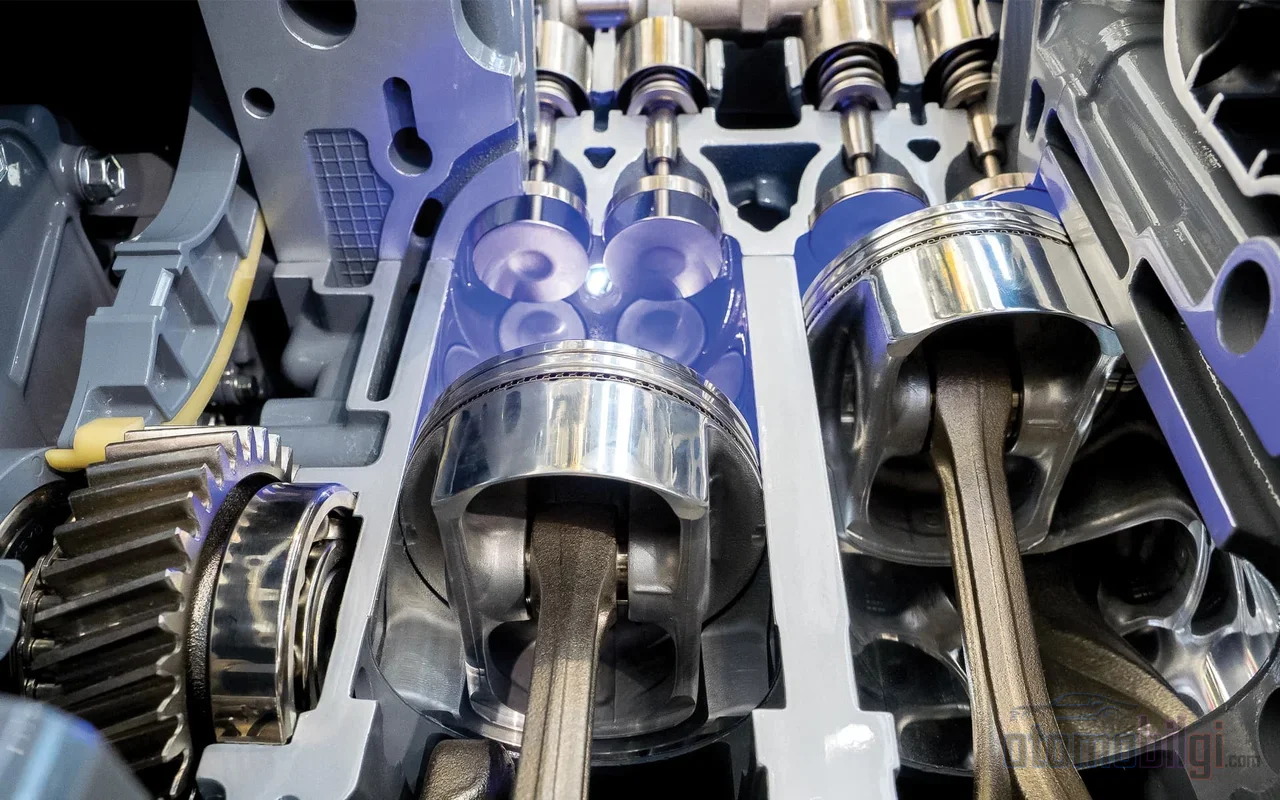
Everything begins with the definition of a "stroke": a stroke is one complete travel of the piston along the cylinder in any direction. When the piston is at its highest position, it is at top dead center (TDC), and when it is at its lowest position, it is at bottom dead center (BDC). The four-stroke cycle spans four strokes between these two points and two complete crankshaft revolutions. The piston's linear motion rotates the crankshaft via the connecting rod; for the entirety of the four strokes, the crankshaft turns 720 degrees.
The role of the valves in this cycle is critical. The intake and exhaust valves are actuated by a camshaft that rotates at half the speed of the crankshaft. This half-speed ratio is not a coincidence but a necessity: since the valve events must be locked to the crank angle, the camshaft follows each cycle at half a crankshaft revolution.
1. Intake: Drawing air in with partial vacuum
When the piston begins to descend from top dead center, the intake valve is open. The piston's descent enlarges the cylinder volume and creates a partial vacuum inside, that is, negative pressure. This pressure difference draws the air-fuel mixture into the cylinder. The intake stroke is the piston's complete descent from TDC to BDC and covers the first 180 degrees of the cycle.
2. Compression: Concentrating energy
At bottom dead center, the intake valve closes and compression begins. Both valves are now closed; the piston rises and compresses the air-fuel mixture into the small volume of the combustion chamber. Compression serves two functions: it causes the fuel vapor to evaporate further and releases more energy upon ignition. The energy spent on compression is only about a quarter of the energy produced by combustion; in other words, the investment pays off.
Measuring the compression ratio is one of the fastest ways to understand an engine's character. In gasoline engines, the common range is 6:1 to 10:1 ; as the ratio increases, efficiency improves, but the risk of the fuel igniting on its own, known as knocking, also rises. This is why a gasoline's octane rating is a measure of its resistance to self-ignition: higher octane allows a higher compression ratio.
3. Power: The only stroke of the cycle that produces work
At the end of the compression stroke, approximately 20 degrees of crank angle before top dead center, the spark plug initiates the spark. Why not exactly at the top? Because the flame front needs time to travel across the combustion chamber; the spark fires in advance so that the pressure peak occurs exactly when the piston is at the top, providing thrust. The burning mixture pushes the piston toward BDC, producing the mechanical work that turns the crankshaft. Throughout the entire cycle, only this stroke produces work; no matter the number of cylinders, every four-stroke engine gets one power stroke per 720 degrees. The secret to the smooth operation of multi-cylinder engines is the merging of these power strokes on the crankshaft.
4. Exhaust: Emptying the combustion chamber
When the piston reaches bottom dead center, the exhaust valve opens, and over the final 180 degrees of the cycle, the piston travels upward, expelling the waste gases through the exhaust port. By the time top dead center is reached, the cylinder is cleared, the intake valve is ready to open again, and the cycle starts anew. Every fill of the cylinder means the re-establishment of the two-revolution cycle.
How Long Does a Stroke Last as Revs Increase?
The answer to the question is found with pure arithmetic. Since one operating cycle lasts two crank revolutions, the engine's speed directly determines the duration of a stroke. As an example, at 1,000 rpm, the engine turns roughly 16.7 revolutions per second; a full cycle takes about 60 milliseconds, meaning a single stroke lasts 15 milliseconds. At 6,000 rpm, there are 100 revolutions per second, and every stroke, including the power stroke, drops to about 2.5 milliseconds. Combustion, valve movement, and gas flow all have to be organized at these scales.
Physics also sets the rev ceiling. Mean piston speed is a function of stroke and revs; in industrial engines, this speed is limited to approximately 10 m/s so that cylinder wall lubrication is not compromised. At high revs, two typical problems come into play: if the valve springs cannot keep up, "valve float" occurs, and piston-valve contact can seriously damage the engine. Additionally, piston ring flutter can lead to a loss of cylinder pressure and power. In short, the limit of how tiny a fraction of a second a stroke can be squeezed into is drawn by material strength and lubrication.
Petrol or Diesel: Same Cycle, Different Ignition
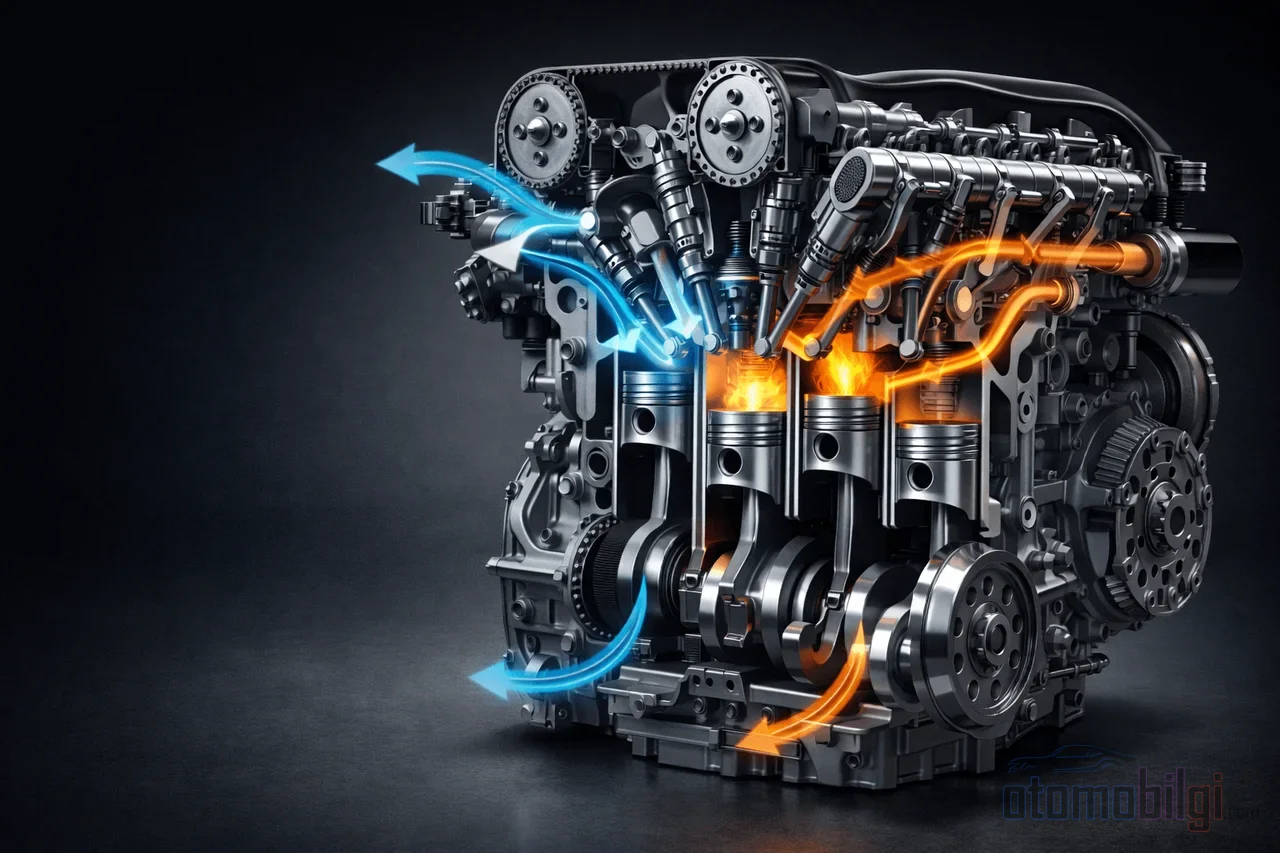
The steps of the four-stroke cycle are the same in both engines; the difference lies in the ignition method that starts the power stroke. A petrol engine is spark-ignition: the spark plug ignites the compressed mixture. A diesel is compression-ignition; the high heat generated by compression self-ignites the diesel fuel, which can ignite under the pressures inside the engine, so no spark plug is needed. Diesel's ignition tendency is defined by its cetane rating, working with a logic exactly opposite to the octane rating in petrol. Due to diesel's low volatility, the most common method of cold starting is the use of glow plugs.
| Feature | Petrol Engine | Diesel Engine |
|---|---|---|
| Ignition | Spark-ignition (spark plugs) | Compression-ignition (compression heat) |
| Cycle | Otto cycle | Diesel cycle |
| Fuel resistance measure | Octane rating | Cetane rating |
| Compression ratio | Typically 6:1 - 10:1 | Compression heat is high, suitable for ignition |
| Rev character | Operates at higher revs | Operates at lower revs; fuel burns more slowly |
The fact that diesel fuel burns more slowly than gasoline explains why diesel engines operate at lower revs; low revs reduce engine wear. Therefore, the character difference between the two engines stems not from the cycle itself, but from the fuel's burn speed.
How Are Modern Technologies Improving These 720 Degrees?
The basic cycle has not changed since 1876; what has changed is how efficiently each 180-degree segment is utilized. Three modern contributions stand out.
Variable valve timing (VVT)
A fixed camshaft optimizes valve events for a single rev band. Variable valve timing, on the other hand, adjusts the timing of the valve lift event in real time according to engine speed, providing optimal power delivery and smoother acceleration. Better management of the air-fuel mixture improves combustion efficiency; under partial load conditions, up to 5% improvement in fuel economy has been measured.
Direct injection (GDI)
In direct injection, used in many of today's four-stroke gasoline engines, the injector nozzle extends into the combustion chamber, and gasoline is sprayed into the cylinder at very high pressure during the compression stroke while the piston is at the top. In other words, the fuel is now delivered not during the intake stroke, but at the most critical segment of the cycle, with millimetric precision.
Turbocharging: Stealing power from the exhaust stroke
A turbocharger is a high-speed, two-part turbine assembly located at the exhaust outlet: one side is fed by exhaust flow, the other compresses intake air. The exhaust stroke carries energy that mostly goes to waste; since the turbo works with this pressure, it operates more efficiently and forces more air into the cylinder, allowing more power to be extracted from each power stroke. In one study of variable turbocharging, output power was improved by 165% compared to a naturally aspirated equivalent. The known limitation of the design is turbo lag: power does not arrive instantly, requiring rev and pressure buildup; at idle and low-to-mid speeds, the engine operates almost as if naturally aspirated.
The Ceiling of Efficiency and a Brief History
An internal combustion engine can convert on average only 40-45% of the supplied energy into mechanical work; the most efficient Otto cycle engines operate at roughly 30% thermal efficiency and the remaining heat is lost through friction and accessories. Moreover, engines can deliberately be built slightly less efficient for emission controls such as the catalytic converter. The Atkinson cycle, on the other hand, achieves efficiency at the expense of power density and is used in modern hybrid applications; many modern engines realize this economy with non-conventional valve timing to produce a short compression and long power stroke effect.
History is instructive too: Otto, while testing the Lenoir engine in 1861, noticed the effect of compression on efficiency; in 1876, Otto and Langen created the first successful internal combustion engine that compressed the fuel mixture before combustion. In 1883, Daimler and Maybach built the first high-speed Otto engine, and in 1885, Daimler produced the world's first internal combustion engine vehicle with the Daimler Reitwagen; in 1886, Karl Benz developed his vehicle with a four-stroke engine, which is considered the first automobile. The diesel engine is a technical refinement of the 1876 Otto cycle: Rudolf Diesel created his successful engine in 1893. Today, the four-stroke design is the most common internal combustion engine architecture of road vehicles, spanning a range from automobiles to trucks, from diesel trains to light aircraft and motorcycles.
Conclusion: 180 Degrees, Four Slices
All the physics of the four-stroke engine can be reduced to four slices divided over a 720-degree turn of the crankshaft: filling by vacuum, compression in a closed volume, combustion that produces work once, and cleaning. Technologies such as valve timing, injection, and turbo all serve the same goal: extracting more efficiency from every millisecond of these slices. Once this foundation is clear, the rest of engine technology, from compression ratio to turbo lag, becomes much more readable.