The VTEC Revolution: How Variable Valve Timing Changed Engine Character
Share This Page
VTEC, the variable valve system Honda brought to production in 1989, which changes the cam profile and valve lift according to engine speed; was the first to solve, in a practical and reliable way, the trade-off of the internal combustion engine being efficient at low revs and powerful at high revs. If a engine's valve timing is fixed, the engineer is forced to make a choice at some point: either low-end torque or high-end power. The real story of VTEC is precisely the history of how this dilemma was broken.
Highlights
- First production VTEC engine: The 1.6-liter B16A inside the 1989 Honda Integra XSi produced 160 hp at 7,600 rpm
- The S2000's F20C engine: 240 hp from 2.0 liters, a 9,000 rpm redline, 120 hp per liter
- The first trace of the idea of variable valve timing goes back to a Cadillac patent filed in 1903
- Today, VVT-based systems have reached roughly 85% market penetration in modern engines
- VTEC-E, with figures of 48/57 mpg in the 1992 Civic VX, became proof of a move into the economy class
Why Is Fixed Valve Timing a Compromise?
In a four-stroke engine, it is the valves that draw the air-fuel mixture into the cylinder and expel the gases after combustion; the timing of their opening and closing is determined by the cam profiles on the camshaft. Here is where the problem lies: These profiles are mechanically fixed, whereas the engine's needs change radically with rpm. Valves that open early and long at low rpm cause exhaust gas to leak back into the intake port and the idle to lose its smoothness.
The reverse applies just as much. An aggressive timing tuned for high rpm produces insufficient cylinder filling and a rough-running engine at low rpm, when piston speed is not enough to sweep the mixture. In Honda's own assessment, four-valve high-revving engines always had to sacrifice low-end torque; a mechanism capable of changing timing, lift, and opening duration according to revs targeted exactly this dilemma. The idea was not new in the 1980s: in the interval from 1880 to the 1989 SAE congress alone, at least 800 variable valve timing patents had been granted. The problem was not the idea, but manufacturing maturity.
How VTEC Works: Three Lobes, One Oil Pin
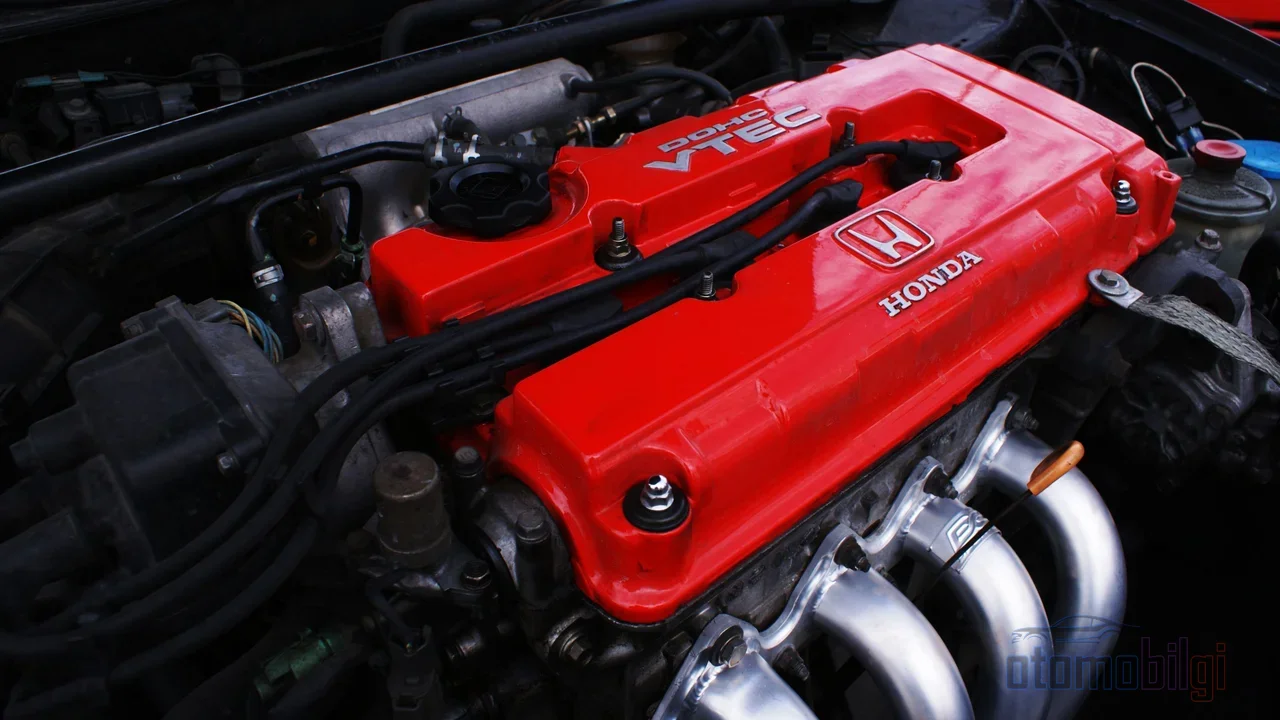
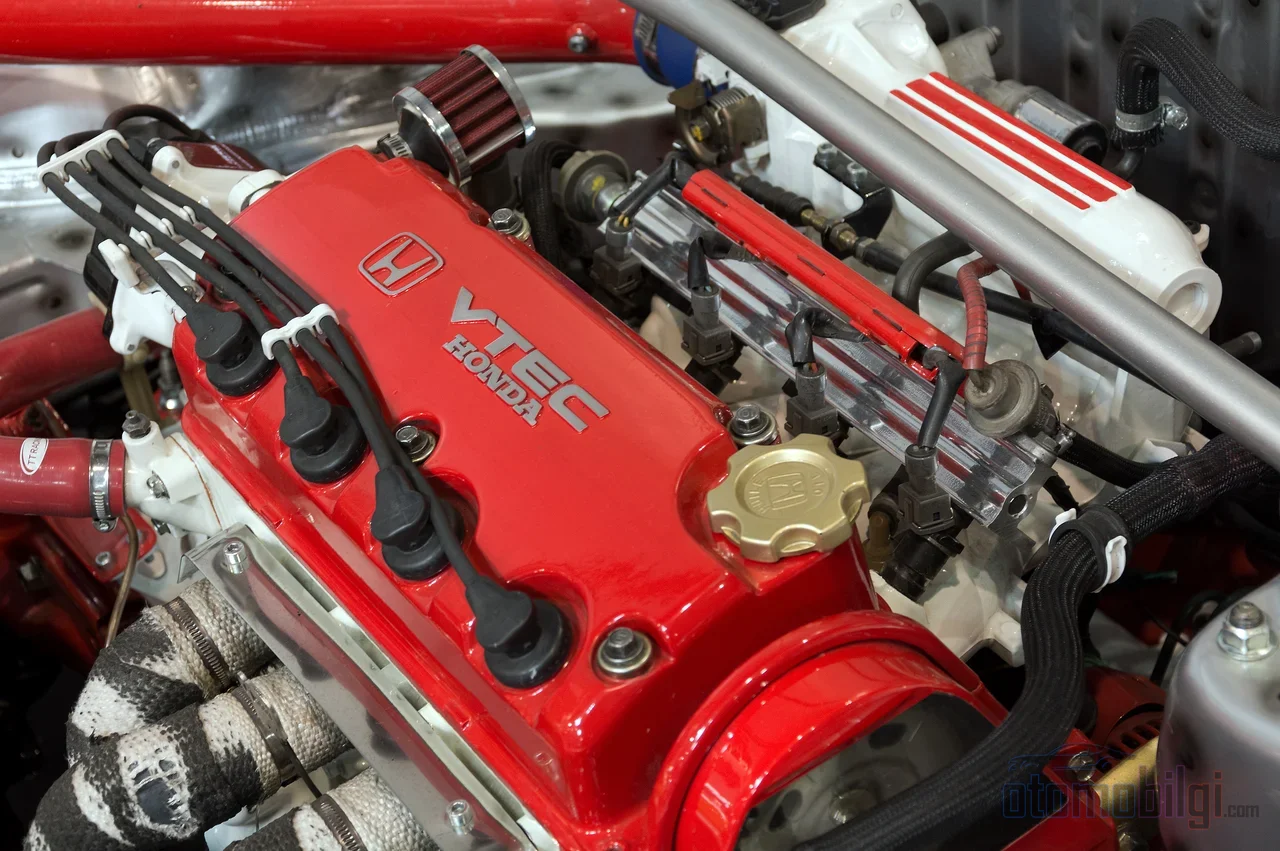
A standard variable valve timing (VVT) system shifts the moment the valves open and close; it does not touch the cam profile or the lift height. VTEC's difference is exactly here: it changes both the timing and the profile. In the DOHC implementation, there are three cam lobes for each pair of valves. The two outer lobes are tuned for low-end torque and smooth idle, while the wide middle lobe is tuned for high-end power.
Up to mid revs, the three rocker arms operate independently and the engine stays calm. The ECU; monitors oil pressure, engine temperature, vehicle and engine speed, and throttle position. When the threshold is crossed, oil pressure through the spool valve pushes a pin, locks the three rocker arms together, and the valves switch to a high-lift, long-duration profile. The transition is not symmetric: following hysteresis logic, the lock disengages at a lower rpm on the way down than the engagement threshold. This prevents the system from oscillating around the threshold. The result can be summarized as economy at low rpm, full performance at high rpm; more than one of the two is indispensable in the same engine.
The Long History of the Idea: What Came Before VTEC?
Honda did not invent VTEC and never made such a claim. What the company positioned it as was the technology's first practical, reliable, and commercially successful application. Its predecessors actually go back over a century: the 1903 Cadillac Runabout, where a variable valve mechanism patent was filed, is counted as the earliest known recorded use. The first manufacturer to patent a functional automotive VVT system that also changed valve lift was Fiat; Giovanni Torazza's development was based on this patent. The first brand to carry VVT in a production car, however, was Alfa Romeo: the patent was granted in 1975, and the system hit the road in the 1980 Alfa Romeo Spider.
Honda's own path did not start with cars, either. The REV (Revolution-Modulated Valve Control) used in the 1983 CBR400 motorcycle tested the idea of switching between cam profiles on a smaller scale, as VTEC's precursor. In 1984, the company launched the New Concept Engine (NCE) program to increase the power and torque of small-displacement engines; the B16A, and therefore production VTEC, is the child of this program. The system, credited to engineer Ikuo Kajitani, went from a laboratory idea to series-production maturity within five years.
1989 and Beyond: Turning-Point Engines
VTEC's commercial debut came with the Honda Integra XSi sold in Japan in 1989. Its DOHC 1.6-liter B16A produced 160 hp at 7,600 rpm from 1.6 liters; the torque figure was announced as 111 lb-ft at 7,000 rpm. The same year, the Civic and CRX 1.6i-VT with the 150 PS B16A1 went on sale in Europe. VTEC only reached the US market in 1991, through the Acura NSX with the C30A 3.0 V6 producing 270 PS.
The following decade was filled with evidence of how far the formula could be pushed. The table below puts the milestones of the era side by side:
| Engine | Displacement | Power | Notable feature |
|---|---|---|---|
| B16A (1989) | 1.6 L | 160 hp @ 7,600 rpm | The first production DOHC VTEC engine |
| H22A1 (1993 Prelude) | 2.2 L | 190 hp | VTEC engagement at 4,800 rpm |
| B16A3 (1994 Del Sol) | 1.6 L | 160 hp | 100 hp/liter without turbocharging |
| B18C (1995 Integra Type R) | 1.8 L | 197 PS | More hp/liter than most supercars of its era |
| F20C (2000 S2000) | 2.0 L | 240 hp | 9,000 rpm redline, 120 hp/liter |
The pinnacle of this series is undoubtedly the F20C engine in the S2000: the ultimate evolution of naturally aspirated DOHC VTEC, with a 9,000 rpm redline and 240 hp extracted from 2.0 liters - 120 hp per liter, approaching racing-technology territory for naturally aspirated engines. In 2004 it gave way to the F22C1; displacement rose to 2.2 liters, power stayed the same, torque increased by 10 lb-ft, and the redline was pulled back to 8,000 rpm. It is also worth noting that the F20C remained exclusive to the S2000 and was never carried over to any other Honda model.
VTEC, VVT-i, or VANOS? Competitor Proliferation Between 1980 and 2000
Honda's solution did not stand alone; the 1990s were the racing decade for variable valve technologies. Toyota VVT-i chose a different philosophy: it keeps the cam profile and changes only the timing of the valves opening and closing according to the engine. In other words, while i-VTEC uses both timing and lift, VVT-i plays only with timing. Although the fuel economy gains of up to 6% and low-to-mid-range torque gains of up to 10% cited in forums remain at the level of claims rather than shared data, the system's basic logic is just this: continuous phase shifting provides a constant and smooth improvement.
BMW VANOS belongs to the same family; it changes timing by moving the camshaft forward and backward. Mitsubishi MIVEC and Toyota's later VVTL-i system are closer to VTEC: they switch between two cam lobes. VTEC's three-lobe arrangement stands apart in this respect. A general distinction is enough to read it correctly: while VVT was born out of the need for emissions control, variable valve lift (VVL) mostly targets high-rpm power. Which philosophy is superior is still debated today; the common assessment is that Honda's approach works better but is more complex and costly, while phase-shifting systems win overall thanks to their simplicity.
From the Track to the Milestone: Descending into the Economy Class
VTEC's smartest move was the inversion of the high-rpm legend. Introduced in the 1992 Civic VX, VTEC-E ran the 16-valve 1.5-liter SOHC engine in 12-valve mode below 2,500 rpm, keeping one intake valve mostly closed to create swirl and stratified charge. The result was 48 mpg city / 57 mpg highway on the EPA measurement; that is, better economy with 30 hp more power than the lighter 1991 CRX HF.
That same year, the D16Z6 engine in the Civic Si/EX raised power from 108 to 125 hp thanks to VTEC and cut consumption from 28/32 to 29/36 mpg. The D16Y5 in the Civic HX reached 115 hp from 90 and 39/45 mpg with the 5-speed manual transmission. Power and efficiency were no longer each other's price; these three examples are the clearest data documenting the technology's transition from supercar toy to standard equipment in economy-class engines.
i-VTEC, VCM, and VTEC Turbo: The Line Extending into Modern Engine Design
In the early 2000s, i-VTEC combined VTEC with VTC (Variable Timing Control) under computer integration; its debut was the 2002 Acura RSX Type S with the K20A2 engine producing 200 hp. In Honda's V6s, VCM (Variable Cylinder Management) came into play: With the 2005 Odyssey, cylinder deactivation was seen in its 2008-2012 Accord form with three modes as a unique application.
After 2016, the picture changed completely. The Civic's 1.5-liter L15B7 turbo engine and the 306-hp K20C1 in the 2017 Civic Type R combined VTEC + VTC + turbo in a single engine for the first time. In the company's own framing, the turbo was no longer an alternative but had become a complement to VTEC. This was the result of a broader industry trend: VVT-based systems reached approximately 85% market penetration in modern engines and became optimizable in combination with direct injection. Variable valve strategies can deliver fuel economy improvements of up to 5% under partial load conditions; the trio of VVT, turbo, and direct injection carries the potential for gains in consumption, emissions, and performance all at once compared to engines of similar displacement. This is precisely the technology stack behind smaller engines producing higher power and torque - that is, downsizing. Honda's assessment points in the same direction: VTEC today plays a key role in meeting strict emissions and fuel economy standards. The overall efficiency curve in the EPA's 2025 Automotive Trends report published in February 2026 shows the magnitude of the collective effect of these technologies; a 9.0 mpg fuel economy improvement was reported in the car SUV class compared to model year 2023.
Conclusion: The Legacy of a Mechanism
The history of VTEC is the story not of a single engine part but of an engineering reflex: refusing the trade-off imposed by a fixed design and changing the mechanism itself. The journey from a patent in 1903, to a Spider in 1980, to an Integra in 1989; then VVT-i, VANOS, and MIVEC following in its footsteps; and finally 85% market penetration and turbo-injection integration are all links in the same chain. Today, in nearly every gasoline engine under the same hood, an echo of that 1989 moment can be heard: if an engine's character can change as revs rise, it owes this to the first mass-produced idea that made it possible.
Sources
- VTEC® - Honda Newsroom
- The VTEC Engine / 1989 - Honda Global Heritage
- VTEC - Wikipedia
- Variable valve timing - Wikipedia
- How VTEC Changed the World - Road & Track
- Pondering Variable Valve Timing - Snap-on
- VTEC vs VVT-i - Diffen
- V-TEC Vs Vanos Vs VVT-i: How Do They All Work? - Car Throttle
- Variable valve timing for fuel economy improvement - ScienceDirect
- Comparing GDI Engines with VVT Systems - PatSnap Eureka
- The 2025 EPA Automotive Trends Report - EPA
- Honda F20C engine - Wikipedia