What Happened Before Benz's Engine?
Share This Page
Karl Benz's 1886 Patent-Motorwagen went down in history as the birth of the automobile; but the road to that legendary engine is a story of pure determination and experimentation. Without de Rivaz's hydrogen vehicle in 1806, Samuel Brown's hill climb in 1826, Lenoir's Hippomobile and Otto's four-stroke cycle, Benz's gasoline engine would never have existed. Here is the story of that chain from beginning to end.
Highlights
- January 30, 1807: François Isaac de Rivaz introduced the first vehicle powered by hydrogen with patent number 731 in Paris.
- May 27, 1826: Samuel Brown's gas engine climbed Shooter's Hill uphill in London.
- 1867: Otto and Langen's atmospheric engine won an award at the Paris World's Fair.
- 1876: Nicolaus Otto laid the foundation of the modern automobile engine with his four-stroke engine that compressed the fuel.
- January 29, 1886: Benz received the patent for his vehicle powered by a gas engine.
How Did the Idea of Pushing the Piston with Explosion Come About?
Steam engines were everywhere at the beginning of the 19th century: they powered factories, ships, and even the first road vehicles. But there was a problem - the steam boiler was heavy and took hours to heat up. What if the fuel burned inside the cylinder rather than outside in the boiler? This is exactly where the idea of the internal combustion engine was born. In other words, moving the fire into the engine itself is like placing the stove under the pot instead of putting the pot on the stove.
The first person to seriously realize this idea was the artillery officer François Isaac de Rivaz. For someone coming from the world of weapons and gunpowder, thinking that an explosion could push a piston was not difficult at all; that is how a cannon works anyway. He mounted the engine he had been working on since 1804 onto a vehicle in 1807, and history's first internal combustion engine vehicle traveled a short distance.
Hydrogen in a Balloon, Ignition in a Volta Pile
De Rivaz's engine contained incredibly modern concepts by today's standards: hydrogen as fuel, an electric spark for ignition. The hydrogen-oxygen mixture was stored in a balloon, the Volta pile produced the spark, and the piston shot upward. What followed was mechanically laborious: the valves had to be opened and closed by hand, there was no timing mechanism. The piston, once lowered, turned the wheels through a crank and ratchet system.
This Swiss inventor of French origin, on January 30, 1807, in Paris, received his patent number 731 ; he also had it registered in the canton of Valais. He continued developing it like an obsessive engineer and in 1813 produced a massive machine: six meters long, with wheels two meters in diameter, weighing approximately one ton . In Vevey, it traveled 26 meters on a road with a 9% incline carrying a 300-kilogram load and a group of four passengers - its speed was 3 km/h . It advanced only 4-6 meters with each stroke; one cannot help but say that getting up and walking would have been faster.
Worse still, no one took him seriously. The scientific circles of the era argued that the internal combustion engine could never surpass the steam engine. History would prove the right one, but it would take half a century. One note: in the same year, 1807, the Niépce brothers patented the Pyreolophore, capable of powering a boat with a water jet - which design was truly the first is still debated today.
Samuel Brown and Defiance of the Hill: The Gas Engine of 1826
The next step came from England. Engineer Samuel Brown received a patent for an internal combustion engine on December 4, 1823. His approach was different from Rivaz's: he adapted an old Newcomen steam engine to burn gas. His engine ran on hydrogen and used separate combustion chambers; it was, in a sense, a gas-vacuum type design that relied on vacuum.
Brown's demonstration was one of the boldest marketing stunts in engine history. On May 27, 1826, he mounted the engine on a wagon and drove it up Shooter's Hill in London. Although it may seem like nothing more than photographing a car today and stopping it at the top, it was a performance with no equal at the time. Still, Brown's vehicle does not count as a practical automobile - it was a demonstration, a proof of concept. But the proof was complete: when combustion happened inside the cylinder, the vehicle could truly move.
Étienne Lenoir: The First Commercial Success and the Hippomobile
From this point on, things get serious. Belgian-French engineer Étienne Lenoir created the first internal combustion engine to achieve commercial success, with the engine he developed between 1858 and 1860. It was a two-stroke gas engine without compression, ignited by a spark plug, and 1860 became the year Lenoir's engine was recognized as the first internal combustion engine. There was real demand for these engines in Paris; around 143 engines were sold by 1865, and some estimates raise the total number sold, including non-vehicle engines, to 350-400 - the reason for the difference lies in what is being counted: vehicle engines only, or all Lenoir gas engines.
But what wrote Lenoir into history was not so much the engine as the vehicle that rode on it. In 1863 he introduced the Hippomobile: a three-wheeled vehicle carrying its own engine. Its engine was single-cylinder, 2543 cc in displacement and only 1.5 hp in power. In the first version, the fuel was hydrogen produced by the electrolysis of water; later it switched to a petroleum-derived fuel, and a primitive carburetor was added. It is even considered by some, controversially or not, to be the first automobile. Meanwhile, the fuel change is an interesting irony: the idea of the first hydrogen vehicle dates back to 1806, Lenoir later turned to gasoline fuel, and today hydrogen engines are being discussed again - history sometimes comes full circle.
The problem, however, was clear from the start: the Lenoir engine was inefficient. Without compression, most of the fuel went to waste, squandering nearly half. Think of it this way: the idea of internal ignition was right, but the mixture must be compressed before ignition - otherwise the explosion remains weak. The person who would cross this threshold had already started working on the other side, in Cologne.
Otto and Langen: The Efficiency Revolution and the Four-Stroke Cycle
In 1864, Nicolaus Otto and Eugen Langen founded N. A. Otto & Co. in Cologne, the world's first internal combustion engine company. Three years later, in 1867, they introduced their free-piston atmospheric engine. The working principle of this engine was quite clever: combustion launched the piston upward, and as the piston came back down under vacuum effect, it did work. It won the grand prize at the 1867 World Exhibition in Paris and earned the title of the most efficient gas engine to date. It was also the first engine to successfully enter mass production - one of its ~0.5 hp versions still runs today, which is an engineering triumph in itself.
But Otto had a bigger idea in mind. He had built his first engine in 1861 and by the end of that year had arrived at the concept of the four-stroke cycle. In 1876, he finally realized the first internal combustion engine that compressed fuel - the Otto cycle, which still bears his name today. What's the difference? Compressing the mixture multiplies the power of the explosion. A simple analogy: it's like inflating a balloon all the way and popping it instead of just inflating it slightly. In the first tests, the engine broke down after a few minutes and the Otto-Langen partnership dissolved, but the idea had taken hold. The old non-compression designs were quickly abandoned; the inefficiency problem that had persisted since Lenoir had been solved.
Delamare-Deboutteville: Early Attempts That Moved on Four Wheels
After 1876, it was time to properly mount this engine into a vehicle. Frenchman Édouard Delamare-Deboutteville, studying the work of Lenoir and Otto, built his first four-stroke internal combustion engine in 1881. In 1883, together with Léon Malandin, he developed a combustion engine based on Otto's four-stroke engine, and that same year designed a gasoline-powered vehicle with an internal combustion engine.
Things didn't always go smoothly: on the first attempt, the car split in two - yes, literally. But in France, this duo is credited today as the inventors of the first four-wheeled automobile. This shows how nuanced the debates over pioneering are: there are serious differences between having a name and a patent and actually bringing something to light in a usable form.
Benz's Final Step Extending to the Patent: 1886
Karl Benz's story actually begins seven years before 1886. His first stationary gasoline engine was a single-cylinder two-stroke engine, and it ran for the first time on New Year's Eve 1879 . As for how the gasoline idea was born, the story is so everyday it's perfect: when Benz saw a bowl of benzene ignite from a spark while cleaning gloves, he thought this volatile liquid could be used as fuel. So a kitchen accident discovered the fuel that started the automobile age.
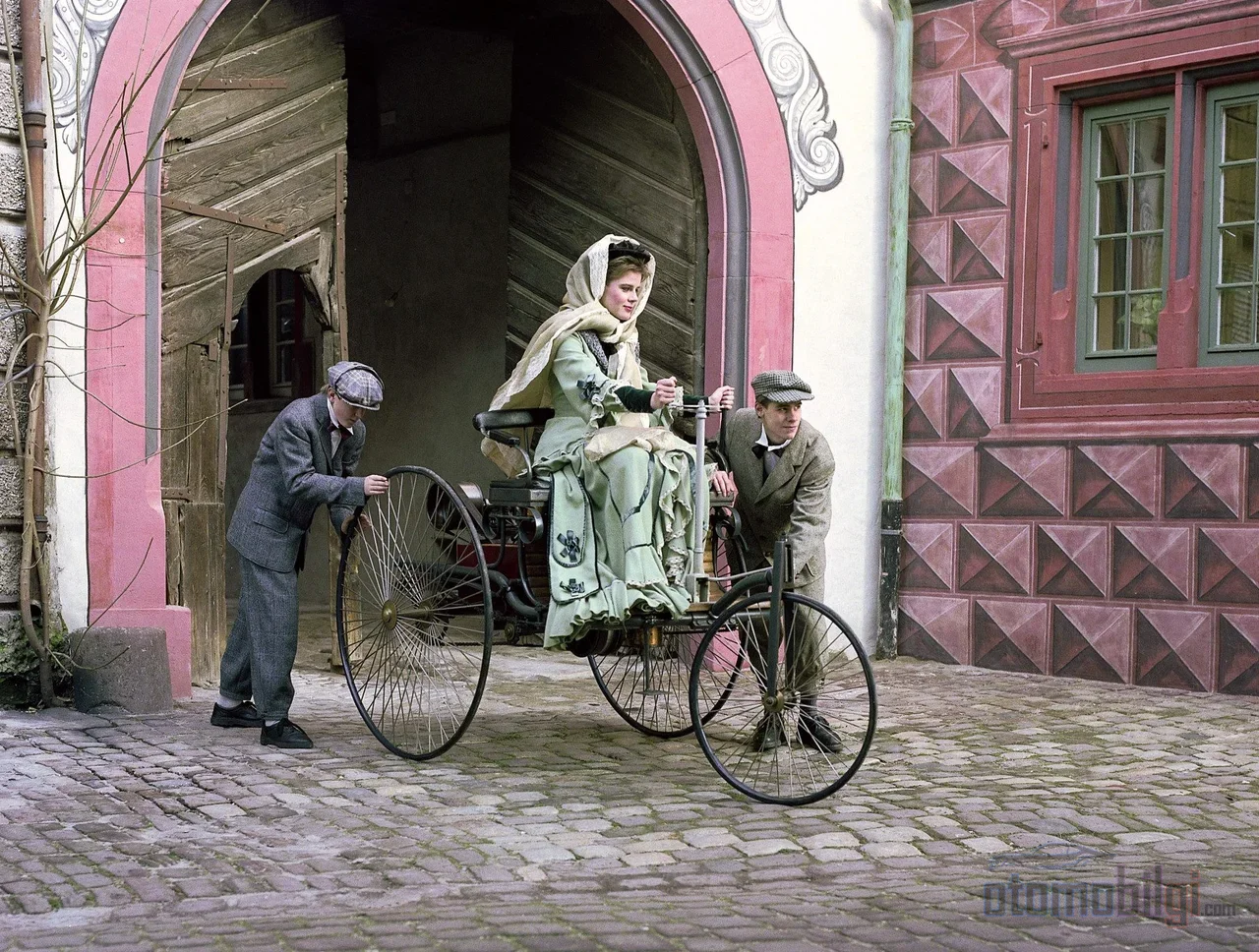
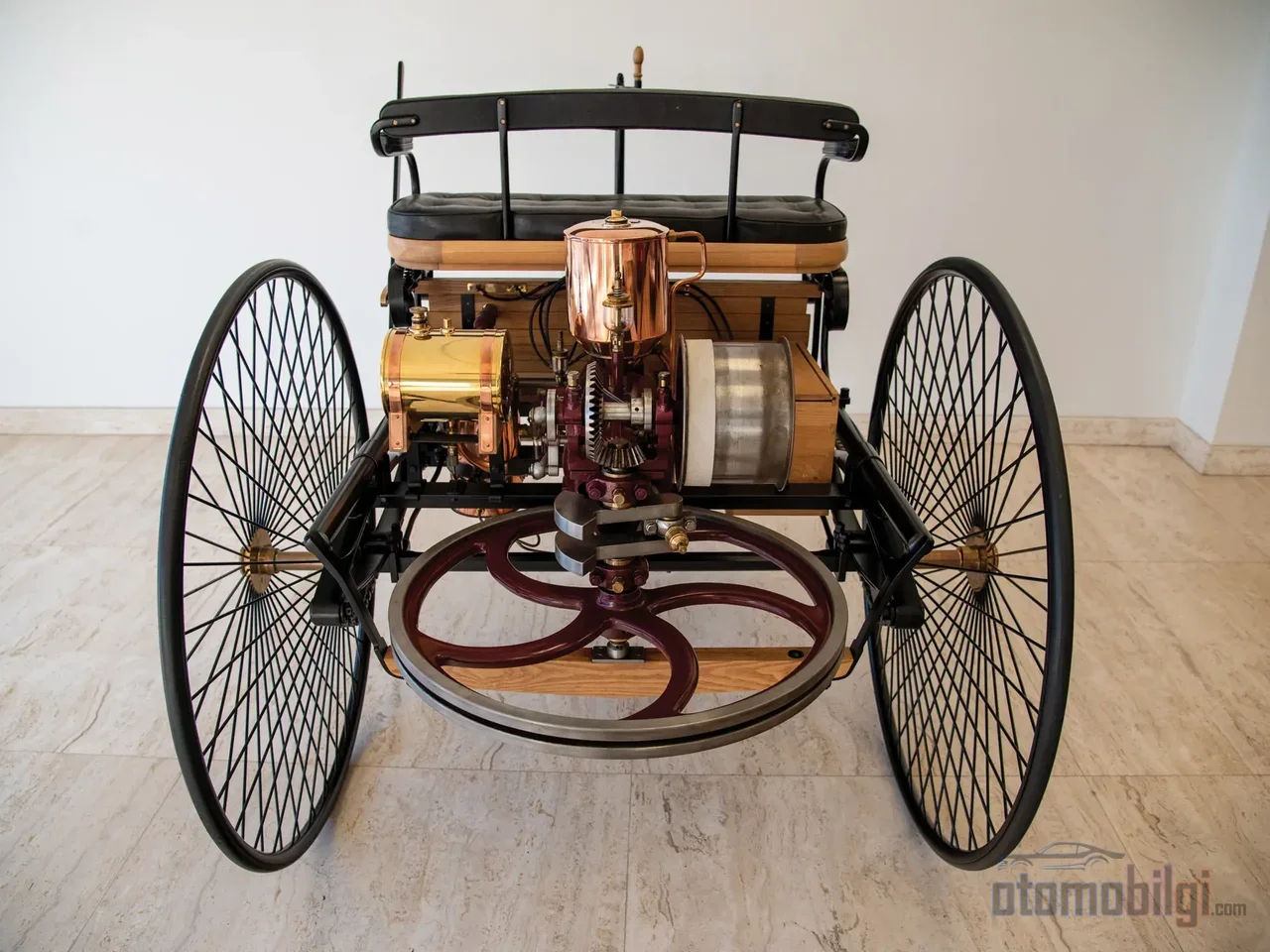
A patent application was filed and granted for a vehicle powered by a gas engine, the Benz Patent-Motorwagen , on January 29, 1886. The single-cylinder four-stroke gasoline engine produces approximately 0.55 kW (0.75 hp), with a top speed of 16 km/h km/h. Compared to de Rivaz's 3 km/h, that was revolutionary, though it still fails to impress by today's standards; the real point was not speed but the combination. A lightweight chassis, a powerful yet small engine, and petroleum-based fuel - with the engine's output balanced by the flywheel. All of this came together and, for the first time, a usable automobile was born. Most historians regard this patent as the birth of the automobile. Shortly afterwards, Gottlieb Daimler also joined the scene; many consider him the first person to create a practical internal combustion engine, and in 1889 he took the road one step further by inventing his V-type two-cylinder four-stroke engine.
Looking at the Whole Chain, What Do We See?
| Inventor | Year | Contribution |
|---|---|---|
| François Isaac de Rivaz | 1806-1807 | First internal combustion engine vehicle running on hydrogen |
| Samuel Brown | 1823-1826 | Gas-vacuum engine, the Shooter's Hill climb |
| Étienne Lenoir | 1860-1863 | First commercial engine and the Hippomobile |
| Otto and Langen | 1867 | Atmospheric engine, first mass production |
| Nicolaus Otto | 1876 | Compression four-stroke cycle |
| Delamare-Deboutteville and Malandin | 1883 | Experiments with Otto-based engine vehicles |
| Karl Benz | 1886 | Patent-Motorwagen, the birth of the automobile |
Each name carried a burden: de Rivaz brought fire into the cylinder, Brown proved it could move, Lenoir demonstrated a sellable engine, Otto solved efficiency, Delamare-Deboutteville moved to four wheels, and Benz brought them all together in a single vehicle. Each would have failed without the others - even though the patent bears the name of one inventor, that engine was in fact the product of eighty years of collective effort.
So the next time you turn your car key and hear the engine start, pause for a second and think: that sound is the final link in a very long story that began in 1807 with a hydrogen balloon. Which step in this chain did you find the boldest? My favorite is Benz pulling his gasoline fuel idea out of a bowl of benzene accident - but de Rivaz's hydrogen vehicle, which received no serious attention, also deserves credit.
Sources
- De Rivaz engine
- Samuel Brown (engineer)
- Samuel Brown (of Brompton)
- First Auto | The Engines of Our Ingenuity - University of Houston
- Hippomobile
- Étienne Lenoir
- Birth of an idea: Etienne Lenoir and the internal combustion engine
- Otto engine
- Otto-Langen Atmospheric Engine
- Otto (1832) - Energy Kids
- Forerunners to the automobile
- Delamare-Deboutteville
- Benz Patent Motor Car
- 1886 Benz Patent Motorwagen Replica
- Benz Patent-Motorwagen
- The History of the Automobile - Gas Engines