Did the First Car Accident Happen by Crashing into a Wall?
Share This Page
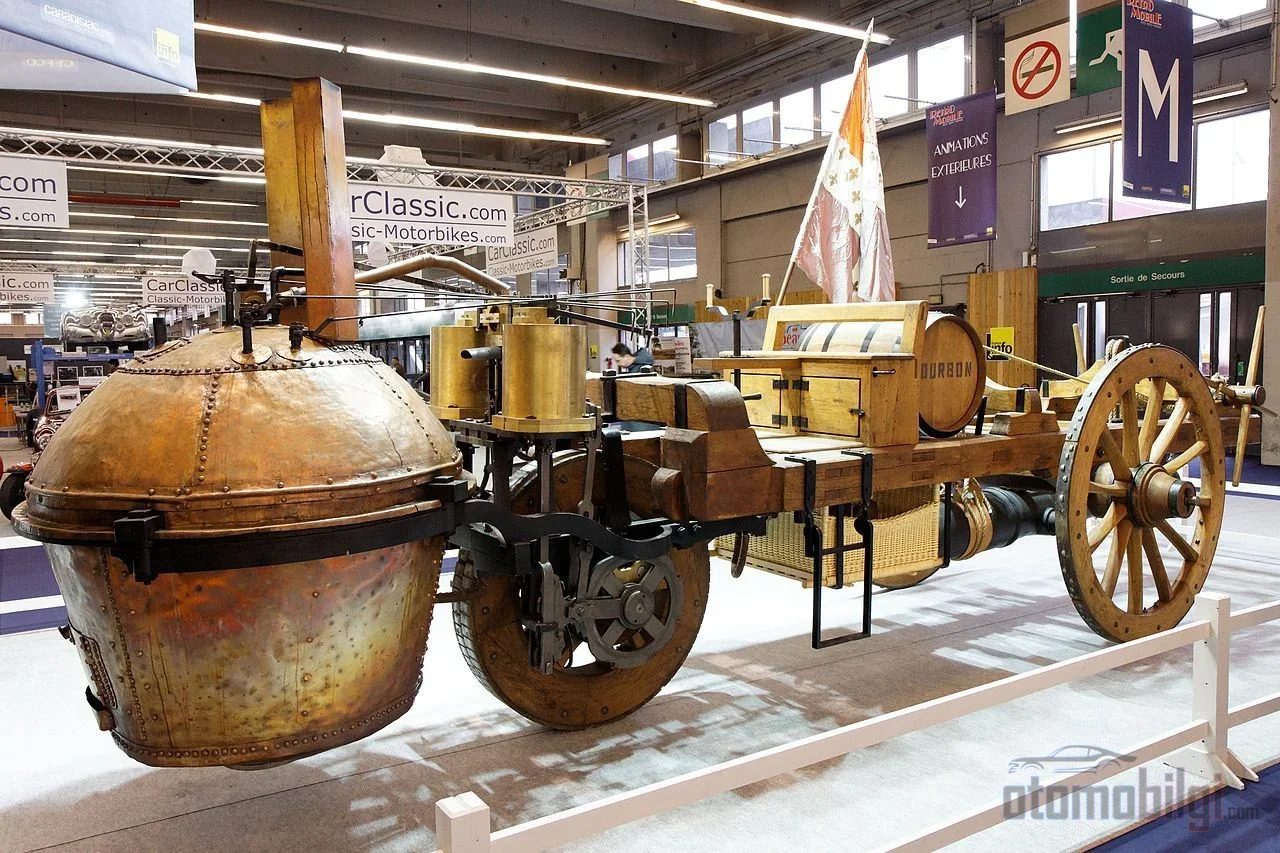
According to the story, the world's first known car accident occurred in 1771 when Nicolas-Joseph Cugnot's steam vehicle knocked down a garden or arsenal wall in Paris. So the automobile entered history for the first time with a crash scene. But there is something odd about this story: the incident appears in no records of the period, and it was first written down exactly 33 years later . So did it really crash into a wall, or is it history's most famous rumor?
Highlights
- Fardier à vapeur, with an unladen weight of approximately 2.5 tons, rises to 2.8 tons when loaded.
- The 62-liter (62,000 cc) two-cylinder steam engine produces 12 hp and 112 Nm .
- Its speed is approximately 3.6 km/h - slightly behind a walking human.
- The boiler has to stop every 10-15 minutes to build up pressure again.
- The original vehicle is on display today at the Conservatoire National des Arts et Métiers in Paris.
Cugnot and That Steam Monster Meant to Carry Cannons
Nicolas-Joseph Cugnot was born on February 26, 1725 in the town of Void-Vacon in Lorraine and passed away on October 2, 1804 in Paris. His profession was military engineering - and that is exactly why his invention came out of the artillery field. The French Army's problem was simple: transporting heavy cannon barrels with draft animals was slow, laborious and chaotic. Cugnot came up with a crazy idea: why not replace the horses with steam?
The "Fardier" was actually a large, two-wheeled horse-drawn cart used for carrying heavy equipment. Cugnot put a third wheel where the horses stood and replaced them with a steam engine. He began experiments with small models in 1765, ran a scaled-down fardier version in 1769, and completed the full-size version in 1770. So the year 1769, which is often cited as the birth date of the automobile, comes from this point.
The most striking detail here was this: Cugnot had to design the first steam engine that drove the piston with steam above atmospheric pressure. His two-cylinder engine had a four-way valve managing the steam, a rotary valve, and a crank mechanism converting the piston's linear motion into rotary motion. For the 18th century, these were serious engineering pinnacles - you can think of it as the distant grandfather of today's engine block.
2.5 Tons, 12 Horsepower: What Kind of Vehicle Was It Technically?
I am sure you will hold your head with both hands while reading the Fardier's technical specifications. You know how we call it a "giant engine" when a sports car's displacement exceeds 3 liters today? Sit at the helm of Cugnot's boiler: 62,000 cc. And the power coming out of this enormous volume? Just 12 horsepower and 112 Nm of torque. A comparison from daily life: it is as if you connected bicycle pedals to a freight truck's engine.
| Feature | Value |
|---|---|
| Engine | 62-liter two-cylinder steam engine |
| Power and torque | 12 hp / 112 Nm |
| Layout | Front engine, front-wheel drive |
| Weight | ~2.5 t unladen, ~2.8 t laden |
| Dimensions | Width 2.19 m, height 7.25 m |
| Passengers | 4 people |
| Practical speed | ~3.6 km/h |
| Goal | 7.8 km per hour, 4-ton load |
Do you spot any key detail in this table? The vehicle's drivetrain and steam boiler were on the front wheel. In other words, history's first automobile was also the first front-wheel-drive automobile - but due to its terrible weight distribution, it was incredibly unstable. What's more, the shortcomings of the body weren't limited to that: the boiler was inefficient, poorly insulated, had no safety valve, and the steering and brakes were extremely primitive (the brake was a wooden block pressed against the wheel!). So it was very heavy, unstable, and had a wooden brake. Does that sound like an accident scenario? That's exactly why this story is found so believable.
That Famous Wall Story: Is History's First Car Accident Real?
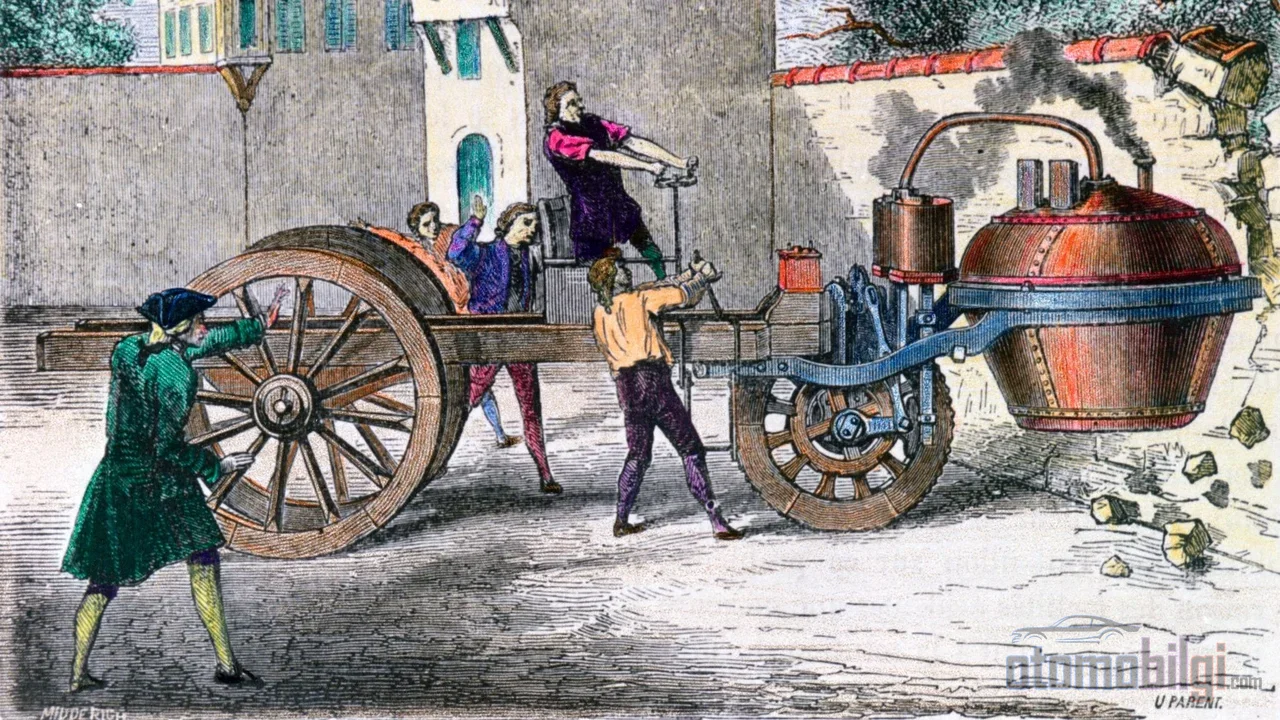
Now we move on to the main course. According to the narrative, in 1771 Cugnot's second prototype went out of control and knocked down a garden wall in Paris - in another version, the brick/stone wall of the Paris Arsenal. This is probably regarded as the first known car accident. A 19th-century engraving depicting the scene is also quite famous: it shows the men fleeing the vehicle that had crashed into the wall, so to speak. If it had gone viral on that era's Facebook, the headline would definitely have been: "The world's first car crashed into a wall on its very first trip!"
But hold on, there's a big question mark here. This event does not appear in any record of the period. It first appeared in written sources in 1804, exactly 33 years after the alleged accident . Likewise, the story that "Cugnot was arrested and convicted for dangerous driving" is widespread, but it too is mentioned only with the caveat "if true." So we have two possibilities: Either there really was an accident and no one thought to write anything down that day, or it was later added to the narrative as a very convincing legend. Honestly, either one suits automotive history quite well, doesn't it?
There's also the fact that the "first" title itself is contested. As the oldest self-propelled vehicle, sometimes a vehicle designed in 1672 by Ferdinand Verbiest at the Jesuit mission in China is put forward. But that vehicle was too small to carry a driver, and perhaps it was never built, perhaps it never ran. Cugnot's difference is this: his vehicle was actually built and actually worked. That's why the title of "first full-size, working mechanical land vehicle" stays with his name.
Why Did the Car Fail, and Why Was the Project Shelved?
The Fardier's greatest enemy was, oddly enough, not the wall but steam pressure. The vehicle's boiler performance was weak even by the standards of the time: the fire had to be relit and steam pressure built up again, so it had to stop every 10-15 minutes . There was also no effective way to refill the boiler quickly. Imagine: today you go to the gas station and fill the tank in 2 minutes; Cugnot, on the other hand, entered into a fire-lighting ritual at every short stop.
Still, there were promising moments. In an important trial conducted in November 1770, the vehicle carried a load of about 4.8 km's distance covered in one hour. Although far below the target, it showed that a self-propelled vehicle was not an empty dream.
But what came after was sad. After a few attempts, the project was abandoned, and thus the French Army's first experience with a mechanical vehicle came to a close. Following the accident, the program was shelved due to a lack of funding in 1771. On top of that came a political storm: one of Cugnot's patrons died, and when the other was sent into exile, funding for the road vehicle experiments dried up completely. The steam vehicle narrowly escaped destruction twice during the French Revolution.
Cugnot's own fate was also a bitter one. In 1772, King Louis XV granted him an annual 600 livres pension; the vehicle was kept in an arsenal and in 1800 was transferred to the Conservatoire National des Arts et Métiers in Paris, where it is still on display today. But in 1789, his pension was cut, and he was forced to go into exile in Brussels. Shortly before his death, he returned to Paris with the pension that had been restored by Bonaparte, and passed away in 1804. So the man regarded as the father of the automobile left this life without ever seeing how great his invention would become.
Red Flag Act: The Laws That Held Back Mechanical Vehicles for Years
Cugnot's story alone is enough to explain why the automobile was so delayed, but there is also a separate tragedy in England. The 1865 Locomotives Act - popularly known as the "Red Flag Act" - imposed speed limits on road locomotives of 2 mph in towns and 4 mph in the countryside, and increased the crew to three people. In some accounts, one of these three people is described as the man walking ahead with a red flag. In other words, a person runs in front of a vehicle moving at a human walking pace - absurd by today's standards, but it shows the magnitude of the fear of mechanical vehicles at the time.
It is believed that these restrictive regulations severely stifled the development of the British motor industry; so much so that these laws ended Britain's chance of becoming the world leader in automobile development. To sum up, the reason for the automobile's delay was not only a lack of technology; it was also bureaucracy, fear, and social resistance. Finally, the 1896 Locomotives on Highways Act became the legislation that allowed the United Kingdom's automotive industry to develop - but no one could bring back the lost years.
From Cugnot to Benz: A Long Wait of 116 Years
The time gap between Cugnot's vehicle and the true automobile is astonishing: approximately 116 years. On January 29, 1886, Carl Benz received the patent for the Motorwagen- Benz had built the first internal combustion engine-powered gasoline car in 1885. That same year, Gottlieb Daimler also developed his own motorized vehicle. In 1926, Benz & Cie. (founded by Carl Benz in 1883) and Daimler merged to form Daimler-Benz, that is, Mercedes-Benz; today it is the world's oldest automobile manufacturer. And toward the 1900s, the Ford Model T became the first truly mass-produced automobile accessible to the general public.
So there is a gap of more than a century between Cugnot's wall story and Benz's patent. In that gap, steam evolved into internal combustion, and the horse-drawn fardier evolved into the modern passenger car. But the seed of it all was planted in that 2.5-ton, unstable, wooden-braked monster.
Restarted in 2010: What Do the Replicas Tell Us?
The sweetest part of the story is this: Cugnot's idea is not dead. In 2010 - fully 241 years later - ParisTech students, in cooperation with the municipality of Void-Vacon, Cugnot's hometown, built a copy of the fardier. The replica worked flawlessly and proved that the trials of 1769 showed the concept really worked. It was exhibited at the 2010 Paris Motor Show, then returned to Void-Vacon.
That same year, the Tampa Bay Automobile Museum also completed a fully functional, faithful replica from scratch, and Cugnot's Fardier was started up for the first time in more than 200 years. This replica is faithful to the original "down to every detail, down to its bolts"; its construction used General de Gribeauval's original specifications, a cruder replica made in Germany in 1935 for a steam documentary, and a modern tubular boiler design (this time with a safety valve added, at least!). So yes, Cugnot's vehicle really did work - even 241 years later. Which raises the real question: If funding and support had continued back then, would the automobile have been born much earlier?
Did It Hit the Wall or Not? Closing Thoughts
My take is this: It is hard to prove whether the crash actually happened, but the reason the story has stuck so well is very clear - the Fardier was a prime candidate for a crash. With its unstable body, wooden brake, steam that faded every 10-15 minutes, and its raging 62-liter displacement, whether it would have hit a wall is anyone's guess... Maybe it really did happen and no one wrote it down; or maybe it never happened at all, but people believed that image so strongly that history was written 33 years later with an engraving.
What's truly striking is this: whether the accident was real or legend, Cugnot's steam vehicle is the best summary of the automobile's adventurous and belated birth. The first car wasn't perfect, it was even dangerous. But it worked. And because it worked, it could become the first stepping stone on the road leading to today's cars. Do you think this story is real? Does a vehicle that crashed into a wall deserve to be one of history's most beloved tales? I think yes - because every great invention begins by crashing into a wall.
Sources
- Nicolas-Joseph Cugnot
- Preview the Archive! | Tampa Bay Automobile Museum - 1770 Fardier De Cugnot
- Cugnot's Steam-Powered Road Carriage | EBSCO Research Starters
- Cugnot fardier à vapeur replica - Octane Magazine
- Locomotive Acts
- The day the automobile was set free - The Times
- Cugnot's Fardier - ETHW
- Replica Fardier de Cugnot in Pinellas Park - Atlas Obscura
- The predecessor companies (1886-1920) - Mercedes-Benz Group
- Car History Timeline - History.com