From Benz to Otto: The Fateful Century of the Internal Combustion Engine
Share This Page
The history of the internal combustion engine effectively begins in 1876 with Nikolaus Otto's compression four-stroke engine; it was transformed into the automobile by Karl Benz's Patent-Motorwagen in 1886, and the century that followed was an engineering race running through cylinder architecture, efficiency crises, and side paths like turbo and diesel. This article follows that century with an archive-based chronological narrative.
Highlights
- The patent for the four-stroke cycle was obtained by Alphonse Beau de Rochas in 1862; the first practical engine was built by Otto in 1876.
- The first automobile patent: January 29, 1886, Benz Patent-Motorwagen, patent number 37435.
- With the revocation of Otto's patent, in 1889 more than 50 companies were producing the same design.
- Diesel's market share in Europe was 52% in 2015 but fell to 18% by 2023.
- The BMW 2002 Turbo became Europe's first mass-produced turbo car, two years before the Porsche 911 Turbo.
From Lenoir to Otto: Why Was the Four-Stroke Engine Revolutionary?
The starting point of the narrative is actually not Otto, but the best solution before him. In 1860, Étienne Lenoir had produced a double-acting internal combustion engine running on lighting gas; but the machine was both large and inefficient: From a 18-liter displacement, only 2 hp (approximately 1.5 kW) was obtained, and three-quarters of the fuel was wasted. Nikolaus Otto, a traveling salesman, learned of this engine through a newspaper advertisement and tested a copy of it in 1861. What the test taught him was simple but decisive: compressing the fuel mixture before combustion was the key to efficiency. His first compression attempt in 1862 failed because the engine was destroyed within a few minutes; but the idea was right.
The most ironic patent episode in automotive history takes place exactly here. The four-stroke cycle - intake, compression, power, and exhaust; four piston strokes over two engine revolutions - was patented in 1862 by the French engineer Alphonse Beau de Rochas, but he never built the machine. Since Otto was the first to build the engine, the cycle today bears his name. Otto, together with his son and Eugen Langen, opened the path step by step through NA Otto & Cie, the world's first internal combustion engine company founded in 1864: at the 1867 Paris World's Fair, their atmospheric engine won a gold medal; this machine consumed less than half the gas of competing gas engines, delivering 12% efficiency and 0.5 hp. The company moved to Deutz in 1869 and took the name Gasmotoren-Fabrik Deutz - today's Deutz AG is the world's oldest engine manufacturer.
The real leap came after 14 years of R&D: on May 9, 1876, Otto created the four-stroke engine operating on the compression charge principle. With the method he called stratified charge, which made combustion controllable, this design reached commercial maturity that same autumn as the Rings-Schumm engine and became the first commercially successful machine to use in-cylinder compression. Thanks to its reliability, efficiency, and relatively quiet operation, more than 30,000 Otto cycle engines were produced over the following 10 years. The technical leap revealed by the figure is clear: the move to compression raised efficiency from 5% to 15% in the 1880-1890 period; a threefold improvement compared to the steam era's engines delivering less than 5%. The spark-ignition four-stroke cycle still powers most of the cars on the road today.
The legal end of the story is also instructive. In 1886, Otto's patent was invalidated with the emergence of Beau de Rochas's earlier-dated patent; Deutz could not prove to the court that its own stratified charge system differed from the French patent. The outcome was liberating from an engineering standpoint: by 1889, more than 50 companies were producing engines based on Otto's design. This classic tension between practical invention and patent priority opened the door to an entire industry of the era. One side of the debate is still alive today: In France, the cycle is sometimes called the "Beau de Rochas cycle," while some point to Reithmann's share - the contributions of the three inventors were not alternatives to one another, but complements.
The Road to the Automobile: Daimler, Maybach, and Benz's Patent-Motorwagen
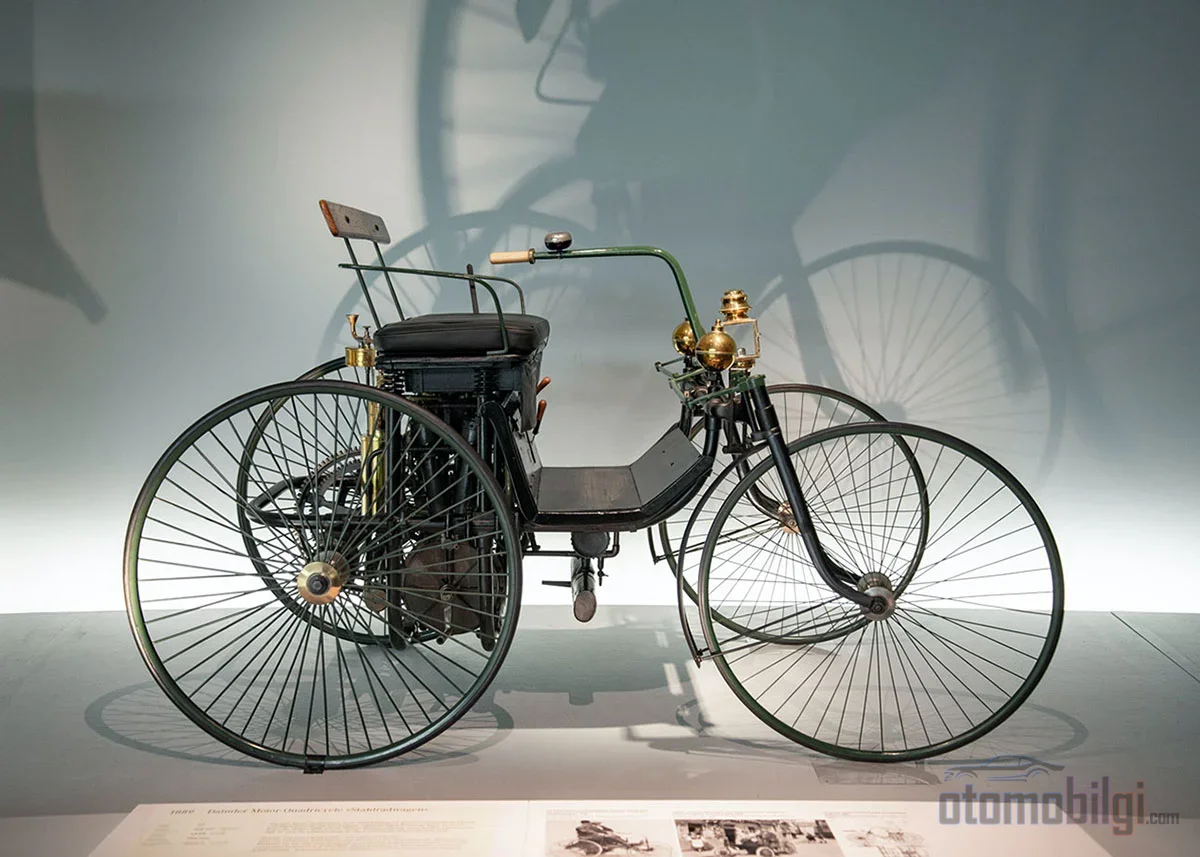
Otto wanted large, stationary engines; but its technical director at Deutz, Gottlieb Daimler, and chief designer Wilhelm Maybach aimed to make the engine portable - small enough to be fitted to vehicles. This difference in production philosophy led the pair to leave the company in 1882. The fruits of the departure came quickly: in 1883, a small and efficient 0.5 hp engine, and in 1885, the first high-revving gasoline engine nicknamed the "Grandfather Clock." The Daimler Reitwagen, built around this engine, was the first motorized vehicle with an internal combustion engine.
The automobile's birth certificate, however, was drawn up not in Cologne but in Mannheim. Karl Benz went down in history with patent number 37435, which he filed for a "vehicle powered by a gas engine" on January 29, 1886. The Benz Patent-Motorwagen, completed in 1885; was a lightweight, three-wheeled vehicle powered by a single-cylinder gasoline engine, and it carried two titles at once: the first true automobile powered by a gasoline internal combustion engine and the first automobile to enter series production. Of course, the page before Benz was not blank - motorized vehicle experiments had been ongoing for nearly a century, including Nicolas-Joseph Cugnot's steam vehicle in 1769; but the line extending from Lenoir's 4% efficient machine to Otto's compression cycle only reached the open road with gasoline and Benz's lightweight chassis.
Deutz's share in this chain should also be noted: the carburetor and reliable low-voltage ignition system developed in 1884 enabled liquid petroleum fuel to be used in engines for the first time. The automobile's fuel was born as a technical by-product. Daimler and Maybach's line was crowned at the end of the 1890s with the automobile developed for Emil Jellinek: The vehicle with its 35 hp engine reached speeds of about 90 km/h, and it bore the name of Jellinek's daughter, Mercedes. The verdict of the era was merciless - Benz's first car was a poor alternative to a horse in the 1880s; but the progress it initiated deepened uninterrupted for a century.
Cylinder Architecture: What Do Inline, V and Flat Layouts Tell Us?
As long as the Otto cycle remained constant, a century of competition largely revolved around how the cylinders were arranged. There are three fundamental layouts, and each answers a different engineering priority:
- Inline (straight): The cylinders are in a single row. It is simple and balanced; the price is length - with the same number of cylinders, it occupies a noticeably longer block than the V layout.
- V: The cylinders are arranged at an angle in two banks; a V8 is typically built at an angle of 60°–90°, with two banks of four cylinders each. It shortens the length and provides a compact engine bay.
- Flat (horizontally opposed): The angle between the banks is 180°. With its low center of gravity and vibration balance, it offers a different balance-performance profile in performance-oriented applications.
The historical reflection of this triangle also becomes clear: in the periods before and after the war, engine displacements and cylinder counts grew; by the 1970s, the American market's default engine was almost entirely the V8. The oil crises we will see below produced the pressure that reversed these architectural choices overnight.
The Post-War Era of the Compact Automobile: Beetle, Fiat 500 and Mini
After two world wars, the story of the engine was written not big, but small. Post-war Europe's family car, the Volkswagen Beetle - officially the Type 1 - was produced continuously between 1938–2003, and with its air-cooled, rear-engine layout it defined the template of the small car of its time. This layout was directly influential: the original Fiat 500 set out inspired by the architecture of the 1938 Beetle and became an icon by selling 3.4 million units between 1957–1975. The Mini joined in 1959. The common denominator of the three was not cheapness, but reliability and simplicity; the small European cars of the classic era were once considered the pinnacle of simplicity and low running costs. In engineering terms, this is the name of the era when shrinking the cylinder count and displacement while increasing reliability became more marketable than increasing power.
How Did the 1973 Oil Crisis Change Engine Design? Downsizing and the Turbo Revolution
In 1973, the OPEC embargo first doubled, then quadrupled the price of a barrel, and showed in full nakedness how fragile America's fuel-hungry automobile fleet was. The terminology of engine design was born from this shock: the Malaise era concept that defines the period begins with the sudden increase in gasoline costs; manufacturers close the era of oversized bodies and engines and turn to efficiency. In the US, the displacements of the default V8s were cut almost in half; The root of what we today call "downsizing" traces back precisely to the OPEC crisis. Toyota's corporate history confirms the same birth pangs: the drop in oil supply and the rise in prices further fueled the material and product shortages of that era.
The performance-side answer to the pressure for efficiency was recovering the energy of exhaust gases: turbocharging. Three names are considered the pioneers of this revolution, and the chronology is as follows:
- BMW 2002 Turbo - unveiled at the 1973 Frankfurt Motor Show after three years of development; built with a KKK turbocharged 2.0-liter (1990 cc) SOHC inline-4 M10 engine and Kugelfischer injection, it became Europe's first series-production turbocharged road car, two years before Porsche's similar solution.
- Porsche 911 Carrera Turbo (930) - placed the turbocharger at the center of the brand's performance identity.
- Saab 99 Turbo - brought the turbo to an ordinary family sedan in 1978, creating an enthusiast following that would last for decades; the Volvo 240 Turbo also followed this practical line.
The balanced reading is this: if the 2002 Turbo and 911 Turbo made the turbocharger a performance symbol, the 99 Turbo and 240 Turbo turned it into a luxury of everyday use. The combined impact of the pioneering trio was to move the turbocharger from a niche racing technology to a mainstream efficiency tool - an elegant answer to the necessity the oil crisis imposed on engineering.
The Rise of Diesel and Its Collapse with Dieselgate
At the end of the twentieth century, diesel was one of the passengers of efficiency; in the first quarter of the twenty-first century, it turned into a reliability crisis. The turning point was September 2015: in the Dieselgate scandal, Volkswagen installed cheat software known as "defeat devices" in millions of diesel vehicles to deceive emissions tests around the world. According to the findings of the US EPA, the company violated the Clean Air Act with approximately 590,000 diesel vehicles across the 2009-2016 model years. The scientific literature confirms that the cheat software illegally produced fake NOx emission results. Nor is the scandal confined to a single company's file; it is accepted as common knowledge within the industry that many manufacturers stretched their test CO2 values and fuel consumption figures. After the scandal, VW suspended sales of its current diesels until technology capable of meeting the new standards arrived.
The result is measurable and harsh. The market share of diesel cars in Europe fell from the 52% level of 2015, when the scandal broke, to 18% in 2023; over the same interval, the share of electric vehicles rose rapidly. While saying diesel is "dead" would be an exaggeration, it is undisputed that an era closed on Europe's road landscape - and this closing created the main gap that opened the way for the rise of electricity.
Side Path: The Wankel Engine and Mazda's 45-Year Stubbornness
The most beloved detour off the main line is the rotary engine of German engineer Felix Wankel; its origins go back to the 1929 concept and matured in the 1950s. This elegant idea, which established the working cycle with a rotating rotor instead of a piston and cylinder, found its most loyal devotee in Japan: Mazda signed a development contract with NSU in 1959, making an early and lasting commitment. The rotary journey began in 1967 with the Cosmo Sport (Mazda 110S); it was carried to the late 1960s with models like the R100, and over the following 45 years the engine was matured by enlarging displacements and adding turbocharging. Although it remained outside the mainstream, the Wankel lives on in engineering memory as the longest-running experimental line proving that the Otto cycle was not the only alternative.
The Japanese Explosion: How the Oil Crisis Changed the Owner of the Era
The last great rupture of the century took place in the geography of production. While Japanese cars in the 1970s were still seen as taboo among older generations, whether the 1973 oil crisis triggered this explosion is a question still debated today. The two ends of the debate are clear: on one side, the crisis suddenly made fuel-efficient, small-engined vehicles the most sought-after products in the world; on the other, the rise of Japanese manufacturers cannot be reduced to a mere price-tagged oil shock. Toyota records its response to the first oil crisis as a separate chapter in its corporate history - meaning the crisis was not a coincidental wind, but a turning point systematically addressed in the company's strategy. Viewed through an engineer's eye, the equation is consistent: efficiency was now an input of design, and from 1973 onward, the culture that managed this input best took over the era's marketplace. The fact that some of the turbo pioneers, such as Saab and Volvo, were efficiency-focused European manufacturers is the European leg of the same logic.
Conclusion: The Present Day of a 150-Year Cycle
The line extending from Otto's 1876 machine to the engine bay vacated after Dieselgate reads with a single logic: each era's constraint dictated the next era's design priority. Lenoir's 4% efficiency forced compression; compression gave birth to the automobile; post-war scarcity made them smaller; the oil crisis imposed efficiency and turbocharging; emission regulations first glorified, then brought down, diesel. The four-stroke cycle with spark ignition still runs on the roads - but adding that the finish line of this 150-year race is now drawn electric is the job of those who read history.
References
- Nikolaus Otto | Britannica
- How Nikolaus August Otto created the 4-stroke internal combustion engine - Accelleron
- Otto (1832) - Energy Kids, EIA
- Benz Patent Motor Car: The first automobile (1885-1886) - Mercedes-Benz Group
- 29th January 1886 - the birth of the motorcar? - National Motor Museum
- Otto engine - Wikipedia
- Benz Patent-Motorwagen - Wikipedia
- Volkswagen Beetle - Wikipedia
- The Fiat 500: Big Fun in a Small Package - Classic Motorsports
- Oil Embargo, 1973–1974 – history.state.gov
- Malaise era – Wikipedia
- Response to the First Oil Crisis – Toyota Global
- The BMW 2002 Turbo Is One Tough Customer – BimmerLife
- Wild bunch: Saab 99 vs Porsche 911 vs BMW 2002 – Classic & Sports Car
- Learn About Volkswagen Violations – US EPA
- Ten Years After Dieselgate – ICCT
- Mazda Wankel engine – Wikipedia
- RX-Rated: Mazda's Early Rotary Cars – Ate Up With Motor