How Did Oil Crises Make Cars Smaller and More Efficient?
Share This Page
The oil crises did not just make car design worse on their own; they forcibly shrank it, made it more efficient, and laid the foundation for today's engine culture. Following the 1973 embargo and the shock of the 1979 Iranian Revolution, the price per barrel first quadrupled, gasoline lines grew longer, and consumers overnight shifted from big-block American sedans to compact, fuel-efficient vehicles. Over the following decade, average consumption rose from 13.5 mpg to 17.1 mpg , the CAFE standards became law, and front-wheel drive and small-displacement engines went mainstream.
Highlights
- Between 1973 and 1974, the price of oil per barrel rose from $3 to about $12 .
- The CAFE target was 18 mpg in 1978 and 27.5 mpg in 1985; average consumption in passenger cars reached 27.5 mpg in 1985, up from 12.9 mpg in 1974.
- The Pontiac 455 V8, with its emissions equipment, dropped from 310 net hp in 1973 to 200 net hp in 1976 .
- The US market share of Japanese brands rose from 9% in 1976 to 21% in 1980 .
- The first American-made transverse-engine front-wheel-drive vehicles were the Plymouth Horizon and Dodge Omni in 1978.
The 1973 Shock: A Fourfold Price Increase and a Sudden Shift in Preferences
The embargo began when OAPEC halted oil exports to the US in response to America's support of Israel in the Yom Kippur War. Production cuts transformed the global price: by March 1974, the price of oil per barrel rose roughly fourfold , from $3 to $12. Gallon limits at stations, quotas, and panic buying became part of daily life.
The impact on the design front was immediate. Consumers turned away from fuel-hungry big domestic cars toward efficient compacts, and Detroit was caught unprepared for this shift. In 1975, American brands sold 7,050,120 vehicles , the worst year since 1962 and far below the 9.6 million units sold in 1973.
Why Did Power Fall? The Overlap of Emissions, Unleaded Gasoline, and Safety Legislation
The power loss of the 1970s was not solely due to fuel prices. Overlapping regulations pressured manufacturers: the 1970 Clean Air Act amendments required a 90% reduction in hydrocarbon, CO, and NOx emissions by 1975. Since the technology to achieve this goal did not yet exist, manufacturers chose the simplest solution: detuning their engines.
From 1971 onward, compression ratios were lowered to accommodate unleaded gasoline. In the same period, horsepower measurement switched from the gross to the net system, so figures also fell on paper; for example, the 1971 Corvette L48 was sold with 270 gross hp, while the same engine was rated at 200 net hp in 1972. Equipment such as smog pumps, EGR, and retarded ignition caused real power losses: the Pontiac 455 V8, which produced 310 net hp in 1973, dropped to 200 net hp in 1976. The catalytic converter became standard on almost all vehicles starting with the 1975 model year and popularized unleaded gasoline. Meanwhile, the 5-mph bumpers mandated by NHTSA in 1971, requiring vehicles to survive low-speed collisions without damage, increased vehicles' height and weight from 1973 onward.
For these reasons, the period extending from the early 1970s to the early-to-mid 1980s is called "malaise era" in American automotive history, meaning the era of stagnation: a decade characterized by weak products and industry-wide unease.
Downsizing: The Shrinking of Flagship Sedans and the Quiet Death of the Muscle Car
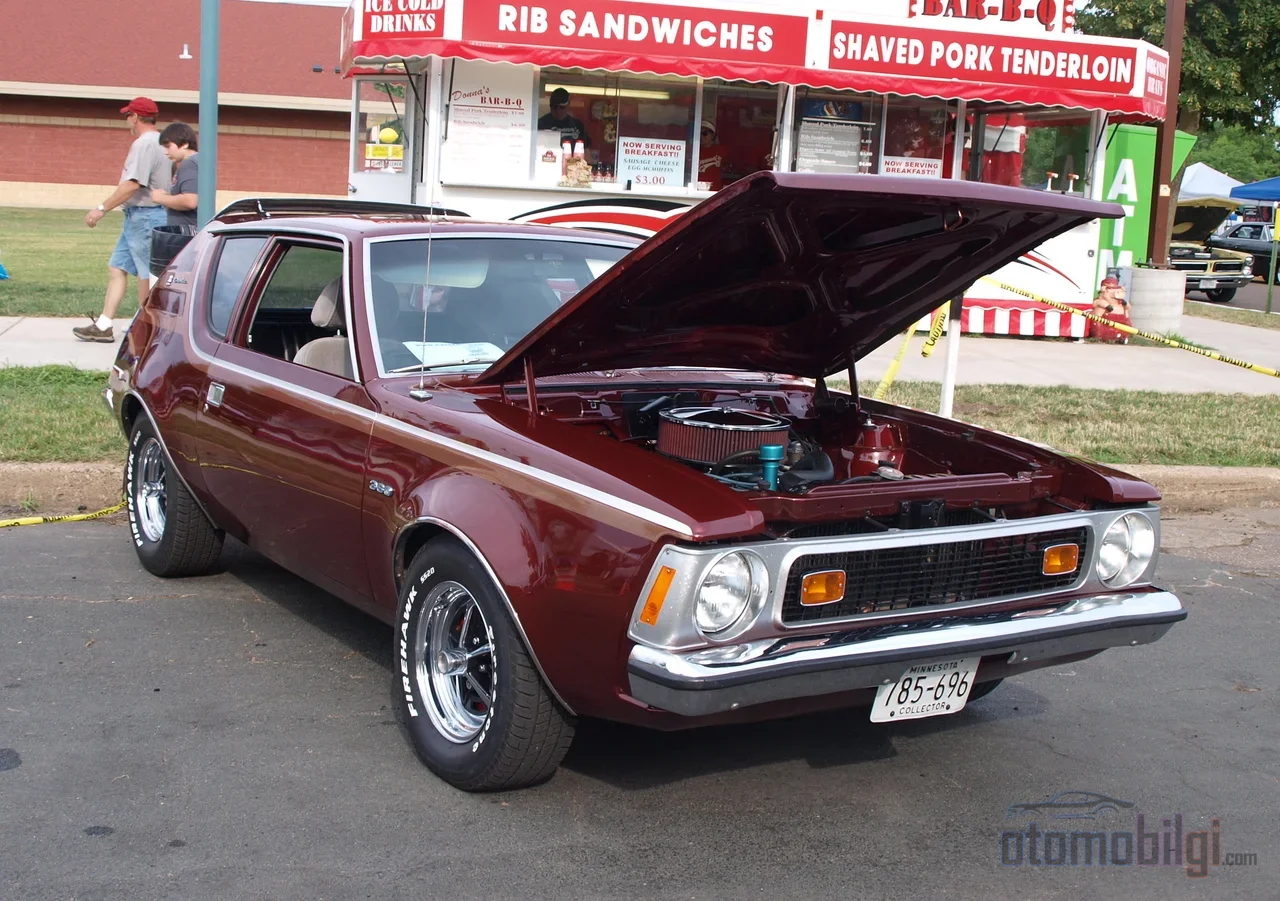
Detroit's response was to downsize. Flagship sedans were shortened, cast-iron components were replaced with plastic and aluminum, and small four- and six-cylinder engines replaced the big V8s. The Ford Mustang II was in its first year roughly 800 pounds lighter than the previous model, but could produce a maximum of 105 net hp; the preceding Mustang offered 266 net hp.
The crisis also brought the end of a class: the Javelin, Challenger, Barracuda and GTO were discontinued entirely after the 1974 model year; the Charger and Cougar shifted to the personal luxury class. In 1974, a 55 mph national speed limit was introduced for fuel savings; the limit remained in effect until 1987.
American manufacturers sought a way out in their European divisions: Ford's Mercury Capri(1970) and Fiesta(1978), GM's Opel-based T-body and J-body platforms, Chrysler's Plymouth Cricket derived from Rootes and Simca, and the Dodge Omni/Plymouth Horizon duo entered the market in this period.
CAFE Standards: How Did Fuel Efficiency Become a Legal Requirement?
As a direct response to the 1973 embargo, CAFE (Corporate Average Fuel Economy) was enacted by Congress in 1975. The Energy Policy and Conservation Act of December 1975 divided passenger cars and trucks into separate classes and set average fuel economy targets per manufacturer. The timeline was clear: 18 mpg in 1978, 19 in 1979, 20 in 1980, 27.5 mpg in 1985. The result was measurable: efficiency in US passenger cars rose from 12.9 mpg in 1974 to 27.5 mpg in 1985; roughly a doubling.
| Model Year | CAFE Target (passenger cars) |
|---|---|
| 1978 | 18 mpg |
| 1979 | 19 mpg |
| 1980 | 20 mpg |
| 1985 | 27.5 mpg |
The 1978 Energy Tax Act imposed a "gas-guzzler" tax on new vehicles that failed to meet the standards. The effectiveness of the standards has remained open to debate: some analysts questioned their costs, and some studies found CAFE's impact on technical change in light trucks to be limited; on the other hand, the efficiency leap in passenger cars is largely a product of this regime. Another point of contention: the view that the 1973 embargo itself did not magnify the crisis, and that the actual price increase stemmed from production interruptions, has also been voiced in economics circles.
The Rise of Japanese Compacts: Who Were the Winners of the Crisis?
The biggest winner of the crisis was Japan. The success of Japanese brands was based on an abundance of compact models and fuel efficiency technology. Honda's CVCC engine could pass emissions standards without using a catalytic converter, and the 1973 Honda Civic It became an overnight hit in the US. Toyota gave production priority after the crisis to the Corolla and the model sold well throughout the crisis.
The numbers tell the story clearly. Between 1978 and 1982, GM's sales fell from 5 million to about 3.5 million (a 34.2% drop), Ford declined 47%, and Chrysler 27%. In the same period, Toyota increased its sales by 19.3% (from 441,800 to 527,128), Honda grew 33.1%, and Datsun 39.1%. The US market share of Japanese cars rose from 9% in 1976 to 21% in 1980; one year after the 1979 crisis, Japanese manufacturers surpassed Detroit's total production to become the world's largest automotive industry and held that position for thirty years. Japanese exports reached approximately 6 million vehicles in 1980.
Front-Wheel Drive, Turbo and Diesel: The Crisis's Technological Legacy
The efficiency pressure changed not only engine displacement but also the drivetrain layout. Front-wheel drive, offering less mechanical loss and more compact packaging, carried the rise it began in the 1970s into market dominance in the 1980s and 1990s. The start of the modern wave in the US was 1978: the Plymouth Horizon and Dodge Omni went down in history as the first American-made transverse-engine vehicles. As an earlier special case, the 1966 Oldsmobile Toronado was America's first mass-produced front-wheel-drive model, roughly 30 years after the earlier Cord.
Turbocharging also opened its doors to road vehicles in this period. Rising fuel prices made it practical to achieve big-engine performance from a small engine by recovering exhaust energy; the concept of "downsizing" came to the fore with this awareness. The roots of today's near-universal turbocharging of commercial diesel engines extend back to this 1970s transition: in that decade, exhaust-gas turbochargers were made suitable for automotive applications.
Post-Crisis Strategic Mistakes and the End of Malaise
Not every decision the industry made was on target. The great American sedans losing their market is regarded as a strategic mistake; models such as the AMC Javelin quietly disappeared in 1974, and AMC's position after the crisis gradually weakened. On the other hand, the era produced bloated, weak, and uninspired vehicles that journalists of the time called "the worst age of automobile design"; in an interesting twist, these vehicles attracted collector interest at the end of the 2010s, and in 2018 1970s models gained 24% in value and 1980s models 38%.
Power was not permanently lost; it waited. Once engine control units, electronic injection, three-way catalytic converters, and oxygen sensors matured, performance returned without compromising efficiency. The malaise era closed between 1985 and 1987, when the Mustang and Buick Regal reached the 200 hp threshold again. The transition to aerodynamic design began with the 1983 Buick and Pontiac lines; the success of the Ford Taurus in the mid-to-late 1980s is considered a turning point. The last examples of the malaise aesthetic, the LTD Crown Victoria (1991) and the Cadillac Brougham (1992), were discontinued.
What Remains Today? The Origins of the Culture of Efficiency
The 1973 shock pushed car owners to replace their "gas guzzlers" with small, efficient engines; analysts say a similar dynamic is accelerating the rise of electric vehicles today. The reason the 1970s shocks were so painful is also clear: the average consumption of vehicles in that era was around 13 mpg, and they had almost no buffer against price shocks. Today's cars, thanks to the CAFE framework established precisely by those crises and efficiency engineering, feel those same shocks far less.
In short, the crisis did not inflate the internal combustion car; on the contrary, it disciplined it. Shrinking bodies, shrinking engines, front-wheel drive, turbocharging, and measurable fuel economy targets were all the engineering response to those two shocks. The modern automobile's culture of efficiency is a direct product of 1973 and 1979.
Sources
- Malaise era - Wikipedia
- Oil Shock of 1973-74 - Federal Reserve History
- Oil Shock of 1978-79 - Federal Reserve History
- Oil Embargo, 1973-1974 - Office of the Historian, U.S. Department of State
- Fuel economy standards have affected vehicle efficiency - U.S. EIA
- A Brief History of US Fuel Efficiency Standards - UCS
- Toyota Global 75 Years: Response to the First Oil Crisis
- Front-wheel drive - Wikipedia
- Turbo timeline part two - AET Turbos
- ENERGY CRISIS AIDED JAPANESE IMPORTS - WardsAuto
- The impact of the corporate average fuel economy - ScienceDirect (Wang, 2021)
- Time to Lay the 1973 Oil Embargo to Rest - Cato Institute
- Oil shock will speed electric cars' comeback - Reuters (2026)
- U.S. fuel efficiency standards soften impact of oil shock - Marketplace (2026)