Why Were Two-Stroke Engines Eliminated From Cars?
Share This Page
Two-stroke engines disappeared from cars because their basic operating principle sends part of the fuel and oil straight out the exhaust; emission regulations that tightened in the 1980s pushed this design to the edge of a ban, and the rapid development of four-stroke engines filled the gap. But that is not the end of the story. The rise and fall of an engine that once moved millions of cars, could be lifted by hand, and was extremely cheap to produce tells one of the most fascinating engineering reckonings in automotive history.
Highlights
- A two-stroke engine completes a power cycle in two crankshaft revolutions ; a four-stroke does the same job in two revolutions.
- The Trabant 601's engine had only 5 moving parts and was light enough to be lifted by hand.
- The Saab 96's 841 cc three-cylinder two-stroke initially produced 38 hp ; by 1966 that figure had risen to 46 hp.
- Two-stroke car production in the West ended in the 1980s due to emission rules; the Eastern Bloc continued until roughly 1991.
- The typical fuel-oil ratio was 32:1; this oil was burned off and inflated hydrocarbon emissions.
How Does a Two-Stroke Engine Work and Why Is It So Simple?
The job of an internal combustion engine is clearly defined: intake, compression, combustion, and exhaust. A four-stroke engine spreads these four stages across four strokes of the piston, that is, two full revolutions of the crankshaft. A two-stroke engine completes the same cycle in two strokes of the piston, in a single crankshaft revolution. The result is mathematically clear: combustion occurs and power is produced every time the piston reaches top dead center. While a four-stroke delivers power in only one of four power strokes, a two-stroke delivers it at every top position. The power stroke frequency is doubled.
The price of this speed is the sacrifice of the valve mechanism. In the basic crankcase two-stroke design there are no valves; ports in the cylinder wall and the piston's own movement take over their role. The exhaust port opens as the piston descends during the power stroke; a fresh fuel-air mixture enters the cylinder through the transfer port and pushes the remaining exhaust gas out. This scavenging process is both the engine's most ingenious feature and its weakest link - as we will see shortly. Lubrication relies on similar simplicity: oil is mixed into the fuel, passes through the crankcase, and burns along with the engine. The mixture allows the engine to run in any orientation; that is why two-stroke engines are still ideal for portable tools where the direction of gravity is irrelevant.
Loop Scavenging: The Critical Improvement
Early two-stroke engines used simple crossflow scavenging, and the escape of fresh mixture into the exhaust was a serious problem. The design developed by Adolf Schnürle in the mid-1920s, loop scavenging, allowed the fresh mixture to trace a controlled loop inside the cylinder, pushing the exhaust gases out. This solution became widespread in Germany in the 1930s and spread across the world after World War II. Later engineering assessments confirmed that loop scavenging was more efficient than crossflow under all conditions; all post-war two-stroke cars were built on this architecture.
The Early Period: Clerk, Benz and the Birth of the Valveless Engine
The two-stroke idea is as old as the automobile itself. Scottish engineer Dugald Clerk patented the first commercial two-stroke engine with cylinder compression in 1881; but Clerk's design was a cumbersome structure that handled compression with a separate charging cylinder. An interesting historical note: Karl Benz produced a two-stroke gas engine on 31 December 1879 and patented it in Germany in 1880. The first engine of the man regarded as the father of the automobile was not a four-stroke but a two-stroke.
The real turning point was the arrival of the crankcase-scavenged design that forms the backbone of the modern two-stroke. This approach is generally attributed to Englishman Joseph Day; Day's employee Frederic Cock, however, made the engine completely valveless, creating the form we know today. The first truly practical application also came from England: Alfred Angas Scott produced twin-cylinder, water-cooled motorcycles from 1908 onwards. The technology that matured in motorcycles would be transferred to the automobile in the following decades, at precisely the moment Europe needed it most.
DKW and the Two-Stroke Explosion in Post-War Europe
In post-war Europe steel was scarce, money was scarce, everything was scarce. The fewer moving parts a car had, the more cheaply it could be produced and the more easily repaired. The two-stroke engine was right at the center of this calculation: fewer parts, lower weight, simpler maintenance. Moreover, the power stroke occurring twice as often meant higher power per liter - reasonable performance could be achieved with small-displacement engines.
The name at the center of this stage was DKW. Its founder, Danish Jørgen Skafte Rasmussen, had bought the Audi factory in Zwickau in 1928. DKW began producing cars from 1929 and also supplied its two-stroke engines to other manufacturers; it started its motorsport career in 1929 with 600 cc twin-cylinder, 15 hp engines. The DKW designs of the 1930s are today regarded as the most important works in the history of the two-stroke engine. In 1953, the company introduced the front-wheel-drive, three-cylinder, 896 cc two-stroke DKW 3=6 model - under the name "Sonderklasse".
Major Two-Stroke Car Manufacturers
- Saab (Sweden): Used three-cylinder two-strokes in the 92, 93, 95, 96, Sonett II and their derivatives.
- DKW and Auto-Union (Germany): The main developer and supplier of the technology.
- VEB Sachsenring (East Germany): The manufacturer of the Trabant.
- VEB Automobilwerk Eisenach (East Germany): Produced the Wartburg.
- FSO and FSM (Poland): Produced licensed two-strokes.
- Suzuki and Subaru (Japan): Produced two-stroke cars until the 1970s.
The same principle applied in microcars, too. In vehicles like the Messerschmitt KR200, adding reverse gear was too costly; reverse movement could be achieved by briefly running the two-stroke engine backwards. This was less about engineering elegance and more about the logic of poverty - but it worked.
Trabant and Wartburg: The Two-Stroke Backbone of the Eastern Bloc
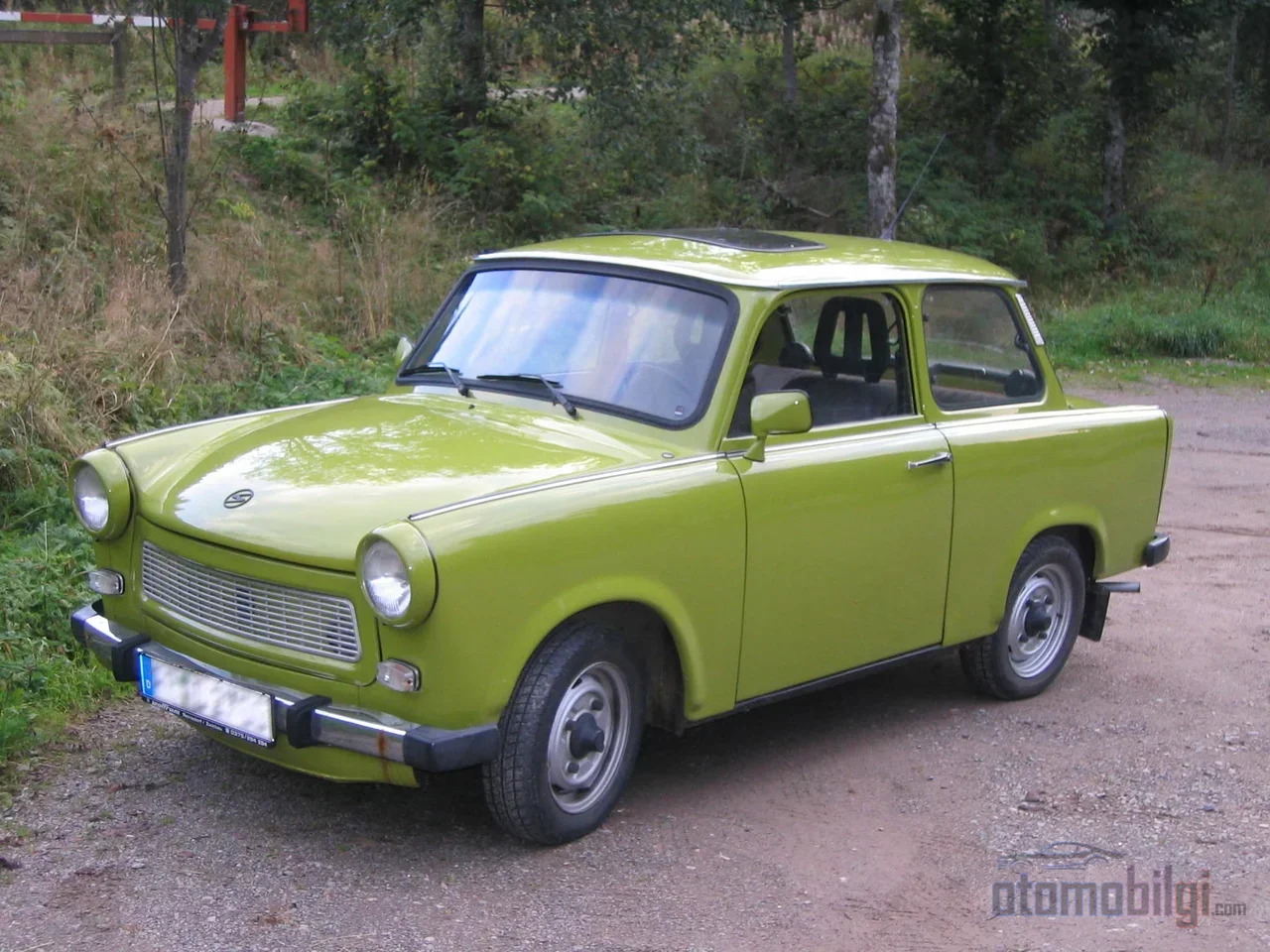
The Trabant was the purest expression of the two-stroke philosophy. The Trabant P50's engine actually came from the DKW F8: 500 cc, initially 17 hp, then 18 hp. The subsequent Trabant 601 carried a 594.5 cc (72×73 mm) two-cylinder two-stroke Otto engine. Versions varied by production run: engines from 1963-1970 produced 23 hp, while engines from 1970-1990 produced 26 PS (19.1 kW) at 4,200 rpm. Torque was 53 Nm, top speed was around 100 km/h, and power output was 38.7 hp per liter.
The figures were modest, but the most striking thing was the engine's architecture: It had only 5 moving parts in total and was so light it could be lifted by hand. Under East German conditions, this meant owners could repair their own engines at the roadside. There was a price, too: the engine ran on mixture fuel (a gasoline-oil mix), and 23 hp with 52 Nm of power and torque were clearly insufficient on hills at cruising speed. This was not a performance problem, but a problem of range and comfort.
Its sister brand Wartburg was more ambitious: it started with a DKW-derived 910 cc three-cylinder two-stroke engine (initially 28 bhp), and after 1962 the displacement was increased to 991 cc. These engines offered an upper-class drive compared to the Trabant's humble unit - but they were built on the same basic principle and had to pay the same environmental price.
Saab: The Most Elegant Voice of the Two-Stroke
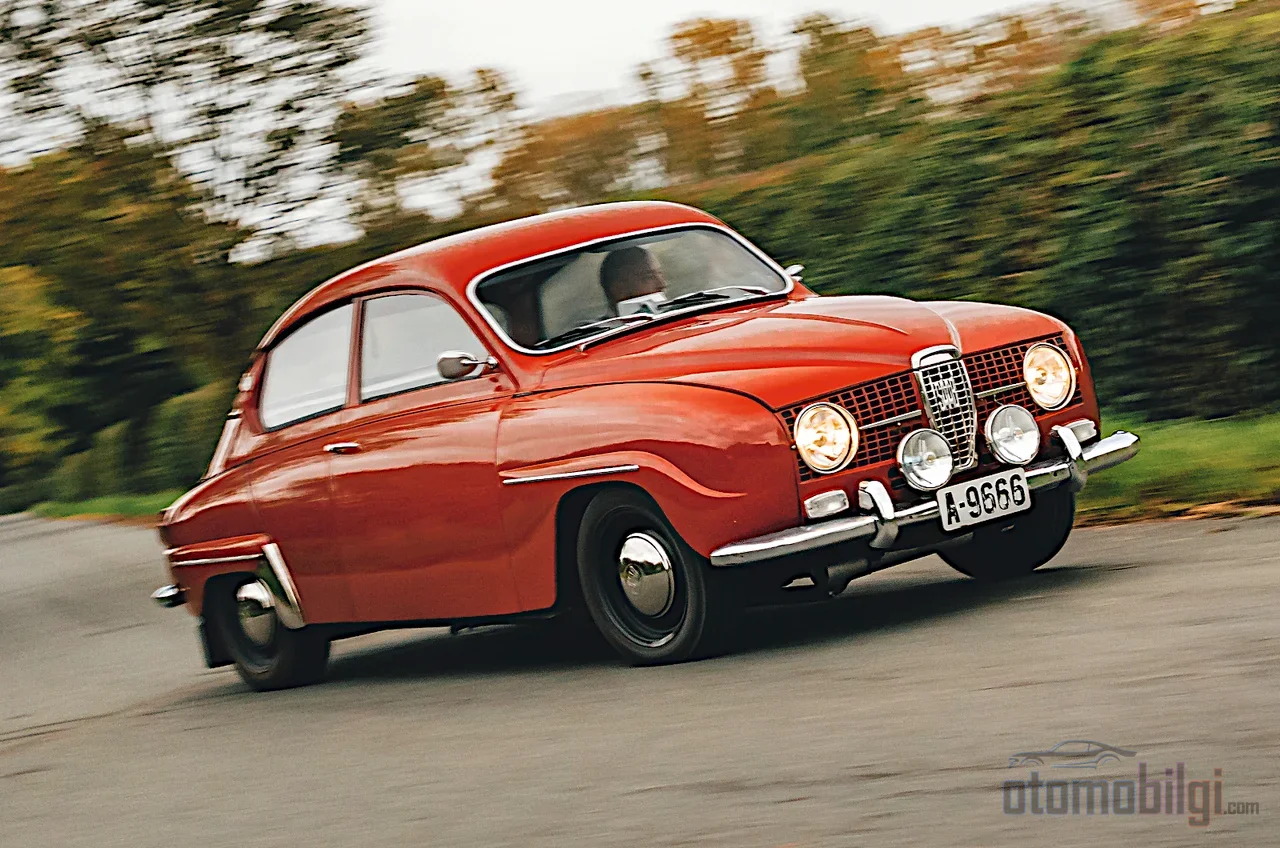
One of the most successful interpretations of the two-stroke car was made in Sweden. Saab's first car, the Saab 92, entered production in December 1949 and drew attention with its highly aerodynamic body. The company developed loop-scavenged three-cylinder engines of 750 and 850 cc based on the DKW design; the standard 750 cc unit produced 36-42 hp depending on the year and model. The engine with a supercharged crankshaft in the Monte Carlo Rally version reached 65 hp - an impressive figure for a small-displacement two-stroke.
Saab 93 (December 1955) brought an inline three-cylinder engine, and this unit became the engine that made Saab's name known to the world. Saab 96 (1960-1980) initially carried an 841 cc three-cylinder two-stroke: initially 38 hp, rising to 46 hp by 1966. But the picture was narrowing. Saab phased out two-strokes in the mid-1960s and switched to the Ford Taunus V4 from the 1967 model year. The 1967 model Saab 96 went down in history as "the last high-end two-stroke car." The four-stroke's quiet, smoke-free and hassle-free character had also won over Swedish customers.
Why Were Two-Stroke Cars Erased? The Emission and Fuel Equation
The reason for their disappearance can be summarized with a single number: 32:1. A typical crankcase-compression two-stroke uses a petroil lubrication system known as "total-loss"; the fuel-oil ratio is approximately 32:1. Some of this oil is burned, while some is expelled into the atmosphere as exhaust droplets. Compared to a four-stroke of equivalent power, hydrocarbon emissions in particular are markedly higher. On top of this, a second mechanical problem arises: in valveless designs, during the period when the intake and exhaust ports are open at the same time, some of the fresh fuel vapor escapes into the exhaust. High combustion temperatures in small air-cooled engines also produce NOx.
Fuel consumption stems from the same root. While the pressurized fuel-air mixture has a cooling effect on the piston, a portion of it escapes directly into the exhaust pipe; in other words, some of the fuel burns without producing work, or exits without burning at all. Although it is a cycle with high theoretical thermodynamic efficiency, in practice scavenging losses swallow this advantage, and two-strokes consume more fuel than four-strokes in the real world. The leakage of fresh mixture into the exhaust during the short period when the intake and exhaust ports are open together is the fundamental physical constraint that determined the two-stroke's fate.
The Paradox of Simplicity
The two-stroke's fundamental reason for existence was its simplicity; but modern requirements reversed that advantage. Two-stroke designs trying to fix emissions and efficiency became as expensive, heavy, and complex as four-strokes - meaning they lost their very reason for being. Direct injection could have largely eliminated the fuel escape of carbureted two-strokes; but that solution meant cost and complexity that no longer fit the cheap-engine philosophy. Increasingly strict air pollution regulations in the West ended two-stroke car production in the 1980s; the Eastern Bloc held out with the Trabant and Wartburg until around 1991.
Why Did Motorcycles Let Go Later?
The same equation applied to two wheels, but the timing played out a bit differently. Honda had given up on road motorcycles much earlier; it stopped selling two-stroke off-road motorcycles in the US in 2007. Today, all new internal combustion automobiles sold in the US are four-strokes - the two-stroke has officially settled into the junkyard of automotive history.
Where Do Two-Stroke Engines Live Today?
Erased from automobiles, the two-stroke did not vanish entirely; only its volume and legal tolerance shrank. The power-to-weight advantage and the ability to run in any orientation are still decisive in certain applications. Today, two-stroke engines live on in the following fields:
- Small road and off-road motorcycles, mopeds, scooters and motorized bicycles
- Marine engines, snowmobiles and go-karts
- Hand tools: saws, leaf blowers, grass trimmers
- Tuk-tuks, RC cars, ultralight and model aircraft
- Large two-stroke diesels: industrial, marine, locomotive and generator applications where weight is irrelevant
Yet the trend is clear: pollution regulations in developed countries are gradually narrowing the two-stroke's areas of use. In regions where regulations remain lax, small-displacement two-strokes continue to be popular in motorcycles and mopeds.
Conclusion: A Historical Lesson from an Engineering Equation
The disappearance of the two-stroke engine from automobiles happened not because the technology was bad, but because the comparison it won had changed. The equation of the postwar years weighted parts count, cost and power-to-weight; the two-stroke won on all three counts, moving millions of automobiles with DKW, Saab, Trabant and Wartburg. The equation of the 1980s, by contrast, weighted emissions, fuel consumption and refined engineering - and the physical constraint created by scavenging losses and total-loss lubrication doomed the two-stroke to defeat in that calculation. Nowhere in automotive history has there been such a clear lesson in understanding how solid a technology's advantages are: just as important as when it was strong is when it became invalid - both are part of a design decision.
Sources
- Two-stroke engine - Wikipedia
- The Two-Stroke Engine Was An Engineering Marvel. Now It's In The Dustbin Of Automotive History - The Autopian
- DKW in racing - Audi
- Car of the Day: 1965 DKW Special - Supercars.net
- Trabant 601 - Wikipedia
- Trabant P 601 0.6 (23 Hp) - auto-data.net
- The History of the Trabant - Gizmo Highway
- Trabant - Wartburg - Historic Vehicles
- Saab two-stroke - Wikipedia
- Curbside Classic: 1967 Saab 96 - The Last Two-Stroke
- Saab Two-stroke Triple - Hemmings
- DKW: The founding father of two-stroke tech - Peter James Insurance
- The Rise and Fall of Two-Stroke Car Engines - CarBuzz
- What makes two-stroke engines less fuel-efficient - Mechanics StackExchange