Why Is the Compression Ratio the Line That Separates Gasoline from Diesel?
Share This Page
The compression ratio is the fundamental dividing line between gasoline and diesel engines: gasoline engines typically operate in the 8:1-12:1 range due to knock risk, while diesels compress between 14:1 and 23:1 to bring the combustion chamber to a temperature that will ignite the diesel. The chemical character of the fuel determines this limit; engine architecture is the way of conforming to it.
Highlights
- Gasoline passenger car engines typically run at 8:1-12:1, while diesels run at 14:1-23:1 ratios.
- Mazda's SkyActiv technology pushed the limits in gasoline engines up to a 14:1 ratio, while SkyActiv-D went below 14:1 in diesels.
- In gasoline engines, moving from 10:1 to 11:1 yields a theoretical gain of about 2-3% in efficiency.
- Turbocharging does not change the mechanical ratio; it raises the effective compression ratio.
- The octane number measures resistance to compression, while the cetane number measures self-ignition.
What Is the Compression Ratio and What Does It Determine?
The compression ratio is the ratio of the cylinder volume at the piston's bottom dead center to the compression volume remaining at top dead center. The formula is simple: CR = (Vd + Vc) / Vc. An engine with a cylinder volume of 50 cc and a compression volume of 5 cc runs at an 11.0:1 ratio; that is, the mixture is compressed to one-eleventh of its initial volume by the end of the compression stroke.
This number directly defines the engine's character. A high ratio allows the post-combustion gases to expand over a longer distance; more mechanical work is extracted from the same fuel and exhaust temperature drops. There is a trade-off too: higher pressure produces more torque per stroke. That is why, on the engineering side, the ratio is seen as a limit that is pushed as high as it can withstand - the limit ends where the fuel can hold out.
Moreover, there is no single ratio number. The static ratio accounts for the full geometric volume change; the dynamic ratio measures only the volume actually compressed after the intake valve closes and is always lower than the static value. When discussing tuning and turbo matching, the more meaningful metric is the dynamic ratio, because what the engine actually compresses is what counts.
Why Can't a Gasoline Engine Compress Highly?
The gasoline engine's problem is the fuel itself. Before the spark plug fires, a homogeneous gasoline-air mixture waits ready in the cylinder; this premixed mixture is sensitive to increases in pressure and temperature. When the ratio rises too high, the mixture explodes spontaneously before the flame front reaches it. This is what we call knock: an uncontrolled detonation replaces controlled combustion. In an engine without knock sensors, this is the road leading first to efficiency loss and then to engine damage.
Fuel quality determines this threshold. High-octane gasoline can withstand higher pressure before igniting; low-octane fuel either limits the ratio or forces the ignition advance to be delayed. That is why the gasoline engine has learned to live below the ceiling allowed by its own fuel's octane number. Because knock disrupts the premixed mixture, it reduces both thermal efficiency and net power - the price of raising the ratio in a gasoline engine is always the risk of knock.
Why Does Diesel Prefer Compression Ignition?
Diesel has no spark plug; the key mechanism is precisely the compression itself. When the piston compresses the air at ratios between 14:1 and 23:1 the cylinder temperature rises above diesel's ignition threshold, and when the injector sprays the fuel, the mixture ignites spontaneously. In other words, the high ratio in diesel is not the result of a choice but the very essence of the ignition system: if the ratio drops, the engine will not start in cold weather.
There is no risk of uncontrolled auto-ignition limiting the gasoline side here, because there is no premixed mixture in the cylinder before the moment of ignition. The fuel does not wait in the air; it ignites the moment it is injected. The combustion speed is also controlled not by spark timing, but by injection timing and the spray pattern. This architectural difference is the technical explanation for why the two engines cannot be copies of each other: gasoline avoids knock, diesel chases ignition.
The ratios used in practice are refined according to the purpose: direct-injection diesels 14:1-23:1, indirect-injection ones 18:1-23:1 are in that band. In light commercial pickups 15:1-17:1, in heavy industry 17:1-20:1 (for example the Cat C15: 18.0:1) is typical; large low-revving two-stroke diesels exceed 20:1 . Lowering the diesel ratio below 14:1 reduces NOx emissions but makes cold starting harder; the Mazda Skyactiv-D was one of the first commercial engines to enter this region and solved the cold-start problem with adaptive injectors.
Octane and Cetane: The Mirror Images of Two Fuels
The octane number is the standardized measure of gasoline's ability to withstand compression and pressure before ignition; in a test engine it shows the fuel's resistance to spontaneous ignition pressure. The cetane number is exactly the opposite: it measures how easily spontaneous ignition occurs in diesel. A good octane means "very late ignition", a good cetane means "immediate ignition".
These two measures are inversely proportional: a fuel with a high cetane has a low octane, and a fuel with a high octane has a low cetane. This single sentence summarizes why the two engine architectures need separate fuels and separate ratios. A gasoline engine wants a fuel that resists compression; a diesel runs, quite unwillingly, on a fuel that ignites easily. Fuel choice is not a marketing decision but a match dictated by the physics of combustion.
The Mathematics of Efficiency: How Much Gain, At What Cost?
The benefit of raising the ratio is measurable: in a gasoline engine, going from 10:1 to 11:1 gains theoretically about 2-3% in thermal efficiency. However, the gain curve is not straight; beyond 14:1 friction and heat losses begin to claw back the gain. The engineer's job is to find the point where the curve is still going up.
| Engine Type | Typical Ratio | Reason for the Limit |
|---|---|---|
| Gasoline passenger cars (last 20 years) | 8:1-12:1 | Knock risk |
| High-ratio gasoline | 14:1-16:1 | Requires direct injection + Atkinson operation |
| Diesel (direct injection) | 14:1-23:1 | Ignition temperature and cold starting |
| Heavy industry diesel | 17:1-20:1 | High torque and durability target |
| Performance diesel (pulling) | ~12:1 static | Balancing the effective ratio with boost above 100 PSI |
This is also the main reason diesels offer better specific fuel consumption: a higher ratio means longer expansion from the same fuel and more work. On the diesel side too, the ratio is not unlimited upward; the balance is struck with mechanical loads and emissions targets. Regulations such as the EPA's 2024 Phase 3 heavy-duty GHG standards are pushing manufacturers toward high-ratio designs; Detroit DD15 style ultra-high-ratio designs with swirl pistons are delivering fuel economy gains of up to 3%.
Where Does Turbo Stand in This Balance?
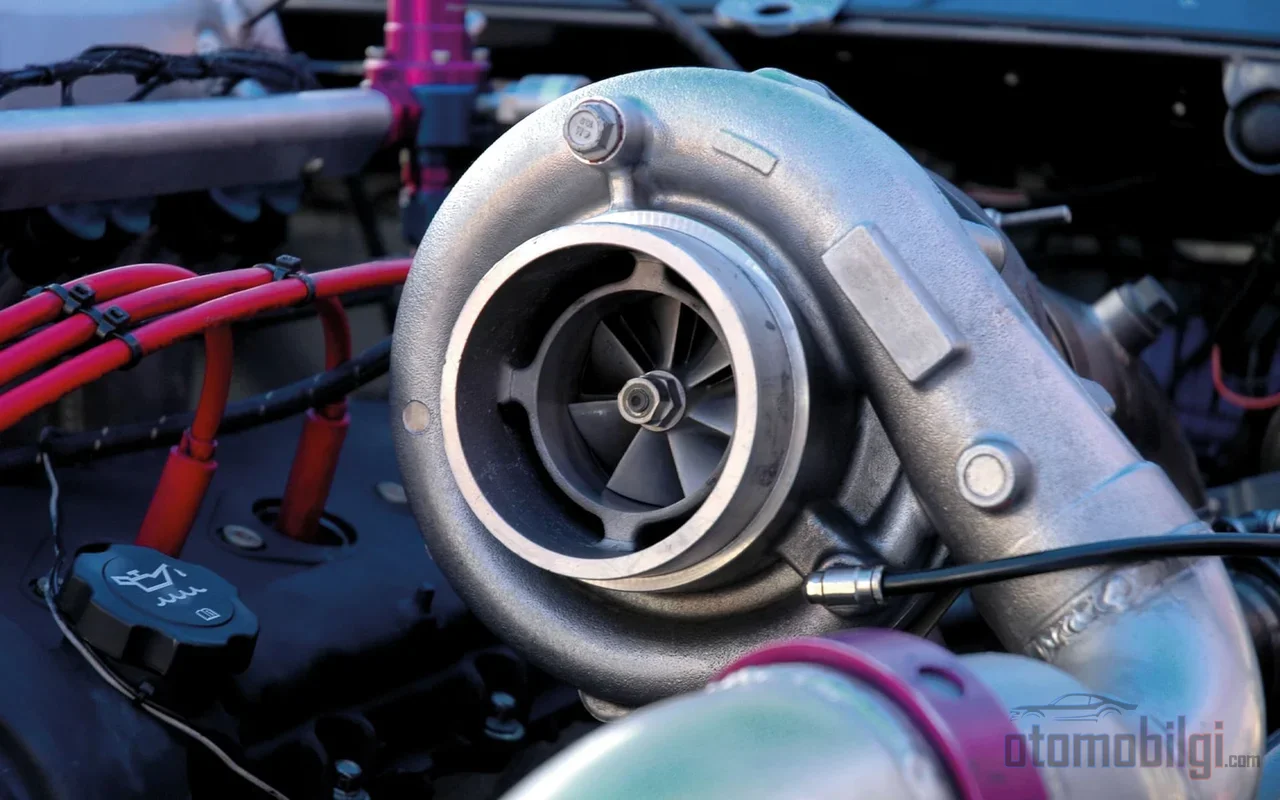
Turbocharged engines generally run at lower ratios than their naturally aspirated siblings, and the reason is simple: the air is already compressed by the compressor before entering the cylinder. The mechanical compression ratio does not change, but since the density of the air entering the cylinder increases, the effective ratio rises. The effective compression ratio formula gives this relationship: ECR = [(Boost / 14.7) + 1] x CRstatic. Every PSI of boost raises the effective ratio; a low static ratio widens the safe boost window.
Injection type also enters this balance. In port-injected engines, the fuel heats together with the air during compression, so the detonation risk arrives earlier; in a direct-injected engine, higher boost is possible because there is no fuel in the heated air. Also, since hot intake air and high cylinder pressure increase knock tendency, intercooling and ignition tuning are integral parts of turbo matching. If the matching is set up wrong, the result can be surge, detonation, or structural damage; on the compressor map, the 70-75% peak efficiency region is typically targeted.
There are two legitimate poles of the ratio-boost balance: a high-ratio, low-boost setup offers sharper throttle response; a low-ratio, high-boost setup provides higher peak power with limited octane. Extreme performance diesels show the diesel version of this logic - the static ratio is lowered to 12:1 and boost above 100 PSI can be run. The 2025 model Cummins 6.7L High Output pickup engine being optimized with a 16.0:1 ratio for high boost and torque reflects the same engineering logic on the manufacturer side.
How Do Modern Engines Push the Limit?
On the gasoline side, the most interesting move was overcoming the knock wall with technology. Direct injection is one of the keys developed against the early-ignition problem when moving to high ratios: the fuel is injected at the end of the compression stage, exactly when needed. Mazda SkyActiv took this path to the extreme; from 2012 onward, with direct injection and exhaust scavenging, it reached a 16:1 ratio on 95 RON fuel. The Toyota Dynamic Force family and Ferrari 458 Speciale (2014) are the other notable examples in this lane with 14:1 ratios.
The second key is the Atkinson cycle. Thanks to the late closing of the intake valve, the engine achieves an expansion ratio significantly higher than its compression ratio: effective compression drops, full expansion is preserved. In other words, a ratio such as the 13:1 written in the spec sheet is largely theoretical - the valve remains partially open at the start of compression, and the real, dynamic compression is much lower. This is where technical reality and popular narrative diverge: many modern "high compression" gasoline engines are in fact high expansion ratio engines. The price is clear: power density is sacrificed for efficiency - which is why Atkinson operation shakes hands with hybrid systems.
Frequently Asked Questions
Why does higher compression feel more powerful?
A more tightly compressed mixture produces higher pressure in the cylinder when it burns; this pressure is transmitted to the piston as more torque per stroke. The difference in the feeling of power is less mechanical than thermal efficiency, but it stems from the same physics.
Does turbocharging increase the compression ratio?
It does not change the mechanical ratio. The turbo sends denser air into the cylinder, raising the effective compression ratio; which is why turbocharged engines are designed with a low static ratio.
At the same ratio, is diesel or gasoline more efficient?
Diesel. Because it can operate at a higher ratio, it has an advantage in specific fuel consumption; the gasoline side, in the same band, is forced to restrict ignition advance due to knock risk.
Conclusion: Two Engines, One Physics, Different Answers
It is no coincidence that compression ratio is the dividing line between gasoline and diesel; it is a consequence of fuel chemistry. Gasoline resists compression, and premature ignition of the premixed charge confines it to around 12:1 ; diesel wants ignition to happen on its own and its engine must operate above 14:1 . Turbocharging, direct injection, and the Atkinson cycle open a window onto this wall but do not tear it down. Whichever engine you ride in, the source of the difference beneath your seat is the mirror-opposite nature of these two fuels.
Sources
- Compression ratio - Wikipedia
- Octane rating - Wikipedia
- Compression Ratio in Diesel Engines: Power & Boost - GoldFarb & Associates
- Understanding Engine Compression Ratios - HP Tuners
- Effect of compression ratio on engine knock, performance - ScienceDirect (Sahoo 2021)
- Gasoline explained - octane in depth - U.S. EIA
- The Difference Between Cetane and Octane - Petroleum Service Company
- Combustion in Diesel Engines - DieselNet
- Compression Ratio with Boost Pressure - GCG Turbo
- Turbochargers: Boost Your Turbo IQ - Engine Builder Magazine
- Atkinson cycle - Wikipedia
- Exploration of combustion strategies for high-efficiency engines - Stanford