How Does a Supercharger Do What a Turbo Can't?
Share This Page
A supercharger is a forced induction system that compresses the air entering the engine, allowing more power to be extracted from the same engine displacement; unlike a turbocharger, it draws mechanical power directly from the crankshaft instead of using exhaust gases. Thanks to this direct connection, it delivers instantaneous, lag-free and linear power; in return, it constantly consumes a portion of the engine's own power and is generally less efficient than a turbocharger in terms of fuel economy.
Highlights
- A supercharger draws power from the crankshaft via a belt, chain or gears; a turbocharger uses exhaust energy.
- Street-use kits typically produce 6–12 psi of boost and can increase the air going into the engine by roughly 50–85% .
- Power gains are typically in the range of 30–75% ; depending on driving style, fuel economy can deteriorate by 15–30% .
- There are three main types: Roots, twin-screw and centrifugal.
- A supercharger can consume up to 20% of the engine's total power to run.
How a Supercharger Works: Power from the Crankshaft
The fundamental limit determining the power an internal combustion engine can produce is how much oxygen enters the cylinders. In a naturally aspirated engine, air enters pushed by its own pressure through the vacuum created by the intake stroke. A supercharger changes this balance: it pumps air into the cylinders at a pressure above atmospheric pressure (boost). More oxygen means more fuel can be burned; a stronger explosion in every cycle, meaning higher horsepower and torque.
From a mechanical standpoint, the critical point is the power source. A supercharger is directly connected to the crankshaft via a belt, chain or gears; the faster the engine spins, the faster the supercharger spins. A turbocharger, on the contrary, spins using the kinetic energy of the exhaust gases, recovering a portion of that energy. This single difference determines the entire character of the two technologies: one responds instantly but pays the price in fuel, while the other makes use of exhaust energy that would otherwise be wasted but makes you wait at first.
The compression process has another cost: heat. Compressed air heats up, the density of heated air drops, and power gains are limited. That is why serious supercharger systems use air-to-air or air-to-water intercoolers; the compressed air is cooled, becoming denser and richer in oxygen. Also, at high boost pressures the risk of knock increases; since high-octane fuel resists knocking, it allows more aggressive tuning.
Turbo vs Supercharger: Throttle Response vs Efficiency
The question that separates the two technologies is actually this: where do you get the energy? A turbocharger recovers exhaust energy that would normally be thrown out of the tailpipe via a turbine; that is why it is theoretically more efficient. But the turbine needs time to start spinning. At low revs the exhaust flow is insufficient, and the engine behaves like a naturally aspirated one until the turbine fills up; this wait is called turbo lag.
There is no such wait with a supercharger. Because the compressor is mechanically linked to the crankshaft, boost is present even at idle and the power curve is linear: the more you press the throttle, the more response you get. This predictability provides a control advantage on the race track; at high altitudes above sea level, it also preserves performance by compressing the thin air.
The price, however, is not transparent but it is measurable: a supercharger can consume up to 20% of the engine's total power output for its own operation. This is called parasitic load. A turbo does not carry this load; it pays the price as a drive brake in the exhaust system. There is also a difference on the plumbing side: with a supercharger, the piping is simple, the air goes from the compressor to the engine. A turbo requires a complex piping arrangement where the exhaust must pass through the turbine, and since hot exhaust components are next to the intake line, the risk of heat soak is high.
| Feature | Supercharger | Turbocharger |
|---|---|---|
| Power source | Mechanical drive from the crankshaft | Exhaust gas energy |
| Throttle response | Instant, linear | Turbo lag wait |
| Efficiency | Carries a parasitic load | Recovers exhaust energy |
| Plumbing | Simple intake line | Complex exhaust-intake arrangement |
| Power curve | Boost from low revs | Peak power at high revs |
Three Supercharger Types and Their Characters
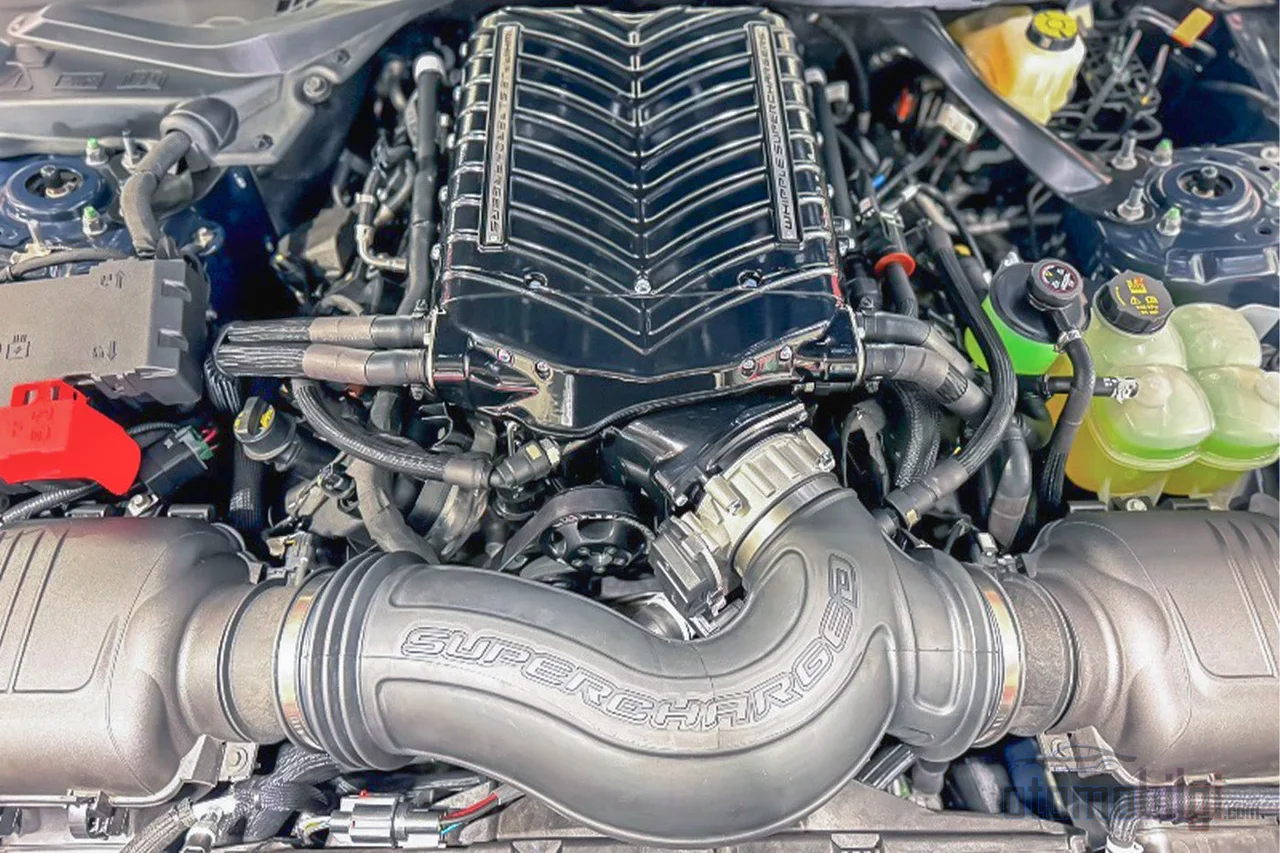
Superchargers are divided into two main families according to how they relate boost to engine speed: positive displacement compressors provide constant boost at almost all revs; in dynamic compressors, boost increases in proportion to revs. All three main types fall into one of these two families.
Roots: The Oldest, The Most Instant
The Roots type is the engine world's adaptation of a design patented in 1860 for mine ventilation. Two lobes (rotor blades) rotating in opposite directions trap the air in the gap between themselves and the housing, and push it to the manifold. The point to note is this: Roots does not compress the air itself; it only carries it. That is why it is known more as a blower than a compressor. It delivers boost across the entire rev range, and with its classic look mounted on top of the engine, it is an icon of muscle car culture. However, at high boost levels its efficiency is only around 40-50% and it generates a significant amount of heat. GMC's blower classification still reflects this tradition: the 6-71 blower is designed to sweep 71 cubic inches of volume per cylinder of a 426 cubic inch (7.0 L) engine.
Twin-Screw: Internally Compressing Design
The twin-screw design, also known as Lysholm, uses two intermeshing helical screws and compresses the air internally in narrowing channels. This single detail determines the difference from Roots: higher thermal efficiency, lower heat. It can provide efficiency approaching dynamic compressors within a narrow load and rev range. The modern design was patented by Alf Lysholm in 1935; the fundamental screw compressor patent, however, dates back to 1878 and Heinrich Krigar. It is the type preferred by applications that want to keep the instant Roots character but reduce its heat.
Centrifugal: Turbo-Like Character, Mechanically Driven
The centrifugal supercharger resembles a turbo in design, but it is driven mechanically rather than by exhaust. The impeller spinning at high rpm accelerates air outward and converts that speed into pressure. Unlike positive displacement types, boost increases along with engine speed; the result is a character similar to a naturally aspirated engine but one that adds power at high rpm. Its efficiency is the highest of the three types: 70-85% range. Heat generation is also lower, and its compact body makes installation easier in cramped engine bays. Its shortcoming is clear: it does not deliver as much power at low rpm as a Roots or twin-screw.
How Much Does It Affect Fuel Consumption?
The supercharger's effect on fuel economy is an open fact: it usually increases consumption. More air means more fuel to be burned; the engine must run without upsetting the air-fuel balance. In a vehicle fitted with a supercharger kit, fuel economy typically degrades by 15-30% depending on driving style and tuning; with aggressive use, consumption can double.
Type selection also changes this picture. The Roots type, due to its significant parasitic load, is the type that strains economy the most; centrifugal designs, thanks to their high efficiency, stand out as the most economical member of the family. But no supercharger can be more efficient than a turbo that recovers exhaust energy. This is precisely the main logic behind manufacturers turning to small displacement turbo engines in the 21st century: Mercedes replaced its supercharged engines carrying the Kompressor name with turbo engines around 2010. There are exceptions too: Audi's 3.0 TFSI engine remained supercharged from 2009 onward, as did Jaguar's AJ-V8 Gen III unit from the same year.
Which Vehicles Choose a Supercharger, and Why?
The choice depends on how critical throttle response is. In disciplines where victory is won in the first tenth of a second, such as drag racing and tractor pulling, superchargers are common; there is no boost lag, and power scales instantly with the throttle pedal. The American muscle car tradition is also built on the same logic: the dominance of superchargers in the high-performance models of GM, Dodge, and Ford is explained by the cultural preference for instant torque and low-end power. Ford's reasons for choosing a supercharger for the GT500 can be listed as heritage compliance, instant throttle response, and high-rpm performance.
The opposite choice can also be made. The twincharging approach, which combines the two technologies, engages the supercharger at low rpm, both of them at mid rpm, and only the turbo at high rpm. Lancia Delta S4 used this arrangement 1985-86 WRC season with electromagnetic clutches and bypass valves. In series production, examples such as the VW 1.4 TSI (2005-2013) and the Volvo B4204T 2.0 applied this dual feeding. Complexity and reliability issues kept the approach niche.
Supercharger or Turbo: Which Is Better?
The most honest answer to a question with no single answer is to narrow the comparison down to two: at low rpm and instantaneous response, the supercharger stands out, while at peak power and efficiency, the turbo takes the lead. The supercharger's weak point is efficiency, and the turbo's weak point is boost lag; which one is better depends on the use case. Are you looking for instant response in city traffic, or efficiency on long journeys? In the first case, a supercharger is the rational choice; in the second, a turbo.
One of the frequently asked questions is about speed: which one is faster? Setting a general rule would be misleading; a turbo's peak power is usually higher, but in terms of measurement, duration, and distance, the vehicle's calibration, type selection, and tuning are decisive. The typical range of power gain with a supercharger is 30-75%, while in a well-designed kit it is around 50-85% ; both must be tuned to stay within the engine's durability limits and knock tolerance.
Conclusion: A Simple Engineering Decision
The supercharger is an alternative worth considering not against the turbo, but alongside it. The mechanical connection fed directly from the crankshaft delivers power with no delay and predictably; the price is that it constantly consumes a portion of the engine's own power. The Roots' instant response across the rev range, the twin-screw's thermal balance, and the centrifugal's high-rpm efficiency are three different engineering paths to the same goal. The right question is not which one is absolutely better, but which character is more likely to work in which use case.
Sources
- What is a Supercharger
- Supercharger
- Turbochargers vs. Superchargers: Which Is Better?
- How Do Supercharger and Turbocharger Engines Differ?
- Supercharger Kit Fuel Economy Impact
- Supercharger Vs Turbocharger - JEGS
- Roots vs. Twin-Screw vs. Centrifugal Superchargers
- Roots vs. Centrifugal vs. Screw Type Supercharging
- Superchargers Vs. Turbochargers
- How Superchargers Work