Bugatti Bolide: The W16's Dedicated Farewell Letter
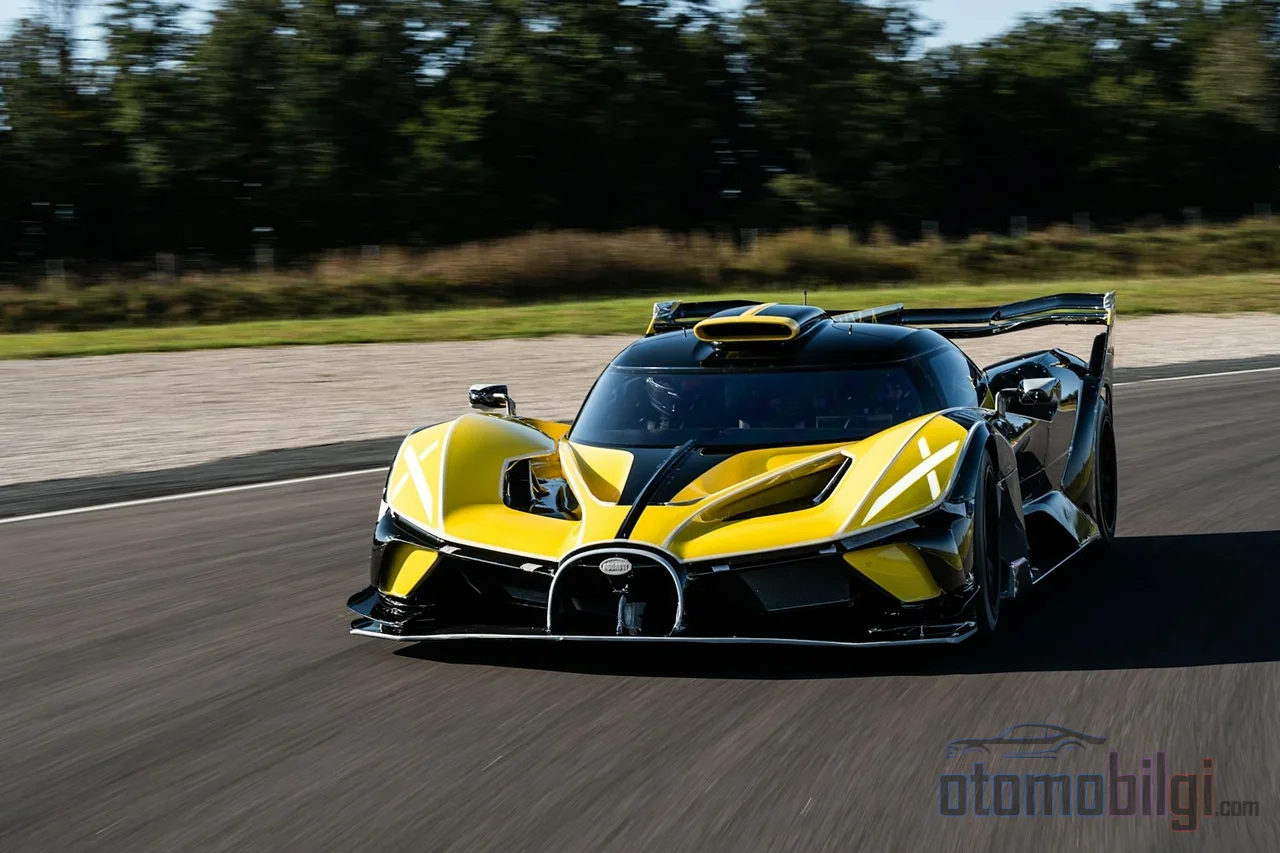
When the Bugatti Bolide was unveiled as a concept in the fall of 2020, it asked a single question: If the company's legendary 8.0-liter W16 engine were stripped of all the constraints of road use, how far could it go? The answer became Bugatti's most extreme machine ever built. However, the Bolide's story gets complicated because most of the figures circulating online belong to the concept, not the production version. The 1850 hp figure is real, but only with the right fuel and in the right version.
What Is the Bolide: A W16 Farewell Letter Off the Road and Devoted to the Track
The Bolide is a hypercar developed by Bugatti Automobiles that is suitable for track use only. The concept was unveiled online on October 28, 2020; the production version was revealed in April 2023, and the first deliveries took place in early 2024. A total of 40 units were produced, with production spanning 2024-2025. While the car is manufactured in Molsheim, the development process is based on Bugatti Engineering in Germany. Its name comes from the Ancient Greek word "bolis," meaning javelin, and the Old French expression "le bolide," meaning meteor.
In terms of design, a mid-engine, all-wheel-drive layout with butterfly doors was adopted. Built on the Chiron platform, the car uses a carbon fiber monocoque body developed together with Dallara; this structure meets the safety requirements of the FIA's Le Mans Hypercar and LMDh categories. The Bolide was announced as Bugatti's final car to use its quad-turbocharged W16 engine; the brand moved into a new era with the Tourbillon. In other words, the Bolide is the closing page of an engineering era that began in 2005 with the Veyron.
Highlights
- The production version delivers 1600 PS / 1600 Nm on 98 RON, while the concept produces 1850 PS on 110 RON racing fuel
- The production version completes 0-100 km/h in 2.2 seconds, and top speed was electronically limited to 380 km/h
- Only 40 units were produced, with a unit price of approximately 4 million Euros
- 2900 kg of downforce at 320 km/h and 2.5G of lateral cornering force
- The carbon monocoque structure meets Le Mans Hypercar safety requirements
Where Does the 1850 Hp Come From: Fuel Choice and the Quad-Turbocharged W16
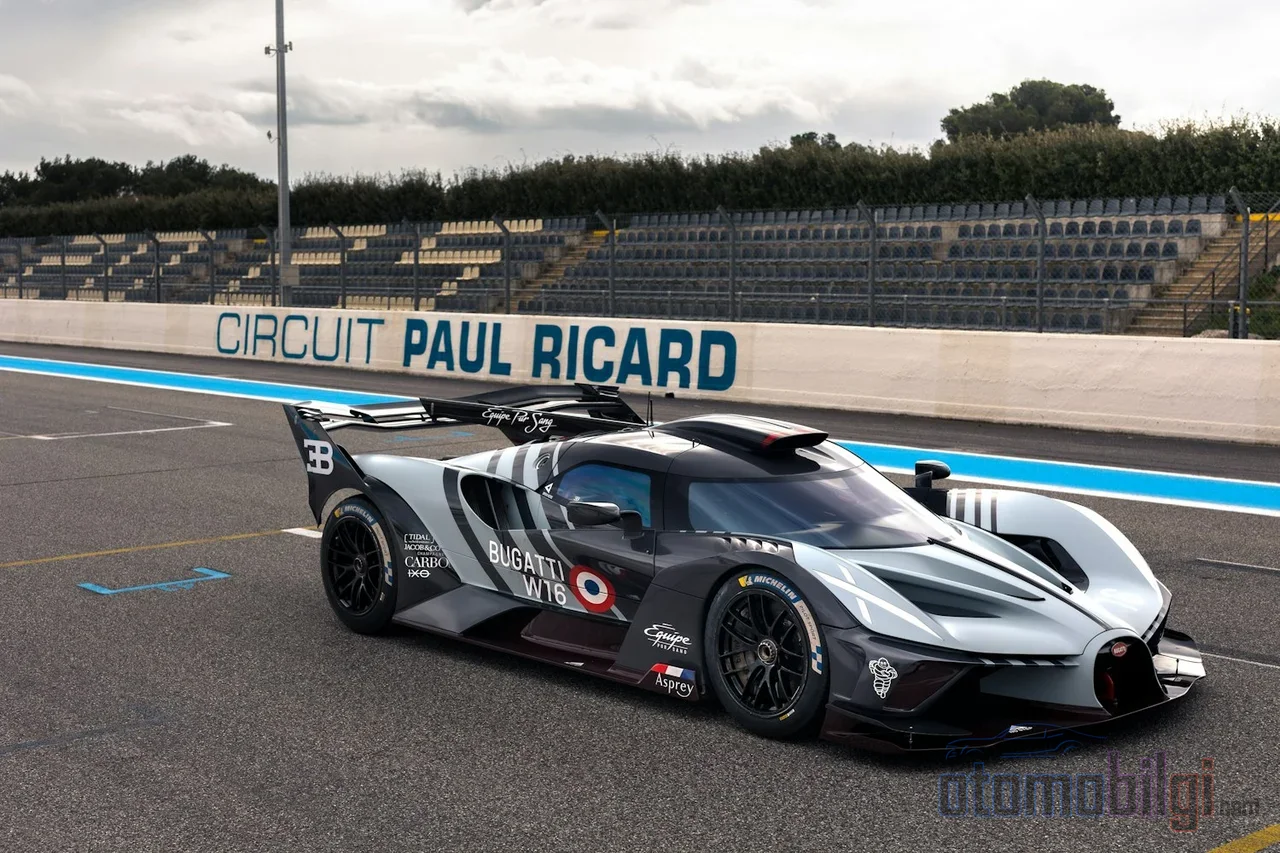
The engine is an 8.0-liter W16 with 7993 cc displacement, four valves per cylinder and four turbocharger feeds. In the concept version, when 110-octane RON racing fuel is used, the engine produces 1850 PS (1360 kW) of power; when the same car runs on standard 98 RON gasoline, this figure drops to 1600 PS. The production version, meanwhile, is officially rated at 1600 PS at 7050 rpm on 98 RON, with 1600 Nm of torque across 3800-7050 rpm. While the concept's torque with racing fuel is stated as 1850 Nm, some sources also cite this figure as 2000 Nm; the framework Bugatti's own announcements were based on is this power ladder that varies according to fuel type. The increase in power was achieved with larger turbine blades and a repositioned turbocharger layout.
Track-Adapted Engine Architecture
The Bolide's engine differs from the Chiron's in several critical respects. Intake and exhaust systems were de-throttled, removing airflow restrictions and speeding up throttle response. The pump, tank and baffling components of the dry sump lubrication system were re-optimized to withstand the high centrifugal forces experienced on track. On the cooling side, air-to-air intercoolers are supported by water pre-cooling; the radiator layout was designed to deliver more effective airflow than that of Formula 1 cars. Three separate oil coolers are used for the engine, transmission and differential. Brake cooling is provided by carbon-titanium turbofan radial compressors. Power delivery is handled by a 7-speed dual-clutch automatic transmission.
Performance: The 2.17-Second Debate and Simulated Lap Times
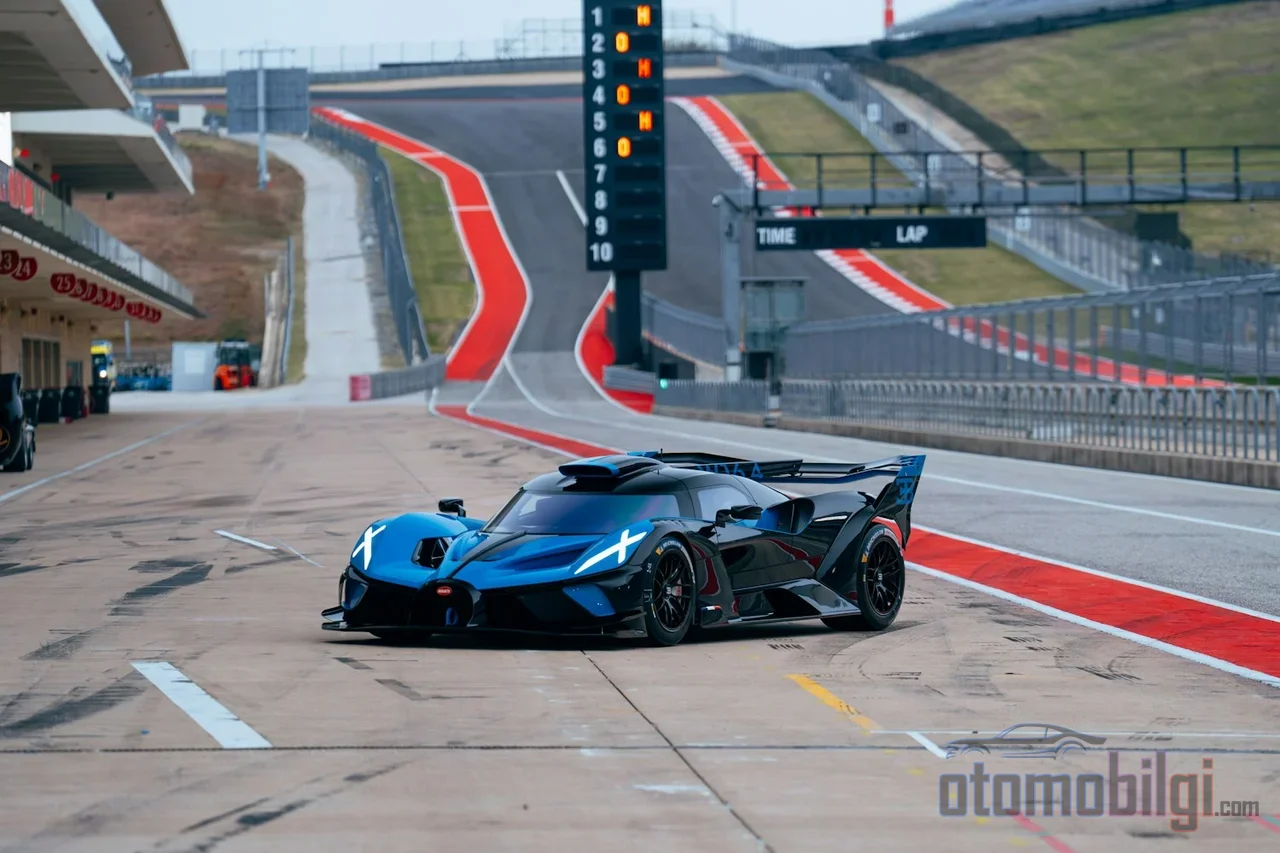
Version differences are once again decisive in acceleration figures. The production Bolide officially completes 0-100 km/h in 2.2 seconds (74 meters), 0-200 km/h in 5.4 seconds and 0-300 km/h in 11.5 seconds; top speed is electronically limited to 380 km/h. For the concept, a 0-100 km/h time of 2.17 seconds was announced; 0-200 km/h was projected at 4.36-4.4 seconds, 0-300 km/h at 7.4 seconds, 0-400 km/h at 12.1 seconds and 0-500 km/h at 20.1 seconds. The concept's theoretical top speed was stated to be above 500 km/h. The point to note is this: these long acceleration chains and the theoretical speed are projections belonging to the 1850 PS concept configuration; the delivered car has different power and speed limits.
The braking figures are striking: the production version completes a 300-0 km/h braking event in 6 seconds and within 228 meters; the 0-300-0 km/h cycle takes 17.5 seconds. The Bolide's lap times are based on Bugatti's computer simulations: 5:23.1 is projected on the Nürburgring Nordschleife; that is only 4 seconds slower than a lap of the Porsche 919 Hybrid Evo. The projected 3:07.1 on the Le Mans circuit is 7.6 seconds faster than the Toyota TS050. These lap times should be read as simulation results, not actual measurements.
Aerodynamics: An X Silhouette and Downforce Approaching Three Tonnes
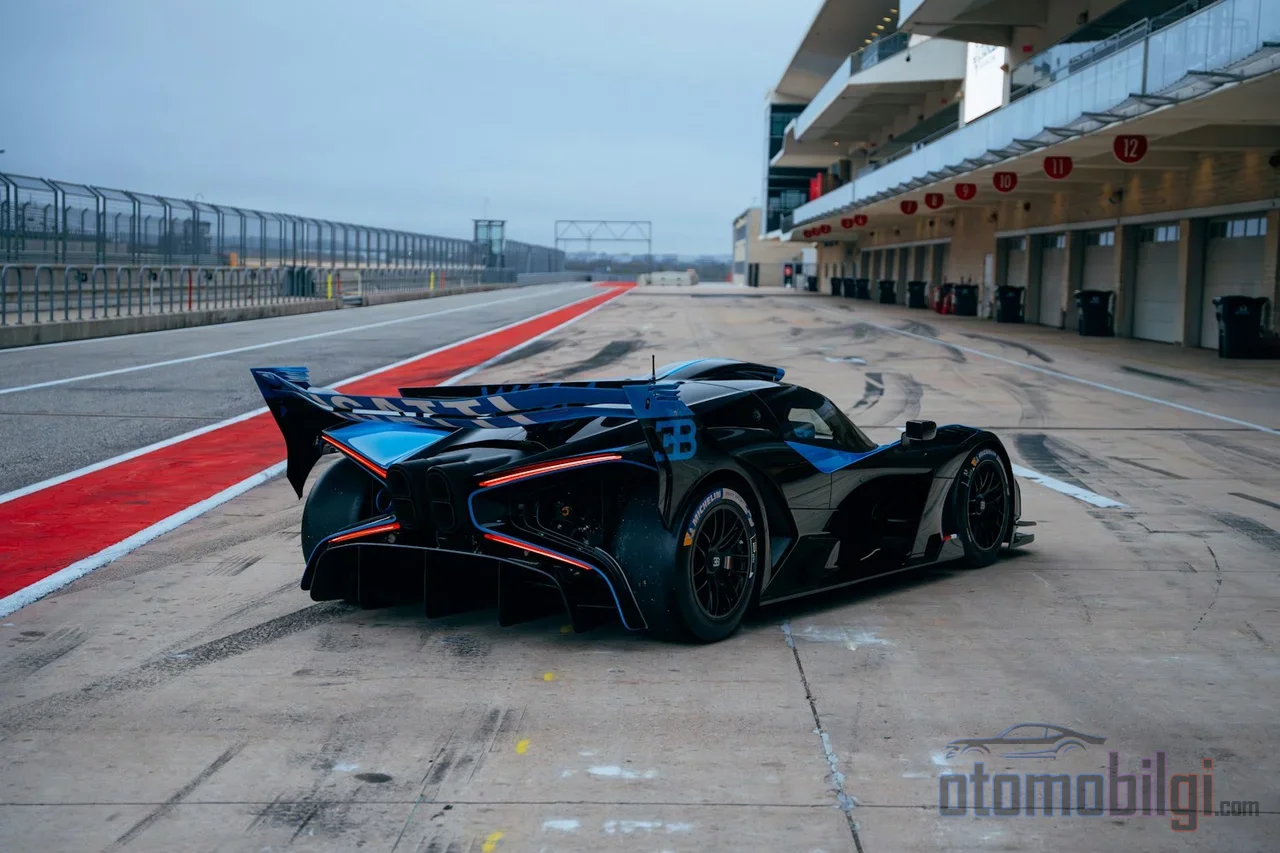
The Bolide's signature feature is the aerodynamic elements forming an X pattern at the front. The inspiration for this design language was the Bell X-1, one of the first aircraft to break the sound barrier. Golf ball-like dimples on the body surface improve aerodynamic efficiency. The vehicle's height of over 1 meter (1047 mm) is almost exactly identical to Bugatti's 1937 Le Mans car, the Type 57C; a long dorsal fin and a roof-mounted air intake are also among the solutions that recall track prototypes.
When we turn to the numbers, the picture becomes clear: the production version generates up to 2900 kg of downforce at 320 km/h and can withstand 2.5G of lateral cornering force. The distribution given in the concept announcement was 2630 kg of total pressure, comprising 1810 kg at the rear wing and 820 kg at the front at 320 km/h. These values bring the Bolide closer to the world of LMP1 prototypes rather than ordinary hypercars. Since no homologation requirements for road traffic were taken into account, the engineers were able to forgo any compromises in favor of downforce and cooling.
Weight Philosophy and Carbon Monocoque Construction
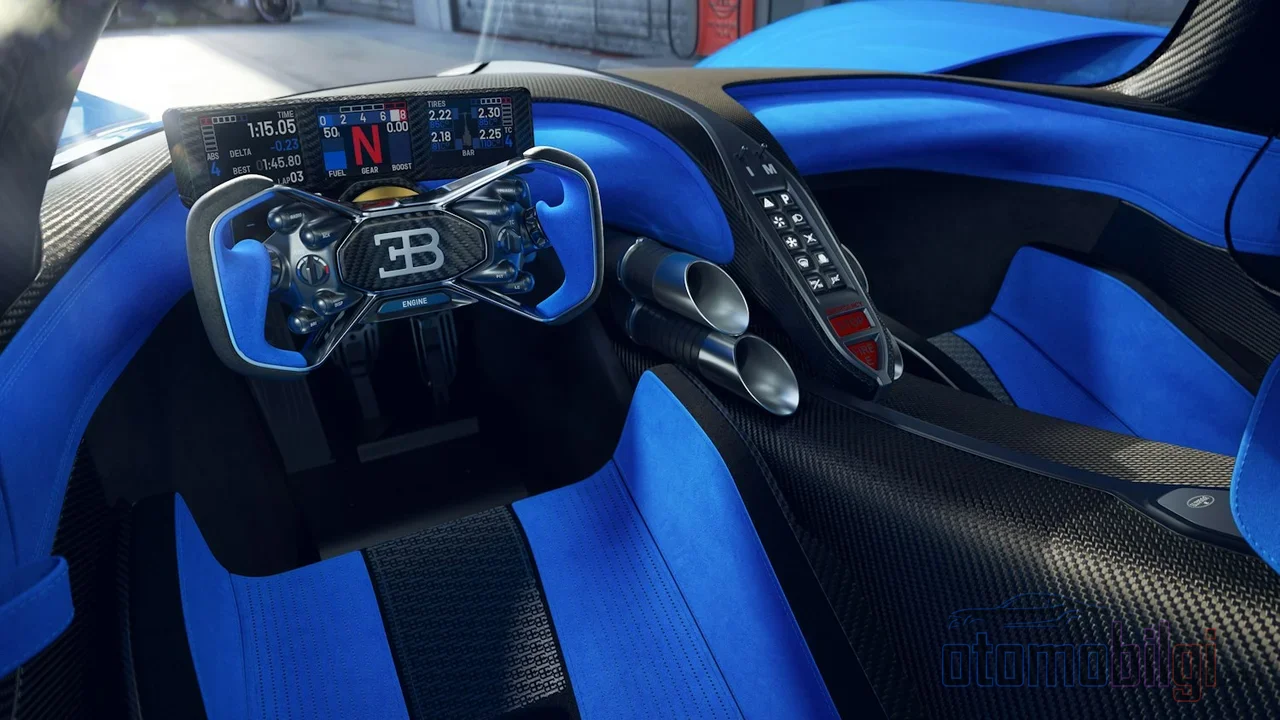
The engineering goal of the concept Bolide was to combine as much power as possible with as little weight as possible: 1240 kg dry weight and 1850 PS of power translated into a weight-to-power ratio of 0.67 PS per kilogram. The production version rose to 1450 kg due to the safety structure and reliability requirements; even that means a power-to-weight balance of around 0.9 kg/PS, notably lighter than the Chiron. Titanium-alloyed carbon construction is used in the monocoque and critical components, with carbon fiber used for the body panels.
At this point, the technical line that distinguishes the Bolide from other track hypercars such as the Pagani Huayra R Evo becomes clear. The Paganis carry relatively conventional naturally aspirated V12 engines and a philosophy focused on a balanced driving experience. The Bolide, on the other hand, is defined by a massive quad-turbocharged W16 and by absolute speed and simulated prototype lap times. Both approaches are valid for the track; one centers on the driving feel, the other on engineering extremes.
Technical Specifications: Bugatti Bolide
| Feature | Production Version (98 RON) | Concept (110 RON racing fuel) |
|---|---|---|
| Engine | 8.0 L quad-turbo W16 (7993 cc) | 8.0 L quad-turbo W16 |
| Power | 1600 PS @ 7050 rpm | 1850 PS (1360 kW) |
| Torque | 1600 Nm @ 3800-7050 rpm | 1850 Nm (2000 Nm in some records) |
| Transmission | 7-speed dual-clutch, AWD | 7-speed dual-clutch, AWD |
| 0-100 km/h | 2.2 s | 2.17 s |
| Top speed | 380 km/h (electronically limited) | Over 500 km/h (theoretical) |
| Weight | 1450 kg | 1240 kg (dry) |
| Dimensions (L/W/H) | 4835 / 2100 / 1047 mm | 4756 / 1998 mm (presentation figures) |
| Production | 40 units, 2024-2025 | A single concept car |
| Price | Approximately 4 million Euro | - |
Classic technical figures such as fuel consumption, CO2 emissions and trunk volume were never disclosed by Bugatti; since the Bolide never entered the road car homologation process, there is no official data in this category.
Road-Legal Conversions and Its Position in 2026
The Bolide's track-locked identity took an interesting turn in 2026. The British engineering firm Lanzante Limited ran a program to make at least two Bolides road legal; in July 2026, the first road-legal Bolide was unveiled at the Goodwood Festival of Speed. The conversion; includes extensive changes such as LED headlights, mirrors, license plate mounts, increased ground clearance, softened pushrod suspension, grooved road tires, high-flow catalytic converters, silenced exhaust, pedestrian protection and a remapped ECU/TCU. Naturally, performance recedes slightly. Bugatti, meanwhile, introduced Destrier in August 2026, its third one-off model based on the Bolide; with its spoiler-free rear design, this special production car keeps its 1600 PS W16 unchanged, taking the brand's track heritage in a different direction.
Conclusion: When Does the Bolide Produce 1850 Hp?
Short and clear answer: The Bugatti Bolide reaches 1850 PS and 1850 Nm only in its concept configuration, which is fed exclusively with 110 RON octane racing fuel; the production version, which runs on 98 RON pump gasoline, produces 1600 PS and 1600 Nm, and its speed is electronically limited to 380 km/h. So the 1850 horsepower in the title is an engineering scenario that depends on fuel choice, and it belongs to the concept's extreme point, not to the official specification of the 40 cars sold.
Beyond that, with its carbon monocoque structure, downforce capacity approaching three tons, and a body that meets Le Mans safety standards, the Bolide is an engineering document that thickens the line between hypercar and racing prototype. As the final carrier of the W16, it was delivered to 40 lucky owners; now its legacy is carried by special productions like Destrier and Lanzante's road-legal conversions.
Sources
- Bugatti Bolide
- Bugatti Bolide
- Bugatti Bolide Track-Focused Hyper Sports Car
- Bugatti W16 Engine - the last of its kind
- Bugatti Bolide 8.0 W16 (1850 Hp) AWD DSG
- 2022 Bugatti Bolide Specs, Performance & Photos
- Bugatti's Last W16-Powered Track Car Is Now Street Legal
- Bugatti Bolide, Pagani Huayra R & Zonda R take to the track
- The Bugatti Bolide is a mind-blowing 1824bhp track car