Koenigsegg Jesko Attack: The Downforce-Focused Monster
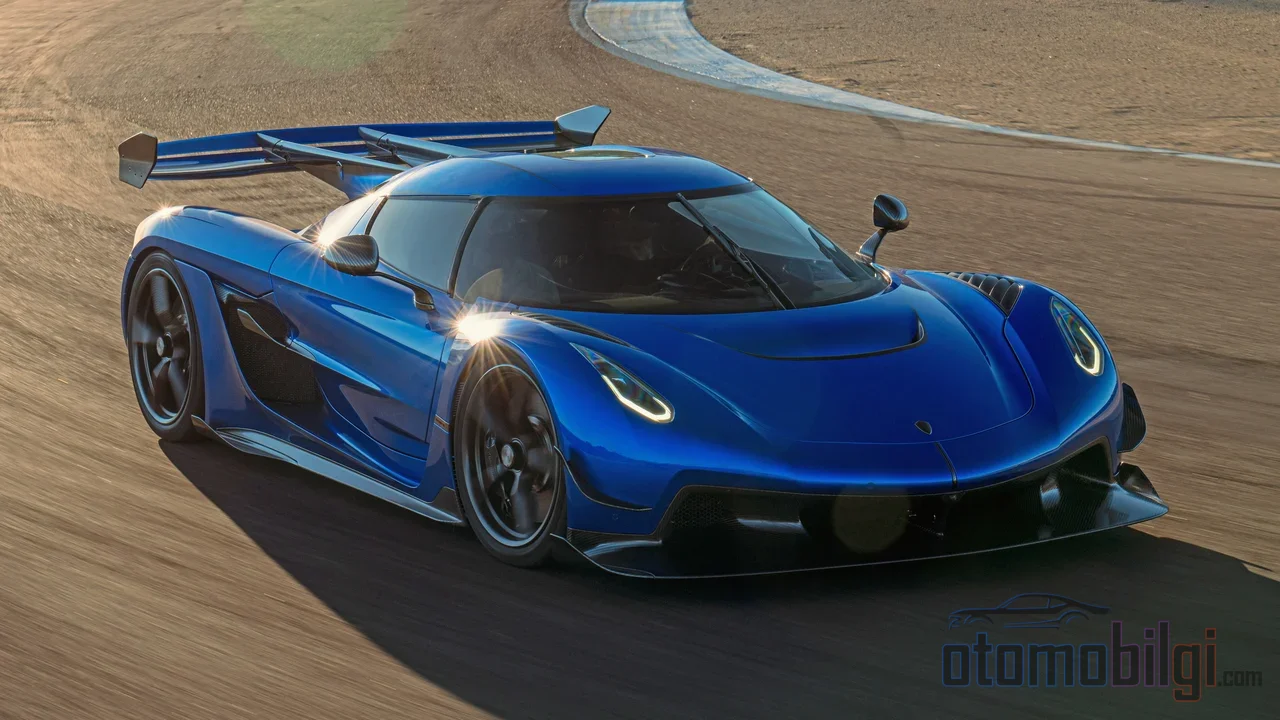
What determines how fast a hypercar can be on track is often not engine power; it is the force that presses the car into the road on corner exits. Koenigsegg demonstrated this clearly by splitting the Jesko into two opposite philosophies on a single platform: one minimizes drag for straight-line speed, while the other maximizes downforce. That is the story of the Jesko Attack - precisely the engineering breakdown of this second philosophy.
A bigger wing means more downforce, but drag also increases - this simple equation is the fundamental trade-off facing all hypercar manufacturers. The Attack is the version that clearly chooses the cornering side of this equation. So how much downforce does it produce, which mechanisms manage this force, and what did it translate to on track? Let's take a look in order.
Highlights
- Maximum downforce: 1,400 kg - only 150 kg in the Absolut version
- 5.0-liter twin-turbo V8: 1,280 hp on gasoline, 1,600 hp on E85
- 9-speed Light Speed Transmission: gear changes in 20-30 milliseconds without interrupting power
- Gotland Ring lap: 2:56.97 (November 2023, Niklas Lilja)
- Laguna Seca record: 1:24.86 (August 2024, Markus Lundh)
What Is the Jesko Attack and How Does It Differ from the Standard Jesko?
The Jesko is a limited-production mid-engine model developed by Koenigsegg as the successor to the Agera. It was introduced at the 2019 Geneva Motor Show and was completely sold out before the show had even ended. Total production is limited to 125 units; they are being built at a pace of 40-50 vehicles per year. It takes its name from Jesko von Koenigsegg, the father of the company's founder.
The Jesko family is divided into three variants: Attack, Absolut and Sadair's Spear. The Attack is the configuration focused on high downforce, featuring a large rear wing and an extended carbon fiber front splitter; track performance is its main goal. The Absolut does exactly the opposite: it replaces the wing with two rear fins, removes the splitter and side winglets, and lowers the Cd value to 0.278 with rear wheel covers and an 85 mm extended rear extension. In return, the Absolut's downforce drops from 1,400 kg to 150 kg - the difference between the two versions is not merely the shape of the wing, but the very purpose of the car.
The engine and transmission are identical in both variants; the divergence is concentrated entirely in the aerodynamic package. The Attack also carries Triplex dampers at the front and rear and, according to its manufacturer, offers grand tourer levels of comfort as well.
Active Rear Wing: The Anatomy of 1,400 Kilos
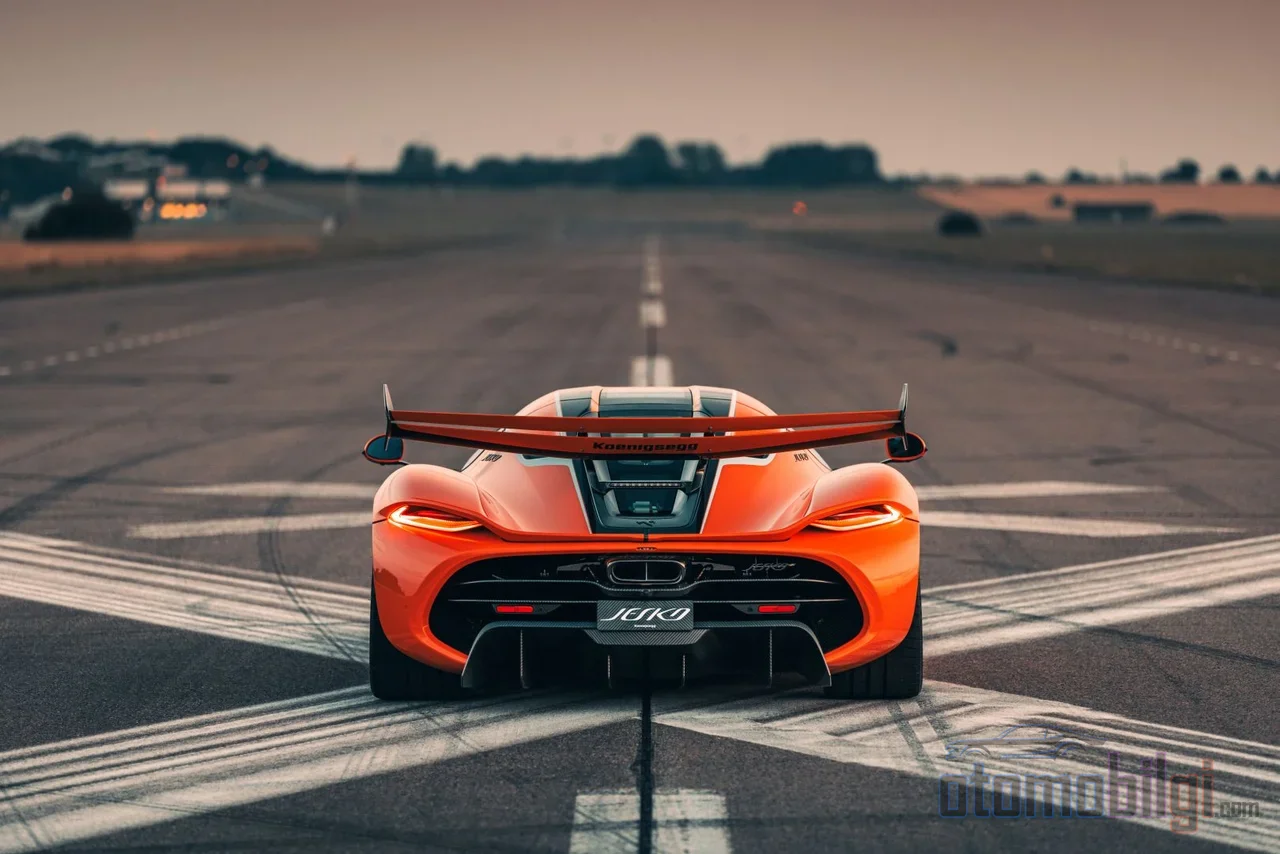
The Attack's signature is its roof-mounted, dynamic and active, twin-profile rear wing. This wing does not behave like a fixed racing wing; it changes its position according to speed and driving conditions, managing the balance between downforce and drag in real time. On straights, the wing lies flat to reduce drag, and on corner entry it stands up to increase the force pressing the car into the road.
Let's look at the numbers: total downforce reaches 700 kg at 250 km/h, 1,000 kg at 290 km/h, and 1,400 kg at maximum. For comparison, let us recall: this car, with a dry weight of 1,320 kg, can be pressed onto the road with more force than its own weight at a certain speed. This is an engineering outcome that directly increases the lateral force the tires can carry at cornering speeds.
The wing does not work alone. The extended front splitter, active and independently moving front underbody aero vanes, large diffusers, the front hood air dam, and the side front and sill vanes all serve the same purpose: to manage the airflow passing under the front axle, ensuring the balance fed by the rear wing finds its counterpart at the front. If downforce gathered only at the rear, it would create instability at high speed; that is why the entire package was designed together.
Supercharged V8: A 1,600-Horsepower Heart
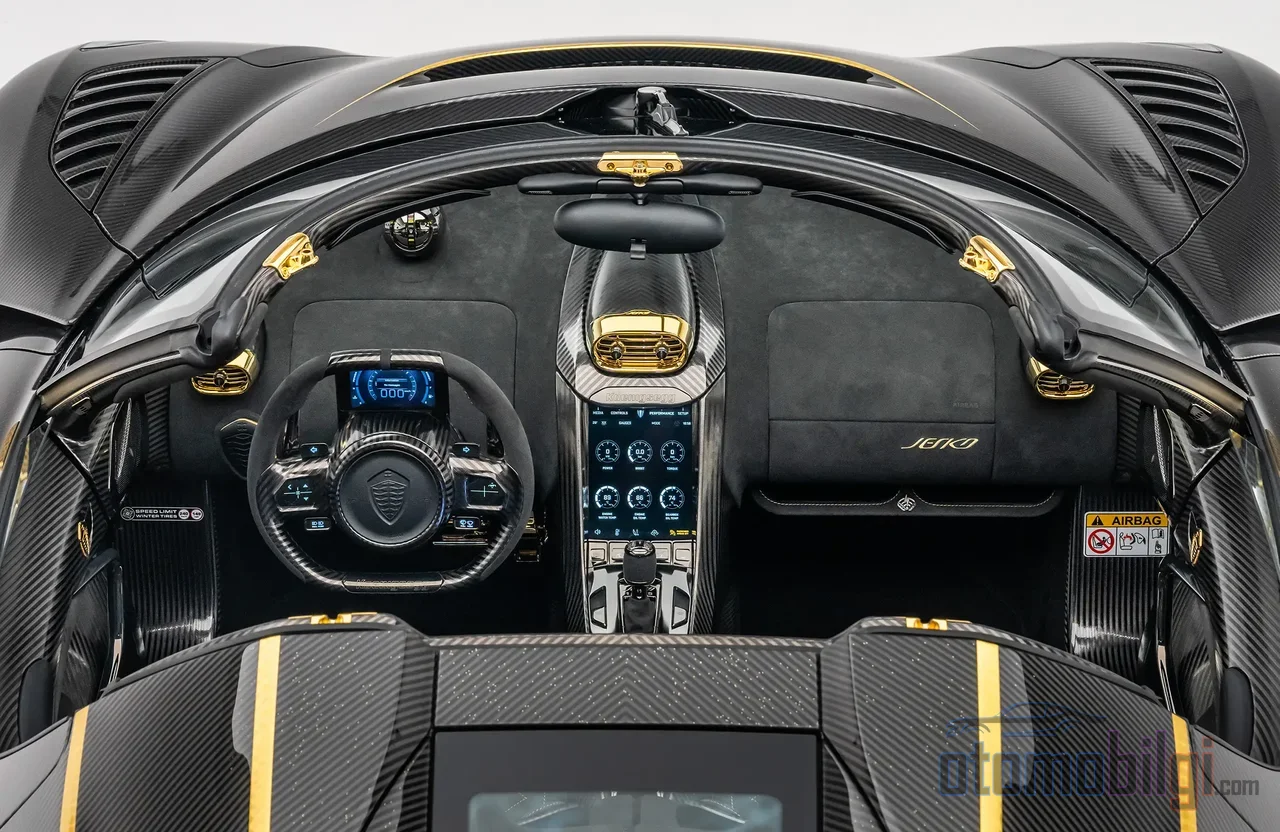
The Attack's engine is Koenigsegg's aluminum 5.0-liter twin-turbo V8. It uses four valves per cylinder, a flat-plane (180°) crankshaft, dual camshafts, and dry sump lubrication. The flat-plane crank, which can be considered a developed version of the unit in the Agera, saves 5 kg and raises the redline from 8,250 to 8,500 rpm. The engine's total weight is only 189 kg.
Power figures vary depending on the fuel: 1,280 hp @ 7,800 rpm on gasoline, 1,600 hp on E85. Torque remains constant in the 1,000 Nm band across the 2,700-6,170 rpm range; the peak figure is 1,500 Nm @ 5,100 rpm. The twin ceramic ball bearing turbochargers produce 1.7 bar of boost; on E85, this figure rises to 2.2 bar.
The compression ratio is a nuance that readers interested in technical details will have noticed: while the manufacturer's model page gives a value of 8.6:1, the technical specifications page states 9.0:1. Considering that a low compression ratio widens the knock margin in high-boost supercharged engines, the 8.6:1 figure is consistent with the engine's philosophy.
Two interesting solutions are in place against turbo lag: a 20-liter carbon fiber air tank and an electric compressor fill the turbo with 20-bar pressurized air, reducing lag. In addition, each cylinder has a pressure sensor, and the engine monitors the combustion process in real time on a cylinder-by-cylinder basis.
Light Speed Transmission: 9 Gears, 30 Milliseconds
In an era when dual-clutch transmissions are considered highly advanced, Koenigsegg developed a 9-speed multi-clutch unit called the Light Speed Transmission (LST). The unit weighs 90 kg and is at least 50% shorter than the previous 7-speed dual-clutch unit. Gear changes occur without any power interruption, in 20-30 milliseconds.
The most radical decision of the LST lies in its mechanical architecture: the crankshaft connects directly to the transmission, and the rotating mass of the transmission components takes over the role of the traditional flywheel. The system works together with the Koenigsegg Electronic Differential (KED) and Ultimate Power on Demand (UPOD). UPOD's function is simple but effective: rather than shifting sequentially, it can jump directly to the optimum gear. Being able to drop from 7th to 3rd from 7th gear to 3rd. makes a measurable difference in lap times.
Chassis, Dimensions and Technical Data
The foundation on which all this aerodynamic and mechanical load rests is a carbon fiber monocoque with an aluminum honeycomb structure; the fuel tanks are integrated into the structure. Torsional rigidity is at the level of 65,000 Nm/degree - a body that can transfer the wing's 1,400-kilogram force to the suspension would be meaningless without this rigidity.
| Parameter | Value |
|---|---|
| Engine | 5.0 L twin-turbo V8, flat-plane |
| Power | 1,280 hp (gasoline) / 1,600 hp (E85) |
| Torque | 1,500 Nm @ 5,100 rpm |
| Transmission | 9-speed LST, multi-clutch |
| Dry weight | 1,320 kg |
| Downforce (max.) | 1,400 kg |
| Length × Width × Height | 4,626 × 2,030 × 1,210 mm |
| Wheelbase | 2,700 mm |
| Torsional rigidity | 65,000 Nm/degree |
| Fuel tank | 72 L |
The suspension features Triplex dampers at the front and rear, with electronically adjustable gas-hydraulic shock absorbers operated by pushrods and adjustable ride height. The brakes are stated as Ø410 mm ceramic discs (6-piston) at the front and Ø395 mm (4-piston) at the rear. The wheels are 20"x9.5" at the front and 21"x12.5" at the rear; with the optional Michelin Pilot Sport Cup 2 R tires (265/35-20 front, 325/30-21 rear), the track-focused configuration is completed. The optional Aircore carbon fiber wheels reduce the front axle to 5.9 kg and the rear to 7.7 kg, lowering inertia.
There is an interesting detail about the dimensions: the Targa roof cannot fit in the 50-liter front trunk, because the Triplex damper system in the front area takes up that space. Nevertheless, the Attack offers 50-liter trunks at both the front and rear.
Proof on the Track: Gotland Ring and Laguna Seca Records
Downforce's real test takes place on the track, and the Attack has passed that test twice. In November 2023, with Niklas Lilja at the wheel, it set a record by completing a full lap of the 7.3-km Gotland Ring in 2:56.97; it left the Porsche 911 GT3 RS Manthey-Racing, which held the previous record, roughly 7 seconds behind.
In August 2024, it was Laguna Seca's turn. The car, lapped by Markus Lundh on Michelin Pilot Sport Cup 2R tires, broke the homologated production car record with a 1:24.86; it beat the 1:25.44 lap that had been held by the Czinger 21C since 2021. Two different tracks, two different records: high-speed stability stood out on the long and fast Gotland, while balance and braking capability prevailed at the technical Laguna Seca.
We must not pass without mentioning the same platform: the sibling version Absolut lowered the 0–400–0 km/h record to 27.83 seconds in June 2024, and then to 25.21 seconds in August 2025. The track-focused Sadair's Spear variant, introduced in June 2025, is reported to have beaten the Attack by 1.1 seconds at Gotland Ring; its production is limited to 30 units.
Price and Purchase Point: How Much Does the Attack Cost?
The Jesko's starting price is around 3 million dollars. Different figures appear in second-hand and sales listings for the Attack configuration: some listings show 3.5 million dollars, while a 2026 model Attack example has been listed at a price exceeding 6.3 million dollars. The limited production and the existence of pending deliveries are the main reasons for the second-hand premium.
Since it is track-focused, no official 0-60 mph figure has been announced for the Attack; such figures circulate as estimates on internet forums and should not be taken as official data. The speed announced by Koenigsegg is already a different definition: the speed at which the maximum 1,400 kg of downforce is achieved depends on the car's wing position.
Why Jesko Attack, Why Absolut? Short Decision Summary
Choosing between the two versions is, in fact, a choice of use case. Same engine, same transmission, same monocoque; the difference lies in how the car relates to the air:
- Attack: Active twin-profile rear wing, wide splitter, active front flaps; maximum 1,400 kg of downforce; for cornering speeds and lap times.
- Absolut: Two rear fins instead of a wing, an 85 mm long rear extension, Cd 0.278; maximum 150 kg of downforce; for straight-line speeds and speed records.
In short, the Jesko Attack is measurable proof of what can be achieved when a hypercar clearly chooses the downforce side of the drag trade-off: 1,400 kg of downforce, two track records, and a character entirely opposite to the straight-line speed version of the same platform. Koenigsegg's engineering claim is clearly on display here - two members of the same 125-car family, one designed to hold the air while the other is designed to cut through it.
Sources
- Technical Specifications - Jesko Attack - Koenigsegg
- Jesko | Koenigsegg (Attack model page)
- Koenigsegg Jesko - Wikipedia
- Jesko Attack Model Information - Koenigsegg Chicago
- Jesko Absolut Model Information - Koenigsegg Chicago
- Koenigsegg Jesko Attack Breaks Lap Record at Laguna Seca on First Try - Road & Track
- Koenigsegg Jesko Attack Sets New Lap Record At Gotland Ring - carandbike
- Official: the track-honed Koenigsegg Jesko is called 'Attack' - Top Gear
- Koenigsegg Jesko Attack: 300 mph, 3 Tracks Timed - LapMeta
- Koenigsegg Jesko Absolut rewrites the production car record books - autonext