McLaren W1: The Road Hypercar Inspired by the F1

If a car's name includes "1", it holds a special place in that manufacturer's history. McLaren hadn't given this letter to any of its models for more than a decade; after the F1 and the P1, it unveiled the machine worthy of a third use on October 6, 2024: the W1. But this is not merely the announcement of a successor; it is the meeting of ground-effect aerodynamics borrowed from Formula 1, a V8 producing 233 PS per litre, and a purely 20-kilogram electric module on the same carbon fiber tub.
How far did the W1 carry forward the path shown by the P1, and which engineering decisions gave it the highest power-to-weight ratio ever achieved by a road-legal McLaren? On this page, we examine the technical identity of the W1 layer by layer.
Highlights
- Total system output of 1,275 PS, torque of 1,340 Nm
- Dry weight of 1,399 kg; power-to-weight of 911 PS/ton
- 0-100 km/h in 2.7 seconds; top speed of 350 km/h
- Up to 1,000 kg of downforce at 280 km/h in Race mode
- Only 399 units produced; all of them already allocated
What Is the McLaren W1 and Why Is It the Third Link in the "1" Family Tree?

The W1 is a two-door, mid-engined, rear-wheel-drive hypercar developed by McLaren under the model code P18. It sits on the brand's MCLA (McLaren Carbon Fibre Lightweight Architecture) carbon fiber platform and is assembled at the Woking, Surrey facility in England. Production began in January 2026; the entire run of 399 units had already found owners even during the presentation phase. The price is approximately 2.0 million GBP - around 2.1 million dollars.
But what truly makes the W1 significant is not the numbers, but the family tree. The McLaren F1, with its production run of 106 units (including road and GTR versions), went down in history as both the first series-production road car with a full carbon fiber monocoque and the fastest naturally aspirated road car ever built. The P1, at 375 units, took the stage at Geneva 2013 as the first hypercar of its era with the most powerful hybrid drivetrain. The W1 is the third model to carry the "1" suffix after these two names - and McLaren describes being deemed worthy of it as a genuinely difficult threshold.
Hybrid Powertrain: Where Does 1,275 PS Come From?
The W1's total system output is 1,275 PS (938 kW), and this power is produced at 9,000 rpm; torque reaches 1,340 Nm at 4,500 rpm. The bulk of this total comes from an engine called the MHP-8: a 3,988 cc, 90-degree, twin-turbocharged V8 with a flat-plane crank. On its own, it produces 928 PS; the remaining 347 PS comes from the E-module mounted on the transmission.
MHP-8: Architecture Inspired by F1
The MHP-8 is a direct evolution of the previous 4.0-litre twin-turbo M840T V8, but a lighter unit. The most striking feature of the engine, developed by Ricardo, is its output of 233 PS per litre - the highest power/fuel specification McLaren has ever fitted to a road car. The choice of a flat-plane crank also traces back to Formula 1: the crank layout supports the engine's free revving and high-revving character.
E-Module: A 20-Kilogram Power Package
The electric side is designed very differently from classic hybrid setups. The radial-flux electric motor and motor control unit are combined in a single package; total weight is only 20 kg, an approach similar to what's found in IndyCar. The motor can rev up to 24,000 rpm and produces a specific output of 23 PS per kilogram - this is a reference-level efficiency for electric machines.
The 1.384 kWh battery offers an emission-free electric mode for up to 2 km and can be charged to 80% in 22 minutes. Other components of the powertrain include an 8-speed dual-clutch transmission (reverse gear is electric) and a hydraulic E-differential. Perhaps the most striking comparison is this: despite offering nearly twice the electric power compared to the P1, the hybrid components are 40 kg lighter.
Performance Figures: What Does 911 PS/ton Mean?
Dry weight 1,399 kg. At this weight, 1,275 PS means 911 PS per ton - the highest power-to-weight ratio ever measured in a road-legal McLaren. The acceleration figures confirm this ratio:
- 0-100 km/h: 2.7 seconds
- 0-200 km/h: 5.8 seconds
- 0-300 km/h: under 12.7 seconds
- Top speed: electronically limited to 350 km/h
Braking performance is just as calculated as the acceleration: a full stop from 100 km/h in 29 meters, and from 200 km/h in 100 meters. McLaren's reference is clear: the W1 is 3 seconds per lap faster than the Senna at the Nardò circuit, and is the brand's fastest-lapping, fastest-accelerating road-legal model to date.
| Specification | Value |
|---|---|
| Total system power | 1,275 PS @ 9,000 rpm |
| Total torque | 1,340 Nm @ 4,500 rpm |
| Dry weight | 1,399 kg |
| 0-100 km/h | 2.7 seconds |
| Top speed | 350 km/h (electronically limited) |
| Length / height | 4,635 mm / 1,182 mm |
| Wheelbase | 2,680 mm |
| Fuel tank | 62 liters |
Ground Effect Aerodynamics: How Is 1,000 kg of Downforce Generated?
At the heart of the W1's aerodynamic philosophy is full ground effect. This means generating downforce not only with wings, but also through the suction produced by air passing under the vehicle. The result: in Race mode, a total downforce of up to 1,000 kg at 280 km/h - 350 kg front, 650 kg rear. Behind this figure lie 350 hours of wind tunnel work and the analysis of 5,000 data points.
Race Mode and Active Long Tail Wing
When Race mode is selected, the vehicle lowers by 37 mm at the front and 17 mm at the rear, the heave suspension stiffens, and the active front splitter and rear wing deploy. The wing itself is no ordinary one: the structure called McLaren Active Long Tail is moved by four E-motors and can extend rearward by up to 300 mm; it also functions as both an air brake and DRS. The engineering team deliberately rejected a high-mounted rear wing solution; the goal was an aerodynamic package that escapes dependence on classic wings.
Aerocell and Anhedral Doors
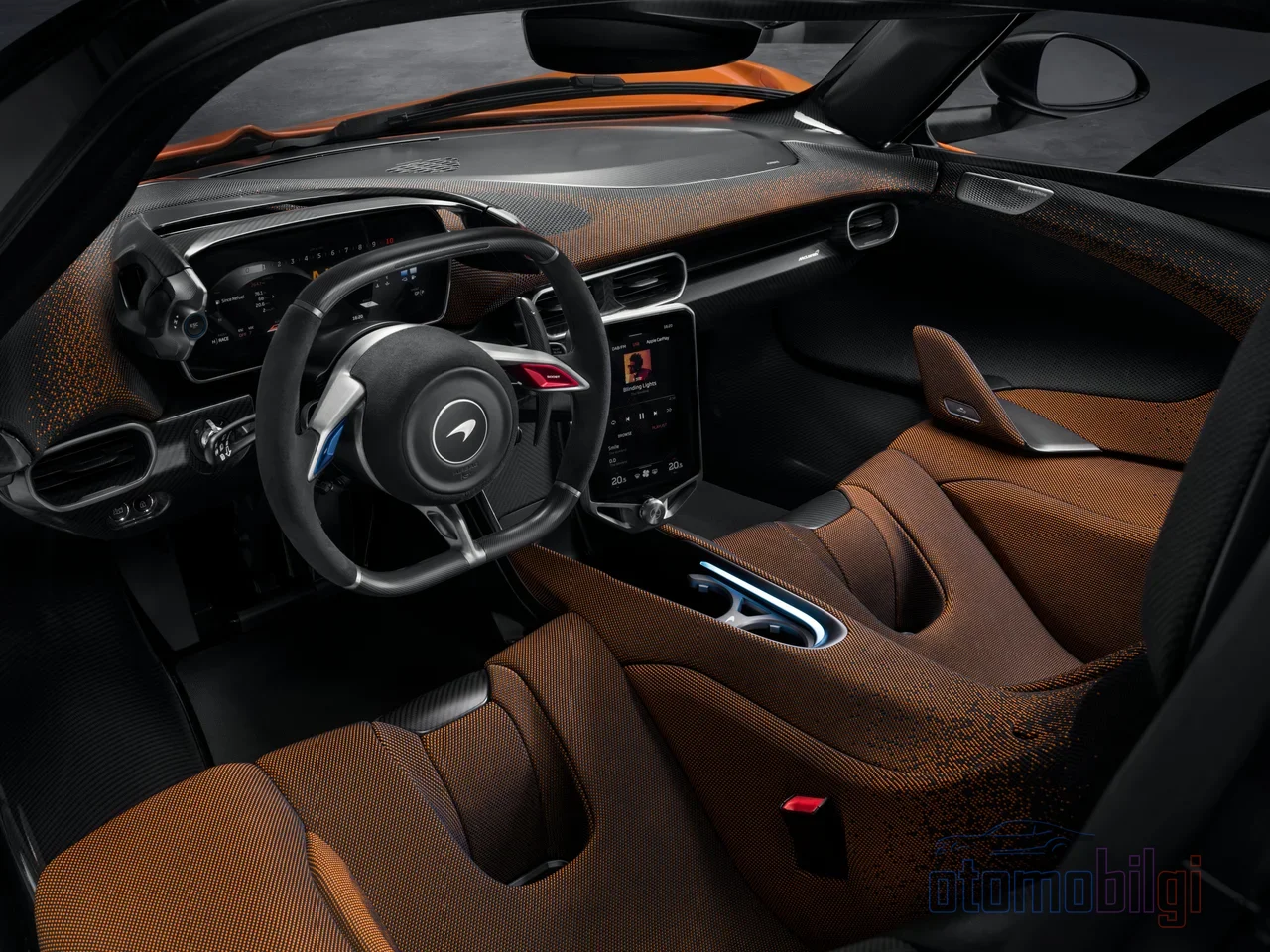
The skeleton that transfers downforce to the road is also inspired by F1. Aerocell is McLaren's lightest and most advanced carbon fiber monocoque to date; the seats are integrated with the monocoque and the front suspension is bolted directly to the carbon cell - a first in McLaren Automotive history. The anhedral doors are hinged from the roof only; this means there is no interruption on the side surfaces of the doors to disrupt airflow. The powertrain is mounted at a 3-degree angle, because it also serves to feed air to the rear diffuser. On the cooling side, three separate water-glycol circuits and a total of 10 heat exchangers are at work.
The tires: The First Super Tires Made from Bio-Based Materials
The W1 has three bespoke tires developed with Pirelli: the standard P Zero Trofeo RS, which is a road-legal track tire, the P Zero R, and the P Zero Winter 2. Sizes are 265/35 R19 at the front, 335/30 R20 at the rear. These tires carry another significance as well: they are the first super tires to contain more than 50% bio-based and recycled materials. The fact that a rubber designed to work at a 1,000 kg load and a 350 km/h speed barrier can carry this composition is a quiet milestone in tire chemistry.
Warranty, Ownership and Production: What the 399 Buyers Need to Know
The package awaiting the 399 owners who will put the W1 in their garages is transparently defined: a 4-year unlimited mileage vehicle warranty, a 6-year/75,000 km hybrid battery warranty for the battery, and a maintenance plan covering 4 years. Production began in Woking in January 2026, and all vehicles already have owners; meaning the W1 is no longer a machine to be hunted on the market, but one that will take to the roads.
Is the W1 Really the P1's Successor?
The answer to the question is clear at the official level: yes. The W1 is the third member of McLaren's "1" lineage and is positioned as the P1's direct successor. Looked at in numbers, it carries the succession claim: nearly twice the electric-side power the P1 offered, hybrid components 40 kg lighter, the highest specific output in the brand's history at 233 PS per liter, and a performance envelope at Nardò that outpaces the Senna by 3 seconds per lap. Assessments of the design language are more measured: the W1's aggressiveness is far from the Senna's exaggeration, yet more assertive than the Artura's; not an indisputable work of beauty, but a form dictated by function.
The question it answers is this: to bring Formula 1 technology to the road, how much can you borrow from carbon fiber, how much from electricity, and how much from the air? The W1's answer is 1,399 kg, 1,275 PS and 1,000 kg of load - and when these three numbers come together in the same car, it becomes clear why McLaren did not hand the "1" letter to anyone for a decade.
Sources
- McLaren W1 | Specs, Speed, Engine, Interior
- McLaren W1 (2026) - pictures, information & specs
- McLaren W1
- W1 breaks the ceiling of road car aerodynamics
- McLaren Aerocell: Meet the team behind W1's monocoque
- Pirelli equips McLaren W1 with first supercar tyres made from more than 50% bio-based and recycled materials
- 2025 McLaren W1 revealed
- Ricardo congratulates McLaren on the reveal of the new W1 supercar
- 2026 McLaren W1: What We Know So Far
- From F1 To W1: The Evolution Of McLaren's Hypercar Royal Family