Ferrari F80: A 1200-Horsepower Hybrid Revolution
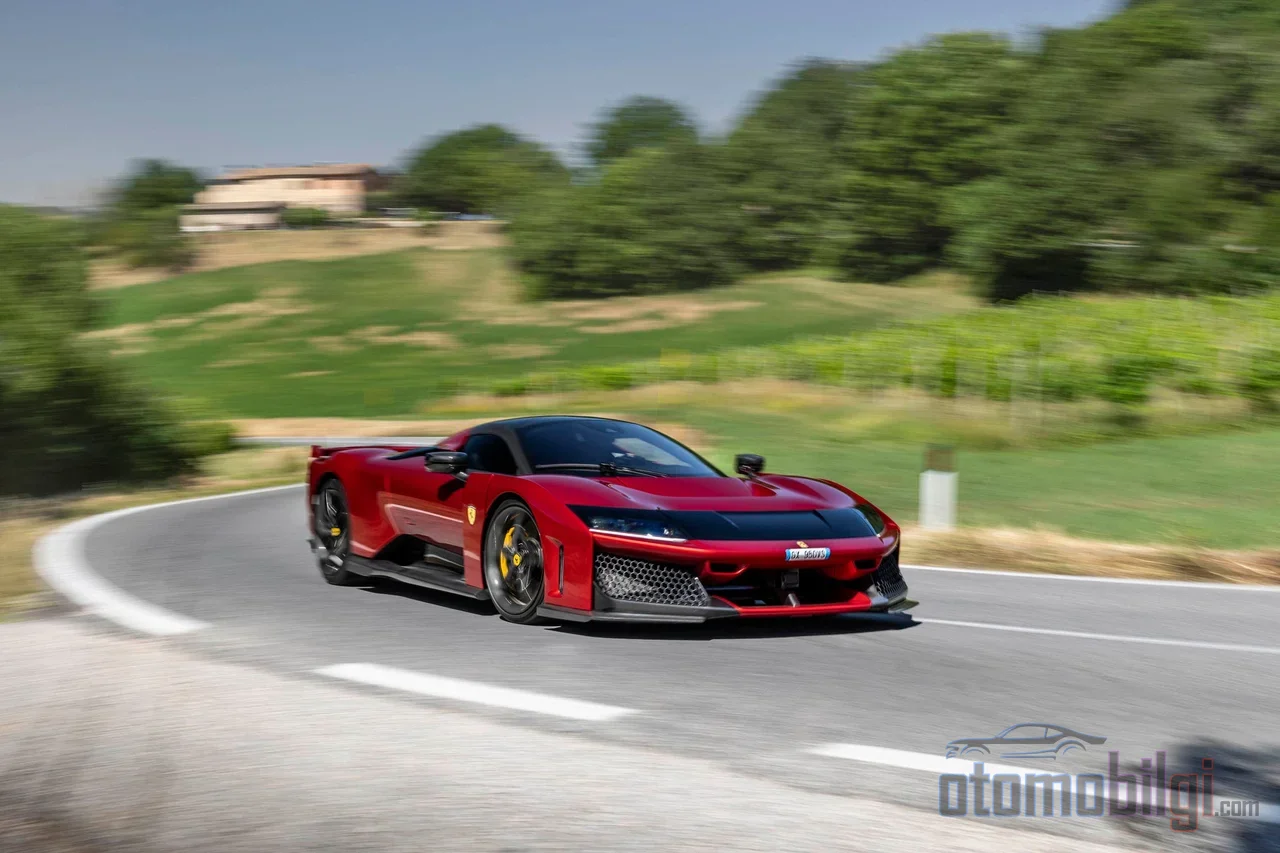
After a half-century hiatus, Ferrari has placed a new name at the top of the hypercar hierarchy: the F80. Unveiled on October 17, 2024, this car is not only the model succeeding the LaFerrari; it also breaks the brand's power record among its road cars. But the truly intriguing question is this: why did a twin-turbocharged V6 with half the cylinders replace the LaFerrari's screaming V12? And how did Ferrari build a 1,200-horsepower system around this engine?
The answer lies not in a single number, but in an engineering chain. The 900 horsepower produced by the internal combustion engine is completed to 1,200 by three electric motors; the 1,000 kg of downforce pressed under the body at 250 km/h entrusts the car's grip on the road not to mechanical traction but to the laws of physics. Production is limited to 799 units, and nearly all of them were already allocated to existing Ferrari customers before the unveiling.
Ferrari F80 Technical Specifications: The Big Picture in Numbers
Summarizing the key figures that define the F80 at a glance is a good starting point for evaluating the engineering decisions in the following sections. The values below combine Ferrari's official data with measurements shared by independent technical reviews.
| Specification | Value |
|---|---|
| Total system power | 1,200 PS (approximately 1,184 hp in SAE terms) |
| Internal combustion engine | 3.0-liter, 120° twin-turbocharged V6, 900 hp |
| Electric motors | 3 units, 300 PS in total |
| Torque | 627 lb-ft (approximately 850 Nm) |
| 0-100 km/h | 2.2 seconds |
| 0-200 km/h | 5.8 seconds |
| Top speed | 350 km/h |
| Downforce | 1,000 kg (at 250 km/h) |
| Production count | 799 |
| List price | approximately €3.6 million / $3.9 million |
The unit confusion around the power figure should be clarified right away: Ferrari speaks in terms of 1,200 PS; when US sources convert it to the SAE standard, that value drops to approximately 1,184 hp. Same machine, different ruler - the essence of the data doesn't change, only the measurement system.
Highlights
- Ferrari's most powerful road car to date with a combined output of 1,200 PS
- 1,000 kg of downforce at 250 km/h - a first for a Ferrari road car
- 0-100 km/h in 2.2 seconds, top speed of 350 km/h
- Production limited to just 799 units; continuing until 2027
- Carbon fiber monocoque, 3D-printed suspension components
The V6's 900 Horsepower: An Engine Pushing Specific Output to 300 hp/liter
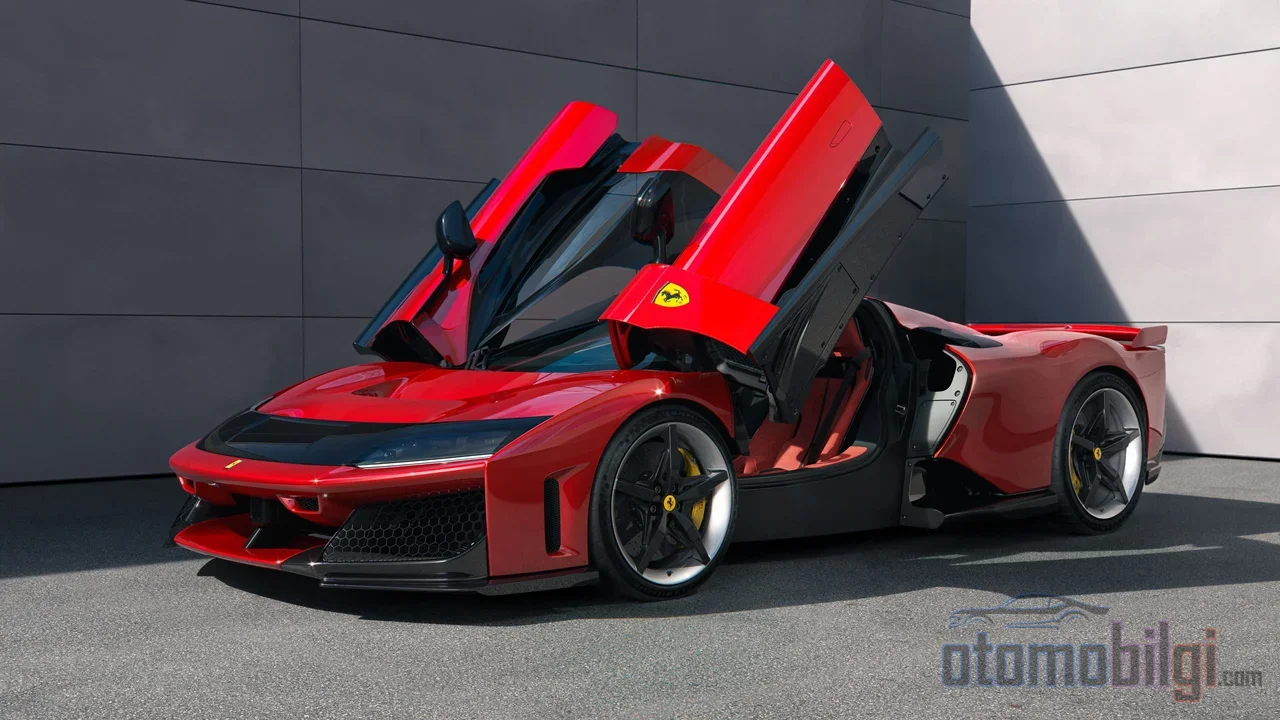
At the heart of the F80 is a 3.0-liter V6 coded F163CF. The 120-degree cylinder angle is this engine's signature; this architecture allows the exhaust manifolds and turbocharger assemblies to be packaged between the cylinder banks, lowering the internal combustion engine's center of gravity to the lowest possible point. On its own, the engine produces 900 hp; 300 hp per liter is a specific power density you wouldn't expect from a manufacturer that doesn't only target the road or the track.
The rev range is also part of its track heritage: The engine revs up to 9,000 rpm. This rev limit on a turbocharged engine shows that Ferrari designed the V6 from scratch with racing engineering logic. Power flows to the wheels through the rear-mounted 8-speed dual-clutch transmission.
MGU-K: A Triple Duty Borrowed from Formula 1
The electric motor on the rear axle is called the MGU-K - Motor Generator Unit-Kinetic - and the name is no accident: the component is conceptually derived from Formula 1's energy recovery system. The MGU-K performs three jobs at once. It starts the engine; it charges the battery by converting kinetic energy into electricity during braking; and it assists the internal combustion engine at full throttle. It operates with a peak power of 70 kW (95 cv) in regenerative braking and 60 kW (81 cv) in boost support; its operating voltage is in the 650-860 V range. The entire system is built on a high-voltage network with an 800V architecture.
e-4WD: Two Motors on the Front Axle, Mechanical Drivetrain at the Rear
The other two electric motors are located on the front axle, one for each wheel; each produces 140 hp. Ferrari calls this setup e-4WD: the drivetrain on the front axle is fully electric, while the one at the rear is mechanical. The result is an all-wheel-drive system where torque vectoring can be controlled with millimeter precision. The energy storage is a lithium-ion battery of approximately 1.5 kWh; it is fed by a 3.3 kW charging unit. The compact battery capacity shows that the car's entire electric side is focused on performance support - that is, short-duration maximum output rather than long range.
Active Aerodynamics: How Is 1,000 kg of Pressure Generated at 250 km/h?
For a road vehicle to produce downforce close to its own weight is one of the most challenging goals in automotive engineering. Ferrari states in its press release that the F80 generates 1,000 kg of downforce at 250 km/h - a level never before seen on a Ferrari road car. It is important to specify the speed range at which this figure applies: the value defines the car's aerodynamic map in the high-speed region; on a city street, this pressure does not exist.
The three main elements producing the pressure can be evaluated. The first is the triplane front wing and S-duct arrangement; the second is the active rear wing, i.e. planes that change angle according to speed and driving mode; the third is Ferrari's 1,800 mm long rear diffuser - the company positions it as a record length in its class. The low-pressure area beneath the diffuser presses the body onto the road without any extra moves on the wings; the active wing, in turn, minimizes the drag sacrifice at low speed and maximizes grip at high speed. This trio is the technical expression of the balance between track and road.
Carbon Monocoque and Active Suspension: Why Does Weight Matter?
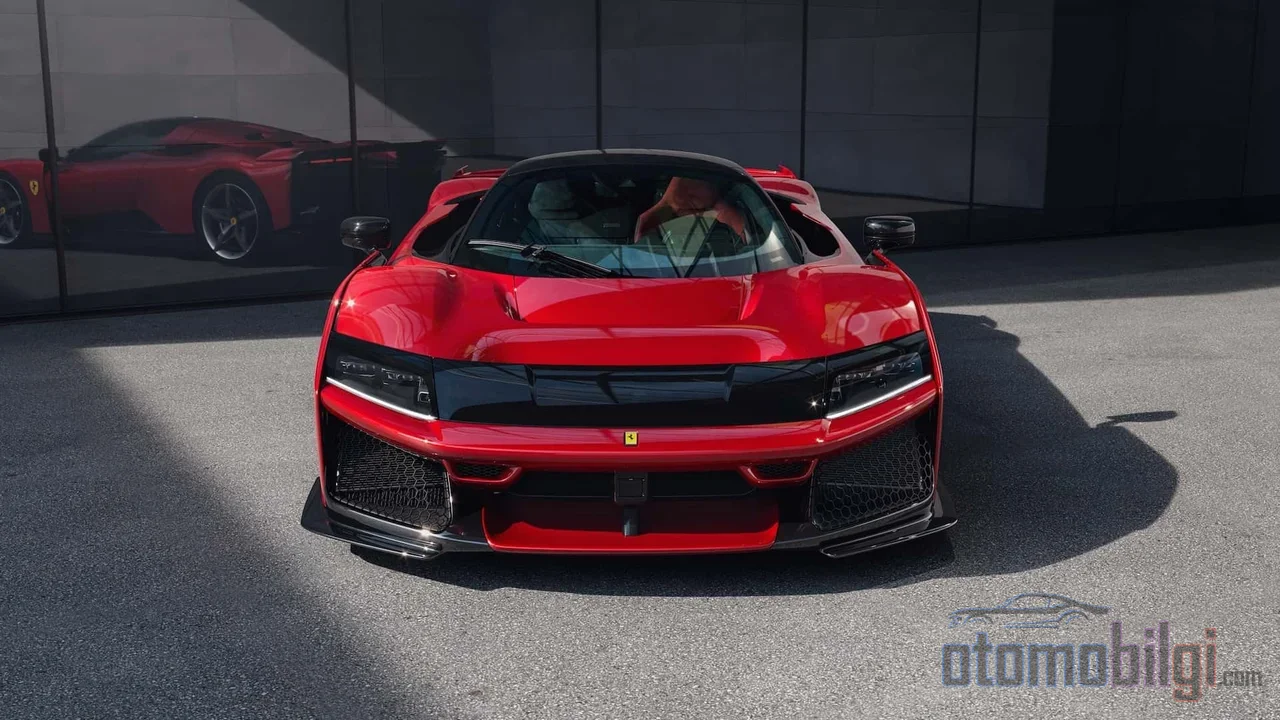
The precondition for putting 1,200 PS onto the road is a body that carries this power without buckling. The F80's shell is a carbon fiber monocoque; aluminum subframes are used in the underpinnings. Even more striking detail is in the suspension: some of the components are produced using 3D printing. Additive manufacturing makes possible geometries that classic casting and machining methods cannot shape, and ensures the parts carry material only where they actually bear loads.
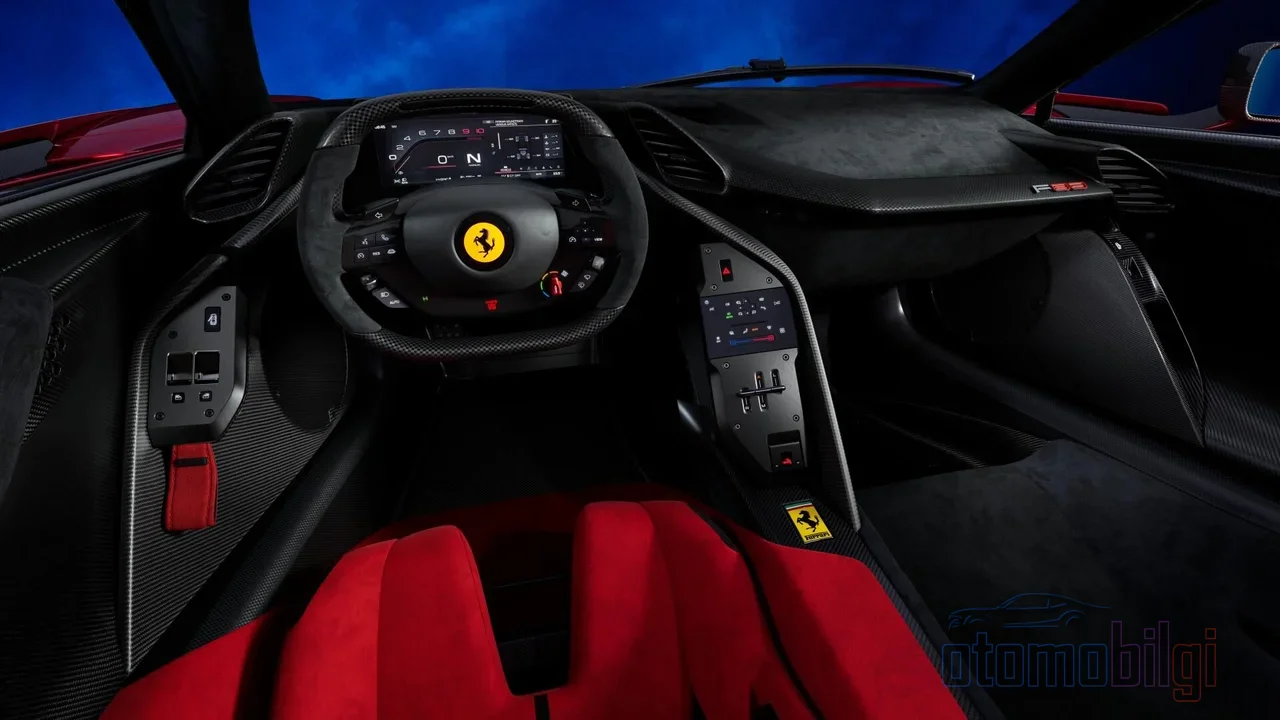
At the four corners of the suspension, 48-volt electric motors control damper stiffness instantly. This active setup sets off with a character that flexes on the track's kerbs and stiffens when entering a straight. Dry weight is approximately 1,525 kg; curb weight estimates come on top of that with fuel and fluids. Inside the cabin, it is focus, not luxury, that speaks: the passenger seat cannot be adjusted and consists of nothing more than a minimal pad fixed to the carbon tub. Ferrari calls this layout "1+". There is no conventional infotainment screen either; there is only a digital instrument panel and a small console screen for climate control.
The hardware list nevertheless includes what is needed for daily usability: automatic emergency braking, Adaptive Cruise Control, lane keeping assist and automatic high beam. On the warranty side, Ferrari is generous - a 3-year unlimited-mileage general and powertrain warranty, plus 7 years of unlimited-mileage free maintenance. This picture shows that the car is designed to be kept in regular use, not just as a garage object.
Why Is the V6 Choice Divisive? Comparison with the LaFerrari
Moving forward with half the cylinders of the LaFerrari's V12 could be read as a chromosome change for an iconic successor. On the sound and grandeur side, filling the V12's place is simply not possible; the segment that debates this regards the V6 hybrid choice as a loss of originality. However, on the engineering side the defense is more concrete: designing the V6 from scratch gave the freedom to optimize the weight distribution and center of gravity to a degree that would be incomparable with the old architecture. Short, compact and low - this trio lays the foundation of the F80's traction and rotational dynamics.
On the heritage side, it should not be forgotten that the line does not come only from the LaFerrari: Ferrari also positions the F80 as a continuation of iconic models such as the 288 GTO. References in the design language to 1970s endurance racing and technology from the consecutive victories at Le Mans make this lineage tangible. So the V6 is not a constraint; it is the expression of an engineering philosophy flowing from the motorsport program to the road car.
799 Units and Closed Doors: How Is the F80 Bought?
The F80's marketing strategy is as worthy of discussion as the product itself. Production is limited to 799 units, and before the reveal nearly all of the cars had been reserved for existing Ferrari customers. The list price in Europe is approximately 3.6 million EUR; in the USA the base price is $3,735,000, and in the United Kingdom approximately 3 million GBP before options. To whom Ferrari allocated the cars was never officially disclosed; in this market, cars are not "ordered", they are offered. The first customer delivery took place in Japan; the first car in Europe drew attention as a gift to a United Kingdom billionaire. Production will continue until 2027.
Demand is being carried far beyond the list price. As of 2026, off-market requests are trading in the range of $5.5-7 million; build slot prices are at a level of approximately $6.4 million. A German dealer had put a €5.9 million tag on a car not yet built, including a premium of approximately $2.5 million over the list price. As of September 2026, the program is closed to new commissions; Ferrari's next hypercar news will be about singular special productions, not extra F80s. On the other side of this rise, claims are also circulating: Ferrari denied published claims that there were unsold slots and announced that all 799 units have been allocated. The weight of the official statement points to a market that is rock solid.
Track Monster or Street Car? Being Both at Once
The F80's real test is carrying two characters in the same body. In road evaluations conducted in Italy, the car was found to be incredibly capable on the track, while remaining surprisingly approachable on the street. The brake system is the clearest proof of this dual character: evaluations show that the system has surprising stopping power and offers a consistent pedal feel without heat-induced fade - being able to brake with the same confidence throughout a track day means the line between a road car and a track car is blurring.
On the fuel consumption side, the picture is the natural consequence of 1,200 PS: in the WLTP cycle, the combined CO2 value is 307 g/km; consumption values vary between 12.9 and 23.5 l/100 km depending on the driving profile. These figures are not a measure of efficiency, but of maximum performance - the F80 exists not with an efficiency claim, but with an output claim.
The conclusion of the story is clear: Ferrari F80 chose to carry LaFerrari's legacy not in cylinder count, but in engineering intensity. When a V6 fed by the racing program, a high-voltage hybrid network, downforce never before seen in a road car, and a strict customer selection strategy combine, the resulting car carries the balance between track and road to a point further than its predecessors. The F80's real revolution is not the 1,200 horsepower itself; it lies in the way this power has been made usable on the road.
Sources
- 2026 Ferrari F80 Review, Pricing, and Specs
- F80: Ferrari's New Supercar - Official Press Release
- Ferrari F80 - Ferrari.com
- Ferrari F80: 1200hp V6 Hybrid and Technical Details Explained
- Ferrari F80 - Wikipedia
- Ferrari F80 Review: Driving a Future Fantasy
- Ferrari F80 UK Delivery, Allocation and Price Explained
- Ferrari F80 Price
- Ferrari F80: Thanks to Hybrid with 1200 HP