Bugatti Mistral: Not Chiron's, But Its Own Path
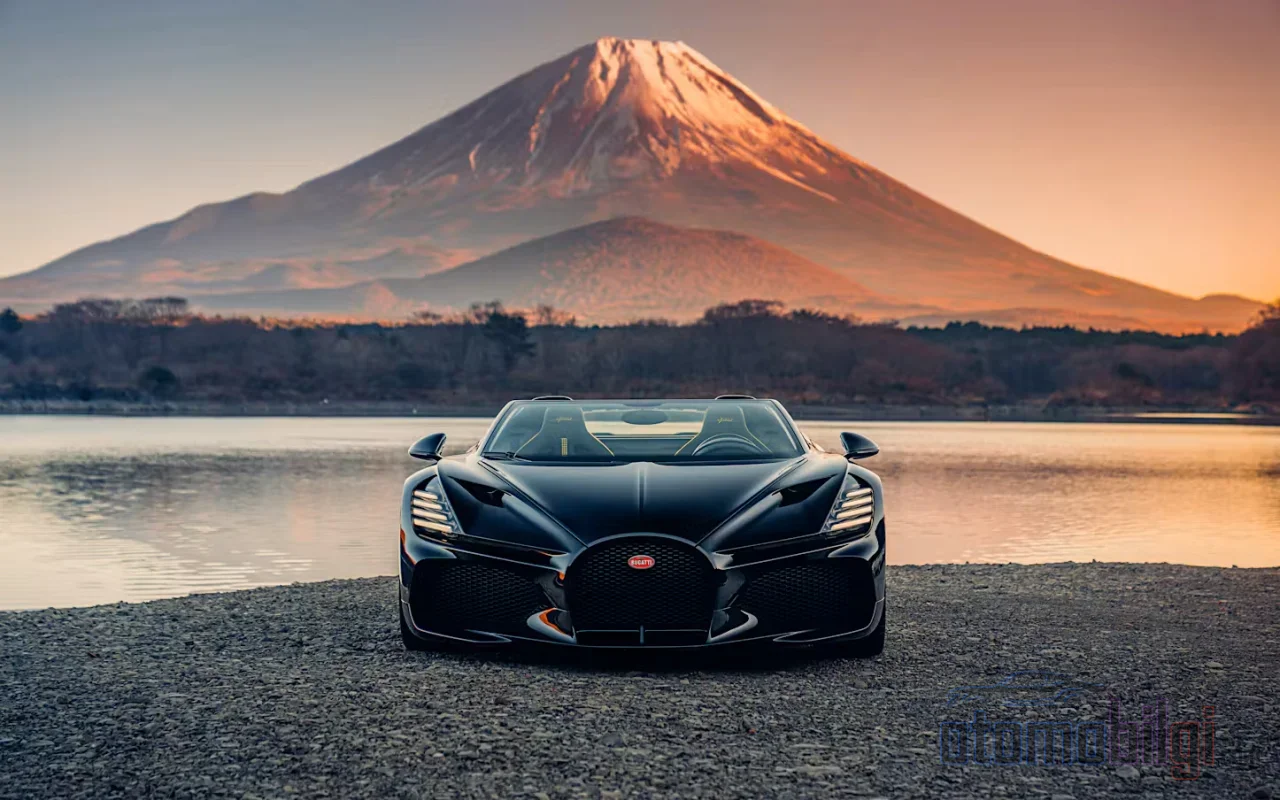
In November 2024, at Germany's Papenburg test track, a roadster set an independently verified world record at 453.91 kilometers per hour. Its roof was open; in front of it sat an 8.0-liter quad-turbocharged W16 engine, and behind it lay a closing date for an era. The Bugatti Mistral is not merely the product of an obsession with speed; it is a calculated farewell, designed as the final road-going hypercar of the internal combustion W16 era. So what engineering decisions make it possible to place a 1,600 PS engine into a targa-bodied car and use it safely above 420 km/h?
What Is the Mistral: Not a Chiron Convertible, But a Standalone Model
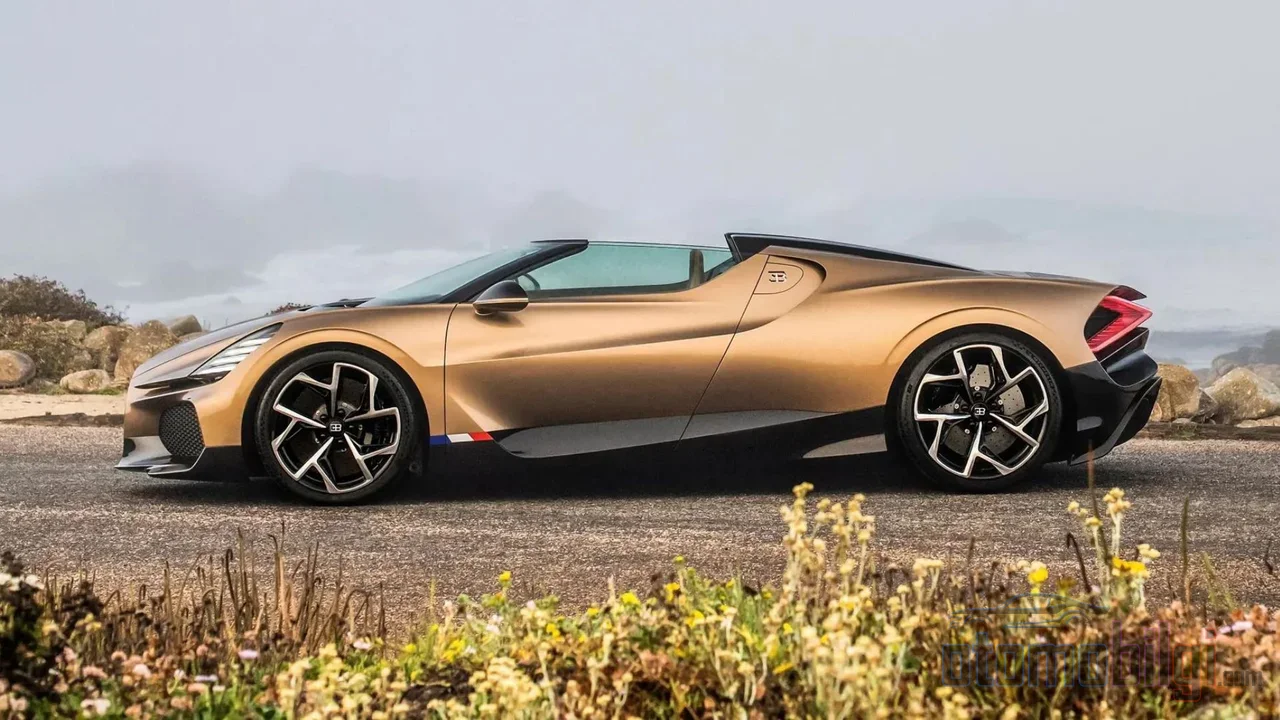
Let's clear up the most common misconception right away: The Bugatti Mistral is not an open-top version of the Chiron. Although its chassis is based on the Chiron, its exterior design is entirely unique to the Mistral - a two-door, two-seat standalone roadster. The car was unveiled on August 19, 2022, production took place in Molsheim between 2024 and 2025, and the total run was limited to 99 units. Each unit was ordered at a price of 5 million euros, meaning the entire production sold out before it had even begun.
This limited production carries a meaning: The Mistral is the last Bugatti road car to carry the W16 engine. This engine architecture, which began with the Veyron in 2005 - formed by joining two narrow-angle VR8 blocks at 90 degrees - is being retired with the Mistral. When the 99th and final car left Molsheim in 2025, the W16 era officially came to an end.
Key Highlights
- 8.0-liter quad-turbocharged W16 engine producing 1,600 PS and 1,600 Nm of torque
- Total production of 99 units, all sold for 5 million euros before production began
- World speed record for open-top cars at 453.91 km/h in November 2024
- Top speed 420 km/h; 0–100 km/h completed in 2.4 seconds
- The last Bugatti road car to use the W16 engine; its successor is the hybrid V16-powered Tourbillon
Technical Package: The 1,600 PS W16 and the Chassis
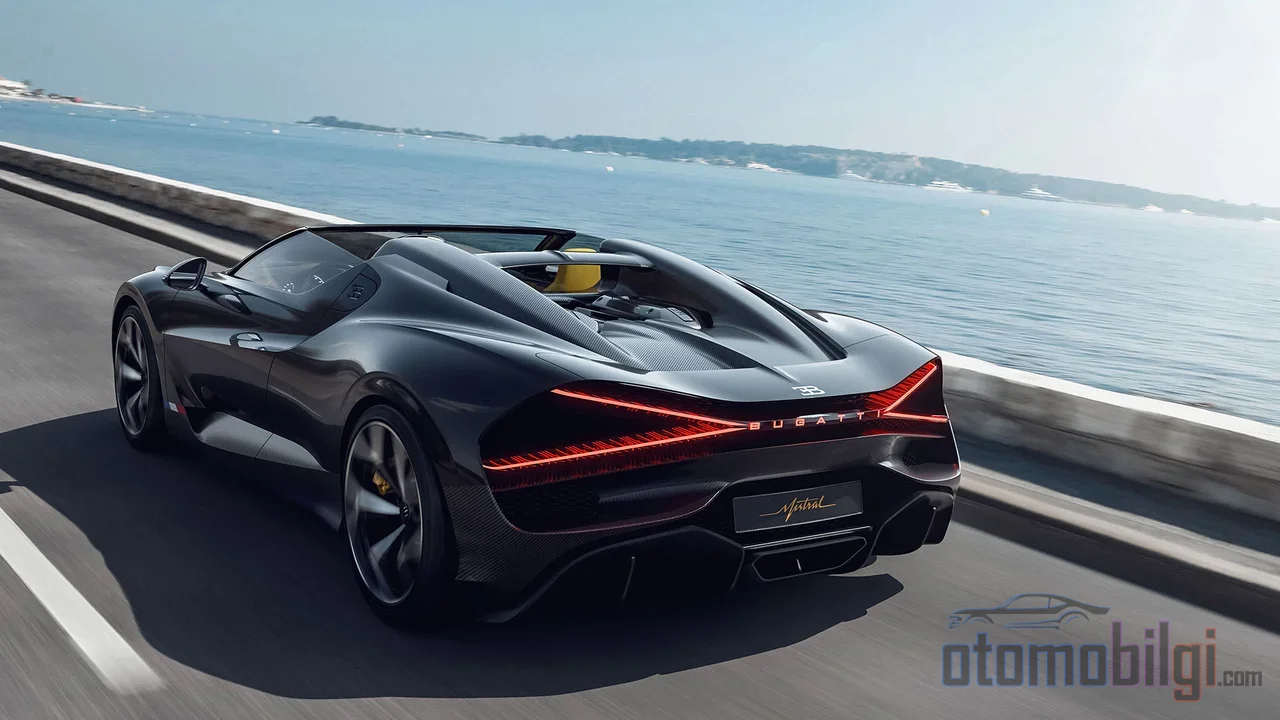
At the heart of the Mistral lies the high-output unit from the Chiron Super Sport 300+: The 7,993 cc W16 engine, quadruple-turbocharged. This unit produces 1,177 kW, i.e. 1,600 PS and 1,600 Nm of torque. Power is sent to a permanent all-wheel-drive system through a 7-speed DSG dual-clutch transmission. The performance figures are the logical result of this package: 0–100 km/h acceleration in 2.4 seconds, with a top speed of 420 km/h. With a curb weight of approximately 1,960 kg, the body measures 4,544 mm in length, 2,162 mm in width and 1,212 mm in height; the wheelbase is 2,711 mm.
| Specification | Value |
|---|---|
| Engine | 8.0 L quad-turbocharged W16 |
| Power | 1,600 PS (1,177 kW) |
| Torque | 1,600 Nm |
| Transmission / drive | 7-speed DSG / permanent all-wheel drive |
| 0–100 km/h | 2.4 seconds |
| Top speed | 420 km/h |
| Production count | 99 |
| Production period | 2024–2025 |
The Balance of Thermodynamics and Aerodynamics in an Open Body
The real engineering question here is this: With an open-top body, how do you manage the heat load of a 1,600 PS engine while at the same time maintaining aerodynamic stability above 420 km/h? Bugatti's answer takes shape in several design decisions. The expanded, three-dimensional horseshoe grille feeds the high-temperature engine radiator from a single intake; the side intakes, meanwhile, only supply air to the intercoolers. This separation ensures the cooling circuits do not interfere with each other.
The curved windshield is shaped to create a cowl effect; the air vents have been moved to the ceiling, above the passengers' heads. This arrangement not only regulates cockpit airflow, but also enriches the sound coming from the engine. One of the critical thermodynamic functions is at the rear: The X-shaped light signature, inspired by the Bolide track car, goes beyond an aesthetic choice and allows hot air to be shed over the mechanicals.
Design Language: Four LED Strips, X Lights and the Dancing Elephant
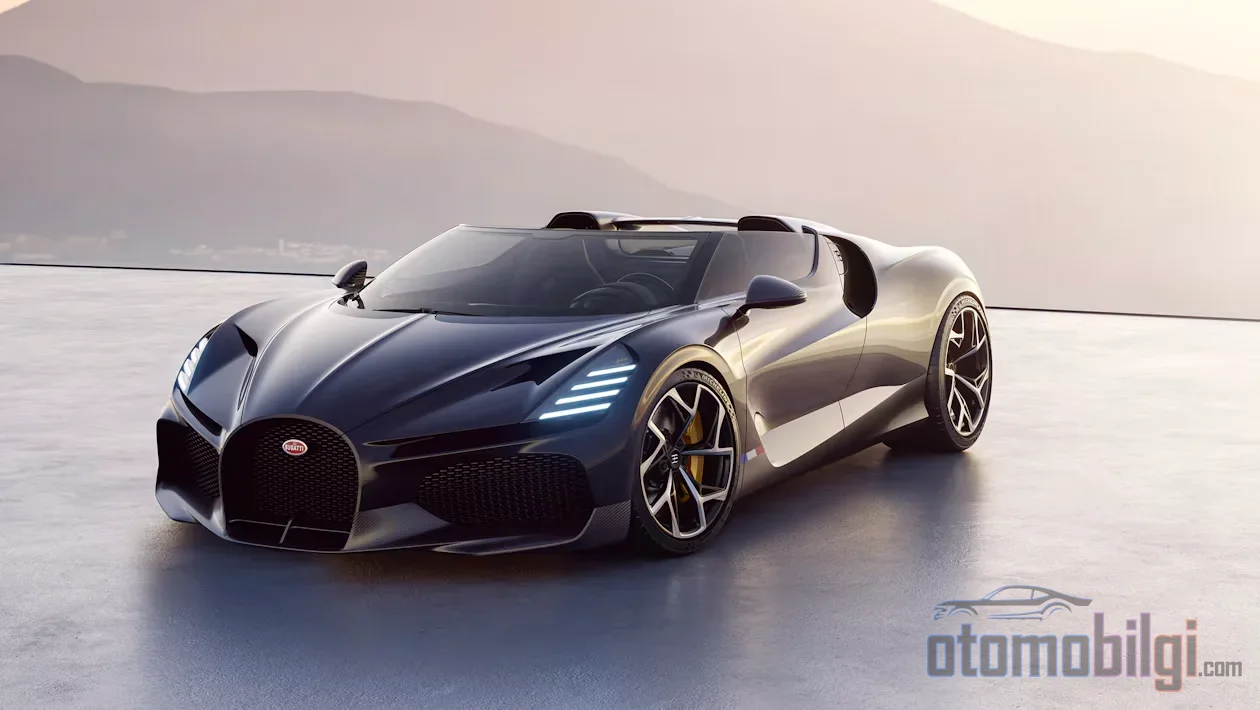
The design team consisted of Frank Heyl, design director Achim Anscheidt and Florian Westermann. The four diagonal LED strips in the headlights are a nod to the car's technical identity: the all-wheel-drive system and four turbochargers. At the rear, the X-shaped taillights can also be read as two arrows pointing to the Bugatti logo.
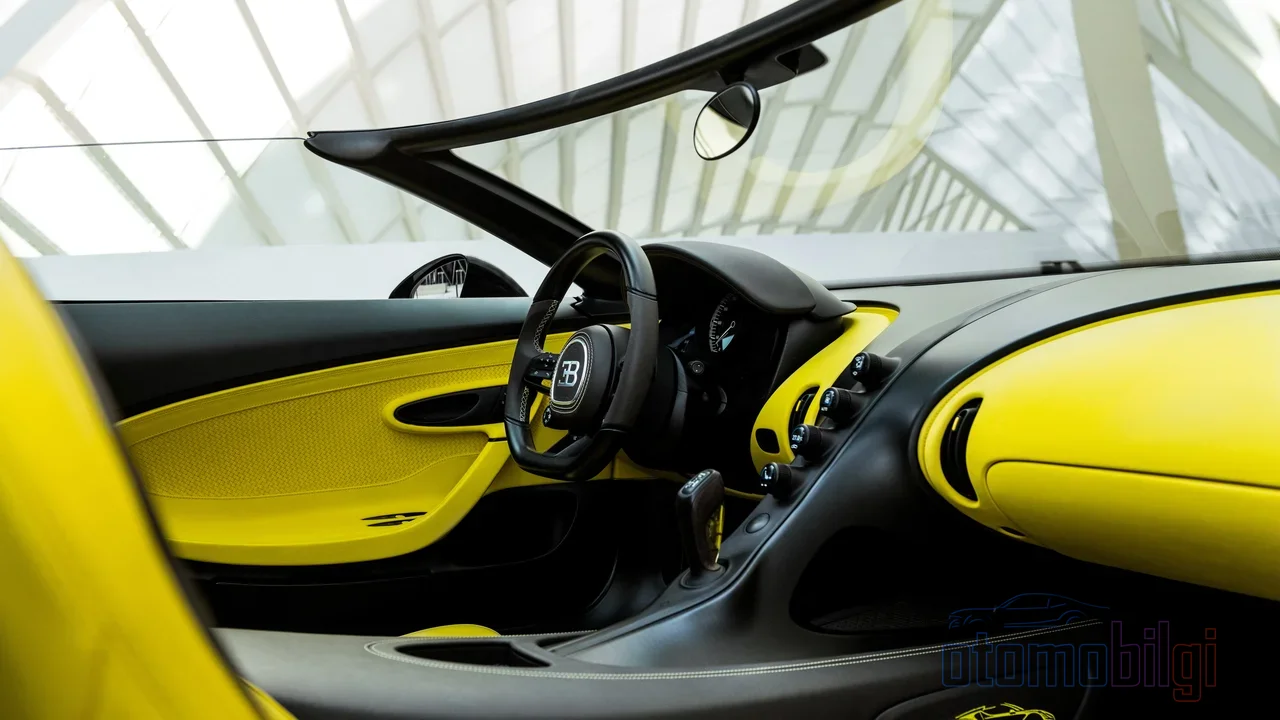
The interior keeps the Chiron foundation but stands apart with a characteristic detail: the gear lever holds an example of Rembrandt Bugatti's Dancing Elephant sculpture - the sculptor brother of Ettore Bugatti - in amber. Mistral also lived through one-off versions; one of them was a special example called Blanc Éternel, in porcelain white with a hand-painted thin black stripe.
453.91 km/h: The Open-Top World Speed Record
The record attempt at Papenburg on November 9, 2024 was the pinnacle of the Mistral's story. The driver entered the banked corner section of the curved track at 200 km/h and progressively unleashed full power. The result: The open-top car world speed record of 453.91 km/h (282.04 mph) was verified by an independent organization. With this figure, the Mistral joined the tradition of record-breaking Bugattis that began with the Veyron and Chiron.
The frame of comparison matters: the 2013 Veyron 16.4 Grand Sport Vitesse, the previous Bugatti roadster, had a top speed of 409 km/h. Despite the aerodynamic and structural disadvantage of the open body, the Mistral exceeded that value by roughly 45 km/h - measurable proof of both the engine's high output and the body engineering.
The End of the W16 Era and the Transition to the Tourbillon
The Mistral's real story is captured here: Bugatti's transition to its hybrid future. Its successor, the Tourbillon, introduced from 2024 onward, is the new generation that replaces the W16 with an entirely different philosophy: a naturally aspirated V16 engine, no turbochargers, plus a hybrid power unit added on top. The Tourbillon's top speed is announced as 276 mph (approximately 444 km/h), 15 mph higher than its predecessor; its total output stands at the 1,800 hp level. This figure takes Bugatti into territory where it competes directly with the 1,914 hp electric Rimac Nevera.
Of course, the W16 legacy is not closing completely. Bugatti positions the Bolide–Mistral–Tourbillon trio as its long-term automobiles and continues to provide after-sales service to Veyron and Chiron owners. Under the Programme Solitaire umbrella, the one-off Brouillard coupé derived from the Mistral and the F.K.P. Hommage, a tribute to Veyron's architect Ferdinand Karl Piëch, were introduced; both vehicles use the 1,600 PS W16 engine.
Market Status and Deliveries
Customer deliveries began in early 2024; vehicles were distributed to markets in Europe, the UK, the USA, the Middle East, and Central Asia. Due to US regulations, all Mistrals destined for the USA had to be delivered before 2026. Production was completed in 2025; as of 2026, the second-hand market value is reported to be around 8-10 million dollars - a notable increase in value compared to the starting price of about 5.3 million dollars.
The Significance of the Bugatti Mistral: Why This Car Matters
To summarize briefly: The Mistral is a hypercar that carried the 8.0-liter quad-turbocharged W16 engine to a road car for the last time with 1,600 PS, of which only 99 units were produced, and which holds the world speed record for open-top automobiles at 453.91 km/h. It is not Chiron's convertible, but an independent roadster based on it yet speaking with its own design language; with its targa-style open body, X-shaped light signature, and four-strip headlights, it represents one of the most extreme points of Bugatti design.
In the bigger picture, the Mistral's place is clear as a threshold vehicle: on one side, the turbocharged W16 era that began in 2005 and extends from the Veyron to the Chiron; on the other, the hybrid Tourbillon era where the naturally aspirated V16 and electric motor combine. The Mistral sits exactly between these two eras, at the point where the farewell and the record are experienced at the same time. It was possible to see Bugatti's massive internal combustion engine on the roads one last time, this loudly, this fast, and in such small numbers - and its 99 owners ordered it fully aware of exactly that.