How Did Matra Win Three Consecutive Victories at Le Mans?
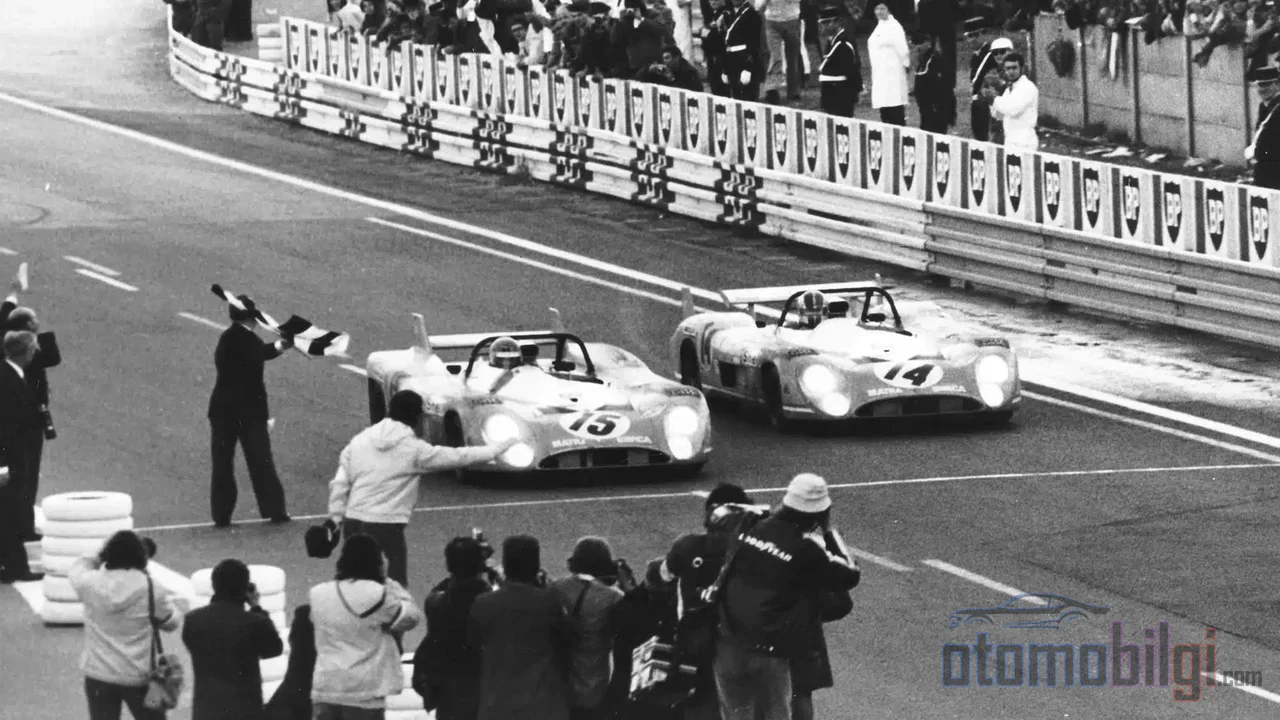
On a June night in 1972, the grandstands at Le Mans were about to go crazy. The car taking to the track before the eyes of the French crowd is a blue-and-white Matra - and behind the wheel is Henri Pescarolo. Just imagine: In 1968, the man who drove alone through the night in the rain with a broken wiper; In 1969, the man whose car was smashed to pieces in a test crash - but who came back. Now the same man stands on the verge of carrying a country that had been unable to win overall victory for more than 20 years to triumph. How, you ask? This story is exactly the answer to that question.
Matra's three consecutive victories at La Sarthe between 1972 and 1974 are one of the least-told factory stories in Le Mans history. We all know the Ford-Ferrari war, the Porsche 917 legend, Audi's dominance. But that French trilogy in between? Most people only know it by hearsay. Yet here we have both an aerospace company's passion for racing, a V12 bearing Georges Martin's signature, and a driver's stubborn comeback on top of it all. If you're ready, let's begin.
How Did an Aerospace Company End Up on the Race Tracks?
First of all, the name itself is a clue: Matra is an abbreviation of Mécanique Aviation Traction. So the company was founded in 1945 to build aircraft. Then in the early 1960s things change when CEO Jean-Luc Lagardère buys Automobiles René Bonnet - aircraft engine engineers suddenly find themselves in the middle of a sports car project.
In 1967, Matra set an open goal: both a Formula 1 championship and a Le Mans victory with a completely French machine. And they were serious: In 1969, the F1 championship with Jackie Stewart is celebrated with an official ceremony. The Le Mans side, however, would be a longer-running adventure.
The first sports cars, the MS620 and MS630, hit the track in 1966-67 with BRM and Ford V8 engines. By 1968, a rule change opens the door: prototype engines were limited to 3 liters. For Matra this was an opportunity - because now they could use an engine of the same displacement as F1 in two arenas at once. That's aerospace company logic for you: one engine for two projects.
Highlights
- Matra won Le Mans three years in a row in 1972, 1973 and 1974.
- Georges Martin's design 3.0-liter V12 produced ~450 hp in the MS670.
- Henri Pescarolo was behind the wheel in all three victories.
- With the 1972 victory, Graham Hill became the only name to complete motorsport's Triple Crown.
- In the same period, Matra also won the manufacturers' championships in 1973 and 1974.
Georges Martin's V12: Building the Heart
Now let's talk a bit of engineering, but don't worry, I'll go with analogies. Matra's racing heart is the 3.0-liter V12 designed by Georges Martin and produced by Moteur Moderne. The technical specifications are as follows: 60-degree bank angle, dual overhead cams, four valves per cylinder. What does all this mean in simple terms? The 60-degree angle is a classic V architecture that keeps the engine both compact and balanced; the dual cams and four valves open up the engine's breathing like a runner's lungs - more air at high revs, more power.
The development curve is interesting too: the endurance version initially produced ~385 bhp, rising to 410 bhp in the MS650 era, and reaching ~450 hp and 405 Nm by the time of the MS670. That's a power increase of over 15% within a few years - achieving this in endurance racing means doing it without compromising reliability. Referred to by the codes MS72 or MS73 depending on the version, this engine was in fact a member of the same family as the F1 unit, adapted for endurance.
The MS640 Tragedy and Pescarolo's Comeback
Every great story has a breaking point; Matra's came around 1969. The MS640 designed by Robert Choulet was a project prepared with its low-drag closed body especially for high-speed tracks like Le Mans. But in its first test, Pescarolo had a very serious crash. The car was never rebuilt and the project was shelved. Perhaps the most promising car of a racing program was buried on day one.
Even thinking about this period of Pescarolo's life sends shivers down the spine: In 1968 he made his name driving a Matra with a faulty wiper on a rainy night; 1968 and 1969 were the years he suffered serious crashes. At Le Mans in 1968, together with Servoz-Gavin, they climbed to 2nd place in the V12-powered MS630 - that is, until a tire blew in the 22nd hour and caused a crash. In 1969, the MS650 finished fourth. They were getting close, but it just wasn't happening. In the era of the 5-liter Porsche 917 and Ferrari 512, the team, still racing under the Matra-Simca name, got the MS660 with its monocoque chassis ready for Le Mans in 1970. The pieces were starting to fall into place. One more move remained.
MS670: The Machine of Three Victories
In 1972, the MS670 signed by Bernard Boyer took the stage: a Group 5 prototype, replacing the MS660C. Its technology was a hybrid construction: fiberglass body, aluminum monocoque, and double-wishbone suspension at the front. Just imagine - a fiberglass body as light as the material of a table tennis racket, and an aluminum monocoque as load-bearing as an aircraft fuselage. That's how you can tell it was an aviation company.
The weight melted away a little more each year: 700 kg in 1972, 678 kg in 1973, and 675 kg in 1974. Wheelbase: 2,558 mm. In 1972 the gearbox was Matra's own 5-speed unit; in 1973-74, a Porsche-sourced 5-speed manual. Yes, you read that right - there was a French team that took a gearbox from Porsche and then beat Porsche.
| Year | Car | Drivers | Notable Result |
|---|---|---|---|
| 1972 | MS670 | Hill / Pescarolo | Victory - by one lap |
| 1973 | MS670B | Pescarolo / Larrousse | Victory - ahead of Ferrari and Porsche |
| 1974 | MS670C specification | Pescarolo / Larrousse | Victory - third in a row |
What's the Difference Between the MS670B and MS670C?
The MS670B that arrived in 1973 continued on 13-inch wheels and revised rear suspension geometry; through 1973-74, the new geometry work continued in the rear area. The car that won 1974 is the interesting part of the story: known as the last MS670 built, this car was a rebuild of the B-06 chassis to the C specification. So while some sources call it the MS670B, what we're actually looking at is a hybrid structure - a C update on a B body. Evolution, in the truest sense.
1972: A French Victory Twenty Years Later
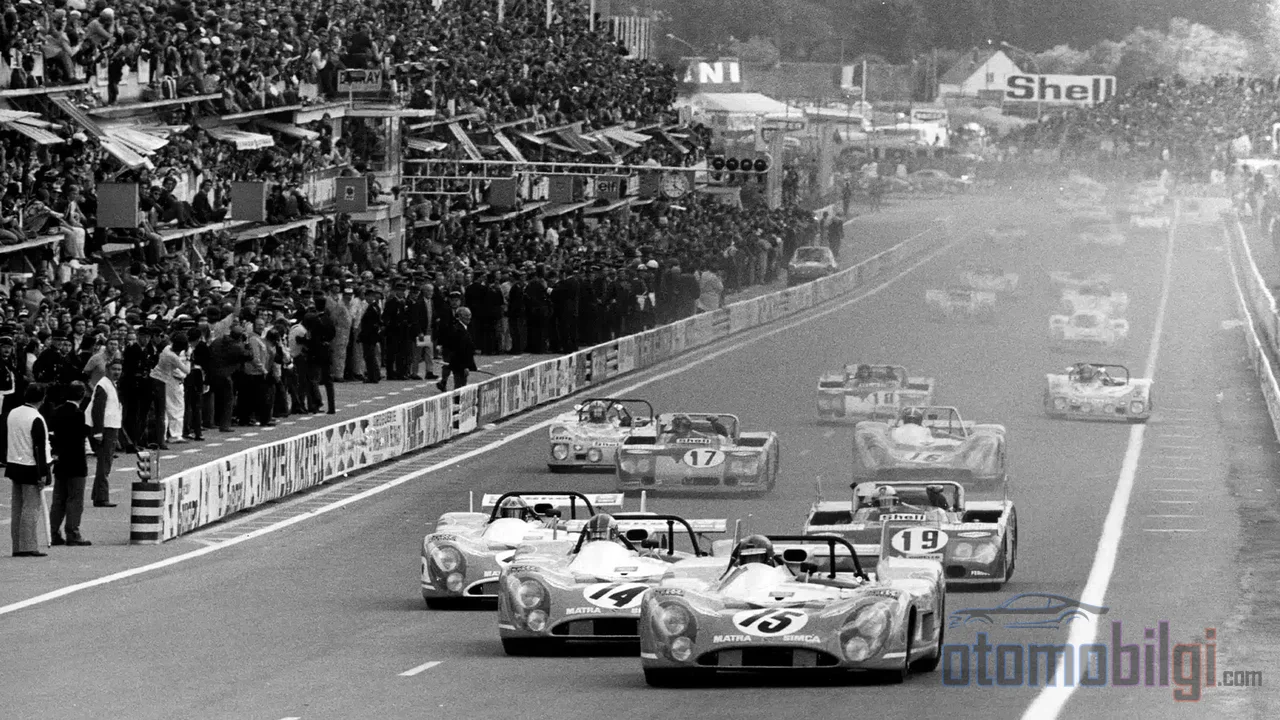
Matra arrived at the 1972 Le Mans in earnest: four cars (two MS670s, two MS660s) and 120 engineers. Think about what that means - as many people as a factory team's entire technical staff today, for a single race. Car number 15 had Graham Hill paired with Henri Pescarolo.
At the end of the race, the Hill/Pescarolo crew wins by a one-lap margin; Cevert/Ganley finish second. Beltoise/Amon retire with engine trouble, Jabouille/Hobbs with a gearbox failure - in other words, the victory rests not on a single car, but on a four-car strategy. France celebrates its first overall win in more than 20 years. And a bonus historical detail: with this victory, Graham Hill becomes the only driver to complete motorsport's Triple Crown, following his Indianapolis 500 win and F1 championship.
1973 and 1974: The Competition Heats Up, Matra Doesn't Miss a Beat
In 1973, things get tougher: Ferrari 312PB and Porsche 908 return with 3-liter prototypes. The Pescarolo/Larrousse duo, in the number 11 MS670B, manages to beat both and win; Jabouille/Jaussaud complete the race in third. That same year, Matra also claims its first World Championship for Makes title, with 124 points. So Le Mans wasn't a one-off chance; it was the peak of a dominance that lasted the entire season.
In 1974, the same duo - Pescarolo/Larrousse - wins for the third consecutive time; Jabouille/Migault finish third once again. Matra takes the manufacturers' title a second time, with 140 points. A bittersweet note must be added to this part of the story: On October 6, 1973, Francois Cevert loses his life at Watkins Glen during his first qualifying lap, at the age of 29. Cevert had also driven a factory Matra MS670 at the 1973 24 Hours of Daytona, but was unable to finish the race. He was part of this team, and with his second-place finish in 1972, he had left his mark on Matra's year of victory.
Would This Triple Have Happened Without Pescarolo?
Let's be honest: probably not. Henri Pescarolo was behind the wheel in all three victories - with Hill in 1972, and with Gérard Larrousse in 1973–74. This man, who left medical school to pursue the track, would go on to achieve four overall Le Mans victories in his career (the Matra years of 1972–74 and 1984), plus two class wins in 1976 and 1992. As for Matra's MS670 family, with a total of 15 wins and 16 pole positions in 20 races, it is regarded as France's most successful race car - a legend that won two manufacturers' championships over its half-century history.
So Why Did Matra Quit?
Here comes the most heart-wrenching part of the story. At the end of the 1974 season, Matra withdrew from motorsport entirely - at its peak, with three consecutive Le Mans victories and two world championships. Why? According to the information available, no clear rationale is on record; the company merely announced at the end of the season that it was withdrawing from sports car racing. Perhaps the most reasonable framework is this: By 1972, the 3-liter engine rule had already pushed the Porsche 917 away from the circuits, Matra had won everything it set out to win, and the resources of a company with aviation roots were not endless. But that is an interpretation; the only certain thing is that 1974 ended in farewell.
Short Answer: How Did Matra Win Three Times?
Matra owes its three consecutive Le Mans victories not to a single magical car, but to a three-legged strategy: Georges Martin's 3.0-liter V12 that could be shared with F1, Bernard Boyer's MS670 family that shed weight and improved every year, and Henri Pescarolo, who was behind the wheel in all three victories. They won in 1972 by a single lap with Hill's Triple Crown, and in 1973-74 by overtaking Ferrari and Porsche - and then, while still at the top, they withdrew from the scene. Short, clear, and painfully so.
Next time Le Mans history comes up, don't forget to squeeze a French trilogy in between Ford and Porsche. It's a story that deserves it, after all.
Sources
- Le Mans, Matra's seventies playground (2) - 24h-lemans.com
- Matra-Simca MS670 - Wikipedia
- Matra MS670: The Underdog Story - autoevolution
- 1973 - 1974 Matra MS670B - Ultimatecarpage
- Henri Pescarolo - Wikipedia
- François Cevert - Wikipedia
- The car that completed Graham Hill's triple crown - Goodwood
- 1973 Matra-Simca MS 670B - supercars.net