How Did Variable Compression Ratio Enter Mass Production?
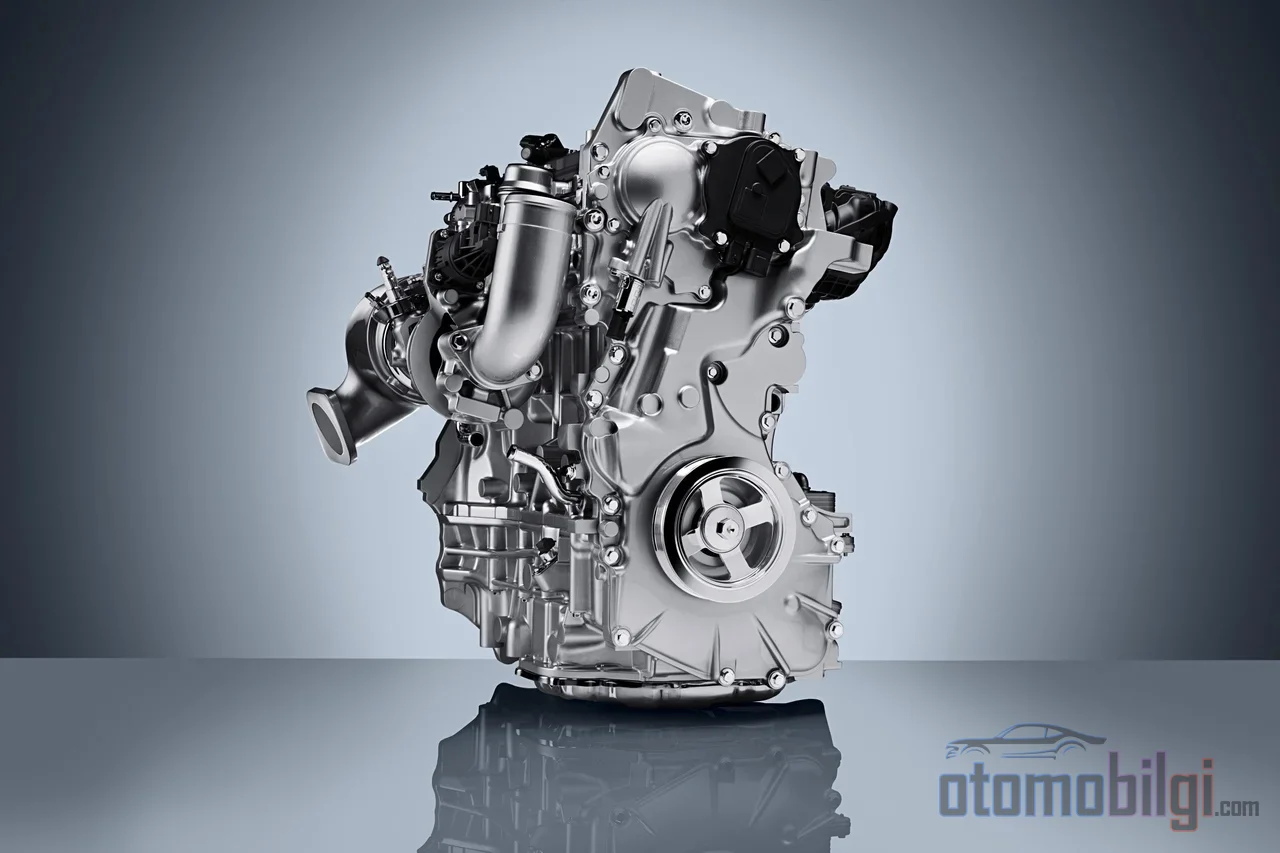
The compression ratio of an internal combustion engine is the volume change inside the cylinder reduced to a single number: the ratio of the largest combustion chamber volume at the piston's bottom dead center to the smallest volume at top dead center. In roughly 130 years of automotive history, this number has remained fixed in every engine produced, dictated by the geometry of the cylinder block and the crank-connecting rod arrangement, once it was determined. The VC-Turbo engine, which entered mass production with the 2019 Infiniti QX50, violated this rule for the first time: the same engine can continuously vary its compression ratio between 8:1 and 14:1 depending on driving conditions. So why couldn't such a seemingly simple adjustment be solved for nearly 140 years?
The answer lies in the definition of the problem. A high compression ratio raises thermal efficiency and lowers consumption; but as temperatures rise, the risk of the air-fuel mixture igniting on its own prematurely - that is, knock - grows. A low ratio, on the other hand, makes more power and torque possible, especially in turbocharged engines - the price is fuel efficiency. The two goals seemed unable to coexist in the same engine; until Infiniti engineers decided to redesign the connection between the piston and the crankshaft themselves.
What Kind of Legacy Is a Fixed Compression Ratio?
The roots of the problem go back to the birth of the four-stroke engine, to 1876. Based on the model proposed by Beau de Rochas, Nikolaus Otto turned the cycle consisting of intake, compression, combustion and exhaust stages into a practical machine and patented it. This first Otto engine - large, fixed, single-cylinder and low-revving - was the first practical four-stroke application that compressed the mixture before igniting it, and it gave its name to the arrangement known today as the Otto cycle.
The architecture Otto established later diversified to an incredible degree: cylinder counts increased, cylinder rows split into inline, V and Boxer layouts, and fuel delivery systems evolved from carburetors to injection. But throughout all this evolution, one thing remained unchanged: the piston was directly connected to the crankshaft via a connecting rod, and once this connection was locked, the compression ratio was locked too. As long as the engine was designed as a geometry problem, it was impossible to change the ratio without changing the geometry.
Highlights
Highlights
- Compression ratio continuously variable between 8:1 and 14:1
- World's first mass-production application with the 2019 Infiniti QX50
- Development time of more than 20 years, over 100 prototypes, more than 300 patents
- 268 hp of power and 380 Nm of torque from 2.0 liters of displacement
- A target of up to 27% efficiency improvement compared to V6 gasoline engines of similar power
Multi-Link Mechanism: The Link Between Piston and Crank Reestablished
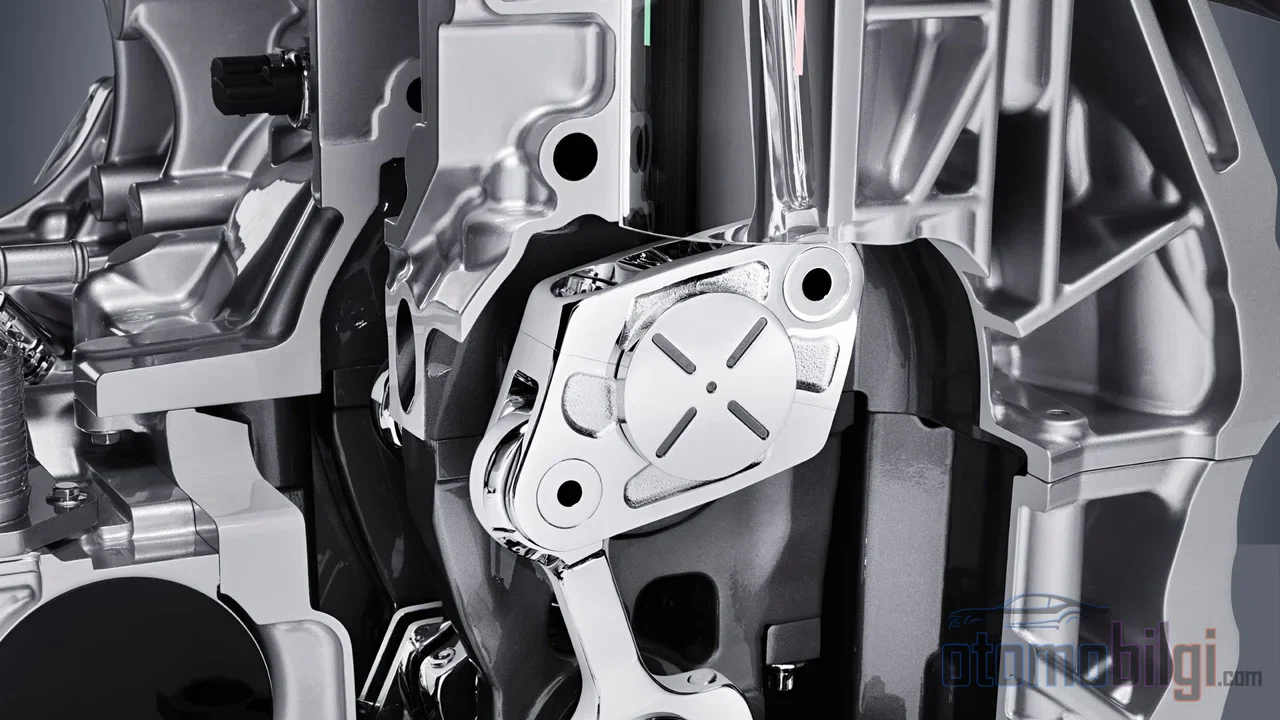
The core idea of the VC-Turbo (internally designated MR20 DDT) is surprisingly radical: to completely eliminate the conventional connecting rod and replace it with a multi-link mechanism. This technology was invented by Infiniti in 1998 and formed the key to variable compression; Nissan's official archive also confirms that VC-Turbo research began in the same year.
The Motion Chain Step by Step
The system operates with an electric motor and proceeds in a chain:
- The actuator motor rotates the control lever connected to the Harmonic Drive reducer.
- The control shaft - a shaft eccentric to the axis - rotates.
- The lower link (L-link) moves, and the angle of the multi-link system changes.
- The highest position the piston reaches along its stroke changes; the compression ratio is transformed.
A single control shaft changes the ratio of all four cylinders at once. Sensing the driving conditions and the driver's inputs, the engine instantly selects the optimal ratio: under hard acceleration and high load it switches to the low ratio with a wide knock margin; at constant highway speed, during deceleration, at idle, and in stop-start traffic it switches to the high ratio offering high efficiency.
An Unexpected Side Benefit: A Smooth Four-Cylinder
The multi-link arrangement has a mechanical bonus: the connecting rods remain almost vertical throughout the combustion cycle. This reduces the piston's lateral pressure on the cylinder wall, and therefore friction. Conventional four-cylinder engines require dual balance shafts to suppress second-order vibrations; the VC-Turbo has no need for them. Vibration noise was reduced from an average of about 30 dB in comparisons to 10 dB - while Infiniti's benchmark 3.5-liter VQ V6 engine produces 3 dB. Achieving a sound and vibration character approaching a V6 despite being a four-cylinder engine shows that the mechanism is a tool not only of efficiency but also of refinement.
From the Combustion Chamber to Supporting Technologies: Why the Mechanism Alone Is Not Enough
Variable compression by itself is not a panacea; cooperation on the combustion side is also required to widen the knock limits. The engine uses both multi-point injection (MPI) and direct injection (DIG): while direct injection suppresses knock at high ratios, MPI contributes to efficiency at low loads. In the high-compression region, the engine can switch to the Atkinson cycle; the intake valves remain open briefly as the compression stroke begins, reducing pumping losses.
On the boost side, a single wide-range turbocharger with an electronic wastegate provides rapid throttle response at every rpm and every compression ratio. The plasma-sprayed coating (mirror bore coating) on the cylinder's inner surface reduces friction by 44% and eliminates the need for cast-iron liners. During the development process, Infiniti collaborated with the Renault Sport Formula 1 team: since the multi-link system contains roughly three times more bearings than a conventional engine, the bearing vibration arising at high rpm was solved with the F1 team's expertise in dynamic motion analysis up to 20,000 rpm.
Saab SVC: The Right Idea with the Wrong Geometry
Infiniti is not the first manufacturer to attempt this, but the first to succeed. The idea of variable compression is very old: a design patented in 1957 was tried by Continental in the USA on single-cylinder prototypes. The most intriguing attempt was Saab's SVC (Saab Variable Compression) engine. The SVC dynamically changed combustion chamber volume by tilting the cylinder head and cylinders relative to the block; it produced 225 hp from a 1.6-liter displacement. Academic assessments described it as a more elegant solution than all previous variable compression patents, in that it required no additional moving parts in the combustion chamber.
The SVC's weak point was the articulated block-head arrangement: the tilting architecture created a potential sealing failure point between the head and the block in exchange for the simplicity of the lower end. The project was shelved by General Motors, which took over Saab Automobile, on cost grounds. The Saab experiment offers an instructive comparison in terms of engineering philosophy: Saab placed a joint that had to maintain the seal, while Infiniti hid the motion within the mechanism itself, rather than in the head where the joint interacted. The difference determined which one remained a concept and which one went into series production.
The 2019 Infiniti QX50's Engine in Numbers
The engine was unveiled at the Paris Motor Show on September 29, 2016, and its first series-production application came in the 2019 QX50. More than 100 prototypes were tested throughout development; the equivalent of 3 million km of road testing and more than 30,000 hours of operation on test benches were carried out. Independent measurements verified the manufacturer's power and torque figures; the engine won Wards Auto's 10 Best Engines award in 2019.
| Specification | Value |
|---|---|
| Compression ratio range | 8:1 – 14:1 (continuously variable) |
| Engine displacement | 1,997 cc (8:1) – 1,970 cc (14:1) |
| Bore × stroke | 84.0 × 94.1 mm |
| Power | 268 hp (200 kW) @ 5,600 rpm |
| Torque | 380 Nm @ 1,600–4,800 rpm |
| Fuel economy (QX50, combined) | 27 mpg (FWD) / 26 mpg (AWD) |
The efficiency gain brought by variable compression at vehicle scale becomes concrete: the new-platform QX50 is 35% more efficient than the previous generation's V6 in front-wheel-drive configuration, and 30% more efficient in the all-wheel-drive version. The 2.0-liter engine is 18-25 kg lighter than the 3.5-liter VQ V6 according to press releases - both figures appear in different announcements. The QX50 also uses Active Torque Rod (ATR), the world's first active engine mount vibration damping system.
Why Was Variable Compression So Difficult?
The answer to the question can now become clear: variable compression was difficult because it required reshaping the engine's most fundamental geometry while driving, and VC-Turbo solved it in series production for the first time with a multi-link mechanism that changes piston travel across the 8:1–14:1 range. Choosing a fixed ratio was, in essence, perpetuating a compromise: the engine would either be efficient or powerful. More than a hundred prototypes and more than 300 patents show that this compromise could only be overcome by completely reinventing the piston-crank connection.
There is, of course, also a cost-debate dimension. Engineering publications feature assessments questioning whether the 8% fuel efficiency improvement was worth the price of two decades of development. Manufacturer claims - being the world's first mass-produced variable compression engine and offering a strong alternative to diesel engines - may be written in marketing language, but independent power measurements and awards confirm the core claims.
Ultimately, the significance of the VC-Turbo lies not in one engine's sales figures, but in breaking the law. Before the century closed, the relationship between the piston and the crankshaft was made fluid for the first time, ending fidelity to the geometry Otto established in 1876. While the future of the internal combustion engine is debated against electricity, Infiniti's 2.0-liter engineering lesson was this: even old technology had not had its final word.
Sources
- INFINITI VC-Turbo: The world's first production-ready variable compression ratio engine (2016)
- VC-Turbo – the world's first production-ready variable compression ratio engine (2017)
- VC-Turbo Engine | Nissan Global
- INFINITI QX50: A luxury crossover with world-first technologies
- Infiniti's variable-compression engine: witchcraft explained
- 2019 Winner: Infiniti QX50 2.0L DOHC VC-Turbo 4-Cyl
- Nissan's New VCR Engine: Worth the Effort?
- Otto (1832) – U.S. EIA Energy Kids
- PH Origins: Variable compression ratio technology
- Saab Variable Compression Engine Generates 225 bhp Out Of 1.6L