Did the Barsanti-Matteucci Engine Run Before Otto?
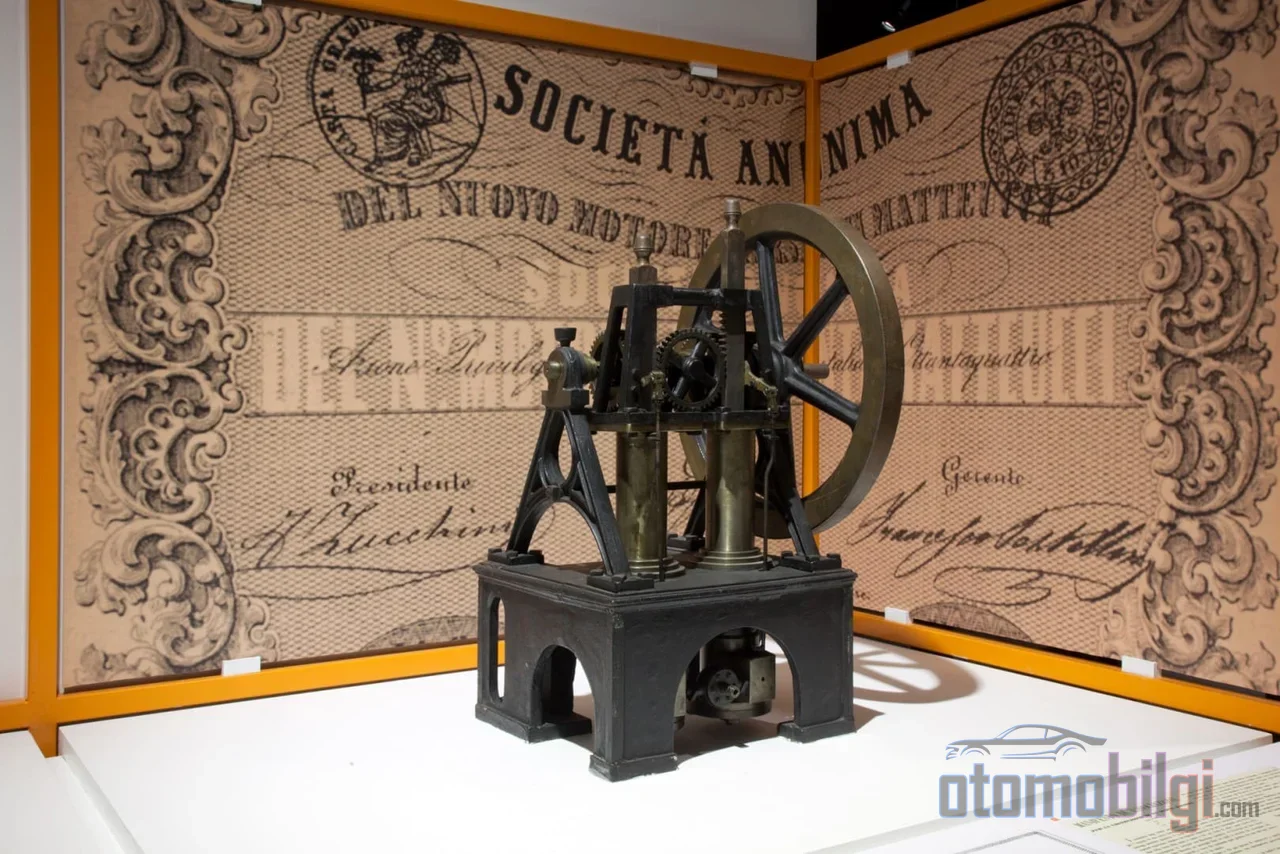
When an engine was presented at an exhibition in Paris in 1867, the history of the internal combustion engine was already considered to have been written. At least, that was what people believed. The atmospheric engine that Nikolaus Otto and Eugen Langen won acclaim with that day was hailed as one of the most brilliant engineering achievements of the era. Yet the working principle of this machine - a piston pushed by an explosion and pulled back by atmospheric pressure - had been designed, patented, and made operational years earlier by two other names, and in a more efficient form. The names were Eugenio Barsanti and Felice Matteucci, and the place was Florence. A full twenty years before the four-stroke patent of Otto, who is counted among the most famous names in automobile history today, the Italian duo was in possession of a working internal combustion engine. So why has this engine been almost completely forgotten today?
How Was the Idea of the Internal Combustion Engine Born?
The story begins in an engineering lecture hall. Barsanti was a priest and engineer belonging to the Piarist order; While teaching at Collegio San Michele in Volterra, he was showing his students that the explosion of a hydrogen and air mixture could produce thrust from expanding gases. Old accounts date this demonstration to 1843. The original instrument used in the experiment is preserved today in the Volterra Civic Museum. The point Barsanti grasped was simple but revolutionary: unlike a steam engine, the expansion energy released during combustion could be produced directly inside the cylinder, not in a boiler.
In 1851, Barsanti met the hydraulic engineer Matteucci in Florence, and they locked onto a common goal: to build an engine more practical than the steam engine. Matteucci had received his mechanical education in Florence and Paris; the duo's technical division roughly followed this distinction. Barsanti designed the thermodynamic concept, while Matteucci undertook the construction of the machine.
The Working Principle of the Free-Piston Engine
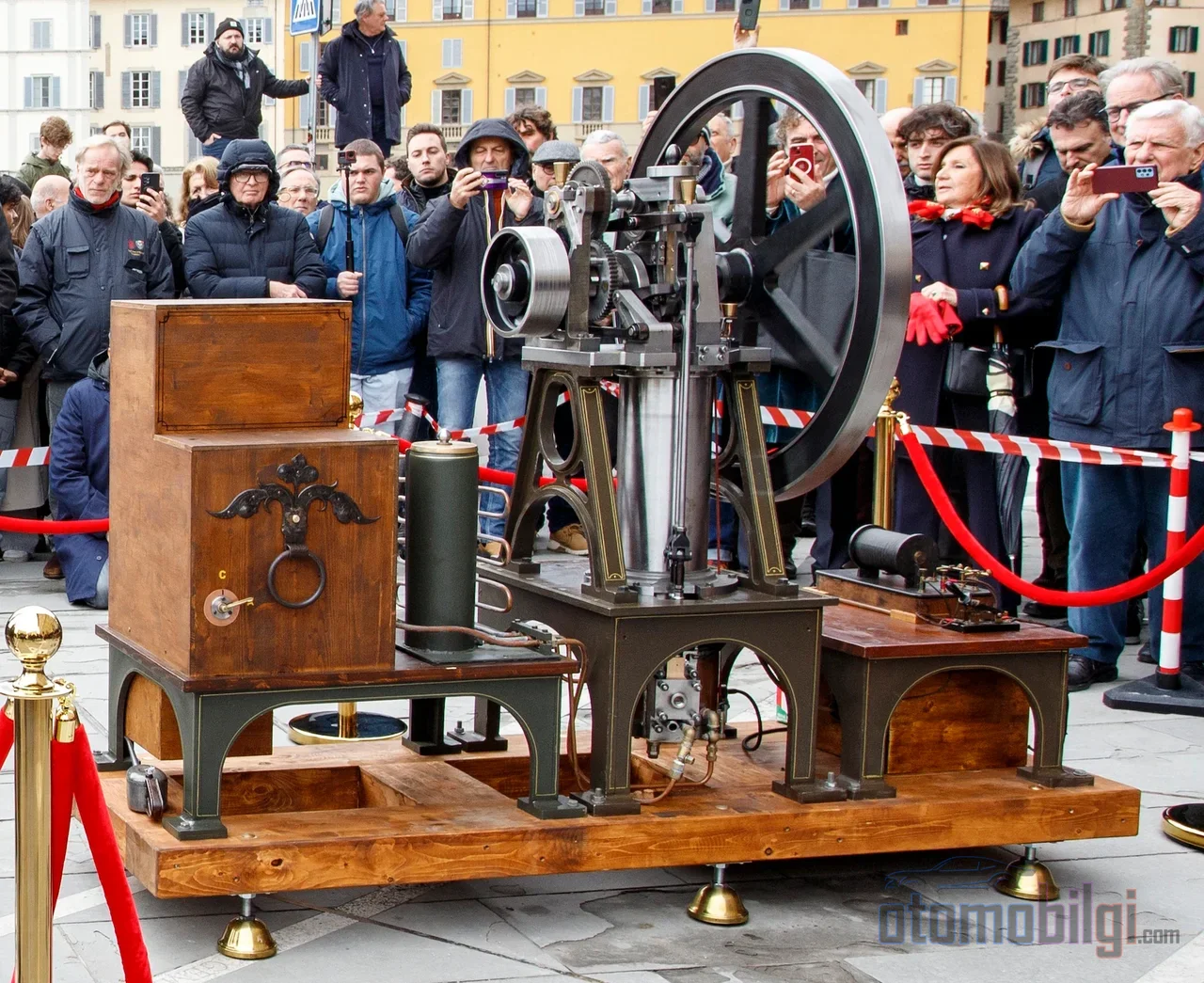
The fundamental feature that set the Barsanti-Matteucci engine apart from other gas engine designs of its time was its approach to power transmission. The piston was not connected to a classic crank mechanism. The linear motion inside the cylinder was transferred directly to a toothed rack - a rack-and-pinion arrangement - and from there it was conveyed to the flywheel. The critical point was in the piston's return stroke: as the gas cooled after combustion, a vacuum formed in the cylinder and the external atmospheric pressure pushed the piston back. The engine drew its work stroke not from the pushing force of the explosion, but from this vacuum-return cycle.
The technical advantage of this solution could be measured. The Lenoir engine relied directly on the thrust of the moment of explosion; which meant an uncontrolled and inefficient power curve. The Barsanti-Matteucci cycle, on the other hand, ran faster and more efficiently. The first engines ran on hydrogen as fuel, and producer gas could also be used. In short, the concept was an engineering answer that could be considered mature for the technology of the 1850s.
Highlights
- The first prototype ran in a documented manner in Florence in 1853.
- The first patent application in London bears the date 12 June 1854.
- In 1857, the British patent was granted under number 1655; opposed-piston versions followed.
- In 1861, Escher Wyss in Zurich built two opposed-piston engines, which achieved success at the Florence exhibition.
- In efficiency comparisons, the Lenoir engine operated in the 3-5% range, while the Barsanti-Matteucci cycle was found to be more efficient.
Patents and the Effort to Form a Company
The process of documenting the project had been carefully planned. On 5 June 1853, the pair left a sealed envelope at the Accademia dei Georgofili in Florence; the envelope was a safeguard designed so that the claim of priority could be proven at a later date, and it was opened on 20 September 1863, when the Lenoir controversy flared up. The patent granted in London on 12 June 1854 could only remain at the level of a provisional certificate numbered 1072, because Italian law at the time was unable to provide international protection. In October of the same year, a partnership was formed for the construction of the engine; in 1859, the company was converted into a joint-stock structure, and Barsanti and Matteucci were appointed technical directors.
The pace of development was also high. In 1856, a two-cylinder engine with an output of 5 HP was completed; in the same year, a unit was actually put into operation at the Maria Antonia Railway workshops in Florence to drive a pair of shears and a drill. From 1858 onwards, with the contribution of engineer priests from Babacci and the Ximenian Institute, the design moved to horizontal-cylinder, two-opposed-piston versions. The opposed-piston arrangement eliminated the backlash problem in gear transmission - a complete engineering solution. Protection was extended with the 1857 British patent, the 1858 Piedmont patent numbered 700, and the 1859 French patent numbered 39730. In 1861, Escher Wyss in Zurich built the two-cylinder, two-opposed-piston engine, and the machine won great success at the first Exhibition of Arts and Manufacturing in Florence.
In Lenoir's Shadow and the Priority Dispute
The year 1860 is the turning point of the story. Étienne Lenoir brought to market a gas engine running on an uncompressed charge, with an efficiency of 3-5%, and rapidly popularized it with an excellent advertising strategy. Technically inferior though it was, this engine became known to the public as the first internal combustion machine to emerge from the experimental stage. It was precisely in this atmosphere that the envelope of Barsanti and Matteucci was opened, in 1863.
The improved version, completed in the same year, was a design that transmitted power to the flywheel via a gear-pinion mechanism and used an auxiliary piston. The report of the Lombard Institute of Science, dated July 1863, evaluated the engine side by side with the Lenoir engine and the steam engine in a consumption comparison; while the Barsanti-Matteucci machine was awarded a silver medal, the report confirmed Lenoir in terms of priority. Technical superiority and market victory here clearly diverged: the Italian engine won the efficiency comparisons, but the engine visible on the streets and in the workshops was Lenoir's.
Why Did Mass Production Never Happen?
The plan was clear: In Belgium, the John Cockerill foundry in Seraing was chosen for the series production of the 4 HP (3,0 kW) engine, and numerous orders arrived from across Europe. In early 1864 Barsanti took the machine to Belgium; the engine on display was met with great acclaim. Shortly afterwards Barsanti contracted typhoid fever and died in Seraing in the spring of 1864. The machine left in Seraing was never seen again; only the drawings returned to Florence.
Matteucci could not run the business alone. He failed to secure the necessary contracts; in 1866 the company was dissolved and Matteucci returned to hydraulic engineering. When Otto and Langen's engine appeared on the scene in 1867, Matteucci made efforts to establish priority for the invention; he also formally defended this claim when Otto obtained the patent, but without result. The links in the chain had broken one by one: the designer's sudden death, the weakness of commercial management, the loss of the prototype, and the rival's market success. There was also an additional fact: Barsanti's goal was mechanical energy for factories and marine propulsion; the engine was not light enough for automotive use. This machine would never end up under the hood of an automobile.
Before Otto? Answer and Context
The direct answer to the question is clear: Yes. Barsanti and Matteucci, with engines patented and documented as working between 1853 and 1857, were in the internal combustion field before both Otto's atmospheric engine (1867) and his compression four-stroke engine (1876); however, since this project could not be carried into series production, history was written through Lenoir's practical engine of 1860 and Otto's four-stroke cycle of 1876. It is also a separate historical fact that Alphonse Beau de Rochas was the first to propose the four-stroke cycle in writing in 1862, and that Otto put it into practice without knowing of it - that is, the milestones of this field were often shaped by different names on paper and in the workshop.
The invalidation of Otto's 1877 German patent by a court in 1886 completes this picture: priority disputes were a structural problem in the first half-century of the internal combustion engine. In the Barsanti-Matteucci case, the divergence between technical priority and commercial priority is one of the most instructive examples in engineering history.
The Modern Legacy of the Free-Piston Idea
The free-piston idea did not remain a project that died in the 1860s. Today's scientific literature indicates that free-piston engines can offer higher thermal efficiency than the classic crankshaft architecture; in the last decade, free-piston engine–linear generator hybrids have been developed. A study published in 2026 examines opposed-piston linear generators, which convert the piston's linear motion directly into electricity and target 50% efficiency, as a promising technology. The logic is the same as Barsanti's intuition in the 1850s: eliminate the crank mechanism and use the piston's linear motion directly.
Historical awareness is also alive. At the 1929 National Exhibition of the History of Science in Florence, a dedicated section was devoted to the pair's invention; Shares issued in 1860 are circulating in the collectors' market today. It is also known that a motor reconstructed on the basis of the 1854 patent was fired up in Florence. The race Barsanti and Matteucci lost determined not the engine itself but only its fame. The free-piston idea born in their workshop still remains a marker on engineers' efficiency maps a century and a half later.