Pyréolophore: The Niépce Brothers' Forgotten First Engine
In an 1807 account, on France's Saône river, a boat weighing approximately 900 kg was moving against the current with neither a sail nor a steam engine on board. The propulsive force was a dust cloud exploding 12-13 times per minute inside the boat. Seventy years before Karl Benz's Patent-Motorwagen and decades before Nikolaus Otto's four-stroke engine, the Niépce brothers had already made the internal combustion engine work. What's more, this machine still holds the claim of being the world's first internal combustion engine. So why do Benz and Otto's names stand at the center of engine history today, and not the Niépce brothers'?
What Is the Pyréolophore and How Did It Work?
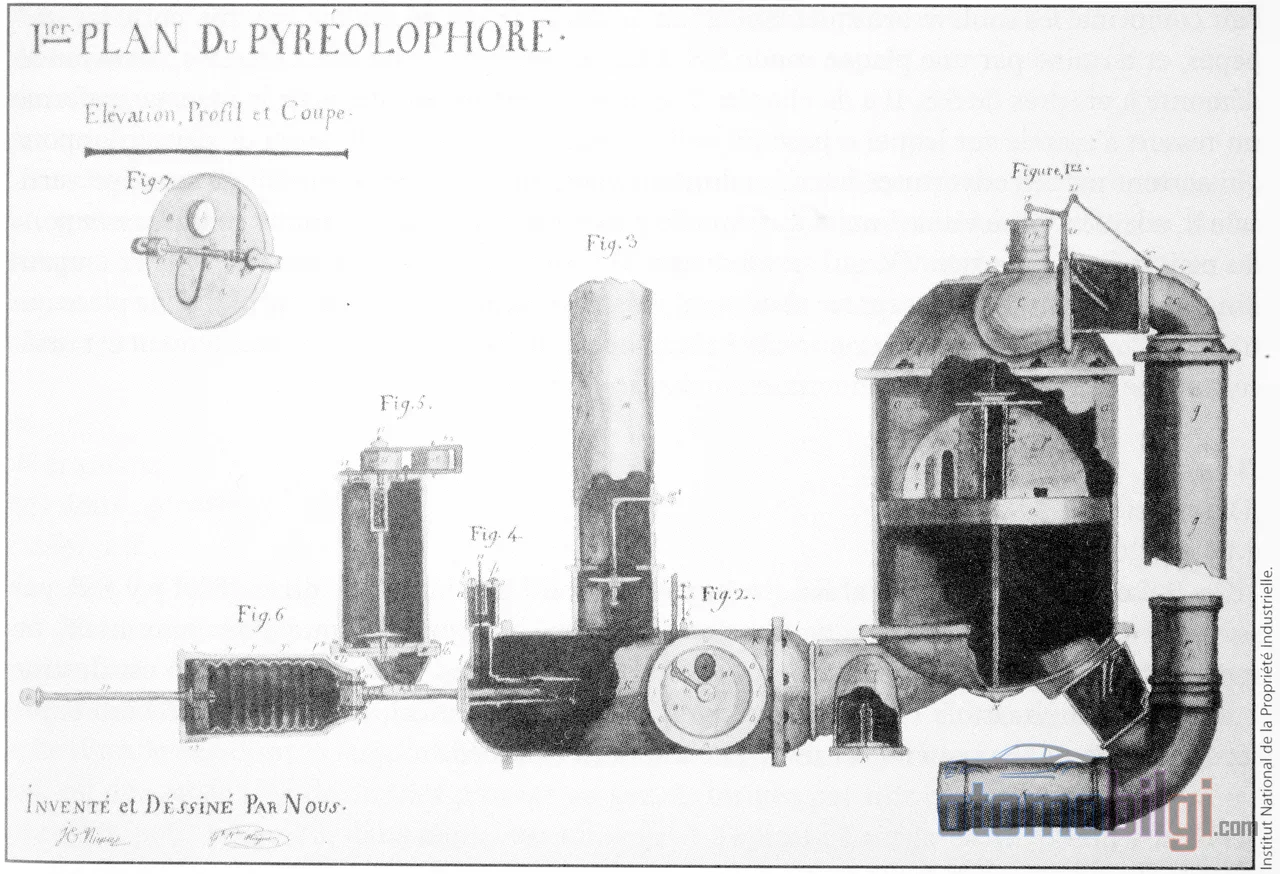
The Pyréolophore, developed by the Nicéphore and Claude Niépce brothers living in Chalon-sur-Saône, was a machine that drew its propulsive power from air expanded by fire. It took its name from three words of Greek origin: pyr meaning fire, eolo meaning wind, and phore meaning to carry. Its official full name was a long definition meaning "new machine whose propulsive principle is air expanded by fire," and it summarized the logic of the invention in a single sentence.
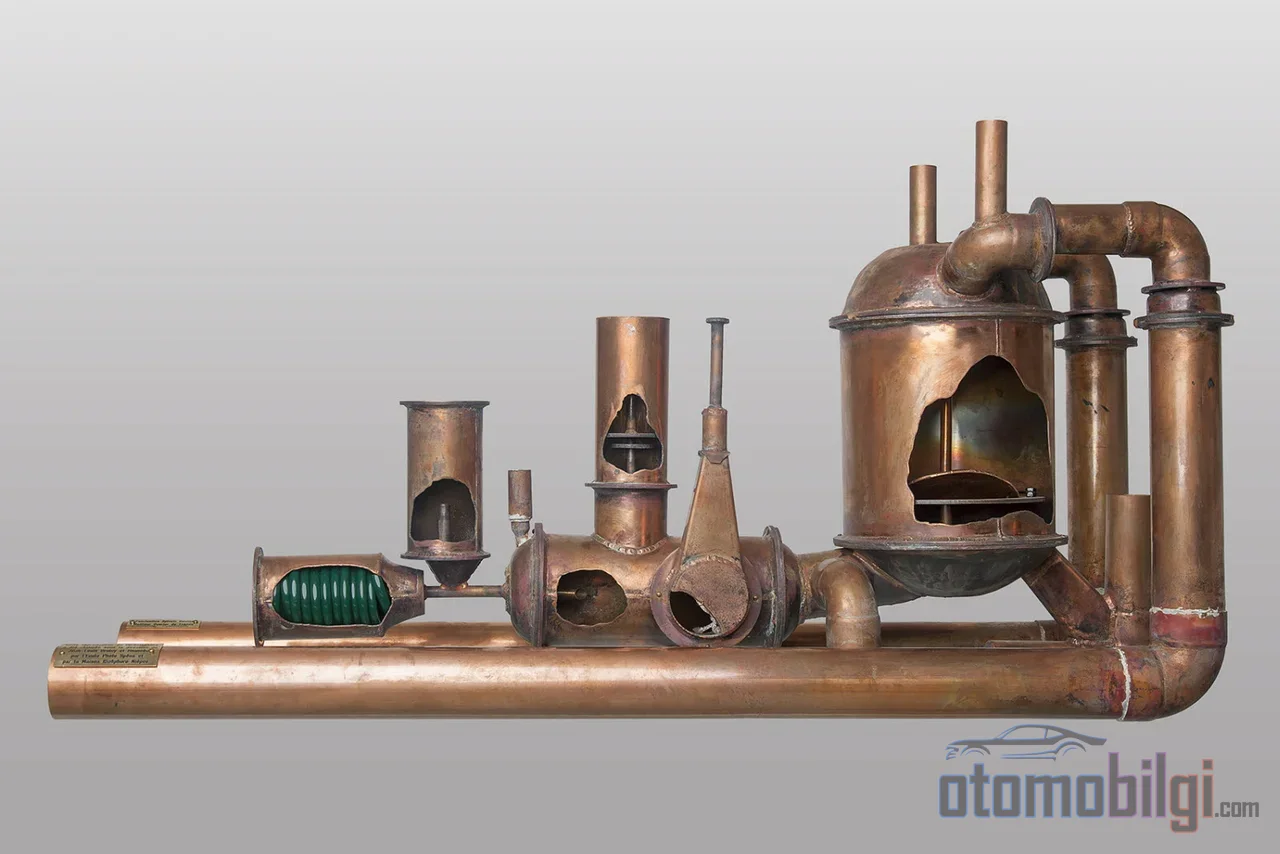
The core of the system was two interconnected chambers: an ignition chamber and a main combustion chamber. The supporting equipment was also surprisingly complete by today's engineering standards: a mechanical bellows blowing air, a distributor providing measured fuel supply, a timing mechanism, and an exhaust pipe extended underwater.
Anatomy of a Stroke
The working cycle proceeded step by step as follows: While the bellows sprayed air into the first chamber, the timing mechanism released measured dust fuel into the air stream. An ember-tipped wick touched this fuel-air jet at exactly the right moment and was then withdrawn behind a metal plate. The ignited dust-air mixture passed through a wide nozzle, reached the main combustion chamber, and expanded there with a rapid, almost explosive combustion. The pressure acted on the water column in the exhaust pipe, pushing the water out of the system.
The propulsion principle was based on direct reaction force: each explosion ejected a mass of water from the tail pipe pointed toward the boat's stern, and the boat was pushed forward by the reaction of the ejected water. The energy of each stroke was stored in a balance wheel loaded with weights, and the wheel's rotation governed the timing of the next cycle. Thus, the ideas of both energy storage and self-synchronization were embodied in the machine at a very early date.
From Lycopodium Powder to Coal: The Fuel Quest
The first fuels were unusual by today's standards: spores of lycopodium (clubmoss) used for flame effects in theaters, finely ground coal dust, and resin mixtures. Toward the end of 1807 the brothers took the matter seriously: in December 1807 they informed Lazare Carnot that they had developed a highly flammable new powder by mixing one part resin into nine parts coal dust.
The truly progressive step came between 1816 and 1817. Nicéphore experimented with white petroleum oil, and in 1817 he added a primitive fuel injection mechanism to the system. Today the Niépce brothers are regarded as the inventors of the principle of fuel injection; delivering liquid fuel, instead of powder, in measured amounts into a current was the first concrete application of an idea that would become one of the main threads of engine development for the next century.
Highlights
- The Pyréolophore is the first internal combustion engine, powering a boat on the Saône river in 1807.
- Fuel consumption was about 8 grams of powder per minute, and the explosion frequency was 12-13 beats per minute.
- The 10-year patent signed by Napoleon Bonaparte was granted on 20 July 1807.
- The brothers are recognized in 1817 as the first names to develop primitive fuel injection.
- Nicéphore Niépce later produced the first photograph in 1826.
The Saône River Experiment and the Academy's Approval
The brothers first conducted tests on Lake Batterey in a wooded area near Saint-Loup-de-Varennes; the stage for the great experiment was the Saône river. The engine was fitted to a boat weighing approximately 2,000 livres, or 9 kantals, and the boat traveled against the current, moving faster than the river's flow, powered solely by the engine. Numerically, the picture was as follows: fuel consumption of about 8 grams per minute and 12-13 explosions per minute.
The commission report of the French Academy of Sciences dated 15 December 1806 bore the signatures of Lazare Carnot and C.L. Berthollet. The commission stated that the machine was an ingenious invention and could prove very interesting in terms of its physical and economic consequences, and therefore deserved recognition. Carnot's own observation was striking as well: he wrote that lycopodium spores burning in closed copper vessels ignited with a bright flame, and that the Niépce brothers had managed to achieve an expansion comparable to a steam engine in a closed volume without using water. Following the boat trial, a 10-year patent was granted on 20 July 1807 with the signature of Emperor Napoleon Bonaparte.
A side note: in the same year, the Swiss Francois Isaac de Rivaz built an internal combustion engine running on hydrogen, and in 1808 he mounted it on a vehicle, achieving the world's first internal combustion automobile attempt. So the first boat application of internal combustion belongs to the Pyréolophore, and the first land vehicle application to de Rivaz. The two inventions developed independently of each other.
Why It Was Forgotten: Efficiency, Fuel Cost and the Lack of Compression
The short answer is this: the Pyréolophore was a design that was ingenious as engineering but could not survive economically. It lacked a critically important part in thermodynamic terms, and its operating cost condemned the idea from the start.
The Fuel Cost Problem
In his famous 1824 book, Sadi Carnot wrote that he found the machine ingenious and interesting, but pointed out a major flaw: lycopodium powder was so expensive that the advantage the machine provided was eroded by the cost. Switching to a cheaper powder was not easy either, because the system required a very fine grain size that burned quickly, spread easily in the air and left almost no ash. Carnot's criticism concerned only the powder fuel of the early period; the brothers' work on liquid fuels after 1816, but it remained in public memory as a label stuck to an expensive dust engine.
No Compression, No Efficiency
The more fundamental problem was thermodynamics. Without compression before combustion, the rate at which heat energy converts into work hits a low ceiling; the Pyréolophore's design had no compression mechanism to achieve this. In 1824, Sadi Carnot's theory of idealized heat engines systematically exposed this shortcoming. This is precisely one of the main lessons of modern engine history, and it is clearly visible in the comparison below.
The Patent Expired, Investment Never Came
The commercial side was even worse. The 1816 progress was not enough to secure subsidies from the invention; in 1817, insufficient development was achieved to attract investors, and the 10-year patent term expired. Claude, fearing he would lose control of the engine, first went to Paris and then to England; near London, he spent a large part of the family fortune over ten years pursuing unsuitable business ventures and eventually lost his health. Nicéphore, meanwhile, had turned his attention entirely to another invention during those years: photography.
What Made Lenoir and Otto Different?
The real breakthrough in internal combustion came in the 1860s, and the difference hinges on a single concept: compression. The following comparison summarizes the distinction between the three architectures.
| Engine | Year | Fuel | Key Feature |
|---|---|---|---|
| Pyréolophore | 1807 | Lycopodium powder, coal dust, later petroleum oil | No compression, explosive combustion, reaction-based propulsion |
| Lenoir engine | 1860 | Coal gas | Double-acting, spark-ignited; no compression stroke |
| Otto engine | 1876 | Air-fuel mixture | Compression before ignition, four-stroke cycle |
Étienne Lenoir produced the first truly effective internal combustion engine with his double-acting, spark-ignited engine running on coal gas. His engine had a displacement of 18 liters, produced 2 hp at 130 rpm, and its thermal efficiency was only around 4.5-5 percent. Why was it so low? Because the Lenoir cycle skipped compression: the fuel was taken into the cylinder during the intake stroke and ignited with a spark. The same fundamental handicap as the Pyréolophore.
Nikolaus Otto set out in 1862 with the goal of improving the low efficiency and reliability of the Lenoir engine. His solution was to compress the air-fuel mixture before ignition. The thermal efficiency of the first flame-ignition Otto engine was 16 percent; more than three times Lenoir's figure. This single architectural decision transformed the internal combustion engine from an object of curiosity into the locomotive of industry. The Niépce brothers' patents had long since become outdated; moreover, before Lenoir, other pioneering attempts had intervened, such as Barsanti-Matteucci (1857), Wright (1833), and Barnett (1838). As the crowd grew, the pioneering first names faded into the dusty shelves of the archive.
Nicéphore Niépce's Second Title: Pioneer of Photography
When the engine story stalled, Nicéphore Niépce (1765-1833) wrote his name into history in another field. In 1824 he placed lithography stones coated with bitumen behind the camera obscura to capture an image; in 1826 he produced heliography, considered the first photograph, using a camera obscura and a bitumen-coated brass plate. This is a story of talent in which the engineering nuance remains the same: a light-sensitive material, long exposure and patience. Niépce's records also included other designs, such as a velocipede and a hydraulic machine called the marly. The fact that the same mind developed both the internal combustion engine and photography shows how broad-spectrum the inventor profile of the early 19th century was.
The Pyréolophore Today: Legacy and Reconstruction
In 2007-2008, the machine's 200th In 2007-2008, marking the 200th anniversary, a faithful reconstruction of the original was carried out under the leadership and technical consultancy of Manuel Bonnet, a direct descendant of Nicéphore Niépce; during the 2008 cultural heritage days, it was celebrated at the place where the invention was made. In 2010, a photography institute in Paris and the Niépce house museum collaborated to produce a 3D animation showing the engine's inner workings. The subject also found its place in engineering literature: a 1993 academic study published by SAE examined the Niépce brothers' boat engines.
The story of the Pyréolophore is one of the clearest examples of a recurring pattern in the history of technology: when the right idea combines with incomplete physics and the wrong economics, you become a pioneer, but not a winner. Karl Benz and Nikolaus Otto could only answer the question posed by the Niépce brothers some 70 years later, with the trio of compression, efficiency and suitable fuel. Whose question the first internal combustion engine answered is clear in the archives: in 1807, on the Saône river, two French brothers powering a boat with dust explosions.