Why Was François Isaac de Rivaz's Hydrogen Vehicle Forgotten?
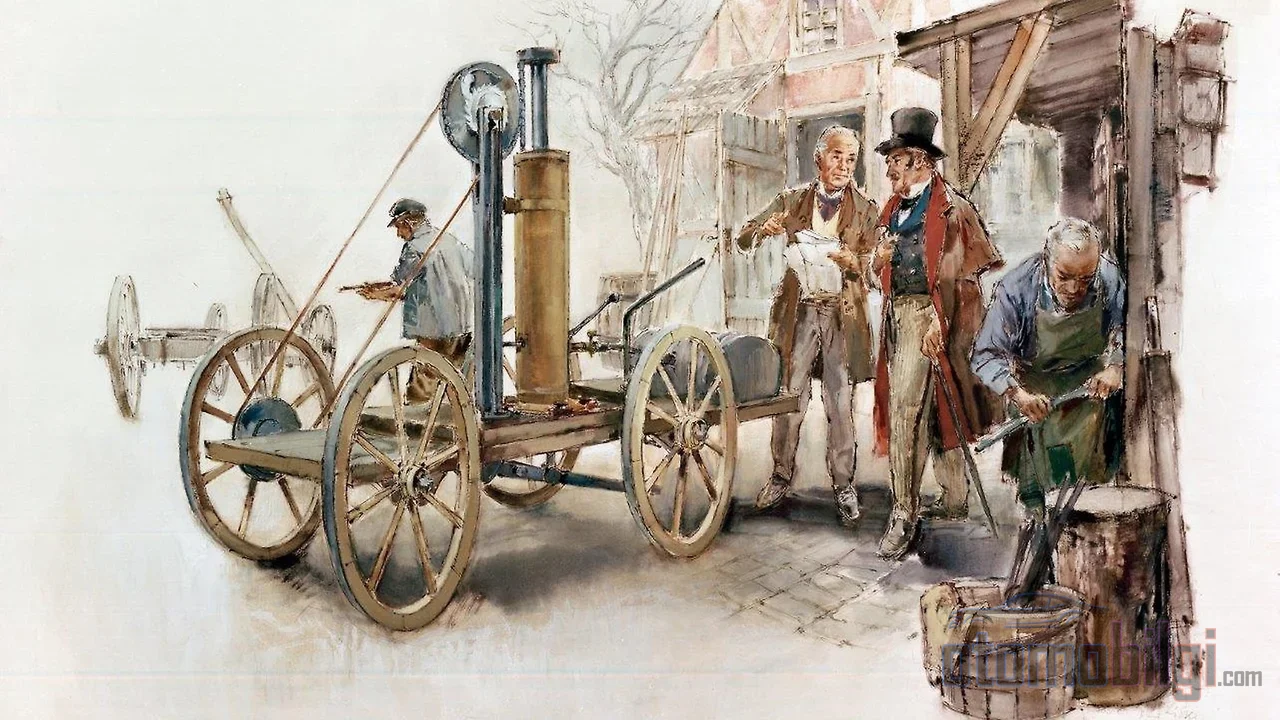
The official narrative of automobile history begins in 1886: Karl Benz receives German patent number 37435 for his gas-fueled Motorwagen, and the era thus reaches its conclusion. Yet exactly 77 years earlier, in Napoleonic Europe, a man had connected a piston exploded by compressed hydrogen gas to a wheeled chassis and actually made the vehicle move. Francois Isaac de Rivaz's 1807 work brought spark ignition and hydrogen fuel together long before today's engines. So why was this attempt erased from the main texts of automobile history? The answer is not simply "failure"; a more interesting mechanism of engineering history was at work.
From Artillery Officer to Inventor: Who Was De Rivaz?
Francois Isaac de Rivaz, who lived from 1752 to 1828, was a French-born Swiss inventor and politician. In sources he is sometimes referred to as French, sometimes as Swiss; both definitions are correct. What truly shaped him was his profession: as a French-Swiss artillery officer, he had designed successful steam-powered vehicles in the late 18th century, and the years he spent with cannons had accustomed his mind to the idea of an explosive charge pushing a piston.
Establishing the chain of logic here is worthwhile. A cannon transfers the explosive energy of gunpowder to a projectile; De Rivaz's question was whether it was possible to transfer the same energy to a machine via a piston, and from there to a vehicle. A steam engine must generate and transmit this energy outside the boiler. Internal combustion, on the other hand, releases the energy directly inside the cylinder. This difference was the very architectural principle that would define the automobile for roughly two centuries.
In 1804, he began experiments with explosions driving a piston inside a cylinder. His first designs were a stationary motor intended to run a pump; the vehicle idea was the next step. On January 30, 1807, he received patent number 731 in Paris, and in the same year he mounted his experimental prototype engine on a cart and drove it a short distance. This was the first known vehicle to move with an internal combustion engine.
Key Highlights
- De Rivaz received the patent for his hydrogen engine, number 731, on January 30, 1807; 77 years before Benz's patent.
- The 1813 "grand char mécanique" weighed approximately 1 ton and was 6 meters long.
- In the Vevey trial, the vehicle advanced 26 meters on a 9 percent incline with a 300 kg load and four people.
- The engine of the 1813 vehicle operated with a 1.5-meter cylinder and a 97 cm piston stroke.
- Compared to the 1600 cc Benz Motorwagen, it remained an experimental prototype.
How the Engine Worked: The Anatomy of the Technical Architecture
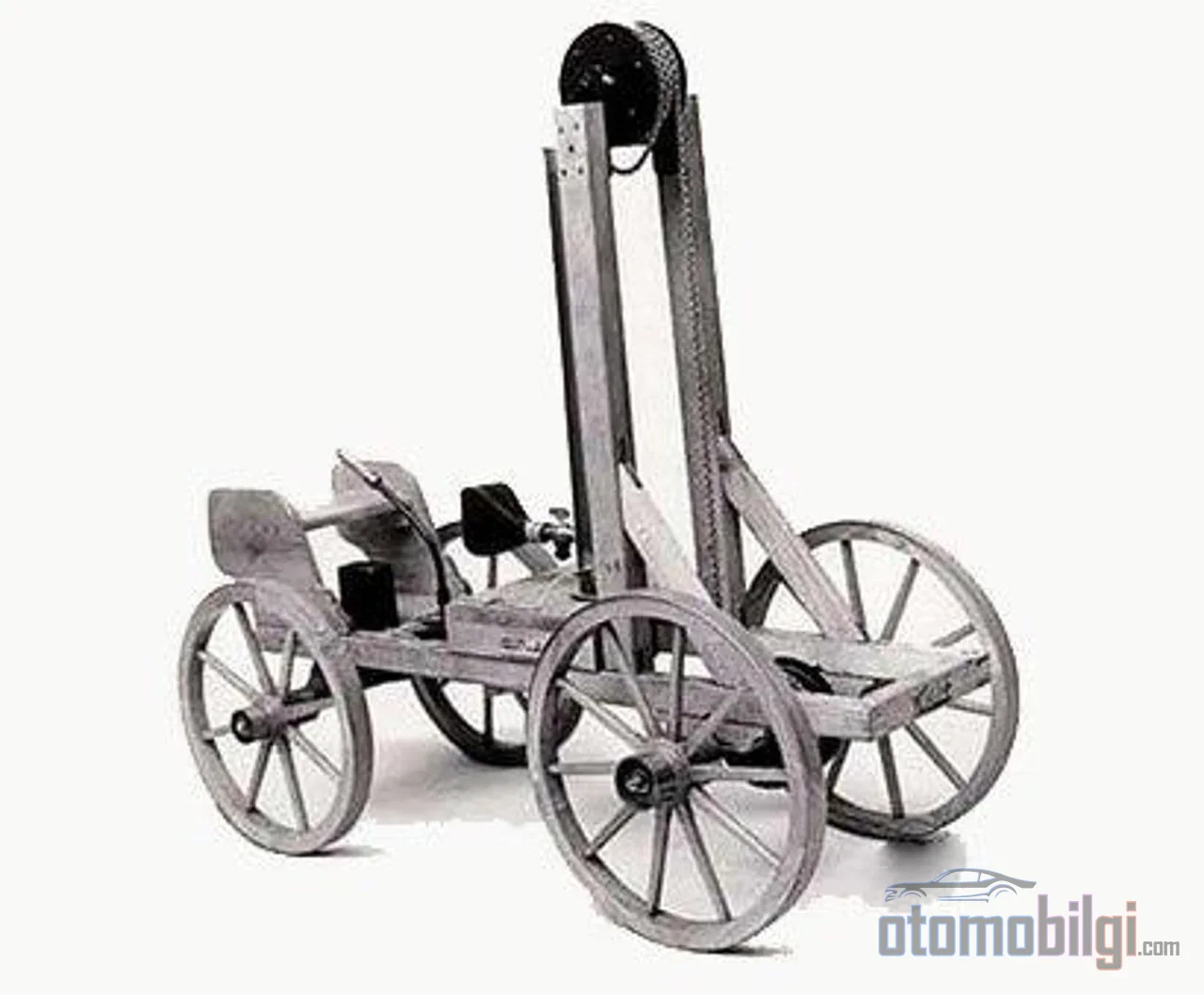
When we examine the De Rivaz engine with a modern eye, we encounter an energy transfer logic very different from today's engines. The system had no timing mechanism; the delivery of the fuel mixture and ignition relied entirely on manual control. This is the clearest indication that the machine was less an automobile than a two-person operation.
Fuel Supply and Ignition
Compressed hydrogen gas was stored in a balloon connected to the cylinder; oxygen was supplied from the atmosphere through a separate air intake. The delivery of gas and air at the correct point in the cycle was done with manually operated valves. On the exhaust side, a secondary, counter-moving piston operated by a hand lever expelled the exhaust gases, drew in the fresh mixture, and closed the valves. For ignition, a Volta cell produced an electric spark inside the cylinder when a button was pressed from outside. Volta's battery consisted of stacks of copper and zinc discs separated by acid-soaked felt, and for the first time produced usable direct current; Volta personally presented his invention to Napoleon himself. De Rivaz immediately recognized electricity's potential as a method of igniting the hydrogen at precise intervals by opening and closing the current. In other words, electric spark ignition was tried in the middle of the steam age, during the Napoleonic era.
Energy Transfer: A Spring-Like Working Piston
The engine's most unusual feature was its energy transfer. The explosion pushed the heavy piston in the vertical cylinder freely upward; as the piston rose to a high position, it stored the energy like a spring. Then, as it descended under its own weight, it pulled the vehicle through a pawl and pulley-rope system connected to the front wheels. So the propulsion came not from the instantaneous punch of the explosion, but from the controlled descent of the piston's weight. This meant leaving the job of today's crankshaft and connecting rod mechanism to gravity; it was a fragile solution in terms of efficiency.
The 1813 Vevey Trial: "Grand Char Mécanique" in Numbers
In 1813, De Rivaz built a much larger experimental vehicle he named the "grand char mécanique". The recorded trial took place in the Swiss city of Vevey, and the result has survived to this day with measurable data.
| Feature | De Rivaz Vehicle (1813) | Benz Patent-Motorwagen (1886) |
|---|---|---|
| Length | 6 m | - |
| Wheel diameter | 2 m | - |
| Weight | Approximately 1 ton | - |
| Cylinder length / stroke | 1.5 m cylinder, 97 cm stroke | 1600 cc, 0.75 hp |
| Maximum speed | 3 km/h (in the Vevey trial) | Approximately 13 km/h |
| Patent | No. 731, January 30, 1807 | DRP-37435, January 29, 1886 |
In the trial, the explosive mixture consisted of approximately 2 liters of coal gas and 10-12 liters of air. Loaded with 300 kg of stone and wood and carrying four people, the vehicle traveled 26 meters at a speed of 3 kilometers per hour on a road with approximately a 9 percent grade; the vehicle covered 4-6 meters with each piston stroke. So for the driver to cover the 26-meter distance, he had to feed the mixture several times, operate the valves, and fire the spark. The "approximately 100 meters" figure that circulated for a long time in the narrative is based not on the recorded Vevey data, but on a working replica built around 1985 being moved approximately 100 meters at a demonstration; some history pages have conveyed these two different situations by merging them. The measured actual figure is 26 meters.
Why Did It Fail Commercially?
The distance between a prototype going down in history and the market embracing it is laid bare in all its starkness by the De Rivaz example. The causes of failure cannot be reduced to a single flaw; four distinct layers piled on top of each other.
- The engineering layer: Manual fuel and ignition control, a transmission architecture that left energy storage to the weight of the piston, and the absence of a timing mechanism kept the vehicle far from being a continuous and reliable means of transport. Institutional assessments clearly found the vehicle's design to be a failure.
- The scientific climate: The French Academy of Sciences held the view that the internal combustion engine could never compete with the performance of the steam engine. This definitive verdict of institutional science steered capital and skilled craftsmen away from this direction.
- Environmental indifference: Very few contemporaries of the era took the work seriously. There was no market to publish to, no manufacturer base to copy it.
- Hydrogen itself: Hydrogen ignites far more easily than gasoline, and the premature ignition problem remains a major one for hydrogen engines. With the materials and manufacturing technology of 1807, this problem was unmanageable.
An additional point of debate was the "first" status itself. Within the same year, on July 20, 1807, the Niépce brothers Nicéphore and Claude received a patent for an internal combustion engine called the Pyreolophore, which propelled a boat by water jet reaction. Although De Rivaz's patent came six months earlier, which design counts as "first" is still disputed today.
Why Wasn't Benz Built on De Rivaz?
The internal combustion principle was actually described in the 17th century by Christiaan Huygens, proposed with a gunpowder-powered engine design, but it never found practical application. De Rivaz's place in this chain is clear: the first name to carry the idea to the cylinder and the wheel. Afterwards, Étienne Lenoir developed the Hippomobile in 1860s Paris, considered the first practical automobile with a gas engine using high-voltage spark plugs; Lenoir was inheriting the electric spark ignition that De Rivaz had pioneered. But the Lenoir engine was highly inefficient because it did not compress the air-fuel mixture before combustion.
The critical leap came from Nikolaus Otto. Otto built his first internal combustion engine in 1861, and by 1876 this design had evolved into an efficient four-stroke engine incorporating compression; Otto also founded the company Deutz. Compression is the key to thermodynamic efficiency, and this was precisely what was missing in the Lenoir-De Rivaz line. Benz, in turn, built the first practical automobile on top of this efficient engine architecture: the 1600 cc, 0.75 horsepower Motorwagen reached a speed of about 13 km/h, becoming the world's first production automobile in 1888. Benz's success lay not in ownership of the idea, but in turning it into a practical whole as the first inventor who designed, built, and tested it. Corporate history pages mention predecessors like De Rivaz, Lenoir and Siegfried Marcus, noting that some efforts remained only on paper, while others produced small self-moving vehicles that could not carry people; This is Benz's difference.
Given Answer: Why Was It Forgotten?
The short and clear answer is this: De Rivaz's engine was adopted neither by scientific institutions nor by the market because it applied the right principles with the wrong architecture; its technical legacy lived on through Lenoir as spark ignition, but not as a vehicle. History's memory rewards not ideas, but working systems. Benz's Motorwagen went down in engineering history as "the first practical automobile" because its measurable performance offered real usability; De Rivaz's vehicle, on the other hand, remained a 26-meter trial.
Today, hydrogen internal combustion engines are back on the agenda. De Rivaz's story is instructive in this context: being early at the idea level is not enough for a technology; materials, manufacturing and institutional acceptance must mature simultaneously. The man who in 1807 presented an idea 77 years ahead of the world was forgotten precisely because he could not wait for this maturation; in contrast, the origin of today's hydrogen engine debates still reaches back to those 26 meters on the road in Vevey.