How the Turbocharger Was Born in 1905: Alfred Buchi's Patent
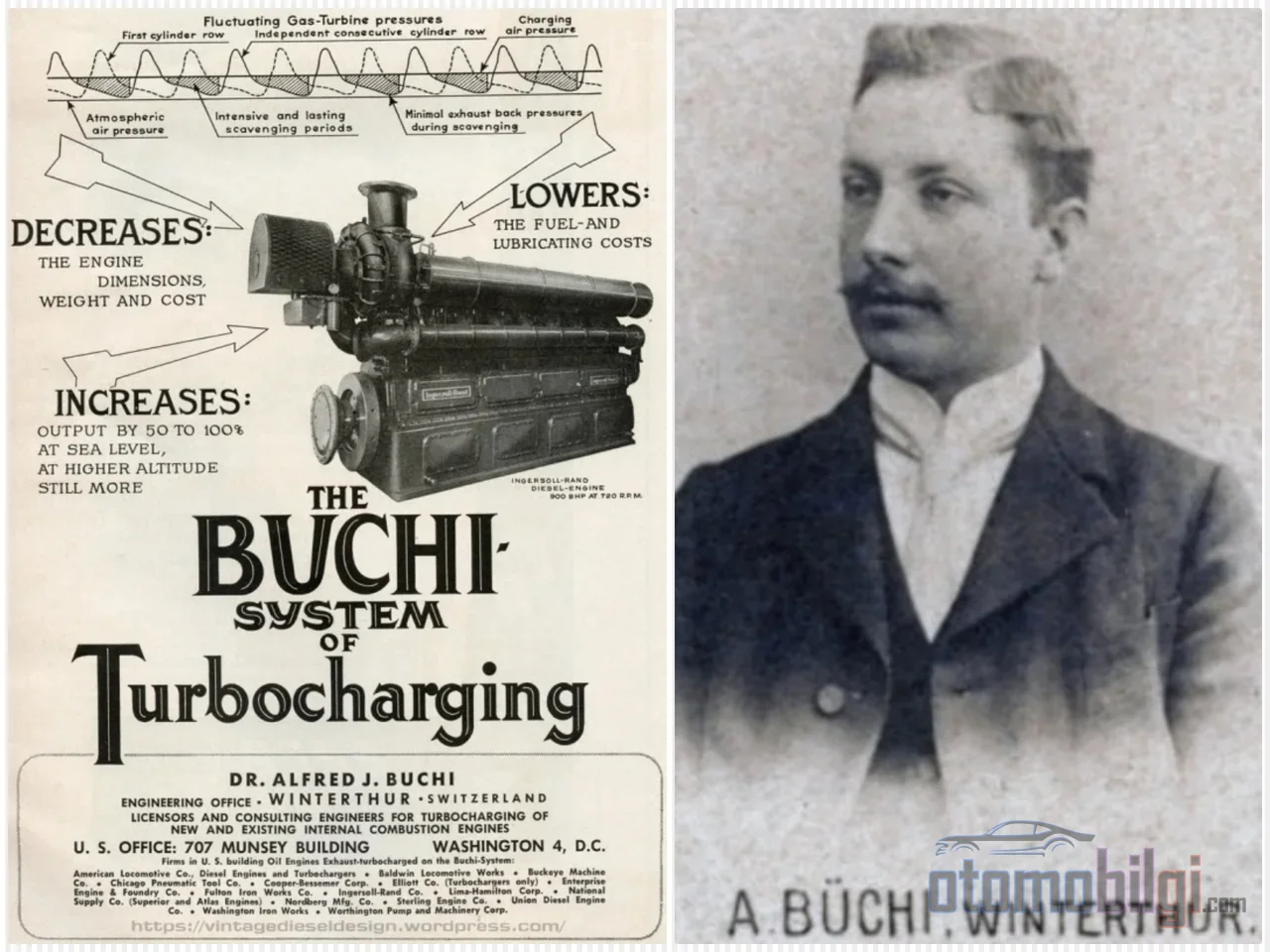
In the autumn of 1905, a file was registered at the imperial patent office in Berlin in the name of a 26-year-old Swiss engineer born in Winterthur: a compound engine design consisting of an axial compressor mounted on a common shaft, a radial piston engine, and an axial turbine, aimed at recovering the energy of exhaust gases. Alfred Buchi's patent application is considered the birth certificate of the turbocharger that works under the hood of millions of cars today. But what is interesting is not the idea itself, but the timing of the idea: the engineering intuition was at least twenty years ahead of its era, and it would wait decades to produce a tangible result.
This page goes down to ground zero of the story that tells the turbo adventure on racetracks and streets: How did Buchi see the energy wasted in the exhaust, what solution did he propose in his patent, and why did this idea have to wait so long to reach mass production?
How Did Buchi See the Energy Loss in the Exhaust?
Alfred Buchi was born on July 11, 1879, in the city of Winterthur, Switzerland. His father, Johann Buchi, was one of the senior executives of the industrial engineering firm Sulzer; so Alfred grew up in an industrial culture right at the heart of the diesel engine revolution. In 1899 he began studying mechanical engineering at the Federal Polytechnic Institute in Zurich (today's ETH Zurich) and received his diploma in 1903.
The years he worked as an engineer in Belgium and England after graduation planted the seeds of his idea. During this period, Buchi took a close interest in the thermal efficiency of internal combustion engines - or, more plainly, in the fact that the energy expelled at high pressure and high temperature from the exhaust at the end of combustion was entirely wasted. The chain of logic was simple: a four-stroke engine must first compress the air it draws into the cylinder in order to use it, and this compression work is supplied from the engine's own power. But what if the kinetic energy expelled from the exhaust were used to feed a compressor that pre-compressed the intake air? The engine would raise its own efficiency with its own waste.
Highlights
- Alfred Buchi laid the foundation of the exhaust-energy-driven turbocharger with his German patent numbered DE 204630, dated 1905.
- The patent described a compound engine consisting of an axial compressor, a radial piston engine, and an axial turbine on a common shaft.
- The first practical success came in 1925: the efficiency of turbocharged diesel engines increased by more than 40 percent.
- The transition took so long because the materials of the era could not withstand the heat and speeds in the turbine.
What Exactly Did the 1905 Patent Propose?
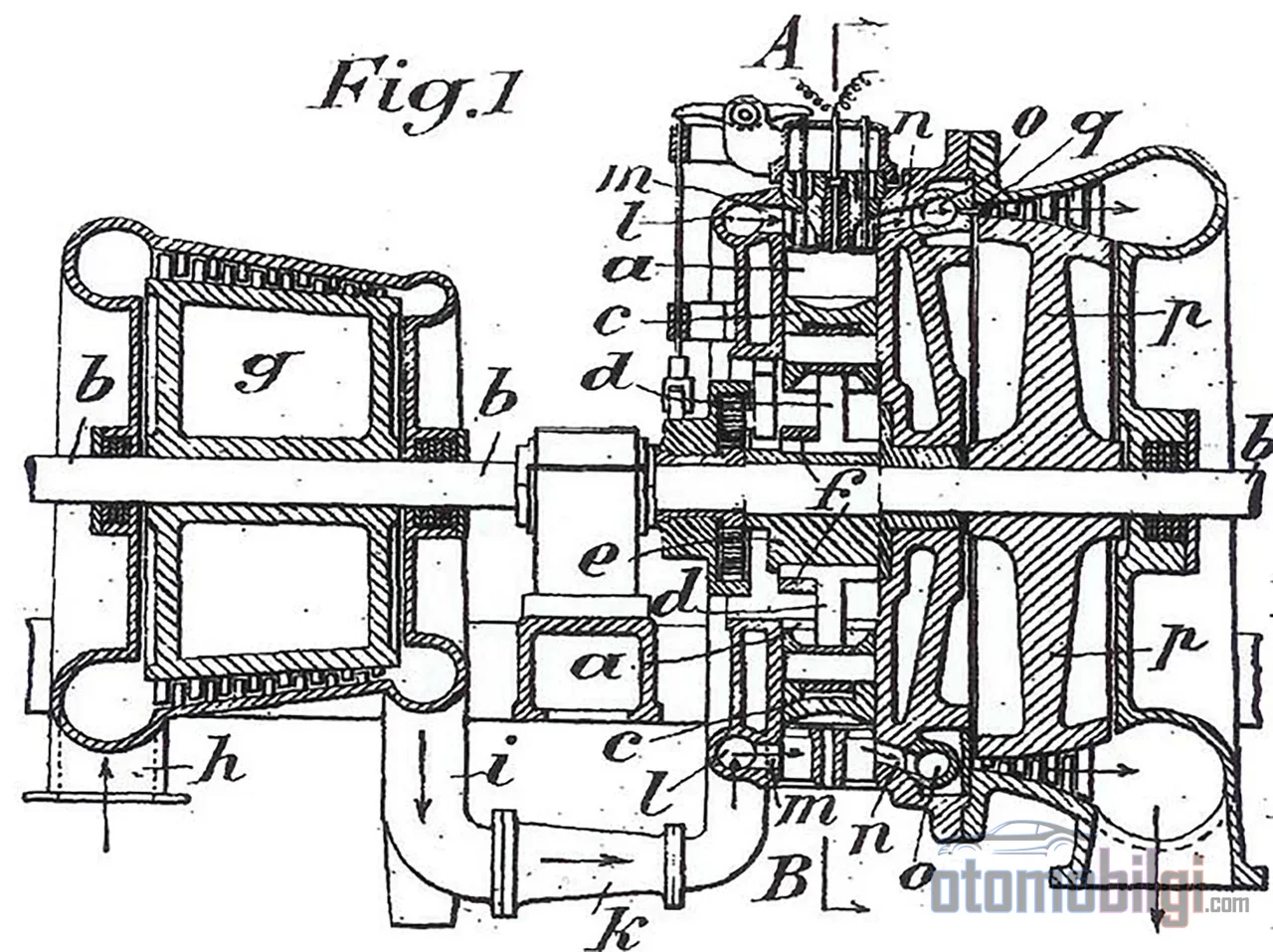
Buchi received the patent numbered 204630 from the German Reich Imperial Patent Office in November 1905; the application was filed in the 1905-06 period, when he was only 26 years old. The records state the issue date as November 6, 1905; some archives date the same patent as November 16. Whatever the day, the content of the document was clear: a highly supercharged compound engine. In this layout, exhaust gas first passes through the turbine, and the compressor driven by the turbine via a common shaft pre-compressed the intake air. The entry in Google Patents also shows that the solution was designed specifically for four-stroke internal combustion, predominantly diesel engines.
The patent is conceptually no different from today's turbocharger: extra air is forced into the cylinders, the energy of the exhaust gas is used to drive the turbine, and power and efficiency increase together. Although this principle was perfected more than a century later with additions such as variable turbine geometry, the core idea remains exactly as it is on the pages of 1905.
Predecessors: The Idea of Forced Induction Was New
Buchi did not produce his idea in a vacuum. Forced induction, that is, the concept of supplying air to the cylinder above atmospheric pressure, had been patented by Gottlieb Daimler in 1885. Daimler's solution did not recover exhaust energy; but it had shown that engine power was limited by the amount of air entering the cylinder. Buchi's contribution was the critical leap at this point: achieving compression using the engine's own waste energy, without straining the engine.
The Idea Was Right but the Era Was Not Ready
Here we come to the engineering lesson of the story. The 1905 patent was based on a simple principle, but the materials needed to physically realize the principle did not yet exist. The exhaust turbine is continuously exposed to very high temperatures and very high rotational speeds; with the metals and manufacturing tolerances of the early 1900s, building a turbine that operated reliably under these conditions was practically impossible. Indeed, the prototypes in the 1905 patent could not be run; which is why the date to which the invention's year should be attributed is still debated in technical circles today. Buchi himself was an engineer who suffered the frustration of having designed something that could not be manufactured.
Aviation Was the First Target
Buchi turned his idea into a concrete prototype in 1915: the first working example of a turbocharged diesel engine. The motivation was aviation; aircraft engines lost significant power in thin air, and supercharging could compensate for this loss. However, the prototype failed to achieve a consistent pressure increase and was not accepted. In the same years, Auguste Rateau obtained his own turbocharger patent for the Renault engines in French warplanes; and in 1918, the flight engineering unit in the USA asked General Electric for a turbocharger design for the Liberty engine. In other words, driven by the momentum of war, the idea quickly circulated in aviation circles, but each time it hit the same wall: heat, speed, and durability.
The Sulzer Years and the Transition to Marine Engines
Buchi joined Sulzer in 1909 and focused on diesel engines in large marine applications; in 1911, Sulzer established an experimental turbocharging facility. This strategic shift was significant: marine diesels were massive, low-speed, and maintainable engines; they offered a far more favorable development platform for turbine technology than automobiles. Cooperation talks with Brown, Boveri & Cie began in 1915, opening a partnership period that lasted until 1923.
The First Real Success Came from the Sea
The turbocharger's first practical application happened not in a car, but on a ship. In 1923, the German Ministry of Transport ordered the construction of the passenger ships Preussen and Hansestadt Danzig; The twin ten-cylinder diesel engines in both ships were boosted from 1750 horsepower to 2500 horsepower using turbochargers designed by Buchi and whose production was supervised by Brown Boveri (today's ABB). These two ships became the first turbocharged ships in history; the order was placed in 1923, while the ships entered service in 1926.
The real turning point came in 1925. Buchi combined the diesel engine with the turbocharger for the first time with complete success: the power of ten-cylinder diesel engines rose from 1,300 kW to 1,860 kW and engine efficiency increased to over 40 percent. In the same year, he received his second patent, Swiss patent 122,664, defining the pulse operating principle in low-pressure supercharging, for the arrangement known today as the Buchi-Duplex turbocharger system. According to many authorities, this 1925 patent is the true breakthrough in a technical sense; the significance of the 1905 patent lies in being the first link in this entire chain. In 1926, Buchi left Sulzer and founded his own company; the test engines came from SLM Winterthur, and the turbochargers from BBC in Baden.
| Year | Event |
|---|---|
| 1905 | Buchi's exhaust turbocharger patent DE 204630 |
| 1911 | Experimental turbocharger facility established at Sulzer |
| 1915 | First turbocharged diesel engine prototype (for aviation purposes) |
| 1923 | Order for the ships Preussen and Hansestadt Danzig |
| 1924 | Delivery of the first heavy-duty turbocharger VT402 from BBC Baden |
| 1925 | First successful commercial application: from 1,300 kW to 1,860 kW |
| 1938 | Saurer produced the first turbocharged truck engine |
Engineering Reasons for the Delay in Series Production
Exactly twenty years passed from 1905 to 1925, the first commercial success; its arrival in automobiles took even longer. Behind this delay lay not a single reason, but several engineering problems stacked one on top of another:
- Material limitations: Turbine blades needed alloys that would withstand exhaust temperatures and high speeds for long periods; such alloys were not available in the 1900s.
- Heat and speed problems: High heat and high rotational speed were the main technical challenges that delayed adoption for decades.
- Turbo lag: The delay between pressing the accelerator and the arrival of the power surge remained an insurmountable problem in early automotive attempts.
- Poor fuel economy: The supercharged arrangements of the era were not convincing in terms of fuel consumption.
The result of this chain is a striking asymmetry: the idea is patented in 1905, becomes operational in marine applications in the 1920s, enters truck engines only in 1938 with Saurer, and serious attempts in automobiles come at the end of the 1950s. Porsche's launch of the world's first series-production exhaust-gas turbocharged sports car with the 911 Turbo in 1974 came a full 69 years after Buchi's patent. Racing circuits only encountered this technology in the 1930s; the Formula 1 turbo era of the 1980s and today's downsizing trend are extensions of the same idea.
Short Answer: How Did Alfred Buchi Discover It?
A clear answer to the question: During his engineering years in Belgium and England, Alfred Buchi saw that the energy of the high-pressure gas expelled from the exhaust of internal combustion engines was going to waste; he developed the idea of driving a compressor that compressed the intake air by passing this energy through a turbine, and in 1905, at the age of 26, he received patent number 204630 from Germany. The essence of the patent was a highly supercharged compound engine arrangement consisting of a compressor, a piston engine and a turbine united on a common shaft.
The lasting significance of the invention is preserved even though the patent did not work immediately. Buchi defined the way to recover the energy expelled after combustion in an engine with a consistent engineering arrangement for the first time; when materials technology matured, this definition became workable in every field, from shipping to aviation, from trucks to passenger cars. Today, anyone looking at a turbocharger facing the exhaust manifold is looking at that page sealed in Berlin in the winter of 1905.
Buchi was recognized for this contribution during his lifetime as well: In 1938, ETH Zurich awarded him an honorary doctorate. When he died on October 27, 1959, he left behind one of the longest-delayed yet most enduring ideas in automotive history. A road opened in Winterthur in 2012 and named after him still reminds us of this legacy in the city where the engineer was born.