Rudolf Diesel: How Was the First Diesel Engine Born?
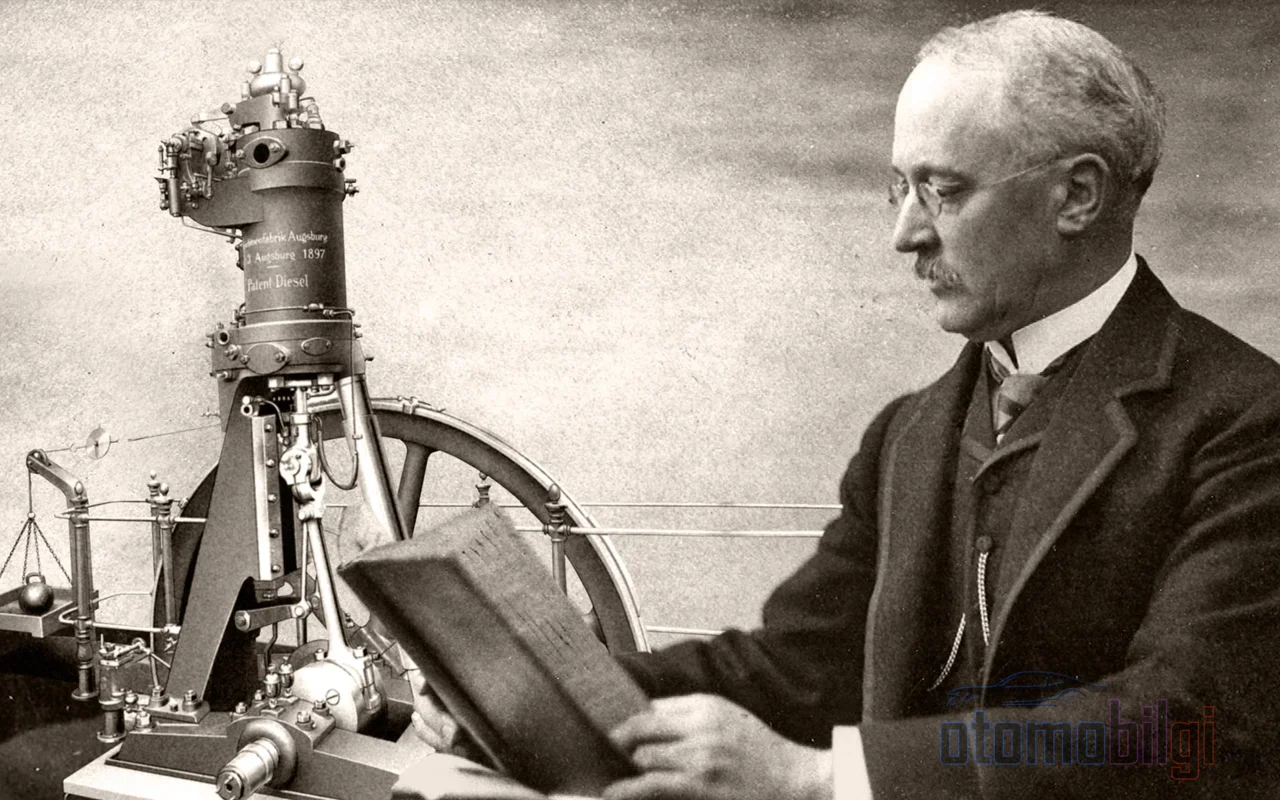
In early 1893, in a workshop in Augsburg, an engineer was trying to turn an idea that looked perfect on paper into steel. The idea on paper multiplied the efficiency of the steam engines of the era several times over; the reality in steel, however, exploded in the first attempts. The four years between Rudolf Diesel and the first diesel engine are one of the most instructive stories in the history of engineering: the collapse of a theory and the birth, from its ashes, of something far more workable.
So how exactly was the first diesel engine born? This page tells not the end of the diesel, but its birth: it traces, in chronological order, the path from the Rational Heat Motor paper of 1892 to the first functional engine running in the MAN workshop in 1897.
February 27, 1892: A Patent Application and a Paper
Rudolf Diesel was born in Paris in 1858 and shaped his engineering career in Germany. On February 27, 1892, he filed an application with the Imperial Patent Office in Berlin for a new engine; in the description, the engine was defined as a rational heat motor. The patent was granted in 1893, and Diesel also obtained protection for the same invention in the United States.
After the patent application, Diesel wrote a book describing his idea in detail. Theorie und Konstruktion eines rationellen Wärmemotors - that is, Rational Heat Motor - was completed in 1892 and published on January 10, 1893. The first German edition was printed as 1,000 copies; the English translation of the book was published in 1894 by Bryan Donkin. In the nine-chapter text, Diesel was sketching a design that would replace the steam engine and all known internal combustion engines.
Highlights
- Patent application: February 27, 1892, Imperial Patent Office, Berlin
- The first functional diesel engine, the Motor 250/400, was completed in 1897 at the MAN workshop in Augsburg
- The gas engines of the era could convert only about 6% of the fuel into work; Diesel's first theory targeted a much higher efficiency
- The first mass-produced diesel passenger car was the Mercedes-Benz 260 D, introduced in 1936
The theory's claim: The Carnot cycle and 50% efficiency
Diesel's starting point was the Carnot cycle, the most efficient cycle in thermodynamics. The idea was an internal combustion engine that converted heat energy into mechanical work under very high pressure, and in the first theoretical calculations the thermal efficiency went up to 73%. To put the figures in context: The gas engines of the 1890s could convert only about 6% of the fuel's energy, and good triple-expansion steam engines only 7.2%, into kinetic energy. Diesel calculated that a design based on Carnot could produce six to seven times more work than these engines, in other words achieve efficiency of around 50% in practice.
The eighth chapter of the book was already listing where the engine could be used: stationary engines for large and small industry, locomotives, trams and trucks, and watercraft. Viewed today, this list predicts the future spread of diesel with surprising accuracy.
The Theory Collapses: What Did the Real World Say?
Diesel sent the paper to the prominent engineers and academics of the day; most of the responses that came back were negative. Only three names - Linde, Schroter and Zeuner - looked favorably on the idea. The most significant criticisms came from Alois Riedler and Wilhelm Zublin, an engineer at Sulzer: both believed the engine would not be able to produce useful work. In fact, Otto Kohler had already written back in 1887 that the ideal Carnot cycle could not be adapted to a real engine, and that friction would consume all the indicated work.
The criticisms were justified, and three reasons can be cited:
- The theoretical isothermal-adiabatic compression combination was physically impossible to implement.
- The proposed 200-300 atm (20.3-30.4 MPa) pressure was far beyond the limit that the machine technology of the era could withstand; friction losses would have rendered the engine useless.
- The extremely lean air-fuel ratio targeted at 99.324:1 made combustion practically impossible.
Between May and September 1893, Diesel redesigned the process from scratch. On June 16, 1893, he acknowledged that the Carnot cycle was not practically feasible and switched to purely adiabatic compression. He reduced the air-fuel ratio from approximately 100:1 to around 14:1, and lowered the compression pressure to 30 atm (3 MPa); experiments showed that ideal compression lay in the 30-35 atm band. This retreat also had a legal dimension: rejecting the conditions of the first patent so openly could have invalidated it. For this reason, Diesel did not publicly admit his mistakes, and to cover the changes he filed for an additional patent, DRP 82 168, on November 29, 1893.
Exploding engines and a bleeding lesson
The experiments between 1893 and 1897 were not only difficult, they were dangerous. In one of the early tests, the engine exploded; Diesel was seriously injured and spent months in the hospital. But even that explosion proved something: without a spark, fuel could ignite on its own inside sufficiently compressed air. The principle we today call compression ignition revealed itself for the first time not on a laboratory bench, but accidentally, in an accident. Meanwhile, Diesel's earlier attempt at an ammonia-vapor steam engine had also ended in an explosion and put him back in the hospital - the Augsburg years passed in an era when personal safety was not taken seriously either.
The first prototype, the Engine 150/400, validated Diesel's revised concepts in preliminary tests and was converted into a second prototype. The time had come to build an engine that actually produced work.
1897: Engine 250/400 and the First Functional Diesel
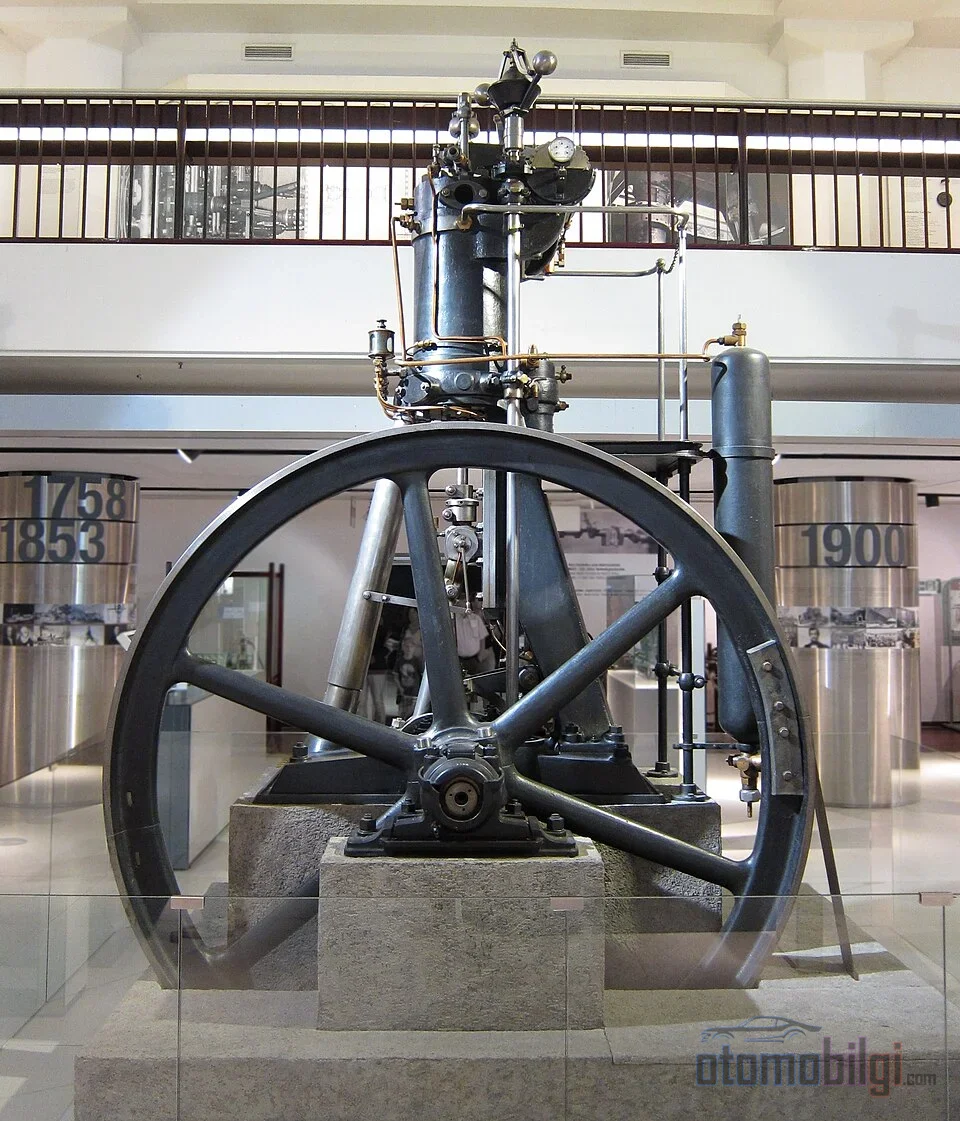
Production began on April 30, 1896; the engine's drawings were made by Imanuel Lauster, a young engineer working alongside Diesel. After four years of work, in 1897 MAN (Maschinenfabrik Augsburg) completed the first functional diesel engine at its workshop in Augsburg and it passed its official tests. Some sources also state that Diesel introduced the engine on January 28, 1897.
| Feature | Engine 250/400 |
|---|---|
| Completion | 1897, Augsburg (MAN) |
| Design / drawings | Rudolf Diesel / Imanuel Lauster |
| Layout | Vertical, with a large flywheel and thick cast-iron components |
| Basic principle | Compression ignition with a very high compression ratio |
| Current location | Deutsches Museum, Munich |
Diesel determined that the engine's theoretical efficiency reached 75%. He obtained his patents in multiple countries and quickly amassed a fortune. It is possible to see it today at the Deutsches Museum in Munich: the oldest known ancestor of the millions of diesel engines around the world is still on display.
Diesel or Akroyd Stuart? The Precedence Debate
There is a frequently asked question in the birth story of the diesel: who really invented the compression-ignition oil engine? The rival candidate is the British inventor Herbert Akroyd Stuart (1864-1927). Akroyd Stuart is known for the hot bulb oil engine he developed with Hornsby, and the version of this engine capable of running on compression was patented, built, and successfully run one year before Diesel's engine. Akroyd Stuart considered himself the inventor of the compression-ignition oil engine and claimed this two years before Diesel's German patents.
The technical difference between the two engines forms the very essence of the debate:
- In the Hornsby-Akroyd engine, fuel injection and gradual combustion were achieved by a different mechanism.
- The diesel engine, on the other hand, injected fuel with very highly pressurized air and was developed in Augsburg seven years after Akroyd's design.
The consensus in the expert literature places both of them on the family tree: today's millions of compression-ignition oil engines were born from both Akroyd Stuart's and Diesel's early work. So the question is less about choosing a single inventor and more about understanding how two different engineering paths converged at the same point.
From the Workshop to the Passenger Car: Diesel's Journey
The first engine in 1897 was a stationary industrial machine; getting it onto the road required a chain of development that would take half a century. In the 1920s, high-revving diesel engines entered commercial vehicles; according to records, the first diesel passenger car seen on the roads appeared in 1929. In the 1930s, it was the turn of passenger cars: Daimler-Benz's OM 138 engine - 2,545 cc, overhead valve, four cylinders - was successfully fitted to a 1935 Mercedes-Benz 230 (W21) chassis, and a total of 5,719 units were produced between 1935 and 1940.
The great turning point came in 1936: The Mercedes-Benz 260 D (W138) was introduced at the Berlin Motor Show and became the world's first series-production diesel passenger car. The following decades gradually developed the diesel: In 1979, Daimler-Benz produced its first turbocharged diesel passenger cars; and in 1997, the Alfa Romeo 156 went down in history as the first diesel passenger car with common rail injection.
Frequently Asked Questions and Short Answers
- Who invented the diesel engine? The first functional, compression-ignition, high-efficiency engine belongs to Rudolf Diesel; but a version of the hot bulb oil engine capable of running on compression alone was patented and run by Herbert Akroyd Stuart one year before Diesel.
- Did Diesel die in the early experiments? No. He was seriously injured in an engine explosion and spent months in the hospital, but he survived. That explosion also proved that ignition without a spark was possible.
- What happened to Diesel later? On September 29, 1913, he mysteriously disappeared from a steamship; his body was found 10 days later. His death was officially ruled a suicide, but accident and assassination theories persist to this day.
- What was the first diesel car? The first diesel passenger car in series production was the Mercedes-Benz 260 D (1936); the first diesel passenger car seen on the roads appeared in 1929.
Conclusion: How Did a Perfect Idea on Paper Become a Real Engine?
The first diesel engine was not an implementation of the Rational Heat Motor paper published in 1892, but its corrected version. Diesel step by step abandoned his original theory-based on the Carnot cycle and promising 200-300 atm of pressure and efficiency exceeding 50%-in the face of real engineering practice: isothermal-adiabatic compression gave way to purely adiabatic compression, an extremely lean mixture gave way to roughly 14:1, and hundreds of atmospheres gave way to 30-35 atm. The first functional diesel engine was born in Augsburg in 1897, through this revised process, as Motor 250/400. The lesson is clear: what invented the diesel was not a single genius, but four years of systematic engineering struggle in which the theory was forced to correct itself.
Sources
- Theory and Construction of a Rational Heat Motor
- Motor 250/400
- Rudolf Diesel
- Hornsby–Akroyd oil engine
- History of the diesel car
- Early History of the Diesel Engine – DieselNet
- Rudolf Diesel – Lemelson-MIT
- Development of the Oil Engine – Nature
- Rudolf Diesel – Britannica
- Inventor Rudolf Diesel mysteriously vanishes – History.com