Four Cylinders or Twelve? Why the Number of Cylinders Has Always Changed
Share This Page
Cylinder count is the most fundamental architectural decision shaping the internal combustion engine's hundred and forty years: from Karl Benz's single-cylinder Patent-Motorwagen to today's turbocharged fours, both engineering physics and market conditions have continuously redefined this number. This article explains why cylinder count has never remained fixed, tracing its milestones alongside technology and economics.
Highlights
- Benz Patent-Motorwagen: 954 cc displacement, 0.75 hp power, 16 km/h top speed
- Nikolaus Otto's four-stroke cycle 1876 emerged in
- Oil price 1973-74 rose from $2.59 to $11.65 per barrel between
- Today's four-cylinder cars reach the power of six-cylinder cars of 2003
Starting from a Single Cylinder: Benz's 1885 Solution
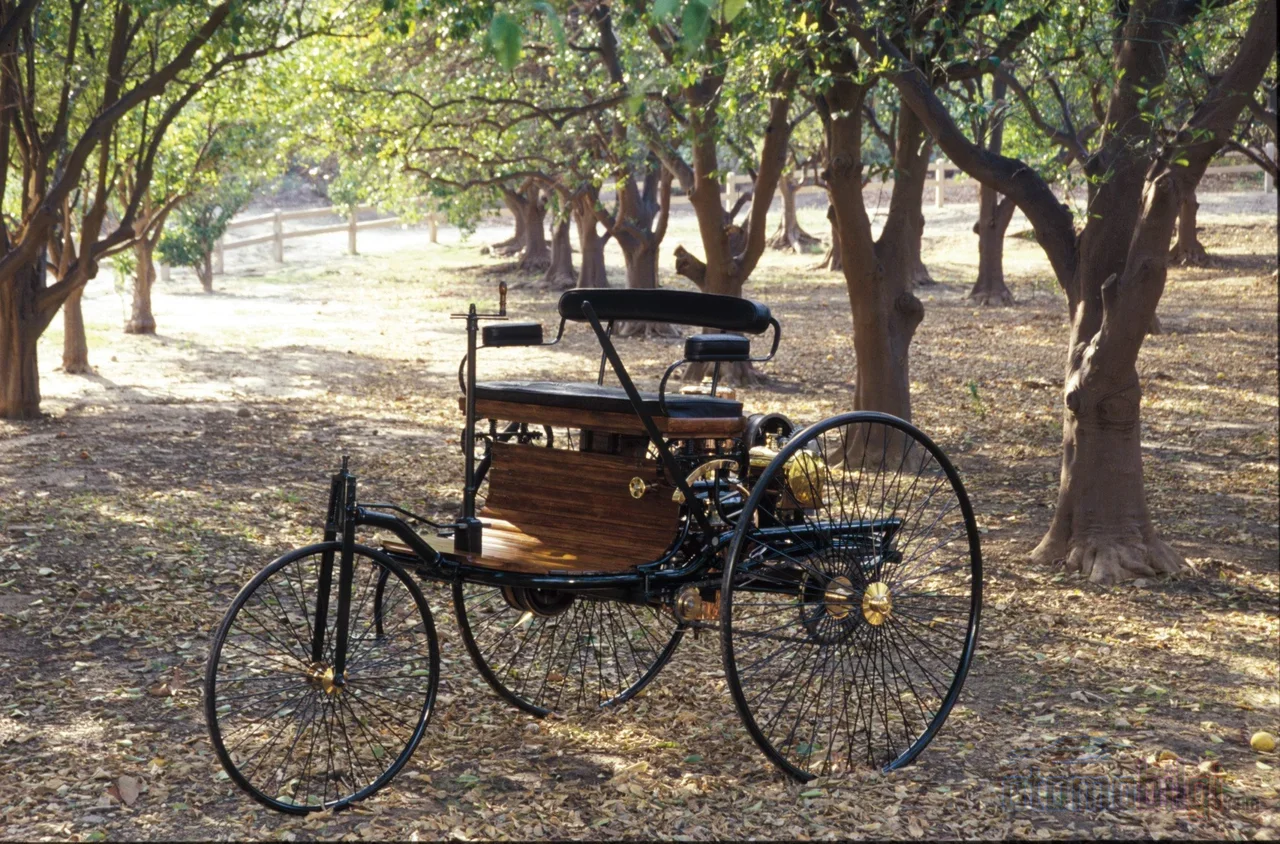
The birth of the automobile is an example of engineering boldness: Karl Benz was the first person to design the vehicle from scratch around the engine, rather than attaching the engine to the back of an existing carriage. Built in Mannheim in 1885, the Benz Patent-Motorwagen carried a single-cylinder, horizontally arranged four-stroke gasoline engine. The patent model displaced 954 cc - some sources give 958 cc, the difference stemming from a difference in definition - with a cylinder bore of 116 mm and a stroke of 160 mm. The result: 0.75 hp and a top speed of approximately 16 km/h.
Even the details of this engine are instructive. High-voltage coil electric ignition and evaporative water cooling were advanced solutions for the time. A massive flywheel was needed to smooth the single cylinder's swinging output; a single ignition period made it impossible for the piston to deliver continuous power to the engine. In engineering terms, the matter was clear: power and smoothness were directly related to cylinder count.
Benz's interest was not limited to a single cylinder. In 1896 he received the first patent for a flat - boxer - engine: horizontally opposed pistons provided momentum balance. This arrangement still lives on today in some models from Porsche, Subaru and BMW Motorrad.
The Otto Cycle: How Did the Four-Stroke Arrangement Come to Be?
Benz's engine was a four-stroke, but he was not the architect of this arrangement. Nikolaus Otto, in 1876 built the internal combustion engine using four strokes per piston. The innovation was assigning a separate function to each stroke: intake, compression, ignition and exhaust were now clearly separated from one another. The piston drew in and compressed the air-fuel mixture inside the cylinder over four strokes; today this arrangement is known as the "Otto cycle."
Otto's engine drew on his first experiments in 1861 and on the design developed with his Eugen Langen partnership that won a gold medal; the theoretical framework was provided by the model proposed by Beau de Rochas. In practice, the product was a large stationary single-cylinder, low-revving engine - a factory power source, not an automobile engine. But the architectural foundation on which it was built passed, as if from a mold, into every automobile engine that followed it: today nearly every gasoline engine on the road runs on Otto's four strokes.
The Inline Four Becomes the Standard
Once the four-stroke cycle was established, the question became how many cylinders it would run on. The answer, for most of a century, gradually converged on the inline-four: four cylinders arranged in a single row along a common crankshaft. The reason is the trio every engineer loves - compactness, efficiency and adequate power. Fewer moving parts, one block, one cylinder head, one or two camshafts; production cost and mechanical complexity drop, and packaging becomes easier.
This formula has produced no shortage of legends. Honda built some of the most respected four-cylinder engines in automotive history; D-Series being just one example. Subaru's EJ engine powered the cars that dominated rallying for the brand in the 1990s and 2000s. These engines proved that a compact architecture can develop character.
V Layout and the Prestige War: How Many Cylinders, How Many Arrangements?
As the cylinder count grows, the layout problem grows too: arranging eight or twelve cylinders in a single row makes the engine too long to fit under a hood. The solution was to combine two cylinder banks at a V angle. V engines are shorter but wider than equivalent inline engines - the length benefits hood height, while the width is at the mercy of the engine bay. The price is complexity: two cylinder heads, each with its own gasket, its own camshafts and manifolds.
On the balance side, the picture is more nuanced. The inline-six and V12 are among the harmonically cleanest architectures, providing natural balance in a four-stroke engine; a V12 is essentially two inline-sixes sharing a common crankshaft, and the inline-six's natural balance is preserved here. The flat-six can be read as a 180-degree "V": three reclined cylinders in each of two banks. Sources clash over the claims that "the V works fine" versus "the inline is better balanced"; in reality both statements rest on different definitions of balance - one measures vibration isolation, the other the simplicity of harmonic balance.
The Oil Crises: How Did the Cylinder Count Shrink?
When the 1970s landed on top of the architecture debate, the calculus changed. The price of oil rose from $2.59 per barrel in January 1973 to $11.65 in January 1974 - an increase of more than fourfold. The trigger was the embargo OPEC imposed on the United States; US domestic oil production had also peaked and begun to decline. This shock effectively ended the era of big cars.
The numbers are concrete: in the mid-1970s, American engines were mostly V8s, displacing anywhere from 5.7 to 7.5 liters. Facing fuel scarcity, manufacturers turned to smaller designs and efficiency; the roots of downsizing reach exactly to this point - the necessity of shrinking cylinder count along with displacement. The 1973-74 "energy crisis" was not only a key moment in America's political and cultural history, it permanently changed the logic of how car engines were sized.
The Turbo Revolution: How Did Four Cylinders Replace the V6?

The second stage of downsizing separated volume from cylinder count: Turbocharging gives a small engine the breathing of a large engine the moment it is forced. Within a few model years, turbocharged four-cylinders replaced naturally aspirated V6 engines in nearly every nameplate. Physics speaks in the same direction: turbo fours are typically lighter than V6s, which makes a modest contribution to payload capacity and front axle weight distribution.
The balance sheet is not one-sided. Turbo components require more specialized maintenance and can increase repair costs; consumers skeptical about long-term durability are not negligible either. The shift from V6 to turbo four is not expected to reverse anytime soon, but there are exceptions: Nissan skipping this trend sparked debate in the industry, and some find this decision "entirely justified." Here is the comparison table for the overall picture:
| Feature | Turbo four-cylinder | Naturally aspirated V6 |
|---|---|---|
| Weight | Typically lighter | Heavier |
| Fuel economy | Advantageous | Higher consumption |
| Maintenance and repair cost | Higher (turbo components) | Lower |
| Market trend | Share increasing | Gradually being phased out |
Why Has Cylinder Count Become Important Again Today?
Having come through the downsizing wave, the automobile has once again made cylinder count a measure of performance and efficiency. The figure is striking: today's four-cylinder engines have the power of six-cylinders from 2003. This combination of fuel economy and performance continues to increase the market share of four-cylinder engines.
The engineering answer to the question "Do more cylinders always mean more power?" is nuanced: A higher cylinder count generally means more torque at low revs - useful for towing and hauling - but it is not decisive on its own; many cylinders are useless if airflow is not optimized. Cylinder count continues to remain a variable that significantly affects efficiency, power, and driving performance. Moreover, there is a symbolic return on the racing side as well: in the debate over Formula 1's post-2026 power unit, the cylinder count was set for the return to the V8 format; technical details have not yet been clarified.
Conclusion: Not the Number, But the Context
There is no single line of progress in the history of cylinder count; what exists is the mutual negotiation between physics and the market. Benz's single cylinder proved ignition, Otto's four strokes provided the architecture, the inline four scalability, V configurations prestige, the oil crises forced downsizing, and the turbo reversed the volume-cylinder balance. Today, the fact that the turbo four has dethroned the V6 is not an indication that one architecture has "won," but an indicator of which side the efficiency-performance balance favors at that moment. Where the next shift will be will be determined not so much by the engine itself as by the economic and regulatory framework that feeds it.
Sources
- Carl Benz | The National Inventors Hall of Fame
- Carl Benz - Mercedes-Benz Group Tradition
- Nikolaus Otto - Britannica
- The Four-Stroke and Its History Explained - Cycle World
- Straight-four engine - Wikipedia
- Response to the First Oil Crisis - Toyota Global
- The Oil Shocks of the 1970s - Yale Energy History
- Are Turbocharged Four-Cylinder Motors Really Better Than V6s? - Jalopnik
- Why Nissan skipped the turbo truck trend - HowToGeek
- 4-Cylinder Engines Continue to Gain Market Share - Experian
- F1's V8 Comeback - Yahoo Sports
- Do More Cylinders Always Mean More Engine Power? - BG Automotive