How Does a Car Behave When the Power Steering Fluid Drops?

The first thing a driver who has made one-handed maneuvering in parking lots a habit usually notices is the loss of that familiar lightness in the steering wheel. Then the sound begins: a stubborn hum that rises as you turn the wheel. Most people assume a major failure at this point; when in fact the issue is often about a few hundred milliliters of fluid in a reservoir. The hydraulic steering system is one of the quietest yet hardest-working subsystems in a car, and it announces its own oil trouble itself. On this page, I will explain how the car behaves when steering fluid drops, how to read the symptoms and when you need to intervene, from the perspective of someone who has been elbow-deep in the job.
What Does the Hydraulic Steering System Do, and What Is the Fluid For?
Vehicles with hydraulic steering assist contain pressurized steering fluid that circulates in a closed loop. This fluid is pushed by a pump connected to the engine by a belt; a significant portion of the force needed to turn the wheel is provided on the driver's behalf by the pressure the pump generates. The fluid's job is not only to transmit power; it also lubricates the system's internal components. In other words, the fluid is both muscle and joint.
Fresh steering fluid is usually a vivid red color. Over time it becomes contaminated with engine residue and turns dark brown. A darkened, nearly black fluid means metal particles have passed through it or it has "cooked" from heat; it is a clear sign that the time to change it has come. If you see a pale, grayish color, that tells a rather different story: there is air in the system. Air in a system that should be closed means fluid has escaped somewhere and air has entered in its place; air oxidizes the fluid and, losing pressure, it fails to do its job.
How Does the Car Behave When Steering Fluid Drops?
Diminishing hydraulics does not announce itself suddenly, but gradually. Its most striking feature is that nearly all the symptoms appear at low speed, that is, in maneuvers where the system is under the greatest load.
Steering becoming stiff
The main symptom is the wheel becoming stiff; turning becomes difficult, and this difficulty becomes noticeable especially in neighborhood driving and parking maneuvers. A steering wheel that feels light at high speed suddenly becomes heavy at low speed, because the pressure the pump generates is also low at low revs.
Humming and whining sounds
The high-pitched hum heard when turning the wheel is a classic sign of low fluid and usually comes from the pump. When the pump cannot find the fluid it needs to circulate, it strains; if there is air in the system, the bubbles straining the pump produce the same sound. The whining and squeaking sounds at low speeds also point to the same causes.
Moderation is required here: a humming or whining sound alone does not prove the fluid is low. The level may be normal; the source of the sound may be the pump, air in the system, or another component. The sound is a sign, not a diagnosis.
A vibrating, bouncing wheel and other signs
- A shaking and juddering steering wheel is another common symptom of a low fluid level.
- The squealing heard when the vehicle is first started is usually the sound of a slipping belt; it should bring the power steering belt to mind.
- A vehicle pulling to one side is usually assumed to be a suspension or tie rod problem; yet a leaking pump can produce the same behavior.
- A reddish-brown residue under the vehicle is a strong sign of a leak while the system is closed; the leak most often comes from hose connections or the pump.
Key Takeaways
- When power steering fluid drops, the wheel stiffens, and humming and vibration begin; the symptoms become more pronounced at low speeds.
- Fresh fluid is red; dark brown fluid needs changing, and a grayish tone is a sign of air and a leak in the system.
- The reservoir must never be overfilled; overfilling leads to leaks from the pressure cap or the seal.
- Electric power steering (EPS) does not use hydraulic fluid; most new vehicles have this system.
- If the level keeps dropping, the problem is not fluid to be topped up but a leak that needs maintenance.
Checking the Reservoir: A Five-Minute Job
Before starting the check, make sure which system your vehicle is equipped with. Most consumer vehicles of recent years use electric power steering, and these systems have no steering fluid; searching for a reservoir is a waste of time. In a hydraulically assisted vehicle, however, the reservoir is not hard to find.
Finding the reservoir and reading the level
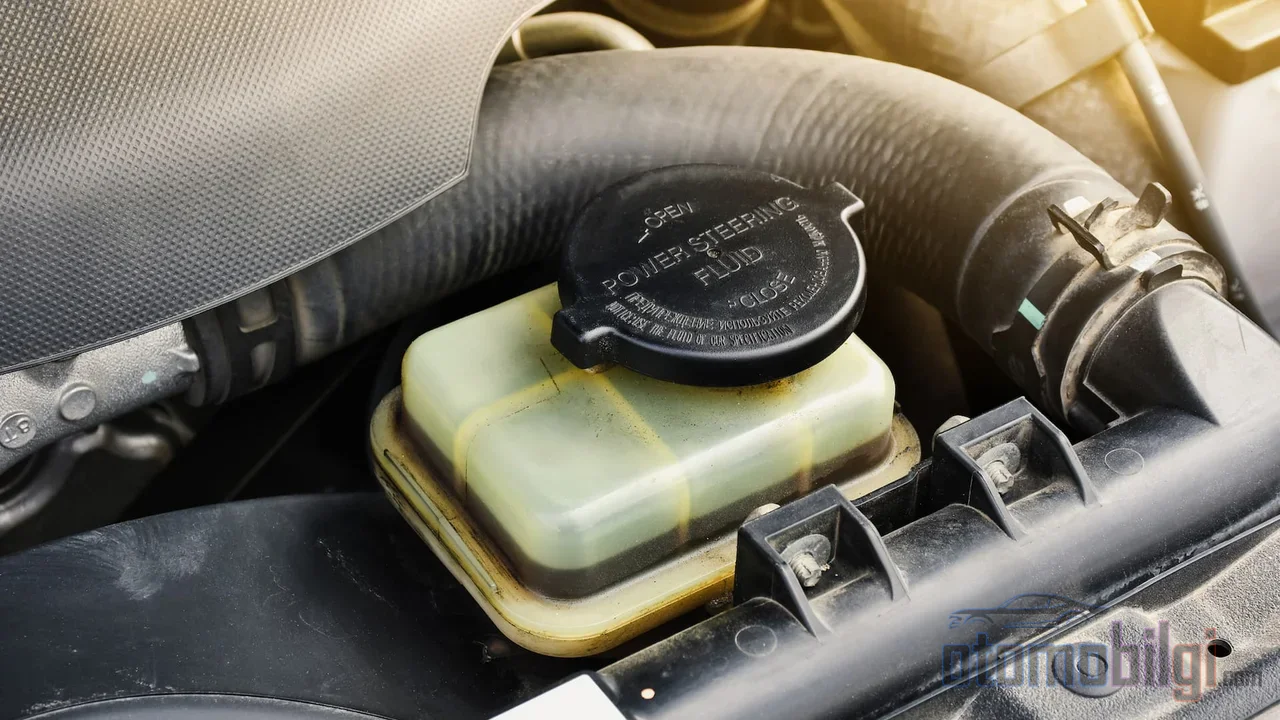
The reservoir is usually a small, translucent container with a black cap; it is noticeable when you look at the engine. In a transparent reservoir, the level is read against the Min and Max marks on the body. In metal reservoirs, the level is checked with the dipstick under the cap. Always wipe the cap before opening it; a pinch of dust falling into the container ends up in a place it should never enter.
Step-by-step check
- Start the engine and let it idle until the temperature gauge reaches its normal level.
- Turn the steering wheel all the way to one side; this circulates the fluid through the entire system.
- Open the cap, and replace it if the cap seal is damaged.
- Read the level against the marks or the dipstick.
- If necessary, top up to a level between Min and Max with the proper fluid specified in the manual.
Two rules are non-negotiable. The first: never overfill the reservoir; overfilling causes leaks from the pressure cap or the seal, and potential damage. The second: use the fluid specified in the manual for your vehicle. A fluid or procedure written for another model is not accepted as a substitute in this system.
When Is Fluid Loss Normal, and When Is It a Sign of a Leak?
In a closed circuit, fluid should not disappear; in reality, over many long years the level can drop slightly due to minor evaporation and indirect losses, and this is normally compensated. The criterion is time: if you top up once and see, months later, that the level is again near Min, what you are dealing with is not fluid but a leak. A leak typically comes from hose connections, the steering box, or the pump, and it does not heal on its own.
A small leak does not leave the car undrivable overnight; but acting quickly is important. Driving without fluid is technically possible, the steering just becomes heavy; but the price is irreversible damage to the pump and other components in the system, a permanent and costly repair. Ignoring the signs of low fluid leads to the failure of important steering components, and in an extreme scenario to the complete loss of assist while driving. If you notice you have lost all assist, do not drive the car; it needs to be towed.
Topping Up or Replacing?
These are two different procedures and they answer different questions. Topping up means bringing the level between Min and Max; it is sufficient if the fluid is in good condition, the amount lost is small, and the level remains stable. Replacement, on the other hand, means filling the entire system with fresh fluid, and the decision rests not on red tape but on two straightforward criteria: the color of the fluid and the manual.
There is clarity on color: fluid that has turned dark brown or black must be replaced. When it comes to replacement intervals, however, there is no consensus in the automotive world; every figure between 50,000 and 100,000 kilometers gets voiced, some advise changing it every two years, while others point to cars that have covered hundreds of thousands of kilometers without a hitch. Manufacturers reflect the same scattered picture: some give specific intervals, while others say there is no scheduled replacement interval for steering fluid and that it should only be replaced based on visual inspection, when necessary.
My observation of thirty years is this: the only reliable authority in this matter is your car's owner's manual. If the manual gives an interval, follow it; if not, checking the reservoir once a year, monitoring the color, and tracking how quickly the level drops is more than enough. One more detail: do not be surprised if the fluid still looks dirty after a replacement. Old fluid left in the twists of the system keeps circulating if it was not fully drained, and it gradually darkens the new fluid.
Hydraulic or Electric? Know Your System
Hydraulic assist used to be almost standard; now electric power steering (EPS) is preferred in consumer vehicles. In this system there is no hydraulic fluid; assist is provided by an electric motor managed by the vehicle's electronic control unit. Since it works independently of the engine, it contributes slightly positively to fuel consumption and enables advanced driver assistance systems such as lane keeping assist. On the maintenance side it is almost entirely silent; no fluid, no belt, no reservoir.
Between the two worlds there are also electro-hydraulic systems: the pump is driven not by a belt but by an electric motor. This hybrid setup is technically sound but has not become widespread except in a few niche models. The hydraulic system, meanwhile, still has a loyal following; particularly performance vehicles and some pickup manufacturers prefer the more authentic road feel and steering feedback that hydraulics offer. A similar distinction can also be seen in the world of tractors. In short: whichever system you have, check your manual first; the power steering fluid debate only makes sense for hydraulic-assisted vehicles.
Short Answer: How to Manage Declining Power Steering Fluid
When power steering fluid drops, the car gives itself away with three signs: a wheel that stiffens at low speed, a rising hum in turns, and a shaky, bouncing steering grip. The check takes five minutes: find the reservoir, read the level against the marks, top up with the proper fluid from the manual if needed, and never overfill. If the fluid is dark brown or black, it is time for a change; if the level keeps dropping, the problem is not the fluid but a leak, and you should go to a service center without delay. The moment you lose steering assist completely, stop driving the vehicle; turning the pump without fluid always costs far more than a reservoir of fluid.
Sources
- Low Power Steering Fluid Noise: What to Do
- Signs of Power Steering Problems
- Power Steering Fluid: How to Check It and When to Change It
- How to Tell If Power Steering Pump Is Bad: 5 Warning Signs
- What Causes Power Steering Whine?
- 4 Major Signs You're Low On Steering Fluid
- Power Steering Fluid: How to Know when it's Time to Change It