Maserati GT2 Stradale Brings Racing DNA to the Road
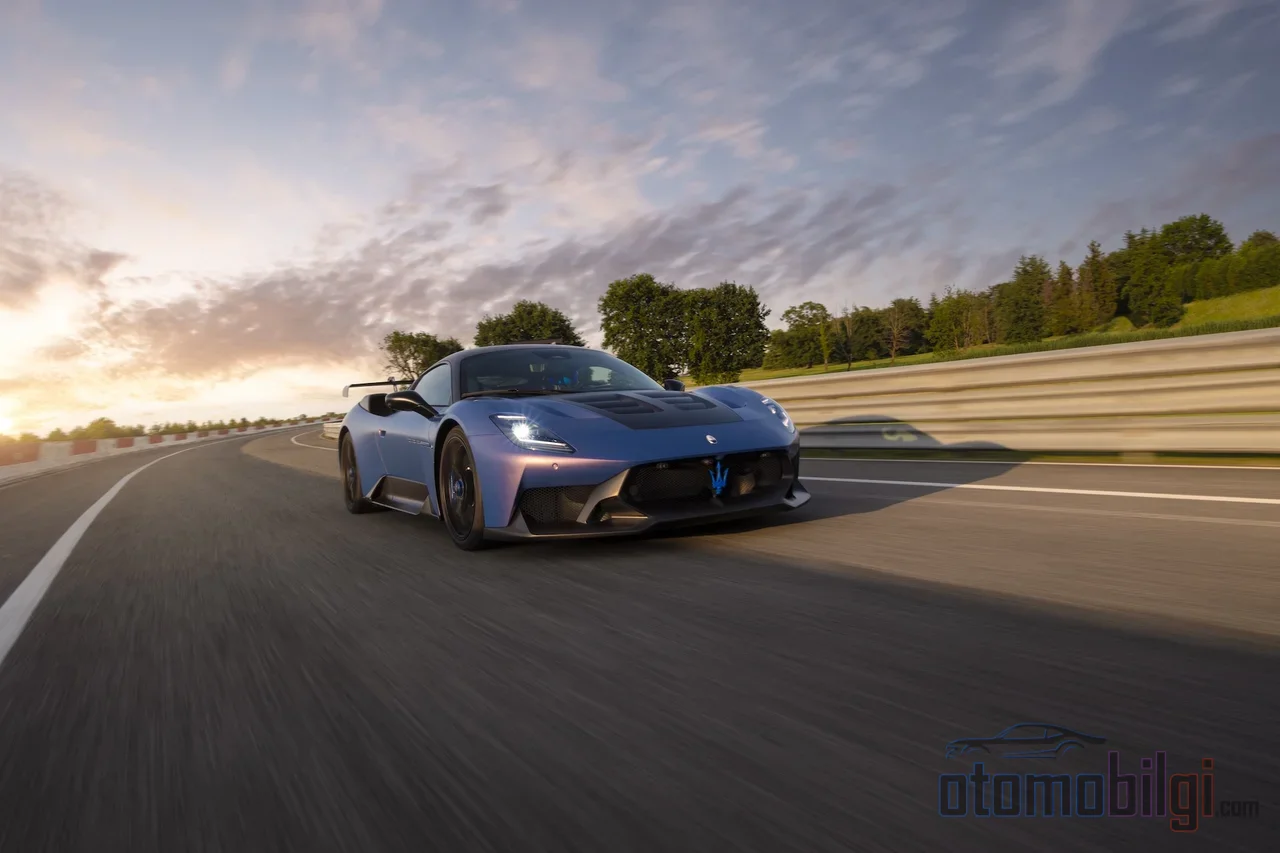
Putting a race car on the road is always a matter of compromise: wings stiffen, suspension hardens, comfort falls into thin air. Maserati's GT2 Stradale is built precisely on this tension - the carbon monocoque of a track car that won in the Fanatec GT2 European Series is being combined with the daily patience of a road-legal supercar. So did Modena really manage it, or are we looking at nothing more than a hardened version of the MC20?
The answer to that question lies in how the differences between this car and the MC20 are distributed. Some differences are visible right on the spec sheet, while others only reveal themselves at the limits on track. Let's first look at the technical foundation.
What Is the GT2 Stradale? From Race Car to Road Car
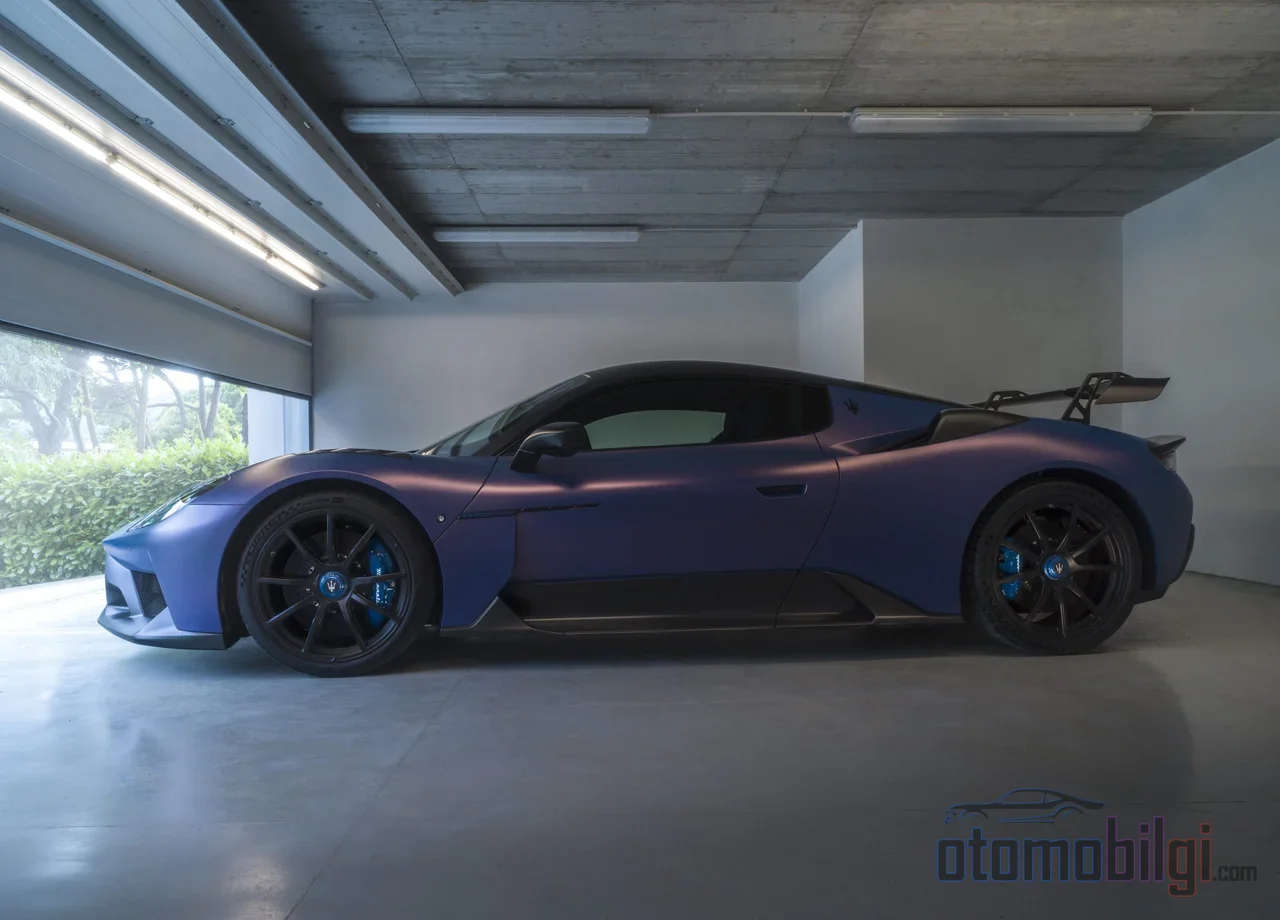
The GT2 Stradale takes its name from Maserati's MC20-based GT2 race car and is described as its road-legal version. The two cars share the MC20's carbon-fiber monocoque chassis; in other words, the shell is the same, everything else is different. The racing derivative won the Fanatec GT2 European Series in the pre-launch period; the MC20-based racing sibling, the GT2 Corsa, has added more than a dozen race victories in the same series' Am class along with both driver and team championships.
Production is limited to 914 units worldwide. This number shows that the car appeals to a clearly defined customer base rather than being a collector's item: drivers who go to track days but use the car on its own wheels, not on a trailer.
Highlights
- A 3.0-liter twin-turbo Nettuno V6 producing 640 hp @ 7,500 rpm and 720 Nm of torque
- 0-100 km/h in 2.8 seconds, top speed 324 km/h
- 1,365 kg dry weight; about 60 kg lighter than the standard MC20
- Up to 500 kg of downforce at high setting - more than three times that of the MC20
- Starting price of $310,000 in the US, 914-unit production run
The Nettuno Engine: How Was 640 HP Achieved?
At its heart is the 3.0-liter 90° twin-turbo Nettuno V6 (2,992 cc) we know from the MC20: dry-sump, mid-mounted, and with F1-inspired pre-chamber combustion technology. This technology is based on the principle of pre-igniting the fuel-air mixture in a small pre-chamber and sending it to the main cylinder as a high-energy flame front; the result is an upper-rev character that is both efficient and eager.
In the GT2 Stradale, the Nettuno has been raised to 640 CV through electronic fine-tuning and exhaust work; torque is stated as 720 Nm at 7,500 rpm, delivered across a 3,000-5,500 rpm band. Specifications for the British and American markets show a value of 631 hp - the difference stems from measurement standards and market specifications; in practice we are talking about a single character. The comparison is interesting: the standard MC20 produces 621 hp and 538 lb-ft; so while power rises by about 10 hp in the Stradale, torque drops back a few lb-ft. A classic tuning artifact in the engine: the sharpened upper rev range comes at a small cost in low-end torque.
The transmission features a rear-wheel-drive 8-speed dual-clutch DCT; Gear shifts are set as pronounced kicks, inspired by the sequential gearbox of a race car. According to official figures, 0-100 km/h takes 2.8 seconds, with a top speed of 324 km/h. Fuel consumption is 11.6 L/100 km, CO2 emissions 265 g/km - actually reasonable figures for this class and this aero package.
Weight and Chassis: Where Do the 60 Kilograms Come From?
Dry weight is 1,365 kg. Compared to the standard MC20 coupe, this difference comes largely from hardware decisions: center-lock 20-inch forged wheels, standard carbon-ceramic brakes, lightweight sport seats, and the removal of most of the cabin carpeting. With the right configuration - forged-hub wheels and carbon seats alone save 20 kg each - savings extend to 60 kg.
Weight distribution is 40:60 (front:rear), the classic result of a mid-engine architecture. The suspension geometry uses the same multi-link layout as the MC20; springs are stiffened by 8% at the front and 10% at the rear, with three-mode adjustable damping offered. Tire sizes are 245/35 R20 at the front and 305/30 R20 at the rear; Bridgestone Potenza comes as standard, while a half-slick track tire is listed as an option. In tests, examples wearing Michelin Pilot Sport Cup 2 R have also been seen.
The front axle lift system is one of the few details showing thought for the practical user: it raises the car 50 mm, works up to 40 km/h, and makes ramps and entrances manageable.
Aerodynamics: What Does 500 kg of Downforce Mean?
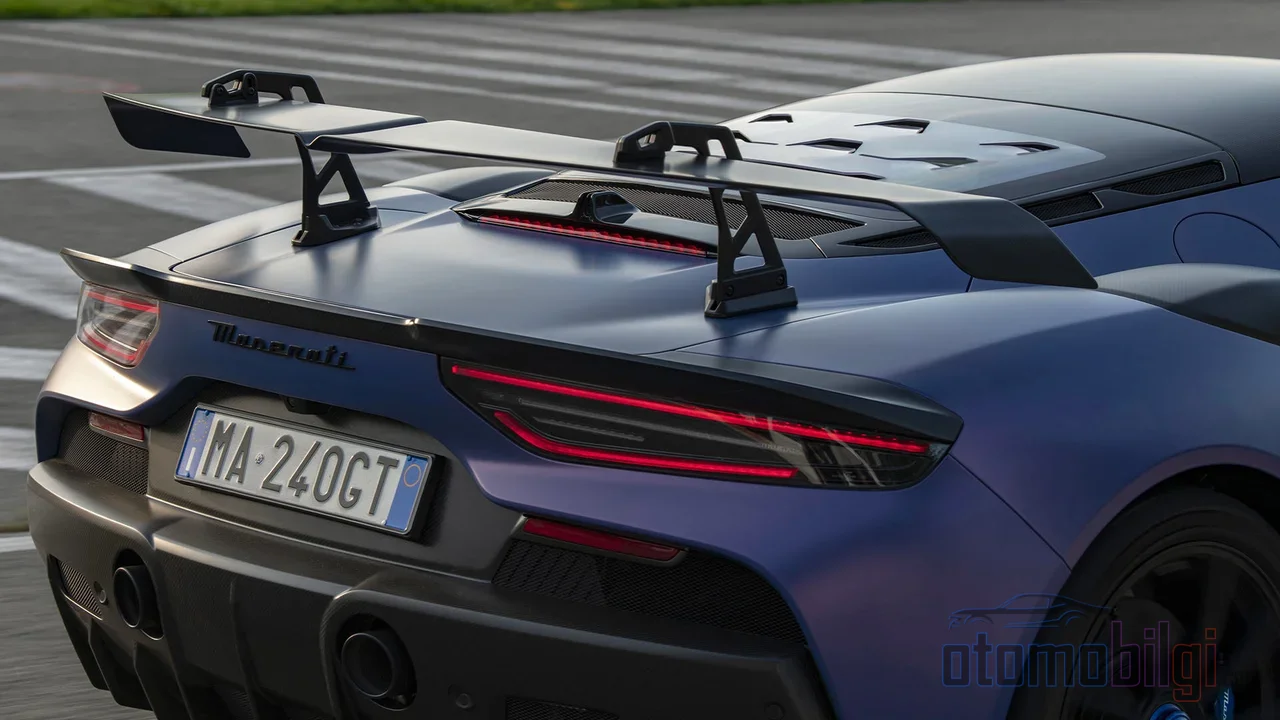
The most tangible difference of the GT2 Stradale is the fixed but manually adjustable carbon wing at the rear. In its low, medium, and high settings, total downforce is 320 / 420 / 500 kg; of this load, a constant 130 kg sits on the front axle, and the wing alone produces up to 370 kg. For comparison: the standard MC20 produces 145 kg of downforce. So at 280 km/h, the difference between the Stradale in the high wing setting and the MC20 reaches 355 kg - which, on a 1,365 kg car, means a massive difference in traction and braking.
What is even more striking is this: even without the wing, that is, with just the flat underbody work, the GT2 Stradale produces nearly twice the downforce of the MC20. The vents in the hood and front fenders, the brake cooling intakes, the large engine air intakes in the rear fenders, and the diffuser make up the other half of this work. The design team's approach is clear - no shape is drawn for style, but for performance.
Still, there is a reasonable distance from the track car: the GT2 race car can produce close to 1,000 kg of downforce; the Stradale does not reach that level, and not reaching it is a calculated choice in terms of road legality and sustainable ride angles.
Track or Road? The Compromise of Character
Maserati's own data says the car is up to 5.0 seconds faster than the standard MC20 on the 3.6-mile test circuit at Balocco. The items above explain one by one where this difference comes from: power, weight, tires and - above all - aerodynamics.
The drive mode architecture supports this dual identity: Sport joins Wet and GT, with four Corsa levels added. In Corsa 1, stability and traction control intervention shuts off completely, ABS intervention drops to 30%, and the electronic differential stays as passive and mechanical as possible. In other words, the track program is a real track program, not a toy.
Steering: Why Does Hydraulic Assistance Matter?
An increasingly rare solution in this class, electro-hydraulic steering assistance is standard here. Feedback from the tests highlights it as the car's most loved feature: a communicative steering wheel with smooth transitions, a quality that multiplies in value as speed builds on track. The brake pedal, on the other hand, could have been a bit firmer; in fact, the brakes stand out as the common point of criticism toward the car - a unit with great potential but missing the final touch.
The overall character assessment is that it is not as hard as the name promises: Don't expect it to be as Hardcore as the Huracán STO or 911 GT3 RS; the car doesn't feel like a born track predator on the circuit, it still feels like a road car, and in character it resembles McLaren's LT series - slightly biased toward the road rather than the track. This can be read either as a shortcoming or as a deliberate compromise: in the tradition of the 911 GT2 RS, a balance has been struck that doesn't punch you in the stomach but preserves everyday usability. Two different assessments, saying it is a more confident and more controlled car than the classic MC20, arrive at the same point.
There is similar restraint on the sound front as well: The Nettuno's voice is not a screaming one, but bass-heavy and growly. For those wanting a harder note, the MC Racing Exhaust is available; however, this unit is for track use only - it is not homologated for public road use, and its performance and sound carry no legal status.
Equipment and Price: What Do You Get?
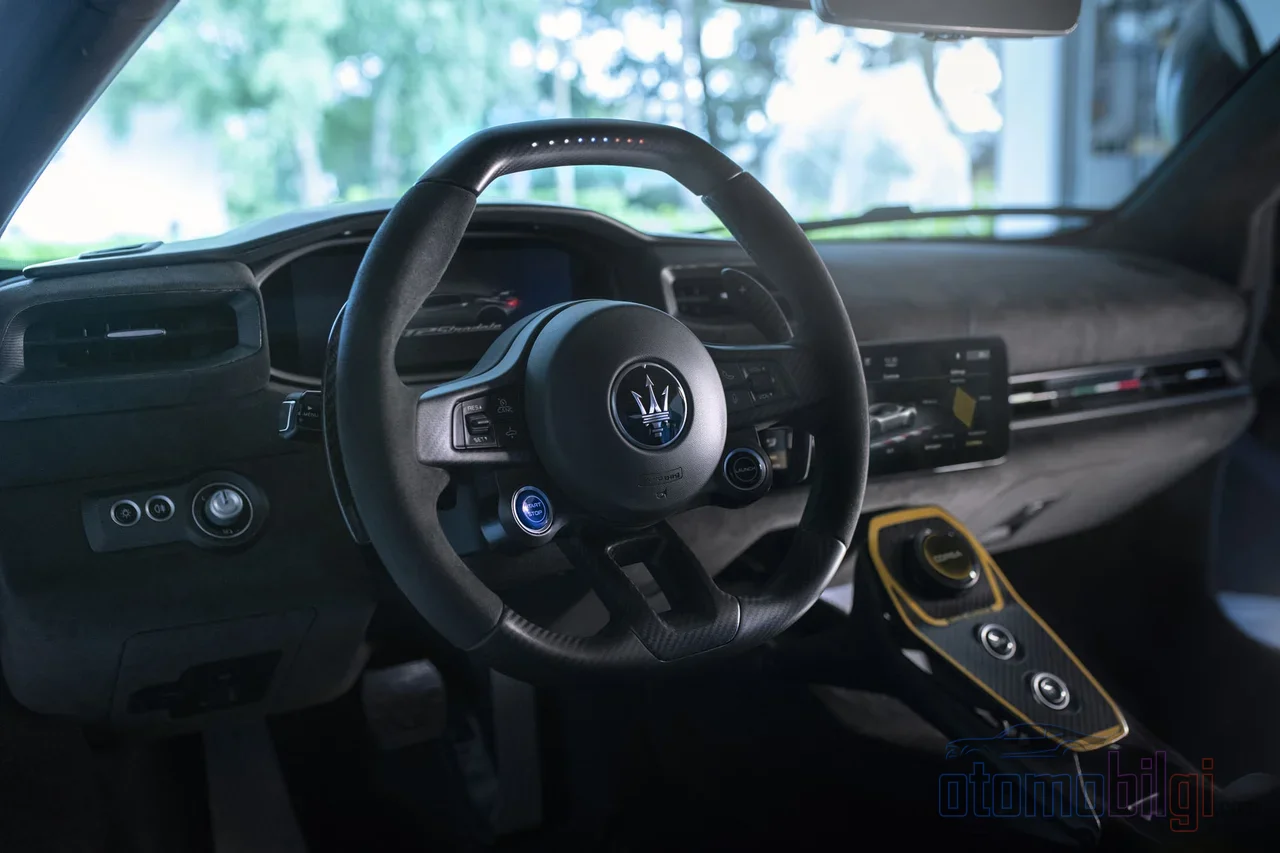
In the cabin there are carbon and Alcantara sport seats (two different sizes), a carbon steering wheel with gear indicator lights, carbon gear paddles, and optional four-point seat belts with a harness bar. The slim carbon console with fluorescent yellow accents saves 2 kg, while the shift light with nine LEDs (3 white, 3 blue, 3 red) communicates the rev limit at eye level. Luggage space is 100 liters; The Sonus Faber High Premium sound system is on the options list.
The price table varies by market: The US starting price of $310,000, in the UK starting at £273,510, almost gets a nearly mandatory Performance Pack on top (Corsa modes, Cup 2 R tires, e-diff, carbon-ceramic brakes, front fender vents) plus Sabelt seats; In the US, there is also a $13,750 Performance package available. PistonHeads' conclusion is striking: A £40,000 premium over the base MCPura, in return for just 10 extra hp. So what you are really paying for is not the power; it's the aero, the weight, and the chassis tuning.
| Specification | GT2 Stradale | Standard MC20 |
|---|---|---|
| Power | 640 hp @ 7,500 rpm | 621 hp |
| Torque | 720 Nm | 538 lb-ft |
| 0-100 km/h | 2.8 s | - |
| Dry weight | 1,365 kg | ~60 kg heavier |
| Max. downforce | 500 kg @ 280 km/h | 145 kg |
| Weight distribution | 40:60 | - |
Where Does the GT2 Stradale Stand Among Its Rivals?
The established names in this class are clear: Porsche 911 GT3 RS, Lamborghini Huracán STO, Ferrari 296 GTB Assetto Fiorano and McLaren 750S. The 296 Speciale, 911 GT3 and McLaren Artura are also added to comparisons. The GT2 Stradale's position in this group is the natural consequence of the compromise in the first two sections: aero efficiency and lightness are at your fingertips, but track radicalism is not at STO or GT3 RS level. In experimental evaluations, it ranked fifth in the car of the year vote, 0.1 points ahead of the Corvette E-Ray and 0.1 points behind Morgan - meaning it does not sit at the top of the stage, but it is not entirely left out either.
There is also a matter of timing: The MCPura, which replaces the MC20, has been introduced and benefits from some of the GT2 Stradale's incremental improvements. In other words, the solutions this car brings are being distilled into the rest of the model range - a classic consequence of limited production.
Conclusion: Does the Racing DNA Fit the Road?
To summarize the GT2 Stradale's identity in one sentence: an MC20 equipped with an aero and lightness package derived from the track, while deliberately preserving its everyday usability. Downforce reaching 500 kg, 1,365 kg dry weight, communicative hydraulically assisted steering and a genuine Corsa program are serious business; the brake feel, the bass-heavy engine sound and a character a touch softer than the name promises are where the criticisms in its class are aimed. It is hard to claim it is the most radical track tool that can be bought for its price; but for those who want to bridge the gap between a track day and a Friday evening, there is a clear buyer base, judging by the audience of the 914-unit production run. Racing DNA has been carried to the road - not at full intensity, but in measurable form.
Sources
- Maserati GT2 Stradale – Racing Is Life
- Maserati GT2 Stradale Press Kit – Stellantis Media
- Maserati GT2 Stradale review – can Modena best the Porsche 911 GT3 RS? – evo
- Driven! Is Maserati's GT2 Stradale Mean Enough? – MotorTrend
- Maserati GT2 Stradale 2026: Specs and Features – Syarah Guide
- 2026 Maserati GT2 Stradale | UK Review – PistonHeads
- GT2 Technical Specifications – Maserati
- Maserati GT2 Stradale 2026 Pricing & Specifications – carsales