McLaren 750S: The Non-Hybrid Pure Supercar
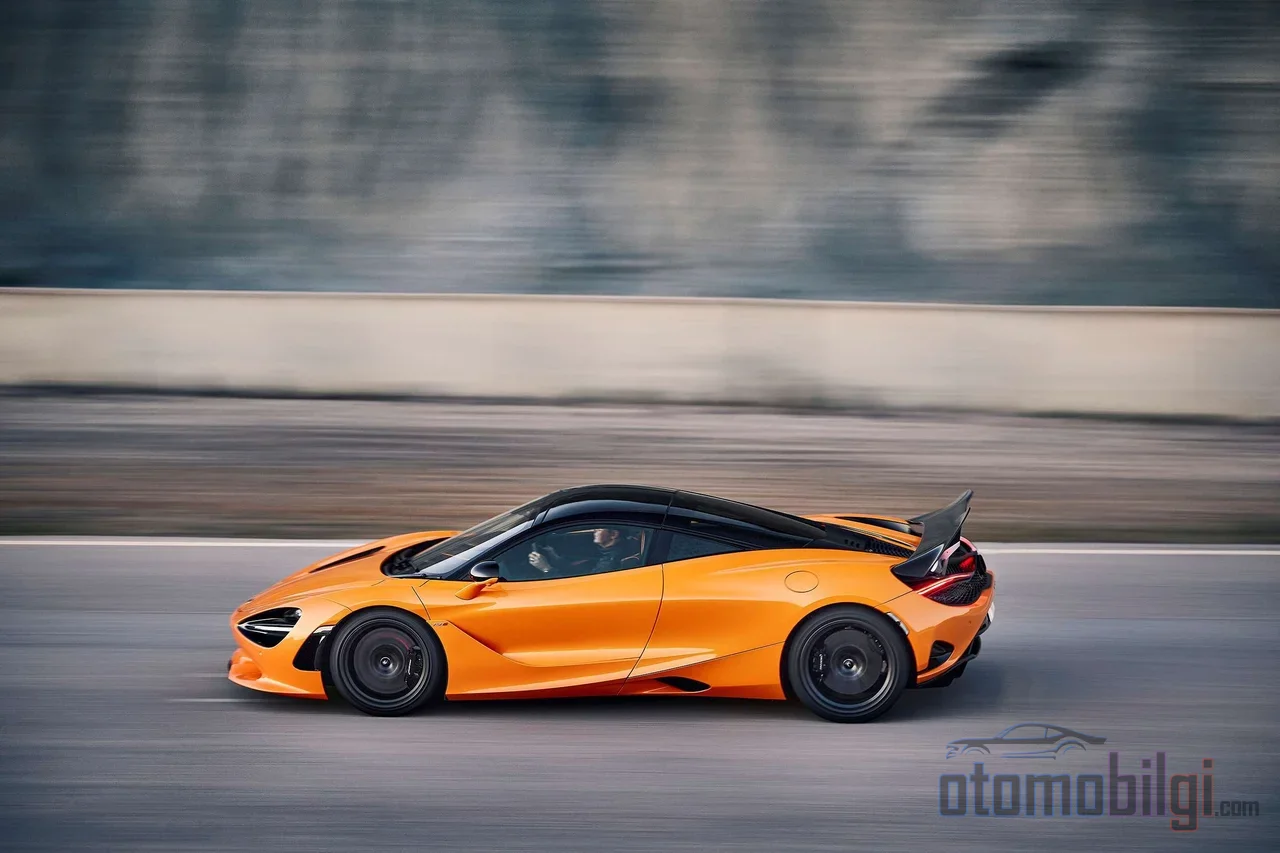
The supercar world has narrowed toward a single word in recent years: hybrid. The Ferrari 296 GTB carries an axial-flow electric motor at the rear, while the Lamborghini Temerario leans on three electric motors. The current mid-engine models of these two legendary brands also share the same philosophy: placing a battery and a motor alongside the internal combustion engine, without exception. McLaren stands in complete opposition to this trend, and the question first asked about the 750S is simple: can a purely petrol V8 still get the job done at the 2026 supercar table, without electric assistance for its power?
The interesting part is that McLaren does not present this choice as a nostalgic move. The company positions the 750S as a deepened engineering revision of its predecessor, the 720S: a shorter final drive ratio, retuned hydraulically linked suspension, increased downforce, and a body trimmed kilogram by kilogram. Looking at the numbers, there is still an impressive picture in terms of engine capacity and performance against its hybrid rivals. In this article, we will examine that picture piece by piece: the engine's technical data, chassis updates inherited from the 720S, the weight target, aerodynamic solutions, and driving dynamics.
Highlights
- Twin-turbocharged V8 with a 4.0-liter capacity producing 750 PS - fully petrol, no hybrid
- 0-96 km/h in 2.7 seconds, top speed 332 km/h
- With a dry weight of 1,277 kg, the lightest McLaren series-production road car
- Revised chassis with 3% softer springs than the 720S and a shortened final drive ratio
- Coupe and Spider launched simultaneously for the first time
750S Technical Specifications: M840T Engine Data
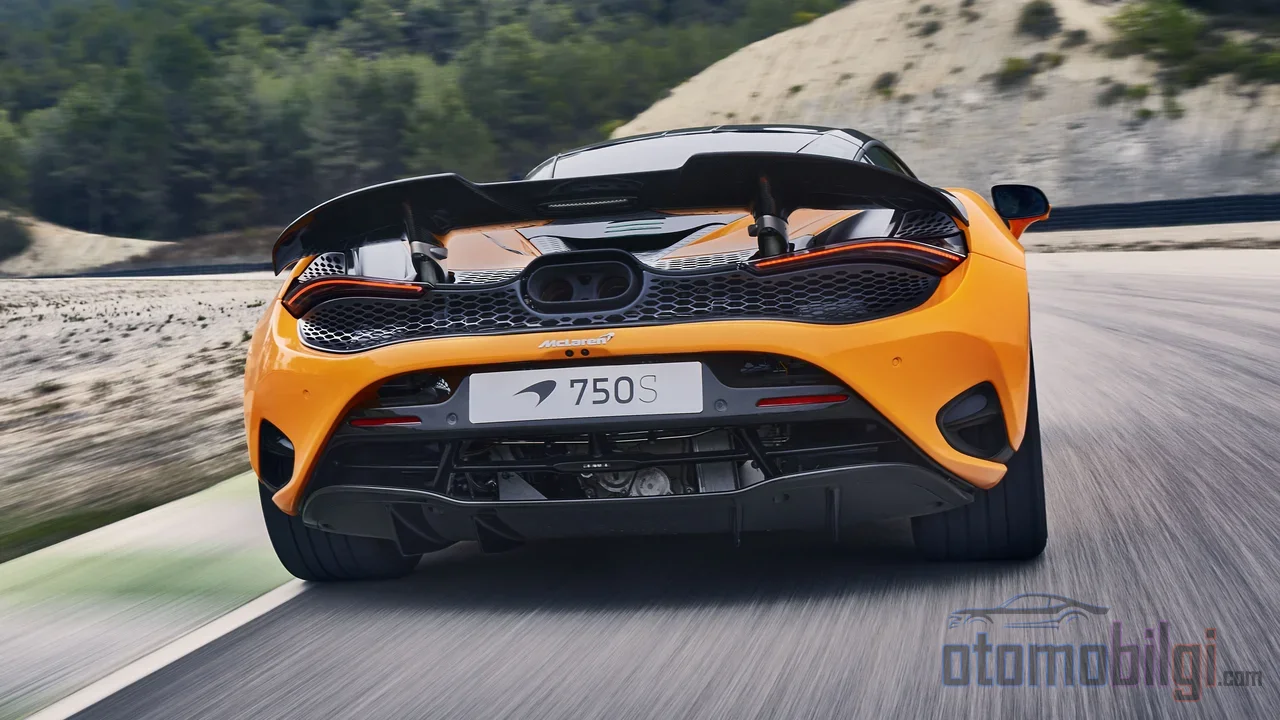
At the heart of the 750S runs McLaren's 4.0-liter twin-turbocharged V8 engine coded M840T. The details shaping the engine's character are far from ordinary: the turbochargers use an electrically assisted twin-scroll design, the dry sump lubrication system prevents oil from separating from the cylinder heads even under high lateral acceleration, and the sequential MPI fuel injection system times injection according to cylinder order. All of these are solutions brought together to keep turbo lag in check and maintain linear power delivery.
On the power side, encountering two different figures is normal: McLaren officially declares 750 PS; sources in the US market list the same engine as 740 hp @ 7,500 rpm. The difference between the two is not a contradiction but a unit difference between metric and imperial horsepower definitions - both values describe the same engine. Torque is consistent on both sides: 800 Nm @ 6,500 rpm.
Power is delivered to the rear wheels only, through a 7-speed dual-clutch gearbox called the Seamless Shift Gearbox. One of the most effective settings the 750S inherited from the 720S is hidden here: the final drive ratio has been shortened to 3.30, providing a more aggressive climb throughout the gears. The result is McLaren's stated acceleration figures: 0-96 km/h in 2.7 seconds, top speed 332 km/h.
| Parameter | Value |
|---|---|
| Engine | 4.0 L twin-turbo V8 (M840T) |
| Power | 750 PS (740 hp @ 7,500 rpm) |
| Torque | 800 Nm @ 6,500 rpm |
| Transmission | 7-speed dual-clutch, rear-wheel drive |
| 0-96 km/h | 2.7 seconds |
| Top speed | 332 km/h |
| Dry weight | 1,277 kg |
From 720S to 750S: What Changed in Chassis and Aerodynamics?
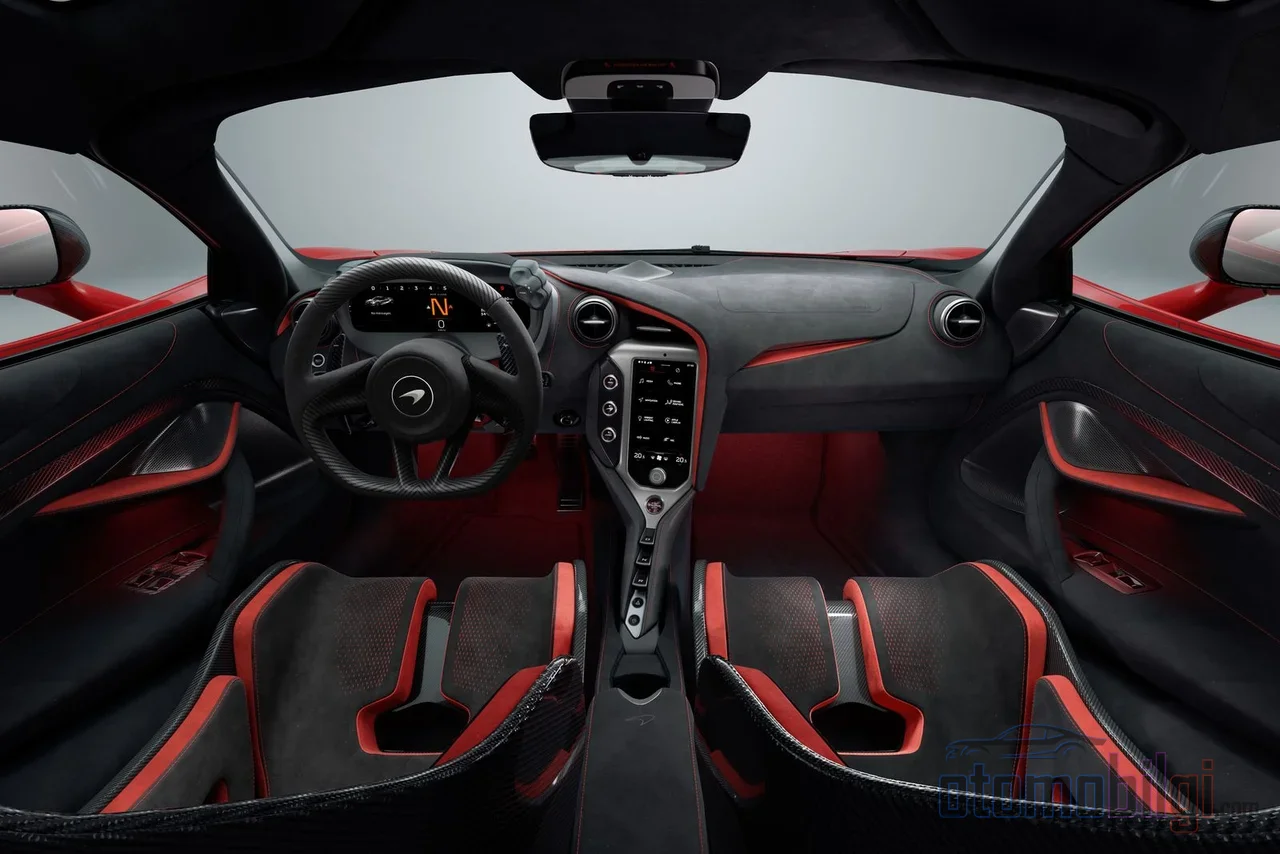
The 750S is often labeled an "upgraded 720S," but the list of engineering revisions narrows that label down. The changes fall into three main headings: suspension, drivetrain and aerodynamics.
Suspension and Drivetrain
McLaren's signature Proactive Chassis Control hydraulically linked suspension system was reworked, and the springs were set 3% softer. While this looks like a small figure on paper, it is a calibration change that directly affects the balance between body control and ride comfort. Combined with a shorter final drive, the car both sits more flexibly through corners and climbs through each gear more eagerly. A double wishbone layout is retained at the front and rear axles, with tire sizes of 245/35R19 front and 305/30R20 rear on forged aluminum wheels. Braking is handled by carbon ceramic discs: 15.4-inch front, 15-inch rear rotors.
Aerodynamics
At the front of the body there are revised air intakes and slimmer headlights, while at the rear there is a reworked profile; the goal is increased stability, grip and the downforce/efficiency pair. The active rear spoiler does two jobs at once: it draws heat away from the engine bay and optimizes airflow for downforce. The wing works in sync with the drive mode - in Aero mode more downforce is generated, while for straight-line acceleration the wing is positioned with less drag. To these should be added a glass solution that saves 3.5 lb (about 1.6 kg) on the windshield; small but clear proof that McLaren's kilogram hunt extends to every surface of the body.
Weight Target: How Was 1,277 kg Achieved?
The most talked-about technical figure of the 750S is its dry weight: 1,277 kg. With this figure, McLaren describes the car as the lightest series-production McLaren road car. Here, attention must be paid to the distinction in definition: dry weight refers to the figure measured without fluids and driver; kerb weight is measured with all fluids and, for this car, sits at approximately 1,389 kg (3,062 lb). Using the two figures against each other would be a faulty comparison - which value belongs to which definition is decisive in supercar comparisons.
This weight takes the power/weight balance to a point where its hybrid rivals cannot reach. With a ratio of roughly 526 hp/ton (per US ton), the 750S plays the masslessness card in a class where electric motors bring their battery masses. The dimensions also confirm the car's compactness: wheelbase 105.1 inches, length 179.9 inches, height only 47.1 inches. Fuel tank 19 gallons (approximately 72 liters).
Does the Pure V8 Philosophy Still Make Sense in the Age of Hybrid Supercars?
The 750S's competitive context is becoming clear: both of its current classmates have chosen the path of electrification. The Ferrari 296 GTB integrates the axial-flow electric motor placed behind its V6 engine into the hybrid system; the Lamborghini Temerario, meanwhile, uses three electric drive motors in a classical layout. Both of these approaches add battery and motor masses to the car while increasing power and torque. The 750S competes in the same performance category without adding any of this mass and remains one of the fastest in its class at its top speed (332 km/h).
The engineering question here is simple: in return for the extra torque that electrification brings, at what point does offsetting the mass penalty of hybrid systems with reduced weight produce better driving dynamics? The 750S is the pure gasoline answer to that question. McLaren's own marketing points in the same direction: 750 PS, lightweight construction and an emphasis on an intense, connected driving experience - not a promise of electric assistance.
Criticisms are not entirely absent either. The car's weaknesses are at a practical level: cargo capacity is limited and Android Auto is not supported. So it would be wrong to position the 750S as a vehicle that meets every need of daily life; where it is positioned is as the serious driver's machine.
Driving Dynamics: Grip, Steering, and Balanced Suspension
Independent evaluations converge on a common point regarding the 750S's driving dynamics: acceleration is unreal, grip is heroic, and the suspension manages to hold performance and comfort together. Steering quality and the driving environment are interpreted as offering a special experience even in ordinary road use. This trio - power, grip, and the balance of comfort - is the tangible payoff of the pure gasoline approach: the hydraulic interconnected suspension's body control, combined with the lightweight body, produces a level of agility that electrically assisted systems struggle to deliver.
The emphasis on the 750S Spider side is a bit harsher: the car does not make things easy with the touch of a button and offers an experience designed for serious drivers. The retractable hard top provides the open-air version of this experience without diluting its dynamic character. McLaren, for the first time, launched the Coupe and Spider versions of a model at the same time, presenting the pair with equal status; the Coupe's dry weight stands at 2,815 lb.
Warranty, Versions, and Pricing
The Coupe and Spider versions of the 750S share the same mechanical foundation in terms of content; the Spider only adds the retractable hard top mechanism and the small mass difference it brings. Regional price references, for example in the Australian market, mark a band for the 750S ranging from AUD 580,163 up to AUD 646,984 for the Spider; in competitor comparisons, in the Indian market the 750S sits below the Temerario and above the 296 GTB. These figures are for comparison purposes only, as they vary with regional taxes and equipment differences.
The warranty package is comprehensive: 3-year unlimited mileage basic warranty, 3-year powertrain warranty, 10-year corrosion warranty, and 3-year roadside assistance. A quick 750S checklist can be summarized as follows:
- M840T 4.0 L twin-turbocharged V8, 750 PS / 800 Nm
- Dry weight 1,277 kg, kerb weight ~1,389 kg
- 0-96 km/h in 2.7 seconds, 332 km/h top speed
- Carbon ceramic brakes, 19-inch front / 20-inch rear forged wheels
- 3-year unlimited mileage basic warranty, 10-year corrosion
Conclusion: The Value of the Non-Hybrid Path
The McLaren 750S is a car that proves the pure petrol path still holds strong in the age of hybrid supercars. With its 750 PS turbocharged V8, 1,277 kg dry weight, 2.7-second acceleration, and revised chassis updates, it shows it can compete at the top of its class even without electric assistance. The Ferrari 296 GTB and Lamborghini Temerario are technologically more complex and benefit from the instant torque advantage that electrification offers; the 750S answers on the side of low mass and mechanical simplicity. Rather than asking which path is "correct," you should consider which driving experience adds value for you: instant torque, or lightness and connectedness? For those who choose the second answer, McLaren builds the clearest example in the current supercar market.
Sources
- McLaren 750S | Lightweight V8 Supercar
- 750S – Under the Microscope (McLaren)
- The new McLaren 750S Americas press pack (McLaren)
- McLaren 750S Review, Pricing, and Specs – Car and Driver
- McLaren 750S Review – Top Gear
- McLaren 750S Review – evo
- 2026 McLaren 750S Spider Review – The Drive
- McLaren 750S Specs & Features – Edmunds
- McLaren 750S prices – CarsGuide