RCTA: What Does It Scan in Reverse, and What Can't It See?
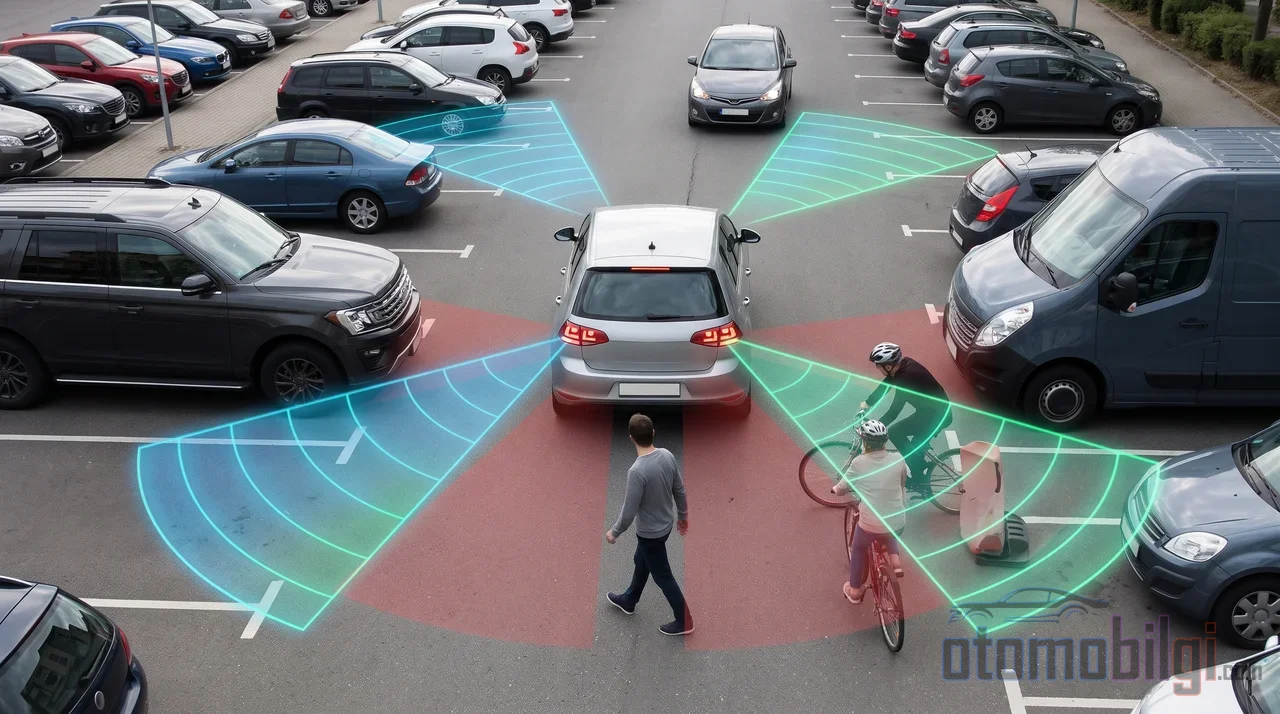
In the shopping mall parking lot, you've parked squeezed between two giant SUVs. You shift into reverse, the rear camera screen comes on, everything looks fine. But right at that moment, a car is approaching fast from the left, from completely outside your field of vision. This is exactly the moment Rear Cross Traffic Alert, or RCTA, was made for. So what does this system actually see when you're in reverse, how far can it see, and more importantly, what can't it see? The most common misconception drivers have about this system is precisely this: assuming that everything has been detected when they hear the beep. That's not the case. And on this page, we explain step by step why.
What Is RCTA and How Does It Work in Reverse?
Rear Cross Traffic Alert is a driver assistance system that activates the moment you shift into reverse. Its job is very clear: while the vehicle is reversing out of a parking spot or garage exit, to monitor approaching vehicles, cyclists and pedestrians from the left or right with radar, and to alert the driver with audible and visual warnings when a collision risk arises.
But how does it do this? The heart of the system is the small radar sensors hidden in the left and right corners of the rear bumper. These sensors emit radio waves and create a detection area extending in both directions of the parking spot. In other words, the system doesn't scan behind your vehicle, but the corridors beside it. When the vehicle is shifted into reverse, the sensors activate and calculate the distance, speed and direction of each detected target, assessing whether there is a risky intersection.
Let's make an analogy: RCTA is like a friend standing behind the door, sticking their head out in both directions to check for oncoming traffic. While you look backward, it looks at the side corridors. But just like a real friend, its job gets harder when its view is blocked or the approaching vehicle is very fast. We'll talk about these limits in detail shortly, because that's the most critical part of the matter.
Key Highlights
- RCTA monitors traffic coming from the sides while in reverse, using radar sensors in the rear bumper corners.
- Detection range varies by brand: Kia scans laterally from 0.5-20 meters, while GMC scans up to 19.8 meters in both directions.
- In AAA's 2019 test, scenarios were produced where systems missed motorcycles 48% of the time, bicycles 40%, and passing vehicles 30%.
- Versions with automatic braking can stop the vehicle before a collision; the driver can override the brake by pressing the accelerator.
- 85% of drivers are very satisfied with the system, but a quarter still reverse without turning their head.
How Is It Different from Parking Sensors?
Let's clarify a point that is often confused: RCTA and conventional rear parking sensors are not the same thing. Parking sensors, using ultrasonic technology, are quite successful at detecting fixed obstacles like walls, poles, or another parked vehicle. But they fall short at detecting a moving vehicle approaching from the sides. This is exactly where RCTA stands apart: radar can read not only the presence of moving targets, but also their speed and direction. Although some manufacturers have offered RCTA versions that work with ultrasonic sensors, radar is the primary technology in most systems today.
Its Relationship with Blind Spot Monitoring
Another nice detail: In most vehicles, RCTA shares the same radar sensors as the blind spot monitoring system, that is, BSM. While driving forward, these sensors monitor vehicles in the blind spot of the adjacent lane; when the gear is shifted to reverse, the same sensors automatically switch to RCTA mode. In other words, one hardware, two different tasks. Manufacturers like Toyota explicitly state this transition in their manuals.
What Is the Range and Speed Threshold of RCTA?
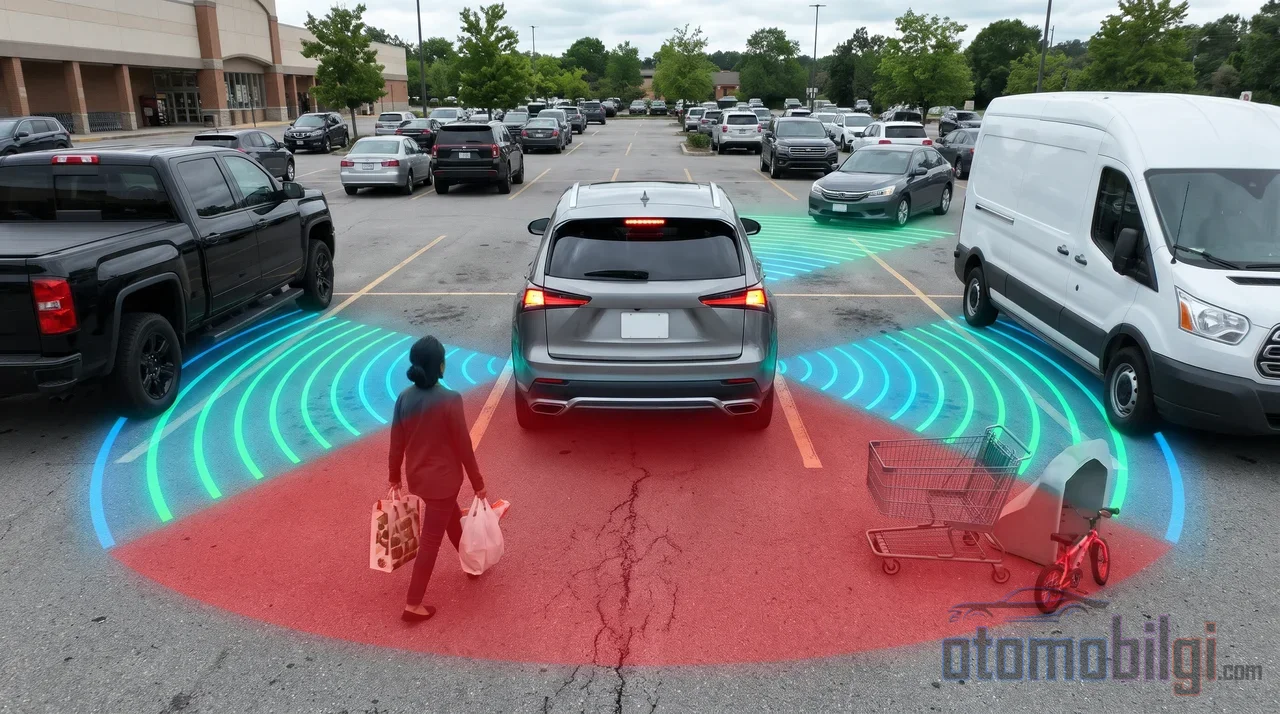
Now let's get to the most concrete question on our minds: how far can the system see, and at what speeds does it work? The answer varies from brand to brand, but the data actually falls within a surprisingly narrow band.
According to Kia's official manuals, RCTA works when the gear is in R and your own vehicle is moving at speeds of up to 10 km/h. The lateral detection range is between 0.5 and 20 meters; the approaching vehicle needs to be within a speed range of 4-36 km/h. GMC states that it detects cross traffic up to 19.8 meters in both directions and plays three beeps upon detection. Bosch's mid-range radar system, on the other hand, can detect objects up to approximately 45 meters when reverse gear is engaged and trigger a warning sound. The radar of Kia's RCCA version with automatic braking can read approaching vehicles from a lateral range of 25 meters and a rear range of 6 meters.
There are also limits regarding the speed of the approaching vehicle. According to Nissan's current manuals, the system may not detect passing vehicles moving below approximately 8 km/h or above 30 km/h. Toyota designs its warnings assuming the approaching vehicle is moving at approximately 8-29 km/h; in brands like GMC, however, the range and thresholds are kept a bit wider. These differences are not contradictions; each manufacturer sets its own thresholds based on its system's radar power, software, and the parking conditions of its target market.
| Manufacturer / System | Range | Speed Condition |
|---|---|---|
| Kia (RCTA) | Lateral 0.5-20 m | Vehicle below 10 km/h, target 4-36 km/h |
| GMC | 19.8 m in both directions | Three beeps upon detection |
| Bosch radar | Approximately 45 m | Active in reverse gear |
| Kia RCCA (braking) | Lateral 25 m, rear 6 m | Graduated intervention |
| Nissan | Not specified in the manual | Target outside the 8-30 km/h band is risky |
| Toyota | Shares the BSM radar | Reverse below 8 km/h, target 8-29 km/h |
The practical conclusion to be drawn from this: RCTA is designed for a slowly reversing vehicle to catch targets approaching at low and moderate speeds. A vehicle passing at top speed in a parking lot or a pedestrian drifting very slowly may fall outside the system's thresholds.
How Does the System Alert You?
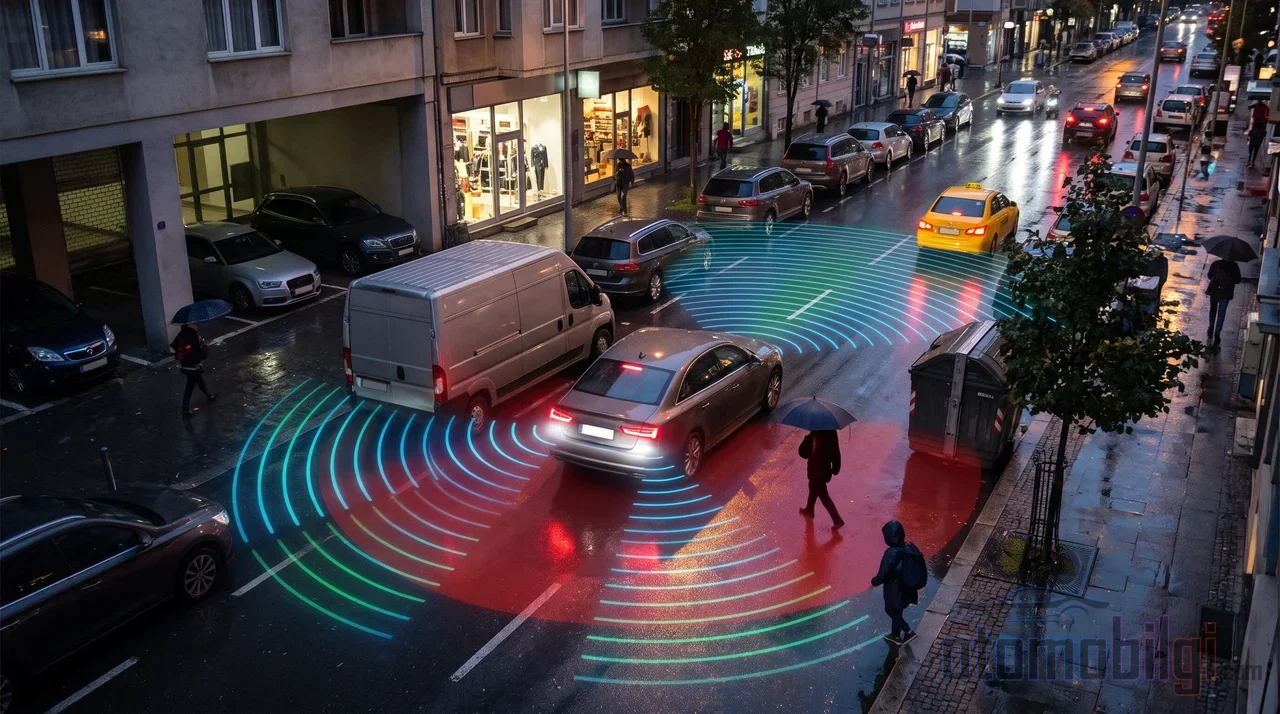
When detection occurs, the warning can come through multiple channels. The most common is an audible beep; this is followed by indicators on the side mirror or the rear camera screen, and even a flashing red triangle icon pointing to the direction of the approaching vehicle. Toyota explains that when a vehicle or cyclist is detected, the exterior mirror indicators flash, a warning sound plays, and an icon appears on the multimedia screen. Brands like Cadillac, on the other hand, warn with seat vibration, meaning the driver's seat delivers a pulse on the risk side; depending on the settings, a single rear beep can also be selected.
When Does Automatic Braking Kick In?
There is one level above RCTA: rear cross-traffic braking, meaning the system not only warns but stops the vehicle itself. In the Chevrolet and GMC system, short-range radars monitor cross traffic while reversing, and when a collision needs to be prevented, firm emergency braking is applied. The critical detail is this: if you think it is safe, you can always override the automatic braking by pressing the accelerator.
Kia explains that the Rear Cross-Traffic Safety system works in stages: first a collision warning, then emergency braking, and finally stopping the vehicle and ending brake control. So the system is not a flawless referee; In Volvo and Polestar, the logic is similar: if the warning is ignored and a collision is unavoidable, the vehicle brakes, and the screen explains why braking was performed; if the accelerator pedal is held down firmly, the system can be disabled.
Two important practical notes: According to GMC, rear cross-traffic braking automatically shuts off when it detects that a trailer is attached to the rear; it can also be deactivated if another object, such as a bicycle, is being carried at the back. In real-world use, there are also complaints that the system brakes unnecessarily, for example stopping unnecessarily for a passing vehicle at a wide garage exit. There are also examples of the opposite: drivers describe how automatic braking engaged at an exit with obstructed visibility and prevented a collision. sometimes it is more cautious than necessary, sometimes it acts too late. sometimes overly cautious, sometimes too late.
The System's Blind Spots: When Does It Not Beep?
A driver who does not know this side of the story may one day pay the price of trusting the system too much. The situations RCTA cannot see are real, and the manufacturers' own manuals state this clearly.
The shadow of stationary vehicles
The most classic scenario: a large vehicle is parked next to you, and that vehicle blocks the radar sensor's beam almost like a wall. Toyota and Nissan manuals state that barriers, walls, and parked vehicles can create blind zones the sensors cannot detect. When parked among large vehicles such as SUVs or minivans, the sensors are partially blocked and the system's functionality is seriously reduced. So the moment you need the system most may be the moment it is weakest.
The cyclist, motorcycle, and pedestrian problem
AAA's comprehensive 2019 test revealed the limits of these systems in the most striking way: the tested systems failed to detect motorcycles in roughly half of the cases, that is, 48% of the time. 40% of cyclists passing behind and 30% of passing vehicles went undetected. These rates are a serious warning sign about the system, especially for motorcyclists and cyclists. The fact that the system fails to see a cyclist passing behind when reversing out of a supermarket parking lot one in five times is not something anyone can ignore.
Other limitations
- RCTA is designed for straight reversing; in angled parking spaces, the detection zone rotates by the same angle, and some vehicles may fall outside this zone.
- Dirt, mud or snow covering the radar in the rear bumper, or its alignment being knocked off by minor impacts, reduces detection accuracy.
- When reversing very slowly, a fast-moving vehicle may exit the detection window before the warning is issued; the system may warn late or not at all.
- If bumper repairs or post-accident ADAS calibration are not performed, the sensors may malfunction and give false warnings.
So What Does RCTA Actually See in Reverse?
Let's give the clear answer to the question: In reverse, RCTA uses radar to monitor motorized vehicles approaching at roughly 4-36 km/h in a corridor of typically 20-45 meters on either side of the vehicle, and alerts you with an audible, visual or vibrating warning; however, its reliability drops significantly in obstructed fields of view, outside speed thresholds, and especially in detecting pedestrians, cyclists and motorcyclists. Unlike parking sensors, the system reads moving traffic; it is not expected to detect stationary obstacles as well as they do.
Another important fact is this: As of 2026, 92% of new cars come standard with at least one driver assistance system, and 85% of RCTA owners are very satisfied with the system. 52% of participants believe the system helped prevent a collision. So the system works; but the confidence it creates does not mean flawlessness.
Your Mirrors Are Still the First Line of Defense
The most striking data concerns not the technology but human behavior: A quarter of RCTA vehicle owners admit they sometimes reverse without turning their head at all. A similar study shows that 30% of drivers with blind spot monitoring systems sometimes change lanes without visually checking their blind spots. Assuming that hearing a beep guarantees you have seen everything is technology's most expensive illusion.
Driver training authorities say the same thing: when reversing or parking, mirrors, head checks and the rear camera should be used together. Electronic warnings may not show all road users; scanning and direct checks must always go hand in hand. The mirrors are always the first and last line of defense. That is already RCTA's design purpose: to warn the driver against collisions that may fall outside the rear camera's field of view, not to replace them.
In summary: RCTA is a genuine helper at parking lot exits, and its automatic braking versions can truly prevent many collisions. But if you parked next to a large vehicle, are in an area with cyclists and pedestrians, or the radar is dirty, the system's silence shouldn't surprise you. Keep turning your head and checking the mirrors while in reverse; if you hear the beep, you're lucky - if you don't, your neck and eyes are still your only protective sensors.
Sources
- What is RCTA? Rear Cross Traffic Alert ADAS Systems
- RCTA (Rear Cross Traffic Alert) - Toyota Owner's Manual
- RCTA Fact Sheet - AAA
- RCTA System Limitations - 2025 Nissan Qashqai Owner's Manual
- Rear Cross Traffic Alert (RCTA) - Suzuki e VITARA Owner's Manual
- Rear Cross Traffic Alert (RCTA) - Mazda MX-5 Manual