What Does the Automatic Braking System See at Intersections?
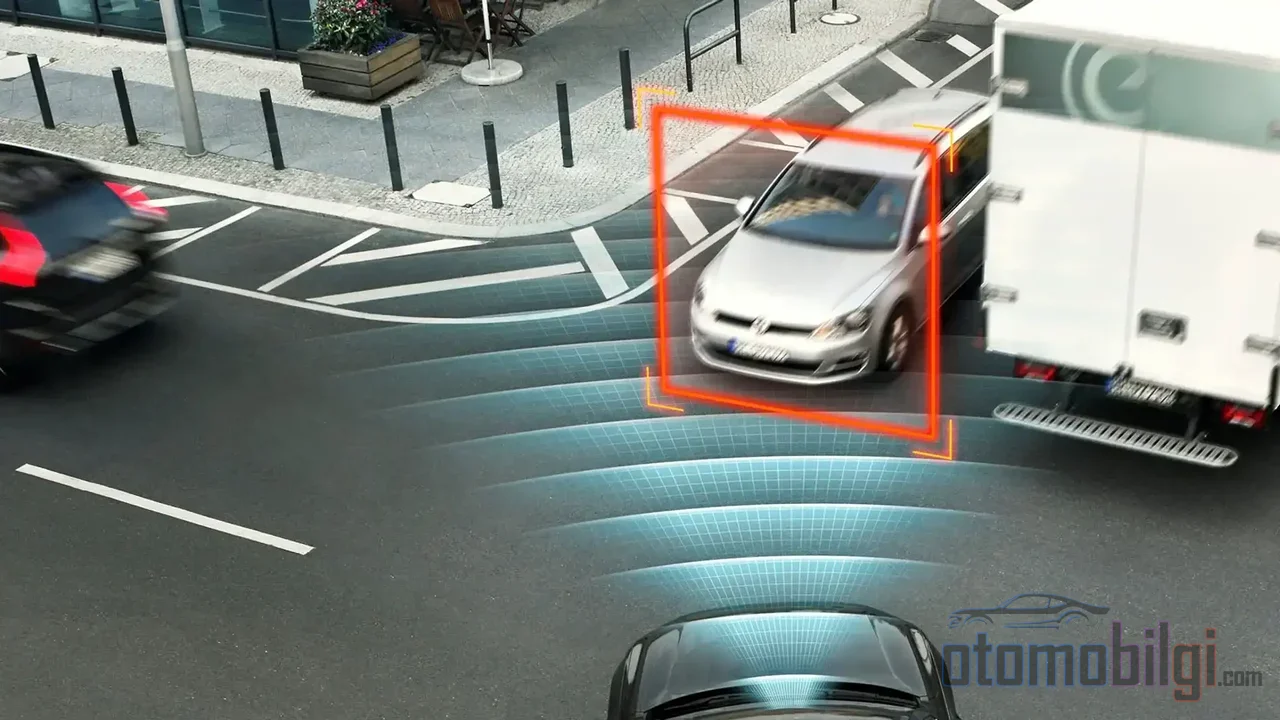
Imagine you've signaled at the intersection, entered the turn slowly, and right at that moment a vehicle comes straight toward you from the opposite direction. Does the system see this moment? This is exactly where automatic emergency braking (AEB) faces its toughest exam: assessing the oncoming vehicle, pedestrians, and cyclists while turning at an intersection. These systems, which almost feel indebted to you in straight-line driving, why do they struggle so much in intersection scenarios? Let's take a look together.
What Does Intersection AEB Actually Do?
Let's start with the basics. Automatic emergency braking is a safety system that continuously monitors the vehicle's surroundings and intervenes in the brakes without you pressing the pedal when a collision risk arises. It aims to protect not only you, but also pedestrians and cyclists. In straight-line driving, this job is relatively simple: the distance and speed relative to the vehicle ahead are calculated, a warning comes if there's a risk, then the brakes engage.
The intersection scenario is a completely different game. This capability, called Junction AEB, warns you especially when turning left or right that you will enter the path of a vehicle coming straight from the opposite direction. So how does it understand this? For example, a system consisting of a camera mounted on the upper part of the windshield and front radar detects vehicles, pedestrians, and cyclists. The vehicle's speed and the distance to the object are used when calculating collision risk. First a visual and audible warning comes, then a light automatic brake; if you don't react, full emergency braking is applied just before the collision.
Some manufacturers take it a step further: there are models that detect vehicles coming straight from the opposite direction during a right turn at an intersection, vehicles approaching from both sides, and pedestrians crossing the street; in some of them, a side radar is also used for objects approaching from the side. So the system actually works not with a single point of view, but with the joint effort of several sensors.
Highlights
- AEB interventions at speeds of over 40 km/h for the turning vehicle and over 60 km/h for the oncoming vehicle can rarely fully prevent a collision.
- Junction AEB can reduce crashes for vehicles turning at intersections by up to 59% under optimum conditions; depending on the strategy, this rate can drop to 14–18%.
- In vehicles with pedestrian-detecting AEB, the overall crash risk appears to be reduced by approximately 20%.
- When the delay time reaches 0.5 seconds, the preventable crash rate drops significantly.
Where Is the System Looking? Sensor Logic
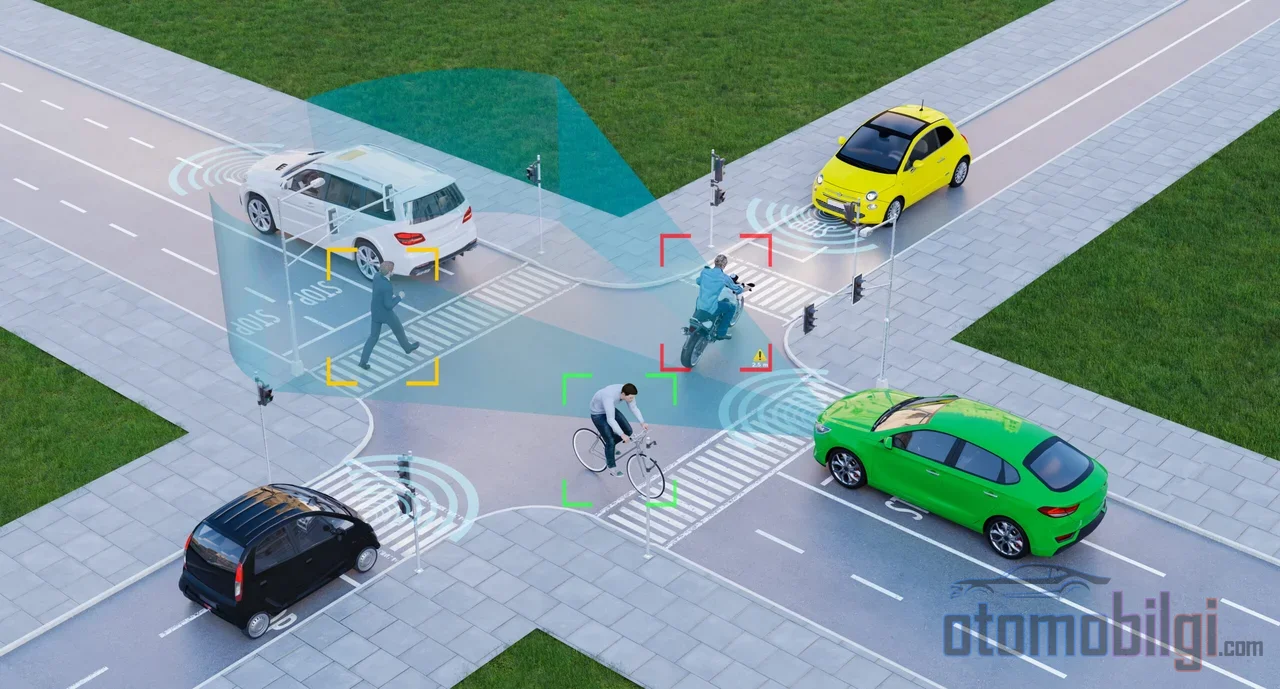
Let's use an analogy: Think of Junction AEB as someone at an intersection who has given their attention to the road. It too tries to filter out not only everything coming toward it, but also what will cross its turning path. The front camera and radar work together, constantly calculating speed and distance; when a potential collision is detected, the brakes are engaged without you needing to press the pedal.
But there is a physical reality at play here: the field of view. Front sensors capture vehicles and pedestrians best in movements coming from the front and the side. When the speed of an oncoming vehicle combines with yours, the closing speed doubles. Imagine you are turning at 30 kilometers per hour while the other vehicle is coming at 50 kilometers per hour; from the system's perspective, the two vehicles approach each other within seconds, not minutes. Even for a computer that constantly monitors and calculates, this means a very short window for making a decision.
There is also the problem of not being seen: a stationary vehicle ahead can be a perfect screen for a pedestrian. This situation is called occlusion, meaning shadowing, and the AEB sensor may fail to detect the pedestrian in such scenarios. The intersection itself makes the job harder; it is a well-known fact that intersection layout affects where drivers direct their attention, and drivers often fail to yield the right of way. The smarter the system, the more is hidden behind the screen, and the narrower the safety margin becomes.
Speed Difference and Reaction Time: Why Is It Sometimes Too Late?
Now let's come to the most crucial part of the matter: speed. According to peer-reviewed safety research, at speeds above 40 km/h for the turning vehicle and above 60 km/h for the vehicle going straight, AEB interventions rarely prevent a collision entirely. In other words, the system will most likely brake, but it may not be able to prevent the collision completely. In another study, assuming a 0.2-meter safety zone, serious injury crashes could be prevented in 59 percent of cases only when the turning vehicle had junction AEB; depending on the application strategy, this rate can drop to as low as 18 percent and 14 percent.
Reaction time is also a critical factor. In simulations, when the delay time reaches 0.5 seconds, the preventable crash rate drops to 15 percent for warning-based systems and 39 percent for intervening systems. That half a second is slightly more than the duration of a blink of an eye; but at an intersection, a blink can cost half the distance between two vehicles. In simulations by Toyota's safety research center, the intersection assistance system kicked in for 93 percent of crashes when there was no driver intervention; 48 percent of the crashes were completely prevented, and damage was reduced in 45 percent. In other words, the system works, but speed and timing determine the outcome.
Speed limits are not unique to intersections either. In most AEB systems designed for pedestrians, detection capability remains within a range of roughly 40-60 km/h; independent testing organizations also say AEB works well up to 56 km/h (35 mph) but struggles at higher speeds. Even sources focusing on commercial vehicles show that the most effective range is low and moderate speeds, and that above 65-80 km/h most systems' ability to prevent a collision remains limited.
Pedestrians and Cyclists: The Most Vulnerable Players at the Intersection
The most sensitive aspect of intersection turns is, of course, those outside the vehicle. New-generation AEB standards are being written accordingly: systems are required to work effectively in daylight and at night, in the range of 10-145 km/h for vehicle collisions and 10-73 km/h for pedestrian collisions. The final rule published by NHTSA in the US in 2024 also requires the AEB system to detect and react to imminent collisions with both vehicles ahead and pedestrians. Test protocols have also expanded in this direction; Euro NCAP's vehicle-to-vehicle protocol includes seven scenarios, while vehicle-to-pedestrian and vehicle-to-cyclist scenarios are evaluated under a separate protocol. ANCAP, meanwhile, has been conducting crash prevention tests for turning into oncoming traffic at intersections since 2020.
So what do the results say? Vehicles equipped with AEB that detect pedestrians and/or cyclists have shown roughly a 20 percent reduction in overall crash risk. Junction AEB systems have also been shown to contribute to reducing cyclist accidents; however, different system designs produce different results. There are promising findings that, in urban crossing scenarios, AEB alone can prevent most accidents and pedestrian deaths or serious injuries. But the difference between day and night, well, that's a whole different story.
Why Is Night Performance a Separate Issue?
It has been observed that vehicles that fail night tests either do not slow down at all or reduce their speed only slightly before hitting the dummy. With low beam headlights, as speed increases, the warnings and braking of pedestrian-detecting AEB occur later; whereas in daytime the situation barely changes at all. In summary: good in daylight, not at night. That's why, especially when making intersection turns in the evening hours, you need to trust your own eyes, not the system.
When Can You Rely on It, and When Are You on Your Own?
Let's clarify this with a table. The situations below are a rough map of how junction AEB performs in the real world:
| Situation | What Can the System Do? |
|---|---|
| Turning at low speed (below about 30-40 km/h), oncoming vehicle coming straight | Warning and braking intervention is the most likely activation scenario |
| Speed above 40 km/h for the turning vehicle, above 60 km/h for the oncoming vehicle | Full prevention is rarely possible; damage reduction is the goal |
| Pedestrian or cyclist crossing the road | Detected in some models; but not standard on all vehicles |
| Pedestrian hidden behind the vehicle in front (occlusion) | The sensor may fail to detect the pedestrian |
| Stationary objects, cyclists, and pedestrians (some junction AEB implementations) | Not designed to detect these objects, may not work as intended |
| Night, high speed with low beams | Warning and braking occur later |
The lesson from this table, in my view, is very clear: Junction AEB is a safety net, but you are still the one holding the rope. Moreover, knowing that the system is not perfect is also important; there are user experiences about systems that needlessly activate on shadows, darkened bridge underpasses, or similar visual illusions. A false alarm can be tolerated to a point, but false trust cannot.
So What Should I Do as a Driver?
I'm telling you this as friendly big-sister/brother advice: at an intersection, the division of roles works like this. The system monitors continuously, warns early, and brakes if necessary; but if you spot the danger before entering the intersection, that braking never becomes necessary. One of the main contributing factors in intersection accidents is information gaps caused by distraction; studies have shown that not only young but even elderly drivers fail to give sufficient attention to zones that require hazard awareness. So the real goal is an intersection discipline that never requires the system to engage at all.
Let's also add this: it is noted that automatic systems need stronger measures to keep the driver engaged, namely driver monitoring and attention recovery methods. As technology advances, the systems will operate across wider speed ranges and with better nighttime performance; even today's standards are moving in that direction. But until that day comes, full attention at the intersection is your job, and braking at the last moment is the system's.
Now let's wrap up the answer to the question: At intersections, the automatic braking system tries to detect oncoming turning vehicles, pedestrians and cyclists crossing the road using the front camera and radars; it calculates the risk from speed and distance, warns first, then brakes. However, this detection is reliable at low speeds and in clear visibility; at high speed differences, in occlusion situations and at night, the system may react late or fail to see at all. That is why the intersection is that critical point where AEB provides support but never takes over. At your next intersection turn, signal, slow down and keep your eyes on the road - trust the system, but don't leave everything to it in order to trust it. Isn't this teamwork, in your opinion too?
Sources
- Intelligent Emergency Braking | Innovation - Nissan Global
- Automatic emergency braking - Bosch Mobility
- How Does Automatic Emergency Braking Work?
- Intersection and Turn Assist - EVKX.net
- What is Automatic Emergency Braking (AEB) - TomTom
- Automatic & Enhanced Auto Emergency Braking - GMC Canada
- Opportunities and limitations for intersection collision avoidance - Sander 2017
- Injury mitigation estimates for an intersection driver assistance - Scanlon 2017
- Few vehicles excel in new nighttime test of pedestrian autobrake - IIHS
- Final rule: AEB systems for light vehicles - NHTSA (2024)