How Do ADAS Systems See Pedestrians and Cyclists at Night?
Share This Page
At night, camera- and radar-based ADAS systems see pedestrians and cyclists far worse than in daylight; systems that prevent roughly 60% of collisions in darkness can raise this rate to 90% in daytime. In other words, the system's eyes genuinely weaken at night, and the one thing that never diminishes is the responsibility at the wheel: reducing your speed in the dark is the driver's job.
Highlights
- Approximately 75-76% of pedestrian fatalities occur at night. .
- In night tests, 4 out of 5 production vehicles failed the automatic pedestrian braking evaluation.
- AEB reduces pedestrian-related crashes by 32% in daytimeand 33% on lit roads at night ; on unlit roads, no significant reduction could be measured.
- Reflective clothing is useful for the human eye but can confuse some sensors.
- At 30 mph (approximately 48 km/h), at least 27 meters are needed to come to a stop.
How Does the System See at Night, and Why Does It Get Confused?
Most automatic emergency braking (AEB) and pedestrian detection systems rely on two senses: camera and radar. The camera depends on visible light; just like your eyes, it cannot see without light. At night, the camera sensor cannot gather enough light and is forced to digitally amplify the signal. That grainy, blurry image you see when taking photos with your phone at night is exactly this. Headlight range, low ambient lighting, glare from oncoming vehicles, fog, and heavy rain degrade this weak image even further.
Radar, on the other hand, is more resilient than cameras in darkness and precipitation; radio waves are hardly affected by light conditions. In return, its spatial resolution is low: it can detect whether an object exists, but it is weak at distinguishing whether that object is a pedestrian, a cyclist, or an object at the roadside. It is also prone to missing slow or stationary objects. That is why the best results are achieved through sensor fusion, that is, combining data from camera, radar, and even thermal cameras. In a peer-reviewed study, the fusion of camera and thermal imagery showed significantly higher detection success than camera alone.
How Much Does Night Performance Drop?
The numbers are not encouraging. In tests conducted with new-generation vehicles, it was found that only 60% of collisions were prevented in night conditions, while the same scenarios were resolved at a rate of 90% in daytime . Even more striking is this number: in nighttime pedestrian braking evaluations of production vehicles, 4 out of 5 vehicles failed. An independent testing organization also revealed that at least two of three 2024 model vehicles failed one or more of the standard night scenarios.
In the first nighttime-focused vehicle evaluation, only 4 out of 23 vehicles were able to receive the top rating. Moreover, these tests were limited to 37 mph (approximately 60 km/h); we have no solid data on nighttime performance at higher speeds. Real-world data confirms the same picture: pedestrian AEB generally reduces pedestrian-related crashes by 27%and injury crashes by 30% is reduced; the daytime reduction rate rises to 32%, and to 33% on nights with lit roads. But on roads without lighting, no meaningful reduction can be detected at night. There is also no evidence of effectiveness on roads with speed limits of 80 km/h and above.
There is another frustrating dimension to this picture: 76% of pedestrian deaths occur at night. In other words, the condition where the system is weakest is the condition where it claims the most lives. Manufacturers are aware of this too; some brands explicitly state in their official documentation that their systems are limited at night and in low-visibility conditions.
Clothing, Light and Speed: What Changes Detection?
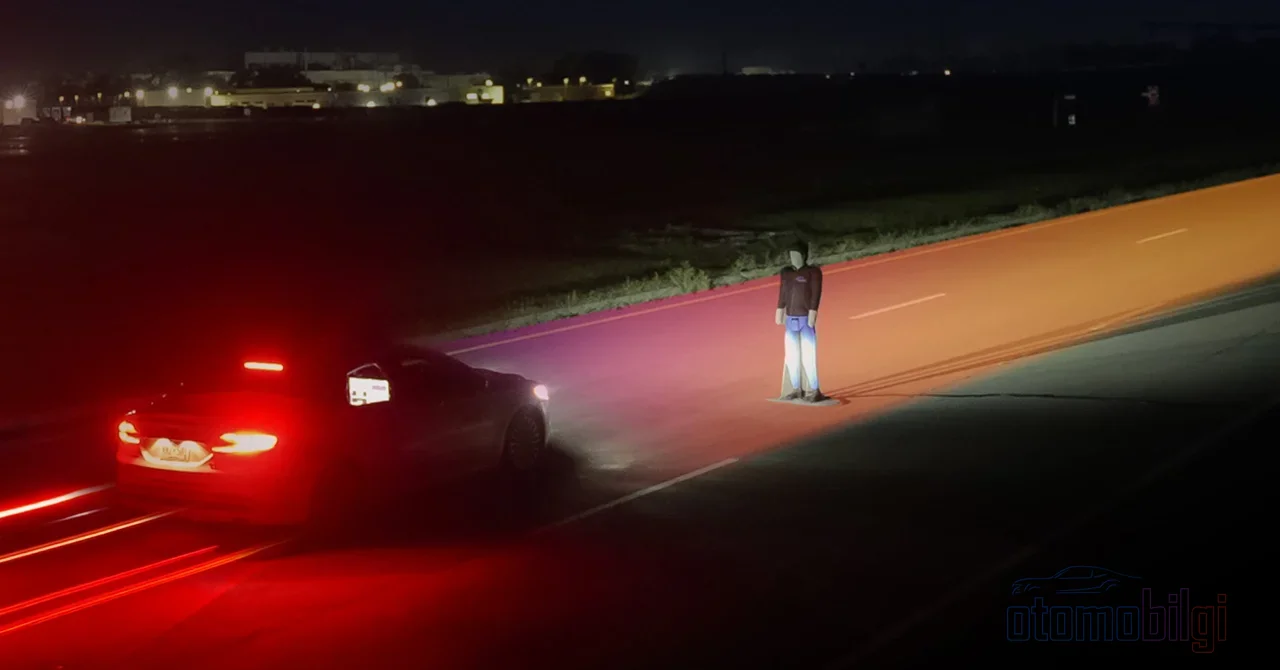
What you wear in the dark determines how you are seen
For the human eye, things are clear: drivers notice pedestrians in dark clothing at much shorter distances, and when headlight glare is in play, almost no driver reacts in time to a darkly dressed pedestrian. For pedestrians in white or yellow clothing, street lighting roughly doubles the detection distance compared to unlit roads. Reflective vests also increase the distance more than expected.
But there is a paradox here. According to a study published in 2025, reflective, high-visibility clothing can confuseautomatic collision avoidance sensors; in some cases it lowers the technology's probability of detecting a pedestrian at night. So a vest that is great for human perception can have the exact opposite effect for machine perception. It should also be remembered that even light-colored clothing does not always give the driver enough information to react quickly.
Speed, the point where everything converges
A vehicle traveling at 30 mph needs at least 27 meters to stop; most of that is the distance spent on the driver noticing. As speed increases, the risk grows exponentially: at 37 mph the risk of pedestrian death reaches 25%,and at 42 mph it reaches 50%.On roads with speed limits of 25 mph and below, the likelihood of pedestrian death is significantly lower. Most AEB systems are designed to work in the 6-50 mph range, and nighttime tests do not exceed 37 mph; in other words, there is a speed zone where the system can safely flash you a smile, and beyond that, there is no record.
What Can the System Do If It Detects Too Late?
If the system detects the pedestrian late, it has three options: issue a warning, provide braking assistance, and apply full automatic braking if necessary. In daylight and on lit roads, this chain genuinely saves lives. But since detection is already late in darkness, the distance remaining for braking after the warning shrinks, and physics becomes irreversible. Braking distance increases with the square of speed; twice the speed means roughly four times the braking distance.
There is also an interesting balance problem here: strengthening the sensors can cause the system to sound alarms for dangers that do not exist, that is, unnecessary braking (phantom braking). Sudden unnecessary braking increases the risk of a collision from the vehicle behind. For this reason, new safety standards demand two-way testing: the system must be able to detect a real threat at night and at high speed, while also not pressing the pedal unnecessarily in fake scenarios such as a trench plate.
Standards and Thermal Cameras: Is the Night Gap Closing?
It is closing, but slowly. The new U.S. safety standard FMVSS No. 127mandates automatic pedestrian braking in by September 2029 most new passenger vehicles and requires the system to work in daylight and darkness at test speeds of up to 45 mph. Euro NCAP's 2026 protocol is even more ambitious: it requires AEB systems to detect pedestrians and cyclists at speeds up to 80 km/h in unlit conditions. In other words, today's weak night performance will not be acceptable in the vehicles you buy in the future.
On the technology side, the brightest card is thermal cameras. These cameras read the temperature of objects without needing visible light, providing high contrast in darkness, fog, smoke, headlight glare, and shadow transitions. Fusion architectures combining visible-light cameras, radar, and thermal cameras promise both better detection and fewer false braking events. LiDAR also offers precise three-dimensional detection independent of light conditions, but it weakens in rain, fog, and snow, and its cost is still high. The last category is aftermarket night vision systems: they claim to detect pedestrians and animals beyond headlight range, but even the manufacturers' own footnotes describe some of them as working in low light, not extremely low light; if they claimed full darkness, that would be another story.
Let's also be honest here: low-resolution thermal sensors struggle in environments close to body temperature and in distinguishing multiple heat sources. So the thermal camera is not a magic eye, but a fix for a missing piece.
| Sensor | Where It Is Strong | Night Limit |
|---|---|---|
| Visible light camera | Object recognition and classification | Dependent on light; boosting the signal in darkness increases noise |
| Radar | Resilience in darkness and precipitation | Low resolution; may miss slow or stationary objects |
| Thermal camera | High contrast in darkness, fog, and glare conditions | Low resolution; struggles to distinguish nearby heat sources |
| LiDAR | Light-independent precise 3D detection | Weakens in rain, fog, and snow; high cost |
Why Is Speed in the Dark the Driver's Responsibility?
Pages of evidence condense into a single sentence: AEB does not measurably reduce crash risk on unlit roads and at high speeds. The system offers you a shield during the day, but at night it is at best a backup. Put the numbers we recorded side by side: most night tests were conducted below 60 km/h, there is no proof of effectiveness on unlit roads, and the 27-meter stopping distance is fixed physics. In this equation, only you can bring down the speed leg.
Moreover, an independent data analysis showed that pedestrian death rates during evening rush hours in ADAS-equipped vehicles can even be slightly higher than in vehicles without the system, clearly exposing the technology's nighttime protection gap. No system replaces safe road design or an attentive driver. So if you can't see beyond where your headlights reach on a night road, it's up to you to adjust the gas pedal according to your headlight range.
Practical Night Rules for Drivers
- On unlit roads, reduce your speed significantly compared to daytime; assume the system gives you no nighttime guarantee.
- Reflective vests are still valuable, but know that the technology may fail to detect you; plan your trust according to light and speed.
- Headlight glare from oncoming vehicles challenges you and the sensors at the same time; increase the distance.
- Don't delegate reacting to the AEB warning to the system; the warning may come too late, brake early yourself.
- Read the limits in your vehicle's manual; many manufacturers clearly state their systems' nighttime limits.
ADAS systems are getting smarter with every passing month, and standards coming into effect from 2026 will significantly narrow the nighttime gap. But if you're behind the wheel today, remember that darkness is not a transparent curtain but a thick veil through which neither the system nor you can see anything. Adjust your throttle accordingly.
Sources
- AAA - Pedestrian Detection Tech Improves, But Still Unreliable at Night (2025)
- IIHS - Pedestrian crash avoidance systems cut crashes -- but not in the dark (2022)
- IIHS - High-visibility clothing may thwart pedestrian crash prevention sensors (2025)
- NHTSA - Pedestrian Safety
- Cicchino, JB (2022) - Effects of AEB systems on pedestrian crashes, Accident Analysis & Prevention
- Teledyne FLIR - Reducing Phantom Braking in ADAS with Thermal-Fused AI (2026)
- FHWA - Nighttime Visibility
- NSC - Driving at Night
- TriEye - New AEB Standards (2024)
- Raytrontek - Euro NCAP 2026 Raises the Bar for Nighttime VRU (2026)
- NAP - Improving Pedestrian Safety at Night
- arXiv - Harnessing ADAS for Pedestrian Safety: A Data-Driven Analysis (2025)