How Does Blind Spot Warning Know About a Vehicle It Doesn't See in the Mirror?
Share This Page
Blind spot warning uses two corner radar sensors hidden in the car's rear bumper to detect vehicles beside and behind you; when it detects one, it lights up the indicator in the side mirror. So the system doesn't actually "see" - it sends out radio waves and measures the returning echo. On this page I explain how the radars work, when the light comes on, and in which situations the system gets it wrong.
Highlights
- The sensors are hidden in the corners of the rear bumper; the detection zone on each side is roughly one lane wide.
- The first mass-production system 2003 Volvo XC90 was offered with a camera and radar mounted in the door mirrors.
- Most systems only detect vehicles with a speed difference of up to 30 mph (approximately 48 km/h) .
- Cyclists and motorcycles are not a design target for most systems - a shoulder check is essential.
- Even adjusting your mirrors correctly can largely eliminate the side blind spot.
How Do Radar Sensors Know Where the Car Is?
I like this comparison: a radar sensor works like a bat in a dark room that uses sound echoes instead of a flashlight. The system emits radio waves, these waves bounce off nearby objects and return to the sensor, and from the properties of the returning signal, the object's presence, distance and speed are calculated. The difference? The echo arrives as radio waves instead of sound, and it works on the same principle in rain, day or night.
In terms of location, they are usually placed inside or under the rear bumper; some manufacturers mount the sensors in the side mirrors, others in the door mirror housings. The detection zone is roughly one lane wide on each side and extends from the side mirror to about 3 meters beyond the rear bumper. So the system only scans the adjacent lane, not two lanes over. Bosch's advanced solution can also catch fast-approaching vehicles in the blind spot - a life-saving detail when the speed difference with the vehicle ahead opens up on the highway.
For the curious, a small historical note: the idea first appeared in a Volvo concept in 2001, and the first mass-production application was the 2003 Volvo XC90 . Mazda also earned the title of first Japanese manufacturer to offer this feature in 2008 with the CX-9 . Today, almost every brand has its own blind spot system sold under its own name.
When Does the Light in the Mirror Come On?
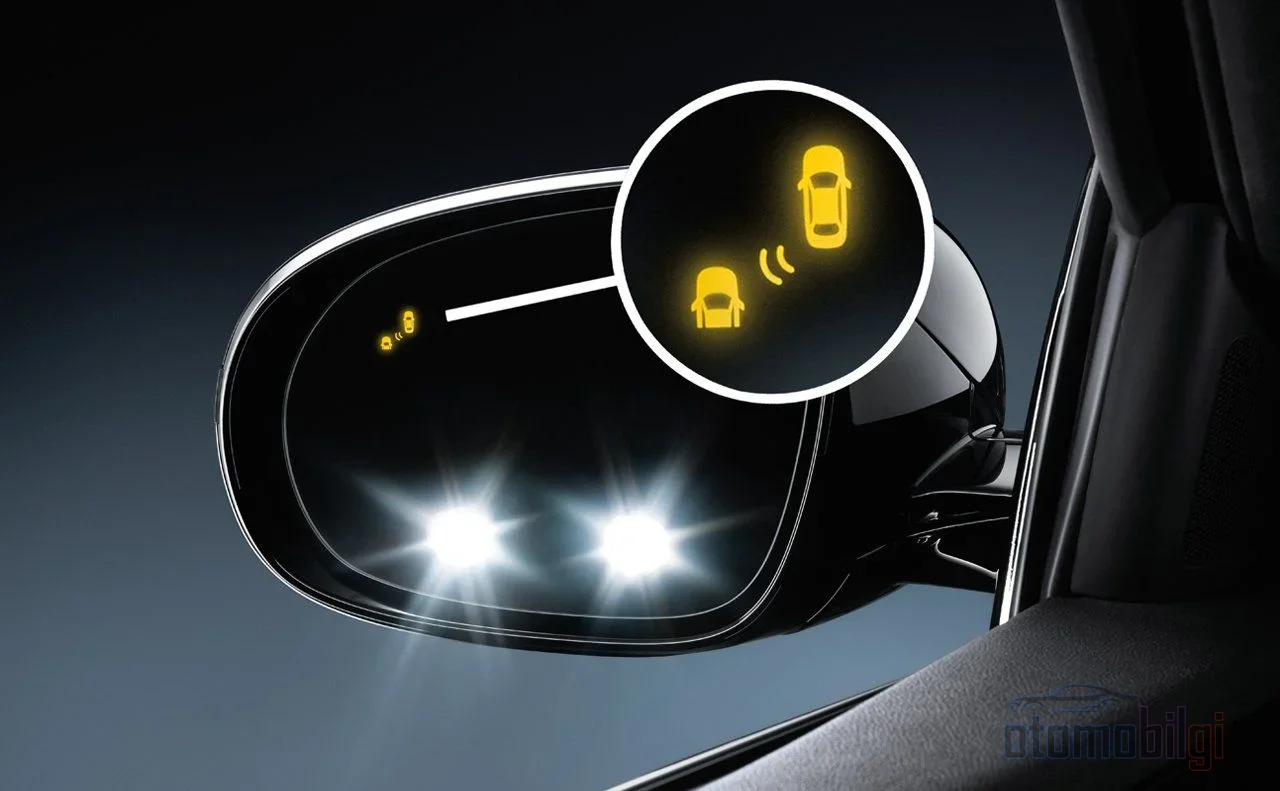
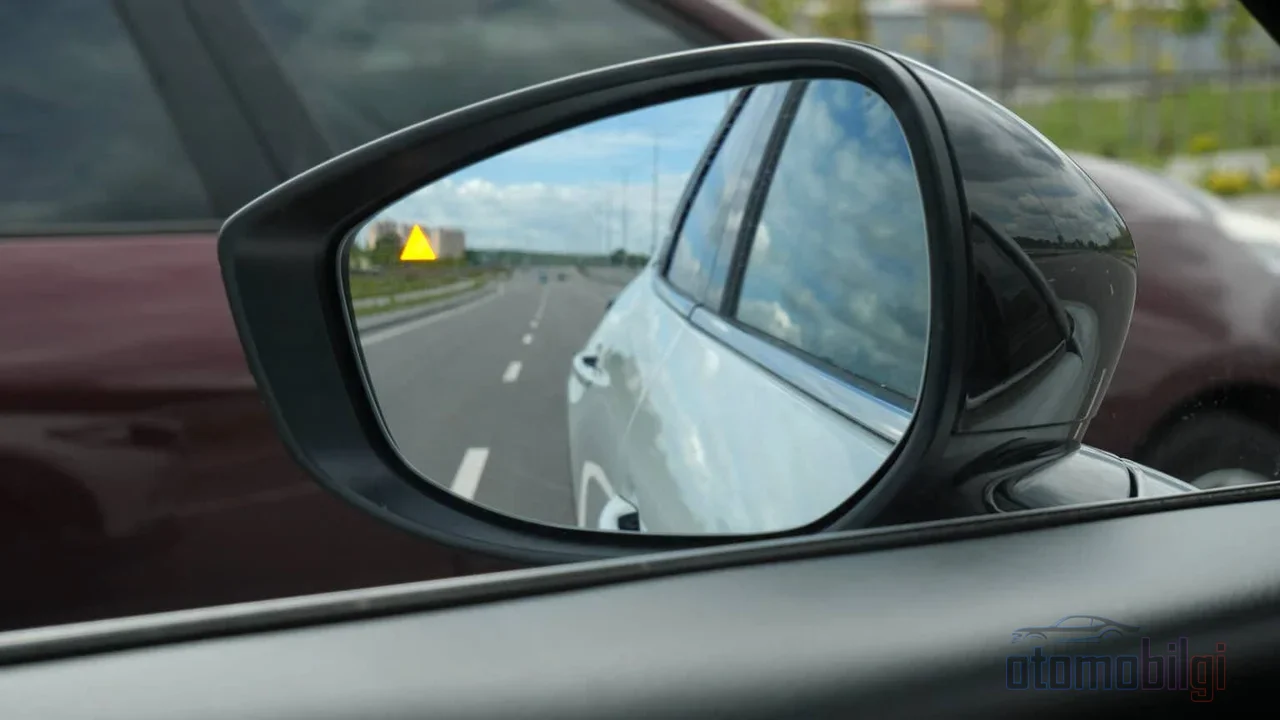
When a vehicle enters your blind spot or comes alongside you, a yellow or red light illuminates in the side mirror or window frame on the relevant side. Some systems also give an audible warning at this point; most activate automatically once you exceed a certain speed. Some, like Ford's BLIS system, work only in "drive" and "neutral" gears and shut themselves off in reverse and park - you don't need the warning while parked because the car isn't moving anyway.
What's the Deal with the Beeping Sound When Changing Lanes?
This is where the system's truly critical moment lies. When you pull the turn signal lever, if there is a vehicle in your blind spot, some systems flash the light rapidly and play a sharp warning chime. In some vehicles, the steering wheel also vibrates briefly. More assertive systems offer additional interventions such as "Intelligent Blind Spot Intervention": if you continue changing lanes, the system tries to keep the vehicle within its own lane. User experiences describe this intervention as genuinely perceptible - that feeling of the steering wheel almost wrestling with you is the moment the system is trying to prevent a collision. Take note: not every vehicle has an audible warning; owners of some popular models complain that there is only a light warning, so it is worth checking your vehicle's manual.
Pay Attention to When the System Gets It Wrong
Everything looks very sweet so far, I know. But blind spot monitoring is not a flawless magician, and in some situations it can remain completely silent. Especially in the following scenarios, trusting the system and skipping the mirror check is a serious risk:
- Cyclists and motorcycles: The system is primarily designed to detect vehicles; even if a cyclist or motorcyclist is in the blind spot, the light may not come on. Metallic and small reflective surfaces seem to be on the radar's blacklist.
- Speed difference: The detection range in most systems is defined up to a speed difference of about 30 mph . If the difference between you exceeds this - for example, if you are driving very slowly on the highway and a vehicle approaches quickly - the system may not see that vehicle.
- Unusual lane width: The detection zone is calibrated for a typical highway lane. On a road with narrow lanes, it may mistake a vehicle in the adjacent lane for one two lanes over; on a wide road, the zone may fail to catch the vehicle at all.
- Trailers: The detection zone does not change when towing a trailer, meaning it does not cover the trailer's own blind area. When changing lanes with a trailer, you must do the verification yourself.
- Stationary objects: Guardrails, trees, and parked vehicles you pass by are deliberately excluded; only things moving alongside you are detected.
- Bad weather: In heavy rain, snow, and icy conditions, safety systems may not work as you expect - even radar waves are affected by weather conditions.
There is also a margin of error: sensor failures can occur, and especially in cheap aftermarket systems, cases have been reported where one side is almost never detected. So when the system gives no warning, it does not mean "nobody is there," it means "the system does not see anything." The two are not the same thing.
False Alarm: Why Is the System Going Off for No Reason?
Have you ever seen a warning light come on while parallel parking or creeping down a narrow street? Most likely, something has entered the system's detection area - a wall you are passing, a guardrail, or a vehicle two lanes over due to very narrow lane markings. This is less a malfunction than a natural consequence of the system's design logic: the radar scans everything within one lane's width and cannot always know with 100% certainty which lane it is in. As lanes narrow, the margin of error grows. The golden rule here is this: a false alarm is annoying, but a missed warning is expensive. When the light flashes, verify first, then decide.
Is Warning Enough, or Should the System Brake by Itself?
Blind spot monitoring also has a more ambitious relative: instead of merely issuing warnings, systems that act on the driver's behalf - for example, automatic braking. Institutional studies looking at crash data show that warning-only systems are not as effective as those that intervene. The logic is simple: it is always possible to ignore the beep and keep pulling out with your signal on, but you cannot argue with a system that touches the brakes. Intervening systems certainly do not replace the driver; they simply provide one more safety net at the last moment.
The good news is that this technology is no longer considered a luxury privilege. From 2026 onward, blind spot monitoring is being included in new vehicle safety rating protocols, and the feature is expected to be offered across a much wider range of vehicles. There is also a reverse truth: choosing this feature on some vehicles can mean more than $1,000 in extra cost - so it is still a piece of hardware up for negotiation.
Is Checking the Mirrors Still Mandatory?
Short answer: yes, absolutely. The long answer is actually this entire page. Blind spot monitoring is an assistant designed to help the driver with tasks such as staying in the lane and avoiding collisions; it is not a system that takes over the job. Legal responsibility always remains with the driver, and most modern vehicles still operate at SAE Level 2, where the driver must travel with full attention at all times. Most importantly, the risk of overconfidence is real: drivers who rely too much on the light and the beep fail to see the cyclist that the system cannot see.
Why is the classic ritual before changing lanes still valid? Because the system frequently misses cyclists and motorcycles, cannot see vehicles outside its speed differential limits, does not cover the trailer's blind zone, and loses performance in bad weather. Looking in the mirror, signaling, checking over your shoulder - all three steps stay.
There is also an interesting counterpoint worth hearing: if the side mirrors are adjusted at the correct angle, there may actually be no blind spot at the side. This method was first documented in a 1995 SAE paper and is unfortunately often skipped in driving courses. So before spending thousands of dollars, even adjusting your mirrors correctly can make a big difference. My take? A correctly adjusted mirror and radar-backed warning are not rivals but complements to each other.
Conclusion: Co-Pilot Yes, Chauffeur No
Blind spot warning - what a clever technology, whispering to you with that little light in the mirror that "there's something there." Radar sensors genuinely know about the car you can't see in the mirror - because they don't see, they measure. But measurement has its limits: motorcycles, high speed differences, trailers, narrow lanes and bad weather are always waiting within or beyond those limits. In my view, the best driving formula is this: listen to the radar's warning, but also check your mirror and look over your shoulder before changing lanes. The system doesn't replace the driver; what makes you a safer driver is using both of these together.