Can AEB Detect Child Pedestrians?
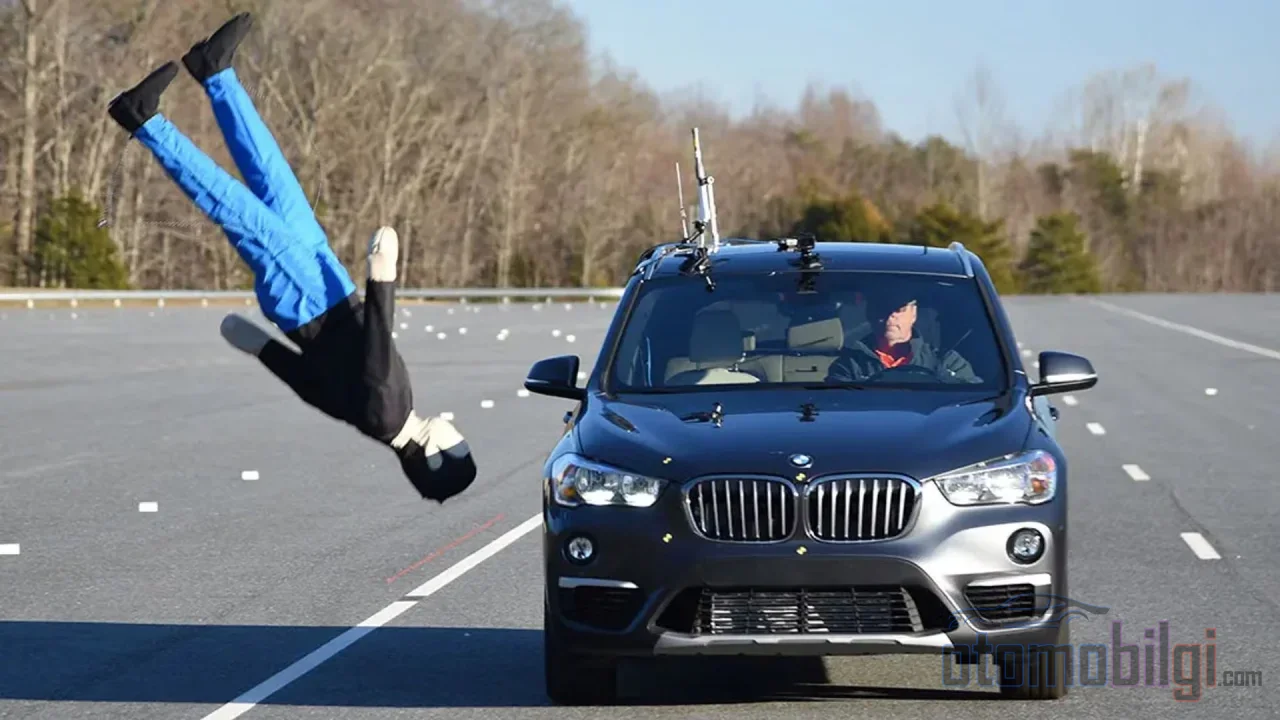
Think about it: there are two parked cars in front of your car, and a child suddenly runs out right between them, chasing a ball. What does Automatic Emergency Braking, or AEB, do at that moment? Does that confident system we see in commercials kick in, or are things not as bright as we think? On this page, we will answer exactly this question with real test data. And let me say upfront: the numbers are a bit scary.
Where Does AEB's Child Pedestrian Detection Problem Come From?
Automatic emergency braking systems work by combining radar and camera data: the camera recognizes shapes, the radar measures distance and speed. Sounds like a match made in heaven, right? But here's the problem: an adult pedestrian presents a large and clear target to the sensors. Long torso, broad shoulders, a regular walking rhythm. A child, however, has both a smaller surface area and usually appears suddenly, running out from behind parked vehicles. In other words, it delivers the hardest combination for sensors in a single package.
Let's look at it from the radar's perspective: radar works with point clouds formed by signals reflected from targets, and when these clouds are sparse, fusion with camera data becomes harder. A small body means few radar reflections. The camera side is no bed of roses either: distinguishing pedestrians at night or in heavy rain becomes seriously difficult. The Doppler signature of a running child on radar is different from that of a walking adult; when the movement profile changes, the system's recognition algorithm faces a completely different picture.
Highlights
- In a 2019 test, at 32 km/h, the collision rate with a child dummy running out between two vehicles was 89 percent.
- In the same test, the collision rate with an adult dummy was 60 percent; the child scenario was significantly worse.
- At around 50 km/h, no test vehicle managed to stop before hitting the child dummy.
- In the nighttime adult pedestrian scenario, no test vehicle detected the pedestrian.
- AEB with pedestrian detection reduces pedestrian injury crashes by roughly 30 percent in the real world - but only in daytime.
What Do the Real Test Data Say?
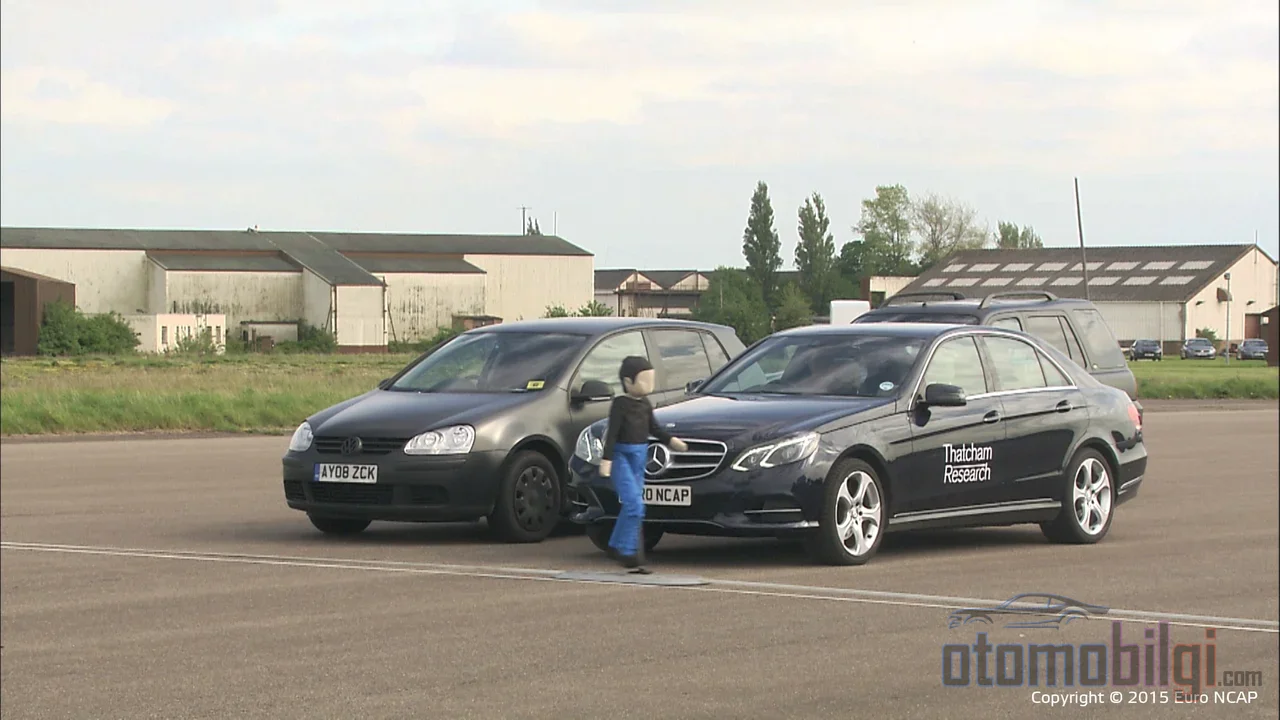
A comprehensive test conducted with four popular sedans of the 2019 model year (Chevrolet Malibu, Honda Accord, Tesla Model 3 and Toyota Camry) laid bare the industry's picture on this issue. In daytime, a vehicle traveling at 32 km/h collided with adult dummies at a rate of 60 percent. Does that sound bad? When we move to the child scenario, the picture gets even darker: the child dummy running out between two parked vehicles was struck at a rate of 89 percent by vehicles traveling at the same speed.
As speed increases, things go downhill: at around 48-50 km/h, the systems generally failed to stop in front of the simulated pedestrian; at 50 km/h, no test vehicle was able to prevent the collision. Night is a different story: in the adult pedestrian scenario, no vehicle detected the pedestrian, and the systems were considered ineffective in nighttime conditions. In the scenario with a pedestrian encountered after a right turn, all four vehicles hit the dummy; a 100 percent failure rate. The collision rate came out at 80 percent when passing at 32 km/h next to two adults standing with their backs turned at the roadside.
This test dates from 2019, meaning the systems have improved since that day until now; but more recent data does not offer complete reassurance either. When reversing AEB systems were tested in 2024, automatic braking occurred in 15 of 20 runs (75 percent) in the stationary child pedestrian simulation behind the vehicle, and in 10 of them (50 percent) the collision was completely avoided. In a different scenario, the collision could be avoided in only one of 40 runs (2.5 percent). In other words, reverse maneuver sensors should not be trusted blindly either.
How Do Euro NCAP and IIHS Test the Child Pedestrian?
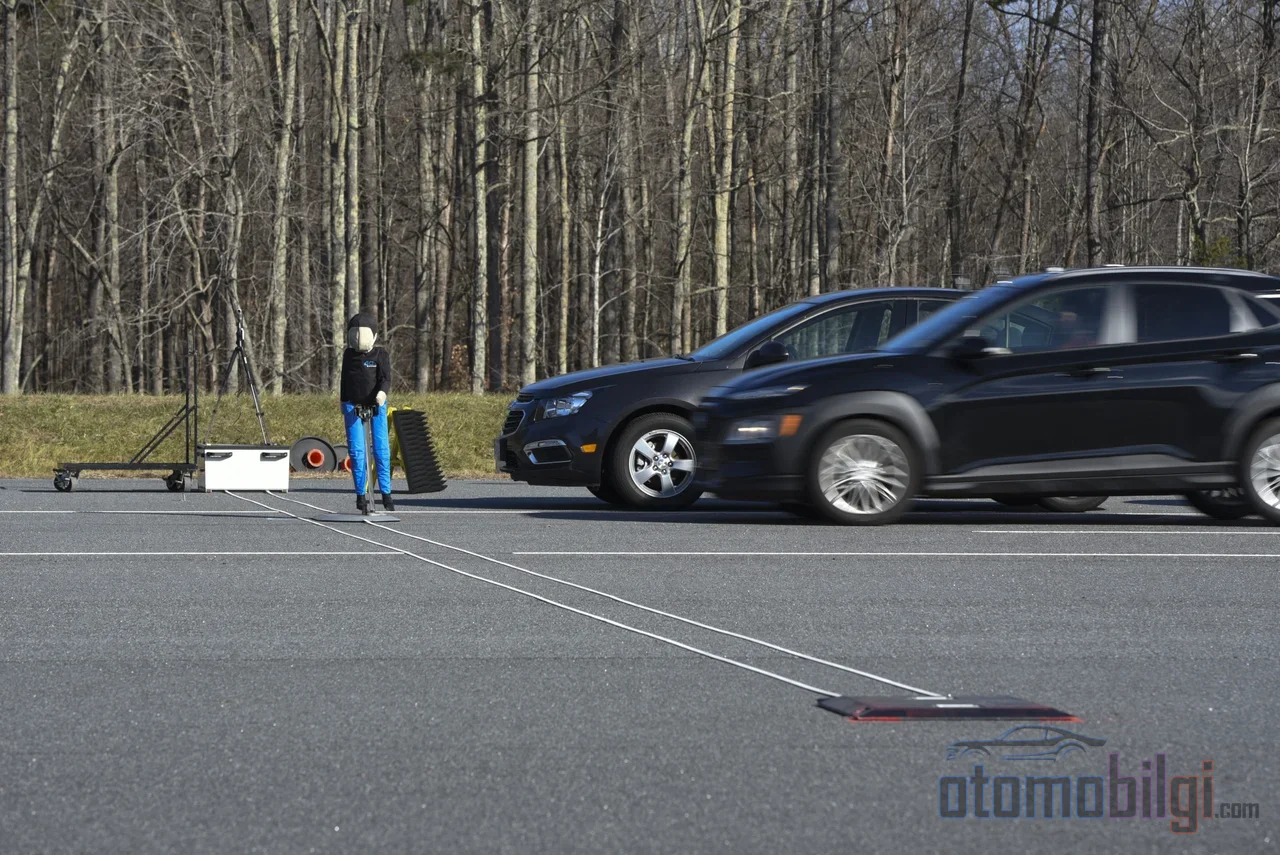
The good news is this: testing organizations are aware of this problem, and the child pedestrian scenario is part of official protocols. Euro NCAP has been testing pedestrian-sensitive AEB in three urban scenarios since 2015: an adult walking into the vehicle's path, an adult running, and a child emerging from behind a parked vehicle. The situation identified as the most challenging scenario is the child pedestrian who appears from behind two parked vehicles and steps directly into the vehicle's lane.
CPNC-50: The Code Name of the Toughest Scenario
Both Euro NCAP and IIHS protocols include a scenario called CPNC-50 (Car-to-Pedestrian Nearside Child 50%): the vehicle is moving toward a child pedestrian who runs out from behind an obstruction. In IIHS's current protocol, the child target moves at a running speed of 5 km/h, its visibility is blocked by a small car and an SUV, and a 50 percent overlap with the vehicle is used. In the adult scenario, the target is tested at a walking speed of 5 km/h with a 25 percent overlap. Test speeds in perpendicular crossing scenarios are 20 and 40 km/h. Euro NCAP's 2026 protocol changes foresee testing collision prevention systems, including AEB, even more rigorously; the typical test speed range covers the 10-60 km/h band.
An interesting detail: Euro NCAP development documents state that children passing behind parked vehicles form a significantly and disproportionately overrepresented group in accidents. In other words, testing organizations did not choose this scenario arbitrarily; real accident data points here.
At What Speed Does It Work How Well?
So if child dummies are being hit even at low speeds, are these systems of no use at all? They are absolutely useful - expectations just need to be set correctly. Real-world data is promising: vehicles with AEB with pedestrian and cyclist detection have approximately 20 percent lower overall crash risk. In speed zones of 50 km/h and below, the indicator of serious injury risk to pedestrians in the group of vehicles hitting pedestrians equipped with AEB was found to be 44 percent lower compared to vehicles without the system. A field study also shows that injury crash rates decreased by 30 percent in vehicles with pedestrian AEB - but this effect disappears in the dark.
| Condition | Result |
|---|---|
| Pedestrian injury accidents (field data) | Approximately 30 percent reduction |
| Overall crash risk (pedestrian/cyclist AEB) | Approximately 20 percent reduction |
| Serious injury risk, under 50 km/h | 44 percent lower |
| Daytime detection rate | Approximately 98 percent |
| Night detection (low beam) | Approximately 87 percent |
| Night detection (high beam) | Approximately 93 percent |
As you can see, there is a serious performance gap between day and night. Earlier system engagement (braking starting with more time remaining before the collision) can reduce accidents by up to 34 percent; meaning timing is everything. On the US front, a major step has been taken: Under the NHTSA rule finalized in April 2024, AEB will be mandatory on all new vehicles by September 2029; the system will have to brake automatically against a vehicle ahead at speeds up to 90 mph and must prevent pedestrian collisions at up to 45 mph, including in darkness. For today's technology that cannot see a child pedestrian in the dark, this is an ambitious target.
What Should You Do Around Schools and on Narrow Streets?
Everything so far is clear: these systems are helpers, not lifesavers. So what do we do in real life, especially around schools and on narrow streets? The answer was right in the past, and it still is: slow down. Reducing vehicle speed in school zones is cited as the single most critical factor in preventing pedestrian injuries and deaths. No sensor can replace a driver who has lifted their foot off the gas.
We can summarize a few permanent rules as follows:
- Do not rely on the pedestrian detection system as the primary means of avoiding a collision; these are backup safeguards, not an insurance policy.
- Learn what your car's AEB can and cannot do from the owner's manual; every system is not the same.
- Around schools, when parking, and on narrow streets, adjust your speed based on your own reflexes, not on the systems.
- Lower your expectations at night and in bad weather; most systems weaken significantly under these conditions.
So, Can AEB Detect Child Pedestrians?
The short and honest answer: partially, and heavily dependent on conditions. In daylight, at low speeds, and with clear visibility, modern systems can detect and brake for child pedestrians; real-world data shows a notable reduction in pedestrian accidents. But if it's a child running out between two parked vehicles, a pedestrian darting onto the road at midnight, or a closing speed above 50 km/h, the system may not be able to save you - test data makes this clearly evident. The common message from safety authorities is this: ADAS systems are designed to support driving, not to replace the driver. A pair of attentive eyes at the wheel is still the best sensor.
One final note: AEB with pedestrian detection first entered the US market with the 2011 model year Volvo S60 and became standard in 62 percent of new vehicle lines by the 2021 model year. Adoption is fast, and the technology improves every year. But the first sensor that sees the child darting out between two parked cars that day will still be your eyes - and let it stay that way.