When Does the Automatic Emergency Braking System Activate, and When Is It Too Late?
Share This Page
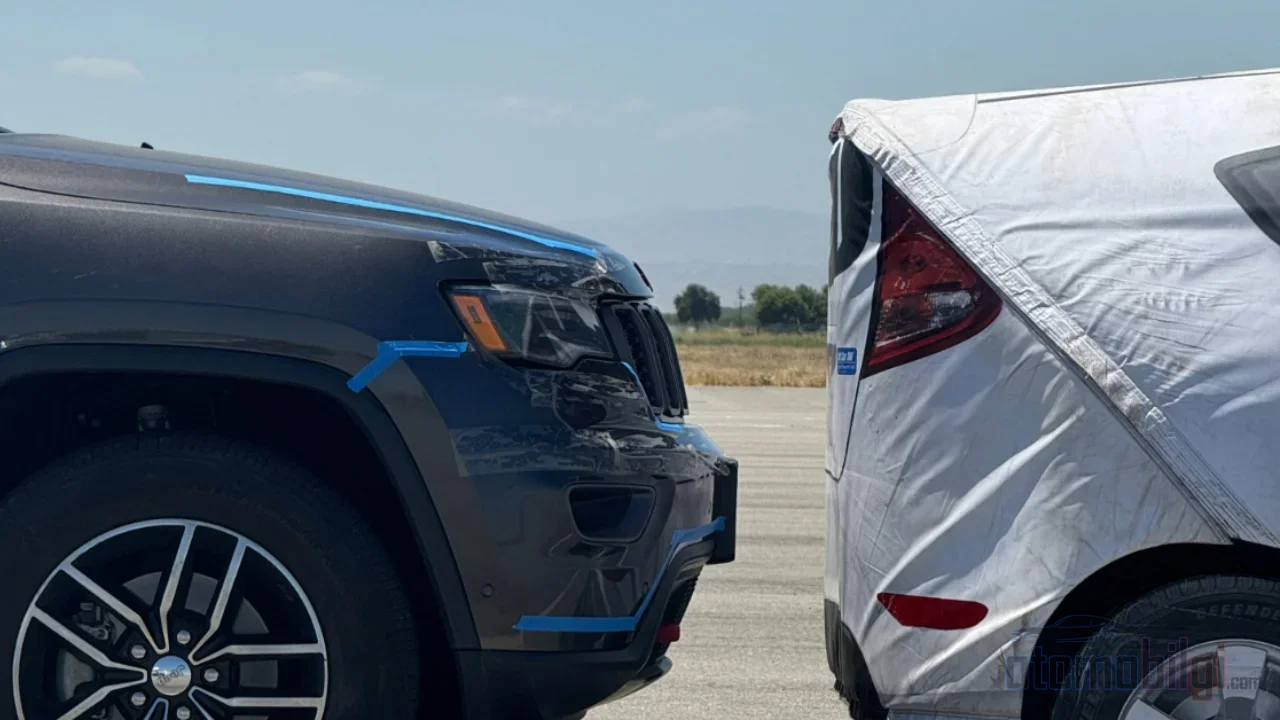
The automatic emergency braking system (AEB) first warns you when it detects a risk of collision ahead, and if you do nothing, it brakes on its own to try to prevent the crash - or at least mitigate it. Most systems typically work across a range of about 10–145 km/h to cover vehicle and pedestrian scenarios; but there is no guarantee for every speed and every scenario. So exactly when does it kick in, and where does it stay silent? Let's take a look.
Highlights
- AEB is different from FCW: Forward collision warning only warns, while AEB brakes on its own.
- Under the new U.S. rule, all passenger vehicles must be able to prevent a fixed-target collision at up to 100 km/h by 2029.
- Low-speed AEB reduced real-world rear-end collisions by about 38–43%.
- There is no evidence of the effectiveness of pedestrian-detecting AEB on dark roads without lighting.
- In Japan, accidents caused by overreliance on the system have been documented: 80 accidents in the first nine months of 2019.
Exactly When Does AEB Kick In?
A simple but clever calculation runs inside AEB's brain: using data from the sensors, it measures how much time remains before you hit the object ahead. This metric is called time-to-collision, or "the time remaining to collision." When the time drops below a critical threshold, the system works in two stages: first a warning that snaps you to attention, then intervention.
The first stage is the warning. A light comes on, a beep sounds, and some vehicles tighten the seatbelt. If you brake, the problem is solved. But if you don't, the system steps in and begins slowing down on its own. In other words, AEB is an autonomous system that lives up to the first letter of its name: it makes decisions independently of the driver, but only speaks up in an emergency, when no other option is left.
How hard does it brake? According to international regulations, the system must be able to produce a deceleration of at least 5 m/s². That means hard braking; the very same braking you make in a panic. At low speeds, for example below 50 km/h, braking can often prevent the collision entirely. At high speeds, however, physics comes into play: since braking distance grows with the square of speed, the system may sometimes only manage to reduce the impact speed. In fact, if the lane is empty, some systems can even calculate that steering away is more sensible than braking.
At Which Speeds Does It Work, and At Which Speeds Does It Give Up?
This is the question everyone wonders about. The answer varies somewhat depending on "which system?", but the general picture is this: most AEB systems are designed for vehicle detection in a band of roughly 10–130 km/h; simpler versions focused on city driving work at lower speeds and give up at high speeds. Pedestrian detection usually stays within a narrower range; the new U.S. safety rule mandates the pedestrian function above 10 km/h and below 73 km/h.
| Scenario | Typical operating range |
|---|---|
| Warning for the vehicle ahead | Above 10 km/h, below 145 km/h (new U.S. rule requirement) |
| Avoidance of a fixed target | Mandatory up to 100 km/h (new rule) |
| Pedestrian detection | 10-73 km/h (new rule requirement) |
| The typical range of systems on the road today | Approximately 10-80 km/h, ~100 m detection range |
| Safety limit on winding roads | Collision speed around 25-40 km/h |
The manufacturers' side is colorful too: some systems can engage AEB at up to 180 km/h; for the 2023 Hyundai Palisade, this figure is even listed as 200 km/h. But beware: "can activate" and "can prevent a collision" are not the same thing. At high speeds, the braking distance may no longer be sufficient; the system only buys you the luxury of reducing the severity of the crash.
In the City: Pedestrians, Cyclists, and Low Speed
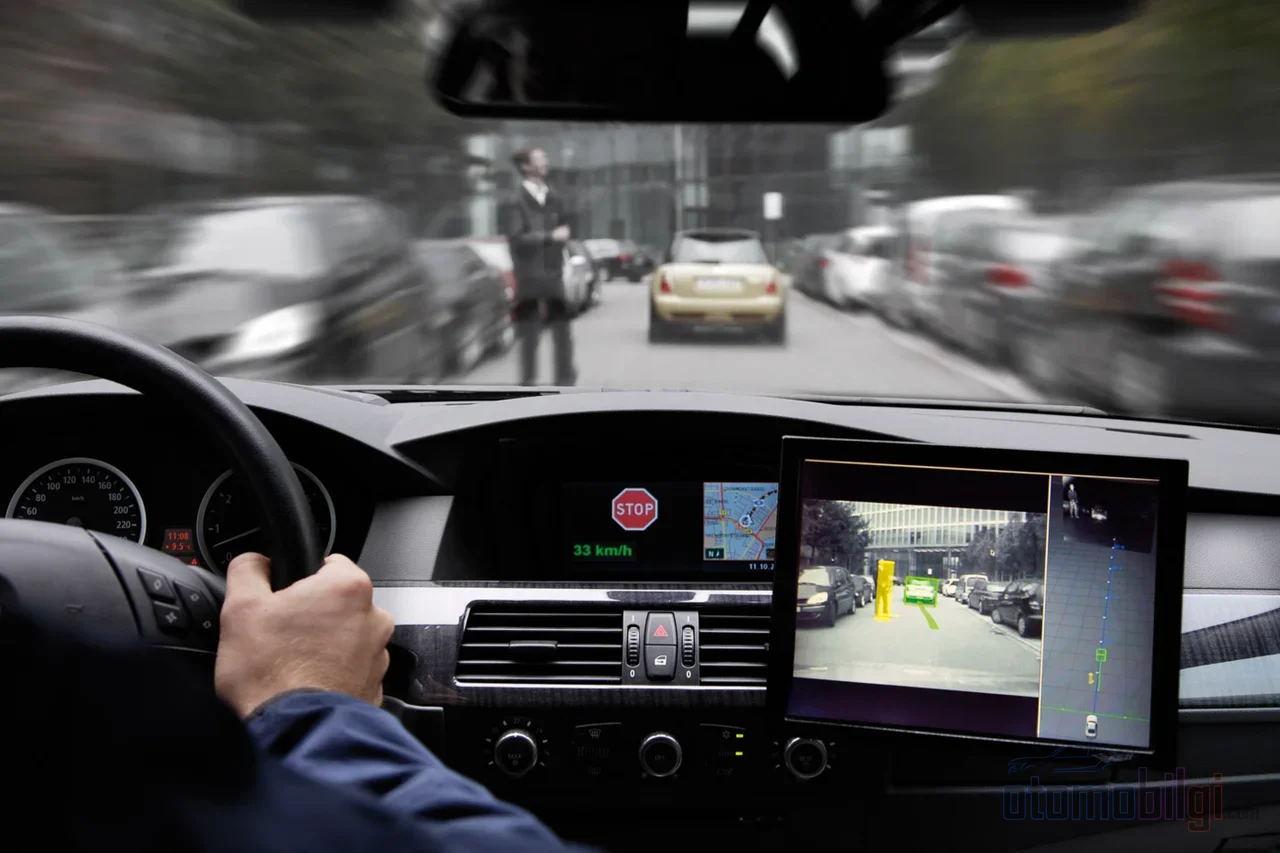
AEB shines brightest in urban low-speed scenarios. In what we call the classic crash of drivers realizing too late that the vehicle ahead has stopped at an intersection, real-world data is impressive: low-speed AEB has reduced rear-end collisions by about 38%; another analysis found a 43% drop in front-to-rear collisions and a 45% drop in injury crashes. When FCW and AEB work together, the picture is even better: a 50% reduction in front-to-rear collisions and 56% in injury crashes. In other words, the warning + automatic braking duo is nearly twice as effective as a warning alone.
There are real gains on the pedestrian side too: pedestrian-detecting AEB reduces pedestrian collision risk by 25-27% and injury crashes by 29-30%. And even if you cannot avoid the collision entirely, braking can reduce pedestrian injury severity. That's why AEB should not be thought of in the "either it saves you or it completely fails" dichotomy; it is both a mitigating system and a lifesaver.
But what about cyclists? This is where the water test heats up. Cycling advocacy groups criticize the US safety testing processes for not including cyclists enough. Japan's AEB requirement, mandatory since 2021, covers cars and pedestrians but not cyclists. Systems also detect motorcycles, buses, and heavy trucks less reliably than light vehicles.
Moments When the System Reacts Late or Doesn't Engage at All
Now for the other side of the coin. AEB is not a superhero, and in some situations it either doesn't wake up at all or reacts too late. Knowing these is essential to not blindly trusting the system.
Night and bad weather
There is no evidence that pedestrian-detecting AEB is effective in darkness, in environments without street lighting. Camera-based systems go blind at night; radar is better but weak at distinguishing pedestrians. Heavy rain, snow, and fog can also temporarily disable the sensors. So driving at night in bad weather is when the system is at its quietest.
Turns, intersections, and lane changes
There is no evidence regarding AEB's effectiveness while turning; in fact, even the proposed new rule did not fully include turning scenarios in effectiveness testing, and the frequency of this crash type is rising. For intersection scenarios (oncoming vehicle while turning left), special "intersection AEB" strategies are being developed, but for them to be effective, both vehicles may need to have suitable equipment. The danger is different in lane changes too: the system may fail to calculate the threat in time as you slide alongside a vehicle; even test protocols evaluate lateral speed only in limited scenarios such as 0.5-0.7 m/s. The NHTSA's target population study also explicitly requires: for AEB to intervene in time, both vehicles must stay within their own lanes.
Stationary targets and rail roads
Detecting stationary objects while approaching at high speed is a known weak point. The new US rule forces manufacturers to be able to prevent collisions with stationary targets up to 100 km/h; but today, some older or basic systems on the road can miss a stationary vehicle at high speed. In cases documented by the NTSB, some systems failed to detect damaged road barriers (crash attenuators) and vehicles crashed directly into them.
False Alarms and "Phantom Braking": Things That Wake the System Up Too Early
There is also the opposite problem with AEB: braking when it is not necessary. This is called a false positive, or in everyday language, "phantom braking". Sometimes the triggers are incredibly innocent: shadows on the road, vehicles parked by the roadside, metal traffic signs in a curve, steeply sloped ramps... Even the federal definition explicitly addresses this as "braking in a situation with no imminent collision".
This is such a serious debate that those opposing the AEB mandate argue, precisely by pointing to these false activations, that the technology should not be made mandatory before it matures. Owners of some new models have also shared complaints of repeated hard braking. So the coin has two sides: sometimes the system is late, and sometimes it slams on the brakes when there is no need at all. Both are annoying, and both are a reminder that the driver must not put their attention aside.
Does AEB Make Drivers Lazy? The Overconfidence Trap
This is the most critical point: AEB does not replace the driver. It is only a support; not the backup of a careful driver, but the backup of the backup. This is not an abstract warning, but a fact supported by concrete accident data: In Japan, accidents caused by overconfidence in automatic braking were counted as 72 in 2017, 101 in 2018, and 80 in the first nine months of 2019, and 18 of them resulted in injury or death. A driver who trusts the system and looks at their phone can crash even with the world's best AEB.
Regulators see this trap too. After heavy vehicle drivers turned off AEB to follow more closely, as of 2025 the EU is limiting the system's deactivation period to 15 minutes in newly type-approved vehicles; when the time runs out, the system automatically reactivates. I think it is a fair rule: benefit from the technology, but do not make it an excuse.
One more note: reverse AEB is still in its childhood. In AAA tests, it applied the brakes in 65% of reverse maneuver scenarios but could prevent a collision in only 2.5% of them. So when backing up, you press the pedal, not the system.
Legal Framework: AEB Is No Longer Optional
These systems are no longer an option in the hardware catalog. The US is mandating AEB on all passenger vehicles and light trucks by September 2029; the new rule requires frontal crash avoidance up to 100 km/h. In the EU, it has been mandatory for newly type-approved vehicles since May 2022 and for all new sales since May 2024. Japan has been rolling it out step by step since 2021; Australia requires AEB on all models on sale from March 2025. The history is also pleasant: the first patents date back to the 1990s, the 1997 Toyota Celsior was a pioneer of its era with its laser-based adaptive cruise control, and in 2016, 20 manufacturers in the US made a voluntary commitment. So today's mandate is the result of thirty years of maturing.
Summary: If the System Is There, Is the Attention There Too?
AEB is one of the most valuable safety technologies of our time; it genuinely reduces accidents, mitigates the ones it cannot prevent, and is now standard on most new vehicles. But knowing its operating ranges, its weaknesses at night and in turns, its cyclist blind spot, and the risk of false braking is essential to using it correctly. Think of the system as your backup, not your pilot. The next braking should always be under your foot; AEB is just your silent helper that can be one second faster than you in that moment. How do you use AEB, has it ever kicked in at a critical moment?
Sources
- Automatic Emergency Braking Systems for Light Vehicles – Federal Register
- Final Rule: AEB Systems for Light Vehicles – NHTSA
- Automated emergency braking system
- Out with the Old (Automatic Emergency Braking), In with the New – AAA Newsroom
- Automatic & Enhanced Automatic Emergency Braking – Chevrolet
- Automatic Emergency Braking (AEB) System Impact – PMC
- Effects on crash risk of automatic emergency braking – PubMed
- Association between automatic emergency braking and pedestrian injury – ScienceDirect
- Automatic Emergency Braking – How Can We Set the Bar – TRB
- Intersection AEB implementation strategies – Taylor & Francis
- The National Highway Traffic Safety Administration is failing bicyclists – League of American Bicyclists
- Opponents to AEB mandate point to false activation reports – Landline Media
- What is Automatic Emergency Braking – JD Power
- ETSC welcomes higher standards for AEB systems on HGVs – ETSC
- What does the upcoming FMVSS 127 AEB protocol mean – AB Dynamics
- Automatic Emergency Braking in Cars – NCSR Safety