The Engineering of Surviving Fatal Crashes in NASCAR
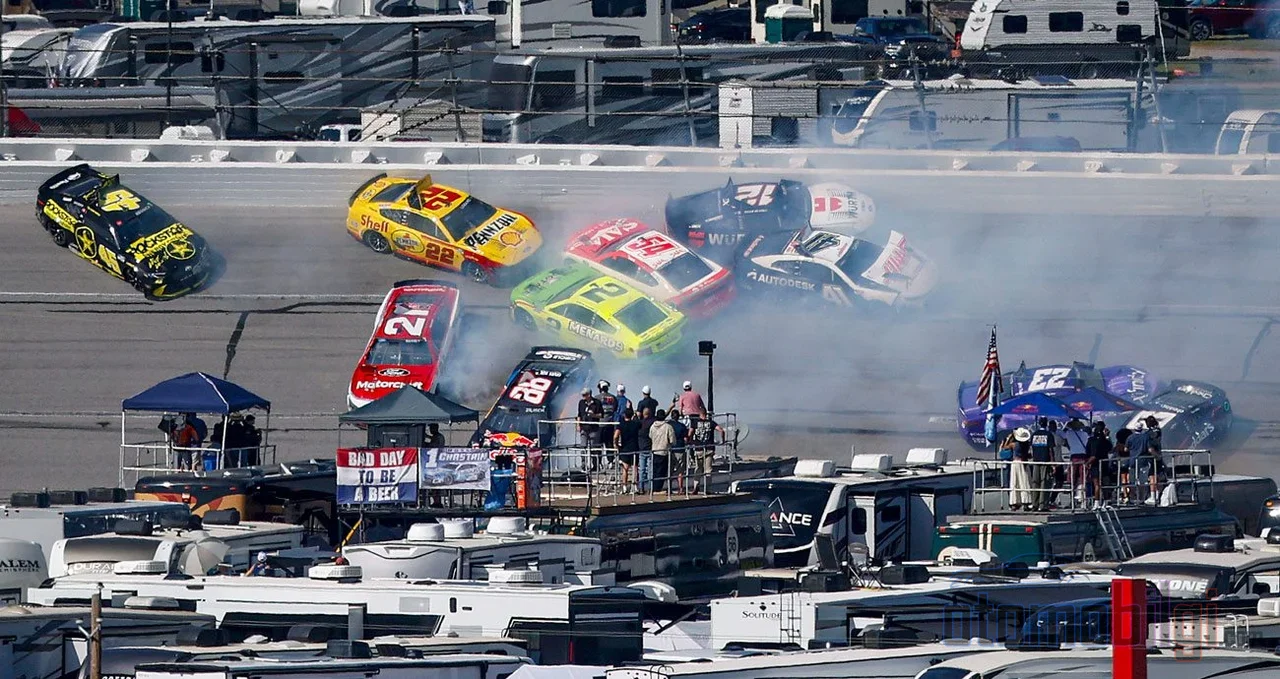
Just imagine: a NASCAR going nearly 300 km/h, flipping over, turning upside down, and then another car slamming into the driver's door at 200 mph. A few minutes later the driver walks to the ambulance on their own two feet. How? Magic? No, engineering. And not just that - the result of a safety revolution set in motion by a bitter lesson learned in 2001. On this page, I'll explain how a driver survived in NASCAR piece by piece, not lap by lap: from soft walls to the devices that act as neck braces, from wings that prevent cars from flying to steel-cage cockpits.
February 18, 2001: The Final Lap That Changed Everything
It was the final lap of the Daytona 500. Seven-time Winston Cup champion Dale Earnhardt hit the wall in the fourth turn and lost his life. From the outside, it looked like an ordinary contact in terms of magnitude: the impact to the left-front area pushed the car's angle to the wall to 53-55 degrees, and the car hit the unprotected concrete wall hard.
Subsequent examinations revealed that Earnhardt most likely died from a fracture at the base of his skull. In the sudden stop, the seat belts held his body, but his head was flung with such speed that his unprotected head struck the steering wheel or the edge of the side window. And here is the painful paradox: Earnhardt was among the drivers who refused to use the very device that prevents this flinging, namely the HANS; he found the device restrictive.
Earlier that season, Adam Petty, Kenny Irwin, and Tony Roper had also lost their lives in concrete wall crashes. Earnhardt's death turned this accumulation into a breaking point. In January 2003, NASCAR opened a 60,000 square feet Research and Development Center near Charlotte Motor Speedway; there is even a section where vehicles involved in serious crashes are examined piece by piece. And let's be clear about this: Earnhardt remains the last driver to lose his life in NASCAR's national series. There have been no driver deaths in the national series since 2001. So is this a coincidence? Absolutely not.
The SAFER Barrier: Why Is the Wall Now "Soft"?
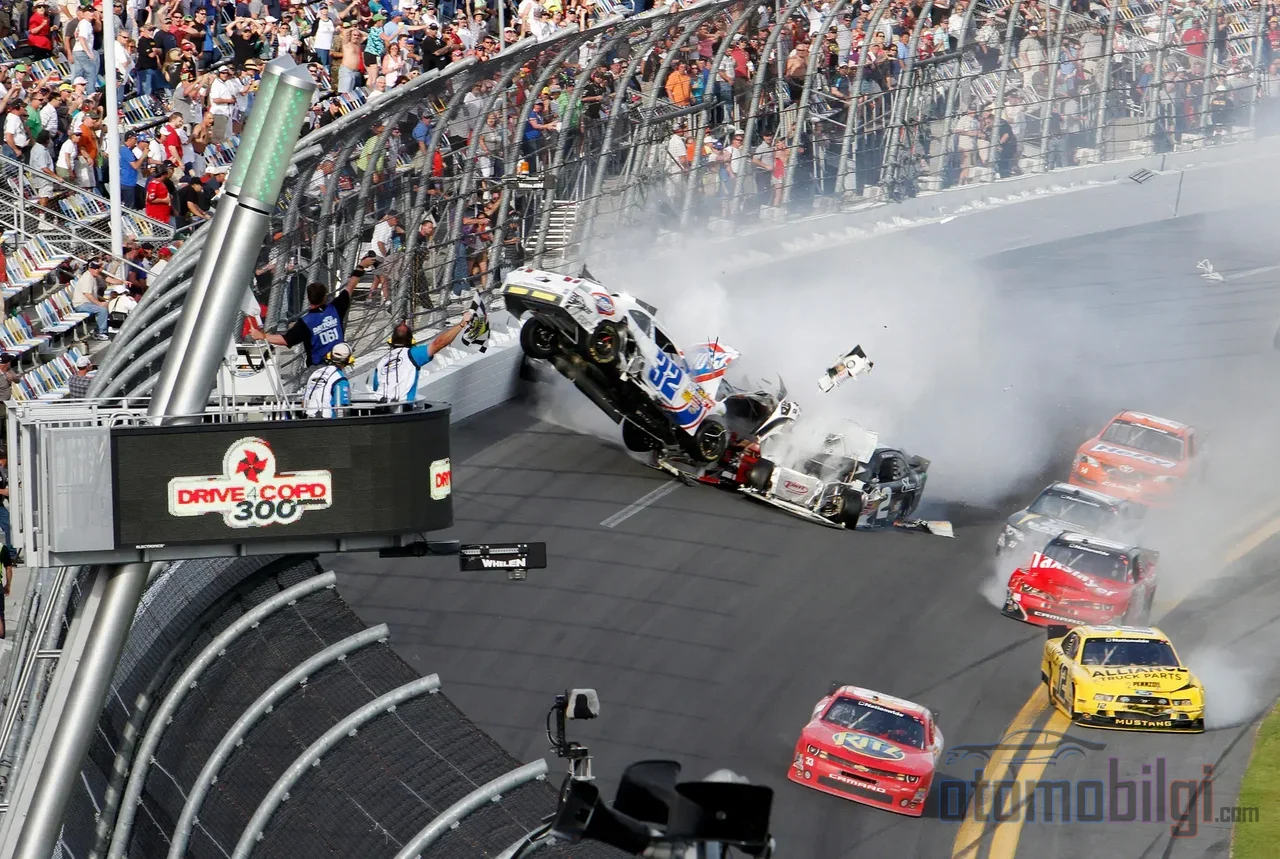
Now let's start with the most critical piece. SAFER stands for Steel And Foam Energy Reduction Barrier. Let me give you an analogy from everyday life: Think of the difference between punching a concrete wall at full force and punching a thick pillow. The energy is the same in both; but the pillow spreads that energy over time, so the peak force on your fist drops. SAFER is exactly that pillow - just a version made of tons of steel and foam, engineered with precise calculations.
Highlights
- Dale Earnhardt lost his life on the final lap of the Daytona 500 on February 18, 2001; after him, there were no driver deaths in NASCAR's national series.
- The SAFER barrier was first installed in Indianapolis in May 2002; it was present at every Cup and IndyCar oval until 2006.
- The HANS device reduces total neck load by up to 78%.
- The new A-post wings introduced in 2025 increase the speed needed for the vehicle to take flight by more than 25%.
The system's architecture was developed by the engineering team at the University of Nebraska-Lincoln; team leader Dr. Dean Sicking was awarded the National Medal of Science and Technology for this work. Here's how the structure works: In front of the concrete wall, straight-mounted welded structural steel tubes are installed (four 20-foot high-strength horizontal strips), and closed-cell polystyrene foam packages are placed in the 30-inch gap between the tubes and the wall. The goal is two things: To spread the kinetic energy of the impact over a longer area along the wall and to prevent the car from bouncing off the wall and flinging back into track traffic.
That second point is crucial, because the first trials failed exactly there. Here's what happened to the system called PEDS, tried in Indianapolis in 1998: In Arie Luyendyk's crash, the barrier broke apart and threw the car back into traffic. The system was removed due to the "catch and rotate" flaw. That failure taught a valuable lesson: The soft wall idea was right, but the design had to be done meticulously. SAFER matured with that lesson; it was first installed at Indianapolis in 2002, reached nearly all IndyCar and NASCAR tracks by 2005, and every oval facility hosting Cup races by 2006.
Depending on the angle of impact, SAFER is reported to absorb between 30 and 80 percent of the g-forces at the moment of impact; this figure is not an officially verified value, so it should be approached with caution. But the concrete result is there: SAFER is considered the number one architect of "seemingly impossible" crashes on NASCAR ovals now becoming survivable ones.
The HANS Device: The Collar That Saved Necks
Next up is the second hero: HANS, meaning Head And Neck Support. The device was developed by biomechanics professor Dr. Robert Hubbard and his former IMSA driver brother-in-law Jim Downing. Remember the problem: Seat belts secured the body but not the head. In a sudden stop, the car wasn't the only thing dropping from 300 km/h to zero; the driver's head was also flung forward and sideways with the same kinetic energy. This is called "head whip," and that fatal strain on the neck was the main source of skull base fractures.
HANS solves this problem elegantly. Imagine a lightweight carbon fiber collar that fits over the shoulders; the helmet is connected to this collar with two straps. This way, the head can no longer be flung independently of the body; the stopping load is transferred from the helmet to the collar, then to the shoulders and the seat. The physics side is striking: HANS reduces neck strain by 81 percent, shear load by 72 percent, and total neck load by 78 percent. In a frontal crash without HANS, the force on the neck drops significantly from a level of roughly 900 pounds to well below that with the device. Additionally, with the device, the head can be protected up to a tolerable load of 62 g.
After 2001, HANS became mandatory in NASCAR. That "restrictive" device Earnhardt refused is today standard equipment worn by every driver - and probably the most life-saving piece of the last 25 years.
Roof Flaps: Why Don't NASCAR Cars Fly?
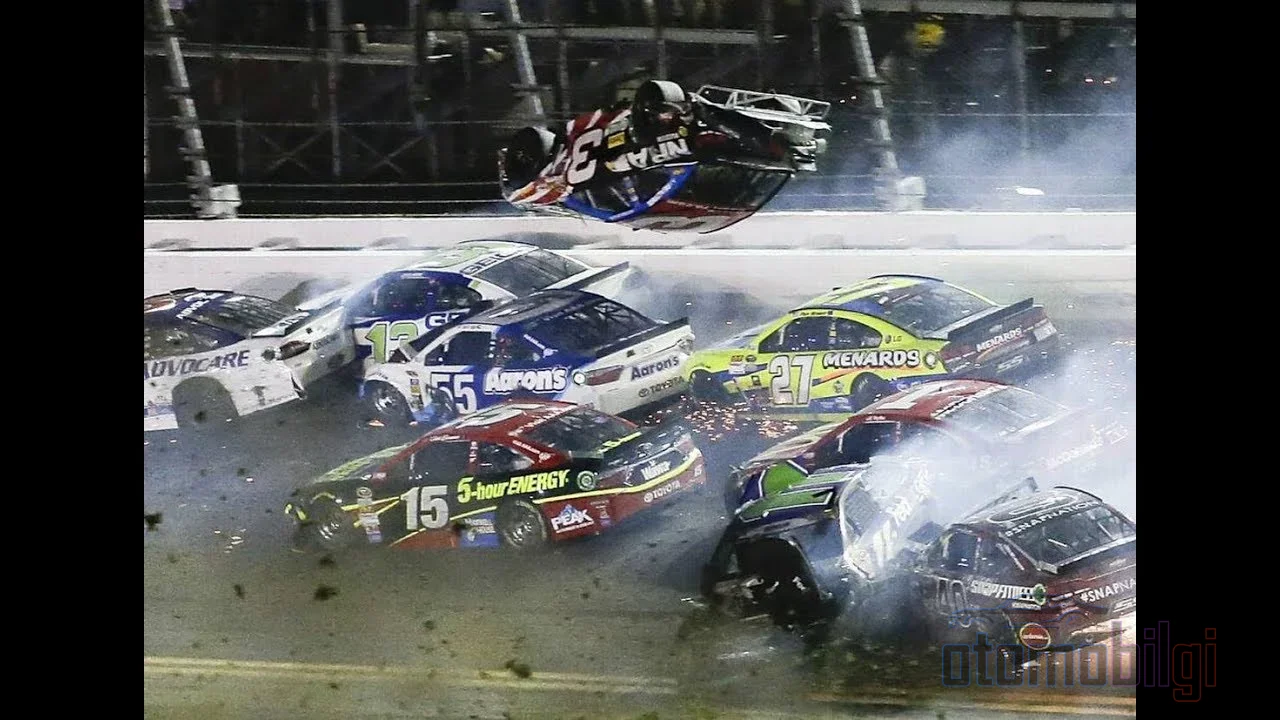
So what about staying on the ground? When a NASCAR car spins and slides backwards, a low-pressure area forms over it that makes lifting off easier. This is exactly where the roof flaps come into play: When the car skids, the flaps open automatically, fill that low-pressure area, and increase the downward force, preventing the car from lifting off the ground. The first flap to open is the one positioned at a 140-degree angle to the vehicle's centerline.
The idea was born from Rusty Wallace's airborne crashes in 1993. In 2013, canvas pieces stretched from the flaps to the corners were added, raising the takeoff threshold even further. In 2025, a new step arrived: A-pillar flaps. Effective at skid angles between 60 and 110 degrees, these flaps increase the speed required for the car to lift off by more than 25 percent. In other words, every year it becomes a bit harder for a NASCAR to become an "airplane."
The Next Gen Cockpit: A Survival Cell Inside a Steel Cage
Now let's look at the car itself. The Next Gen car carries an integrated roll cage on a steel tube frame chassis. Think of Formula 1's autoclave-produced carbon fiber monocoque, which serves as a survival cell in a crash and is surrounded by an energy-absorbing structure; NASCAR solved the same problem differently. Instead of a carbon monocoque, a modular cage woven from steel tubes. A different path, the same logic: A non-deforming core that envelops the driver, surrounded by zones that absorb energy.
With the Next Gen, NASCAR used a real crash structure and energy-absorbing foam on the outer surface for the first time. The 2023 safety package made moves in three directions at once: At the rear clip, some structures were deliberately weakened to deform at lower loads (fewer bars, changing bar designs, holes opened at potential buckling points); the lower zones in the front and side areas that first make contact with the wall were reworked; a new steel door plate on the right side and two left door reinforcement brackets were added to the cockpit section. Additionally, starting in 2023, data collection became mandatory in the cars.
| Next Gen Vehicle | Value |
|---|---|
| Length | 4,912 mm (193.4 inches) |
| Width | 1,996 mm (78.6 inches) |
| Height | 1,280 mm (50.4 inches) |
| Chassis structure | Steel tube frame + integrated roll cage |
The subtlety here is this: Softening the rear and front zones while stiffening the cockpit. The part that crushes in a crash should be where the driver is not - just like the crumple zones in road cars, only calculated at far more extreme limits. NASCAR establishes this balance through simulations, evaluating the seat, harness, and injury-reduction systems using human body models.
So Why Do Drivers Walk Away?
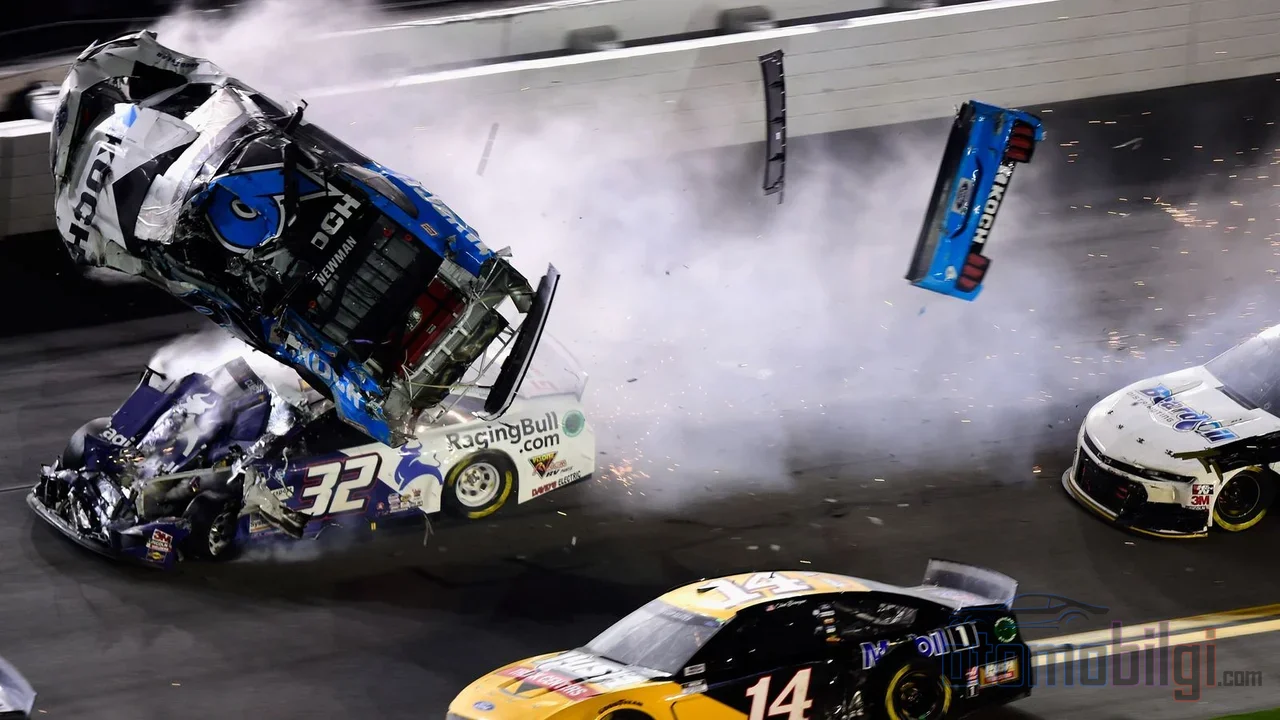
Here is the answer to our opening question, now with all its pieces. The best example is Ryan Newman's crash at the 2020 Daytona 500: First he hit the SAFER barrier (the soft wall absorbed some of the energy), the car flipped upside down, and another car in the vicinity struck the driver's door at approximately 200 mph. Newman survived. Here is how the chain worked: The SAFER barrier softened the first impact, the crumple zones absorbed the energy of the second blow, the forces were transferred to the seat and HANS, and the strong side structure prevented intrusion into the cockpit.
The side structure matters literally inch by inch: When a driver is struck T-bone style from the side, only about 10 inches of space remain between the body and the point of contact. That is why the steel door plate and strength brackets added in 2023 are not decoration but a lifeline. Thanks to this chain, in the SAFER and HANS era, names like Kyle Larson, Brad Keselowski, Jimmie Johnson, Matt Kenseth, Jeff Gordon, Michael McDowell, and Danica Patrick walked away from extremely hard crashes unscathed. Bubba Wallace, after his big crash at Talladega, described himself as having only bitten his cheek and his foot hitting the pedal, emphasizing how far safety has come.
The short answer is this: NASCAR drivers are able to walk away from even crashes that look extremely severe, thanks to the SAFER barrier absorbing crash energy, the HANS cutting neck loads, the roof flaps keeping the car on the ground, and the roll cage protecting the cockpit like a shell. Of course, additional layers like Nomex fire-retardant suits, multi-point harnesses, and helmets are on duty at every moment in the background.
Conclusion: The Price of a Lesson, the Reward of a Revolution
We have to say this honestly: Most of these technologies had been developed by 2001 but were not widespread at the tracks. Concrete walls had been designed for decades primarily with spectator safety in mind; from the driver's perspective they were inadequate, and this situation persisted until Earnhardt's death. The price was very heavy, but after that price was paid, the transformation was swift and determined: soft walls spread to every oval, HANS became mandatory, and cars protect a little more intelligently every year.
As a NASCAR viewer, what I appreciate most is this: Now, at the moment of a crash, my first thought is "thank goodness," not "oh my God." Because behind that pile of steel, foam, and carbon fiber stands 25 years of engineering will. And the proof is there: Since 2001, not a single driver has lost their life in NASCAR's national series. No checkered victory flag can be a more beautiful statistic than that.
Sources
- The aftermath of Dale Earnhardt: 'We made the sport so much safer. That's the legacy'
- NASCAR's safety evolution: No driver fatalities since Earnhardt's tragic 2001 Daytona crash
- How SAFER Barriers Came To Help NASCAR Drivers Survive 'The Big One'
- SAFER barrier - Wikipedia
- HANS device - Wikipedia
- How 19-Year-Old Solutions Saved a Life at the Daytona 500
- Next Gen (NASCAR) - Wikipedia
- Roof flap - Wikipedia