V2X: How Autonomous Vehicles Talk to Each Other
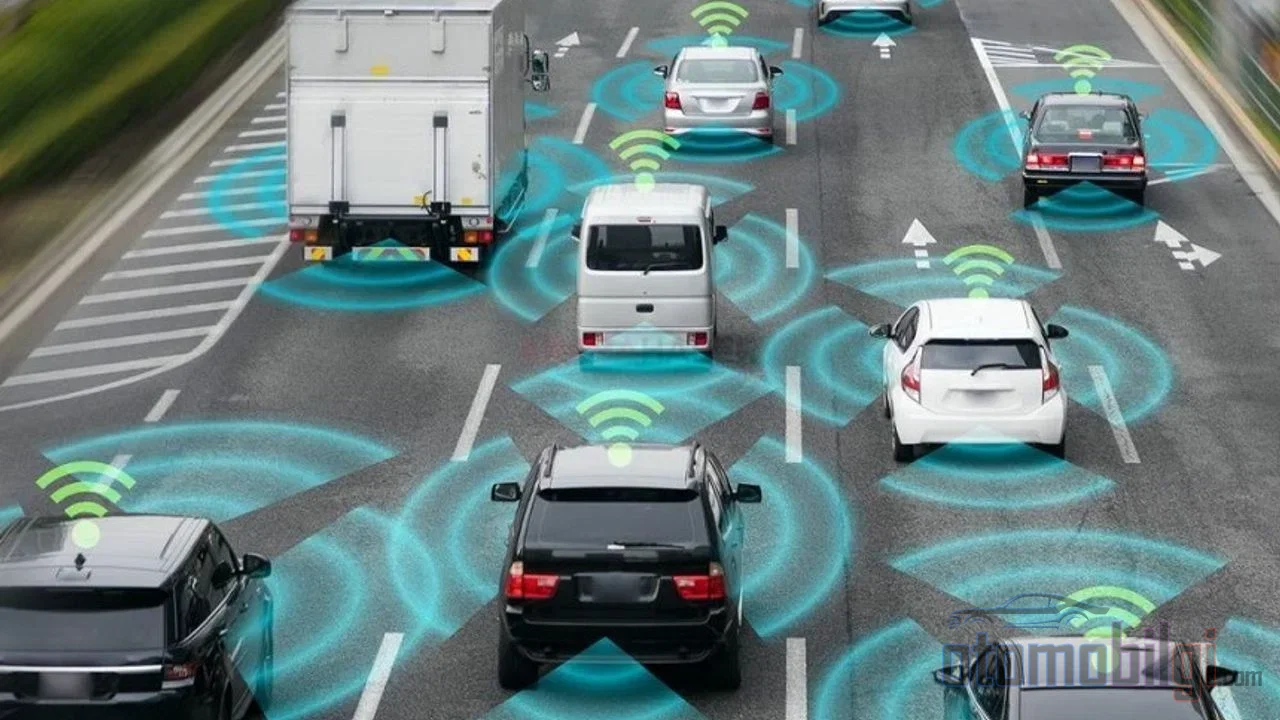
Say you're on a rainy road at night, and right around the corner someone slams on the brakes in panic. Unfortunately, you can't expect lidar to see around corners; the camera doesn't see behind walls either, only what's ahead. But what if your car could warn the vehicle behind from 300 meters away, in the very first millisecond the brakes were applied? That's exactly what V2X - autonomous vehicles talking to each other - is chasing after. But as we'll see, this story holds quite an interesting gap between promises and reality.
Everywhere we look, the conversation around autonomous vehicles revolves around lidar, radar, and cameras. Yet the most fundamental weakness of sensors comes from physics: line of sight. Radio waves, on the other hand, can bend around corners, bounce off walls, and carry the pulse of a vehicle you've never seen to you. In this article, we'll talk about what V2X is, which messages it works with, the technology rivalry between DSRC and 5G-based C-V2X, and why this technology is still an exception on the roads. If you're ready, let's begin.
What Is V2X? The Vehicle's Right to Talk to Everything
V2X, short for Vehicle-to-Everything, means the vehicle establishing wireless communication with any entity that could affect it. Under this umbrella there are several different conversations: vehicle-to-vehicle communication, that is V2V, vehicle-to-infrastructure communication, that is V2I, V2P extending to pedestrians and cyclists, and of course the connection with the network. V2V is actually the heart of this system; it only refers to messaging between vehicles. V2X extends the same idea to traffic units at intersections, roadside systems, and even a pedestrian on their phone.
So what are these vehicles telling each other? The main language is the Basic Safety Message, the basic safety message. A DSRC-equipped vehicle broadcasts its position, direction, and speed 10 times per second to announce itself to its surroundings. These messages are used for collision prevention, speed control, emergency braking warnings, and lane-changing decisions. On the infrastructure side, things work differently: roadside systems, for example, can detect a queue of trucks waiting in front of a work zone and send warnings to drivers approaching from behind. So even an intersection sensor can now join the conversation.
Highlights
- DSRC-equipped vehicles broadcast position, direction, and speed data 10 times per second
- 5G C-V2X targets ~10 ms end-to-end latency and 99.999% reliability
- From 2023 onward, new deployments have effectively switched to C-V2X technology
- The industry has turned to a dual-mode hardware strategy instead of a single standard
- In the US, the Connected Vehicle pilot program plans funding of up to 100 million dollars for V2I projects
How Does It See What Sensors Can't?
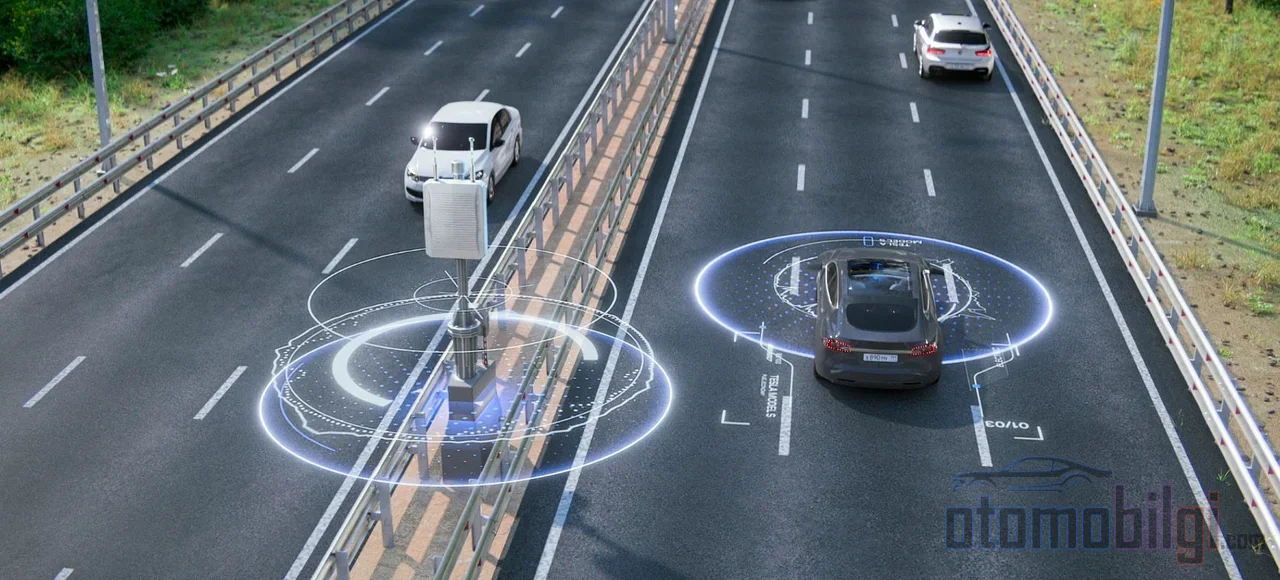
The idea here is truly beautiful: transforming traffic safety from an ego-centric perception problem, where each vehicle tries to see its surroundings on its own, into a problem of collective intelligence. When the vehicle ahead brakes suddenly, your car only detects it through its own sensors, by seeing the brake light or noticing how quickly the distance is closing. With V2V, however, the braking vehicle broadcasts this with a message, and everyone within range receives the information before even seeing the brake light.
This capability shines precisely where sensors fall short: behind corners, beyond intersections, and in blind spots. A vehicle approaching rapidly from outside the field of view is a hidden danger that never appears on the sensors' radar, yet it can already be detected through a radio message. Technical assessments published in 2026 show that C-V2X can extend perception beyond sensor limits, operate in all weather conditions, and provide reliable real-time object data. When camera and lidar performance drops in bad weather, such a communication layer means a serious backup.
An important detail: V2X does not replace lidar and cameras. The correct picture is that it positions itself as an additional layer that goes beyond the sensors. There are also studies showing that video-based safety messages can offer an advantage over classic messages based solely on in-vehicle sensors; in other words, the two worlds complement each other.
DSRC vs. C-V2X Competition: Beta or VHS?
The longest-running rivalry in the V2X world revolves around the technology standard. On one side is DSRC (based on IEEE 802.11p), which has been in the field for years; on the other is C-V2X, the cellular world's entry.
DSRC: Simple, Independent, Once Reliable
DSRC's biggest advantage is its simplicity: without needing a base station, a network, or an operator, vehicles talk to each other directly through peer-to-peer broadcast. It typically operates with an end-to-end latency target of around 100 ms, and according to sources, the communication range varies between 50-500 meters; in some measurements, the reliable range can reach up to 300-1000 meters. Packets are small: V2V messages are under 100 bytes, and V2I messages are under 340 bytes. It can maintain communication in the presence of physical obstacles and in extreme weather conditions, and works at speeds of up to 500 km/h - so technically you could even catch a message coming from a speed trap vehicle.
But there are two problems. The first is technical: the latency of the 802.11p-based system is not bounded, and quality of service can fluctuate in heavy traffic; real-world measurements show that bidirectional latency is affected in crowded environments. The second is political: in the US, the communications regulator FCC opened the lower 45 MHz of the 5.9 GHz band to unlicensed Wi-Fi use in November 2021, and DSRC's habitat shrank considerably.
C-V2X: The Road That Opens the Door to 5G
C-V2X is part of 3GPP standardization: LTE-V2X came with Release 14, and the enhanced NR-V2X was defined with Release 16. It offers two operating modes: PC5 sidelink, which requires no base station, and network-supported Uu. Sidelink's Mode 4 scheduling works with 1 ms subframes and, at high vehicle density, theoretically promises a lower collision rate than DSRC's CSMA/CA approach. The targets on the 5G side are ambitious: end-to-end latency of around 10 ms, reliability 99.999%. Sources put 5G latency down to the 1-5 ms range; the truth is that both technologies are thought to be able to meet V2V's millisecond-level safety requirements.
C-V2X has another trump card that DSRC lacks: wide-area coordination with cloud and edge computing. And the market reality looks clear: as of 2023, real deployments are using C-V2X; DSRC is gradually becoming a component integrated with C-V2X. While the US invested in DSRC, China leaned on cellular technologies - much like the format wars of the old video cassette days.
| Feature | DSRC | C-V2X |
|---|---|---|
| Basis | IEEE 802.11p / WAVE | 3GPP (LTE-V2X, NR-V2X) |
| Infrastructure requirement | None, peer-to-peer broadcast | No sidelink; requires the Uu network |
| Typical latency target | ~100 ms (target) | ~10 ms (5G target) |
| Standout aspect | Simplicity, independence | Scalability, cloud coordination |
| Status (2026) | Its spectrum has dwindled | The de facto choice for new deployments |
So is the winner clear? Technically, neither standard is universally superior in every environment, and the industry openly admits this. Patent data paints an interesting picture: some manufacturers are developing dual-module hardware that dynamically switches between the two standards by continuously comparing packet error rate, latency and signal strength; the Korean industry, meanwhile, has turned to simultaneous systems that run both standards at once. So the answer will most likely be neither DSRC nor C-V2X, but vehicles that speak both.
So What Is Actually on the Roads Today?
This is where the paths of promise and reality diverge. On paper everything is wonderful; in the field, V2X is still a niche application. Even so, concrete steps are being taken. Under a national acceleration program in the US, the goal is to install V2X infrastructure at 750 signalized intersections and equip approximately 400 vehicles - including emergency response vehicles. The state of Georgia's V2X deployment won a transportation award in 2026. On the market side, optimism is high: the vehicle-to-infrastructure communication market is projected to grow from roughly 592 million dollars in 2025 to 2.89 billion dollars by 2032, with average annual growth of 37%.
On the public side, the US Department of Transportation's plan to fund V2I projects with up to 100 million dollars over five years under a pilot program is a sign that this effort cannot move forward without government support. And in fact, this also sums up V2X's position: while the dream of fully autonomous driving is still further away, V2X is seen as the pragmatic way to make today's human-driven traffic safer.
Why Doesn't Every Vehicle Have V2X Yet?
One of this technology's biggest headaches is a chicken-and-egg problem: if a manufacturer puts V2X hardware in a vehicle, the technology is useless when there are no other vehicles to talk to. Communication is impossible unless the vast majority of traffic speaks the same technology - and no manufacturer wants to make this investment without any guarantee that its competitors will take the same step. Unlike the decline in sensor prices, the benefit of communication technology depends entirely on network effects.
Cost and infrastructure burden are also contentious: DSRC-based systems demand public funding for installing and maintaining roadside units; 5G can run on private base stations, but if the cost is shifted onto individual drivers, large-scale rollout becomes difficult. The chip shortage following COVID-19 was one of the factors that raised equipment costs and slowed the transition to 5G. On top of that, the complexity of real-world conditions makes even testing V2X difficult; bad weather, signal loss, and hardware limits can reduce reliability. Detection of vulnerable road users such as pedestrians, precise positioning, and lack of network coverage remain open problems. And of course, the generally slow progress of autonomous vehicle adoption, along with safety concerns and high-profile incidents, adds extra weight to this picture.
Safety, Privacy, and That Tricky Question: Who Do You Trust?
You cannot assume that every message a vehicle receives is correct. What if someone broadcasts a fake braking message? What if a vehicle deliberately reports its position incorrectly? V2X security is a field of its own for precisely this reason: it covers the set of protocols that protect communication between vehicles, roadside systems, and network services against cyberattacks. Alongside the integrity, authenticity, and confidentiality of communication, anonymity is also added - because a vehicle broadcasting its position 10 times per second is ready-made tracking data for a malicious actor. A comprehensive privacy review published in 2026 shows that new data sources in V2X networks bring new attack vectors with them.
Candidate solutions include V2X authentication, artificial intelligence-powered threat detection, and trust computation approaches that score message reliability; upcoming obstacles include data privacy and high storage costs. In short, even if the technical layer of vehicle-to-vehicle communication is solved, the question of who to trust remains an active research topic.
Conclusion: Where Does V2X Stand on Its Promise?
The summary of the summary is this: V2X is a communication layer built on safety messages broadcast 10 times per second that allows autonomous vehicles to overcome the physical limits of their sensors - what's behind the corner, beyond the intersection, an icy curve; yet due to network effects, infrastructure costs, and trust/privacy issues, as of 2026 it is still a niche technology. The standards war tends largely to end in favor of C-V2X, but the industry's real strategy is hardware that speaks both standards. While lidar and the camera continue to be the heroes of the story, V2X has taken on the supporting role of quietly listening and whispering where they cannot see. We are heading toward a world where, one day, your car will receive news of a panic braking three intersections ahead without you noticing - only that day is a little further off than today.
Sources
- Vehicle-to-everything
- C-V2X vs DSRC for Autonomous Vehicles
- DSRC vs 5G for connected vehicles
- ITS America National V2X Deployment Plan (2023)
- Vehicle-to-Infrastructure Technologies - GAO
- 5GAA Technical Report - Dynamic V2X Use Cases (June 2026)
- Privacy in V2X communication: A comprehensive survey (2026)
- Why V2X will make the difference for Autonomous Vehicles