Why Did the MINI QED Never Reach Series Production?
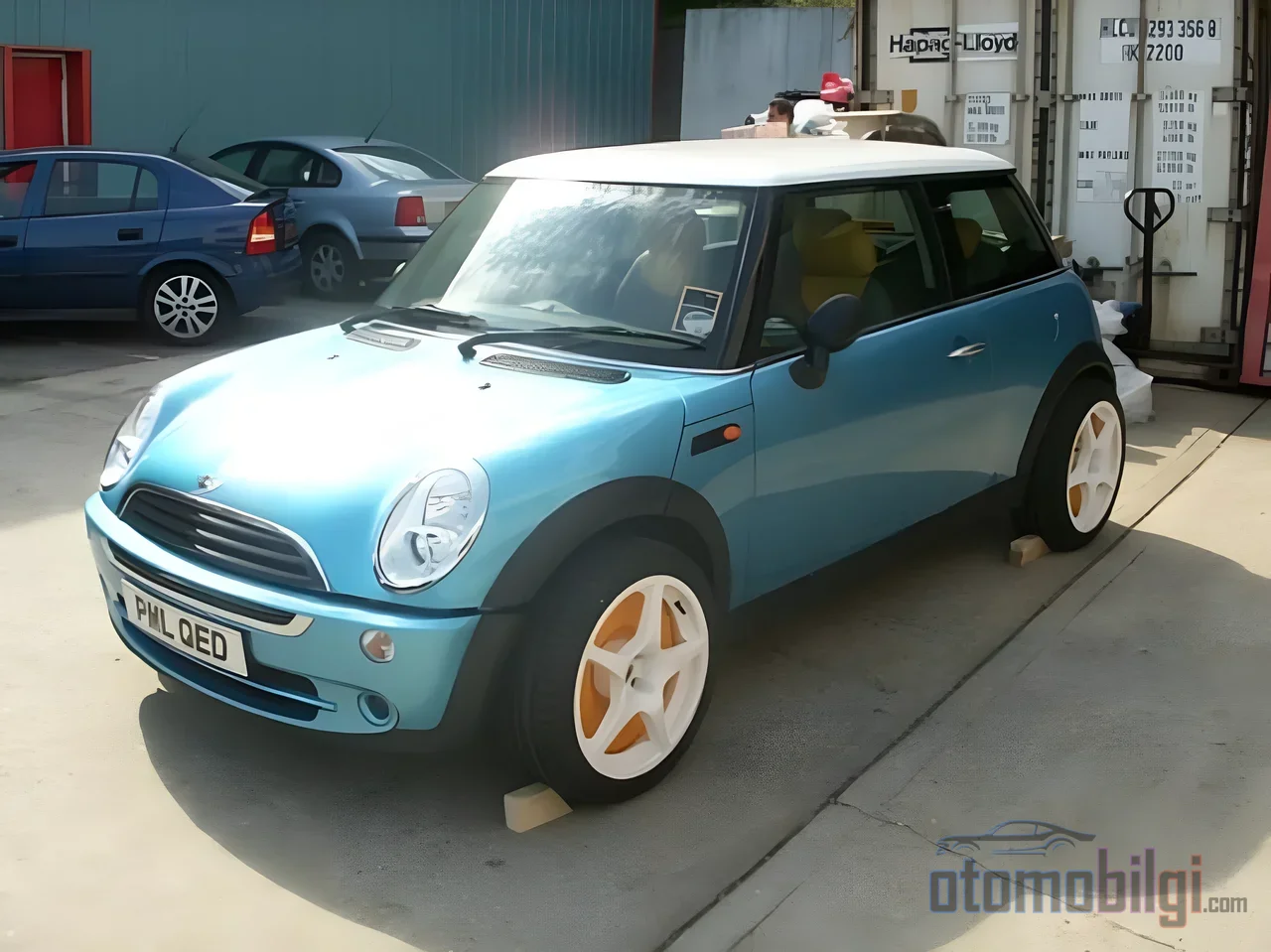
At the British Motor Show stage in London in the summer of 2006, under the hood of an ordinary-looking MINI Cooper there was neither a gasoline V8 nor the enclosed engine of a sports car; it carried an electric motor mounted in the hub of each of the four wheels. The vehicle was called the MINI QED: an abbreviation of the Latin "quod erat demonstrandum", that is, "that which is to be proven". The name was no accident; Hampshire-based engine manufacturer PML Flightlink aimed to present exactly such a proof to dispel doubts that in-wheel electric motors had no place in the future of automobiles. The proof was ambitious: 640 horsepower, 0-60 mph acceleration in 3.7 seconds, and a range approaching 1,000 miles with fuel and charging combined.
This page examines the MINI QED's technical architecture, its performance promises, and its place in plug-in hybrid history; it then follows why, despite those striking figures, the project never reached series production. The short answer is not a genuine "cancellation decision", but rather one of engineering history's most familiar patterns: the technology was ahead, the company fell behind.
A Radical Interpretation of the Series Hybrid Architecture: In-Wheel Motors
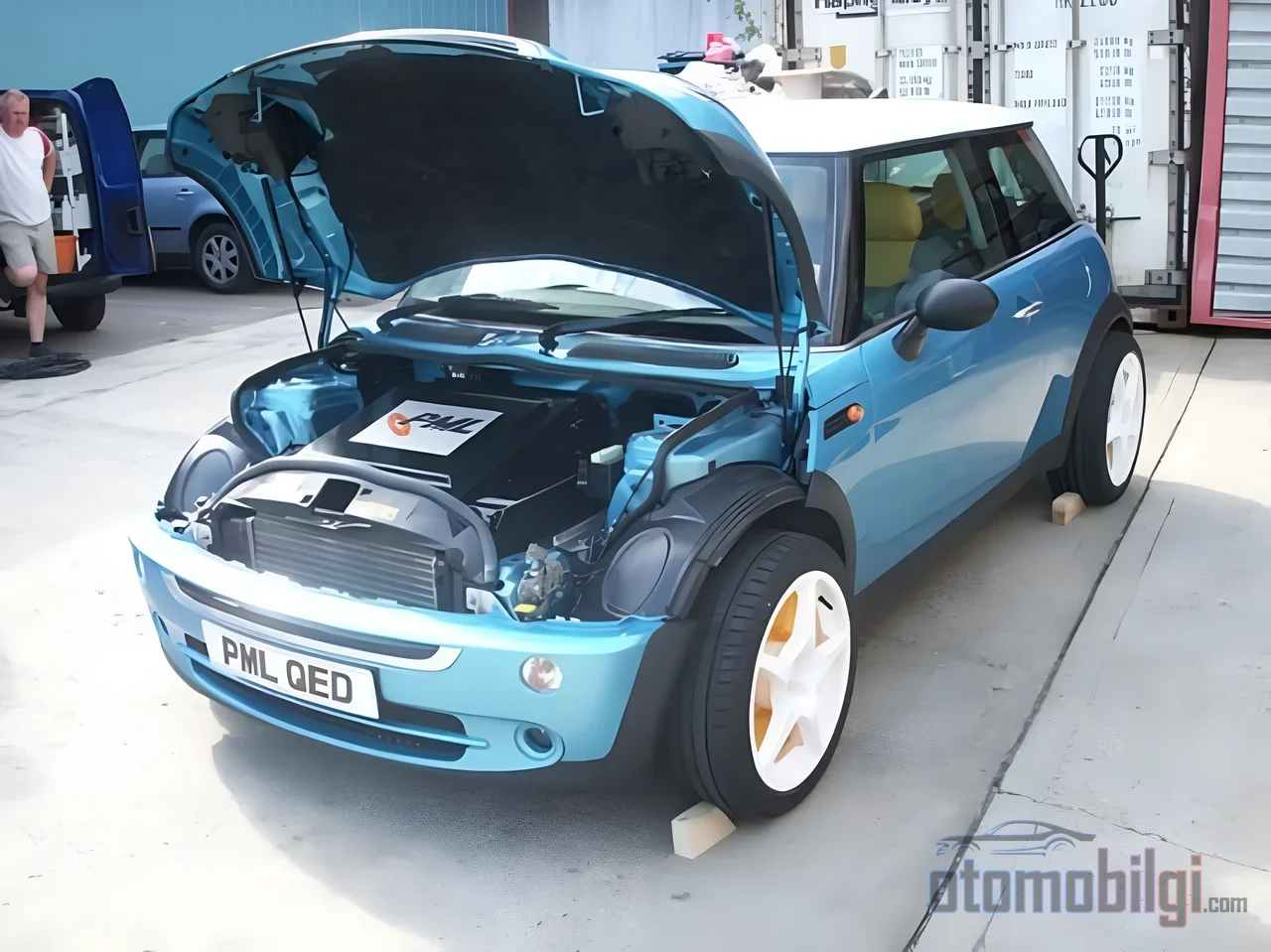
The MINI QED's foundation was a series hybrid layout: the wheels were turned only by electric motors, and the internal combustion engine never provided direct drive. The small 250 cc four-stroke gasoline unit ran at constant speed and constant load, acting like a generator and feeding the battery. This architecture had the advantage of keeping the internal combustion engine at the most efficient point of its efficiency map; in the early years of the plug-in hybrid concept, it was an early and bold application of the logic later adopted by vehicles like the Chevrolet Volt.
The real innovation, however, lay in the power transmission. The brushless, permanent-magnet, sinusoidal motors that PML Flightlink called Hi-Pa Drive had 24 phases and were water-cooled; each was mounted directly inside its corresponding wheel. There were no intermediate power transmission elements such as a gearbox, differential, driveshaft or axle. The same layout, with the same motors, was later used in the Volvo ReCharge concept and in a Ford F150 pickup prototype unveiled at the 2008 SEMA Show.
The power figures were serious: each of the four motors produced 120 kW, i.e. 160 hp; a total of 640 hp, roughly four times that of a standard Cooper S. On the torque side the picture was even more striking: 750 Nm per wheel, a manageable total of 3,000 Nm, together with torque control usable in both directions.
Highlights
- Four in-wheel motors, a total of 640 hp and 3,000 Nm torque management
- 0-60 mph in 3.7 seconds, top speed in the region of over 150 mph
- Approximately 1,000-mile (1,500 km) range with fuel and charging combined, roughly 80 mpg consumption
- Fully electric range of 200-250 miles; the generator a 250 cc constant-speed unit
- PML Flightlink went into administration on 28 November 2008; the project never reached series production
Bold Decisions on Performance, Energy Storage and Braking
Battery and Ultracapacitor Duo
On the energy side, there was a two-layer system. The main storage was a 300V, 70 Ah lithium-polymer battery with a 700 amp peak current tolerance. Alongside it, an ultracapacitor pack rated at 350V and 11 Farad served a role; it could absorb and deliver energy about ten times faster than the battery and kicked in especially during sudden power demands. PML Flightlink described this effect as a nitro-like feeling of performance. The logic of the capacitor was simple: the battery met energy density, the capacitor met power density.
Removing the Brake Discs
One of the vehicle's most striking engineering decisions was the complete removal of conventional disc brakes. It was claimed that the inverters taking on the regenerative braking duty could produce more deceleration than a brake disc could provide, so no friction-based braking system was needed. This was a theoretically consistent approach that both reduced unsprung mass and maximized the recovery rate of braking energy.
The Unsprung Mass Problem and the Answer
The classic criticism of in-wheel motors is that by increasing unsprung mass, the motor degrades handling and comfort. QED's answer came with numbers: the motor made up a total mass of 24 kg together with the magnesium alloy wheel and tire; the MINI One's original assembly mass was 22.5 kg excluding the brakes. Thanks to this practically negligible difference, it was argued that ride comfort remained unchanged.
| Feature | Value |
|---|---|
| Number and type of wheel motors | 4 x 120 kW (160 hp) Hi-Pa Drive, brushless, 24-phase, water-cooled |
| Total power | 640 hp |
| Torque (per wheel / total) | 750 Nm / 3,000 Nm manageable torque |
| 0-60 mph | 3.7 seconds |
| Top speed | Over 150 mph (specification data) |
| Battery | 300V, 70 Ah lithium-polymer (700A peak) |
| Ultracapacitor | 350V, 11 Farad |
| Generator | 250 cc four-stroke gasoline unit, constant speed/constant load |
| Fuel consumption | Approximately 80 mpg |
| Range | 200-250 miles fully electric; approximately 1,000 miles (1,500 km) in total |
The vehicle had three driving modes named Eco, Normal and Sport, selected from a touchscreen. In Eco mode the generator stays off, in Normal mode it kicks in when the battery charge drops below 50 percent, and Sport mode offers enhanced performance. The stability system could change power distribution every millisecond; steering angle along with gyroscopic sensor data from the pitch, roll and yaw axes fed the traction control. The plans also included GPRS-based route-energy reserve matching, speed limit control, remote fault diagnosis and automatic fault notification; no small connectivity vision for 2006.
Why a MINI?
The choice of the MINI platform was a strategic, not technical, decision. The brand's broad appeal and iconic design gave the project visibility. Moreover, the calculation behind it was this: if they could successfully integrate such voluminous components into such a limited volume, applying the same transformation to other vehicles would become easier. The concept was also displayed at Lotus's 60th anniversary event; the figures of 160 hp per wheel and 640 hp in total are confirmed in the records there as well.
One point needs correcting: although the concept is frequently linked to 2007, the debut was made at the 2006 British Motor Show, and the vehicle was introduced to the public with its technical details in September of the same year. In addition, some accounts refer to a 0-60 mph time of 4.5 seconds; the primary figure in the launch materials is 3.7 seconds. No official value for the metric 0-100 km/h was announced by the manufacturer.
The Long History of In-Wheel Motors: From Lohner-Porsche to QED
The MINI QED was not the first example of the in-wheel motor idea, but one of its most ambitious examples. The roots of the idea go back to Ferdinand Porsche. The Lohner-Porsche, displayed at the 1900 Paris World's Fair, ran on steerable wheel hub motors each producing 2.5 PS of power and reached a top speed of 32 km/h. In 1901, the production-ready Mixte version established a true series hybrid arrangement in which a generator driven by a Daimler-built internal combustion engine fed the electric wheel hub motors; Porsche's vehicle named La Toujours Contente, meanwhile, was the first all-wheel-drive electric racing car with its four hub motors.
In other words, the QED's architecture is a plan drawn a full century before its debut, adapted to the age of lithium-polymer batteries and digital control. The timing was also meaningful: In 1997, the world's first mass-produced hybrid car, the Toyota Prius, took to the roads in Japan, the Honda Insight became the first gasoline-electric hybrid sold in the US in 1999, and battery technology had evolved from heavy lead-acid batteries to lithium-ion chemistry. The Chevrolet Volt, the first commercial plug-in hybrid, came only after the QED, with battery technology backed by the Department of Energy. Right in this transition window, PML Flightlink made its claim by supporting the heavy batteries with ultracapacitors and combining them with hub motors.
Why Didn't the MINI QED Reach Production?
There is no signed cancellation decision or detailed cost and scalability analysis explaining the fate of the concept; what is documented is the process that unfolded at the company level. PML Flightlink was placed into bankruptcy administration by court order in the UK on 28 November 2008; thus, in the harshest period of the global financial crisis, the entity in a position to produce the vehicle exited the stage.
However, the story did not quite end. In 2009, the company split in two: Protean Electric continued to develop automotive in-wheel motor applications of the Hi-Pa Drive technology and still exists today as a firm working in this field. Printed Motor Works, on the other hand, focused on manufacturing pancake-type axial flux motors and drive systems. The technology did not die; its carrier changed.
To summarize with today's perspective: The MINI QED was one of the most ambitious in-wheel motor experiments to leave its mark on plug-in hybrid history; with four hub motors it produced 640 hp and 3,000 Nm of torque, promised 80 mpg consumption and a range of roughly 1,000 miles, and did so with an approach radical enough to do away with even the brake discs. Its failure to reach series production was not proven to be the technology's shortcoming, but rather its developer entering bankruptcy administration in 2008.
Where Is the In-Wheel Motor Today?
The question the QED posed is one the automotive industry still grapples with today. With the spread of electric vehicles, the in-wheel motor is attracting renewed interest; Hyundai Mobis is developing in-wheel motor technology that eliminates the transmission, and in the academic literature this architecture is discussed as a non-conventional drive arrangement advantageous for flexible torque control and high power density. No direct successor came from MINI; the brand's hybrid step was limited to the 48V mild hybrid plan announced in 2020, using the B48 four-cylinder engine.
In this context, the place of the MINI QED becomes clear: although it was a concept that never reached production, it is a distinct link in a chain extending from the Lohner-Porsche to today's drive architectures, one that tested the limits of in-wheel motor architecture and ultracapacitor-supported series hybrid arrangement back in 2006. What needed to be proven was proven, at least on the engineering paper; what was missing was the organization and capital to carry it into series production.
Sources
- The 640 bhp MINI QED plug-in EV
- PML Flightlink
- PML Mini QED electric vehicle
- Ahead of his time: Electric wheel-hub motor from 1900 - Porsche Newsroom
- Lohner-Porsche
- Milestones: Toyota Prius, the World's First Mass-Produced Hybrid Vehicle, 1997
- The History of the Electric Car
- In-Wheel Electric Motors Gain Traction Again
- The Future of the Automobile Transformed by In-Wheel Motors - Hyundai Motor Group
- Protean Electric