Dry Electrode Accelerates Battery Production
Share This Page
When you think of lithium-ion batteries, everyone's mind goes to chemistry: new cathodes, silicon anodes, solid-state promises. But what really shook the industry in 2026 isn't a lab formula - it's the production line on the factory floor. The dry electrode process promises to strip solvents out of the decades-unchanged wet coating and manufacture the battery in a completely different way from before. So how much of that promise has actually made it down to the factory floor? Let's take a look, because the answer isn't as clear-cut as you might think.
What Is Dry Electrode Manufacturing, and How Does It Differ From Wet Coating?
Let's start with the basics. In classic wet coating, the active material, conductive additive, and binder are turned into a slurry with a liquid solvent. On the cathode side, this solvent is a toxic chemical called NMP; on the anode side, it's water. This slurry is spread onto copper and aluminum foils, and then the most grueling part of the job begins: drying. The electrodes pass through ovens tens of meters long, often running above 100°C. What's more, these ovens consume roughly 39% of the total energy in lithium-ion battery production. Yes, a single step, almost half the energy!
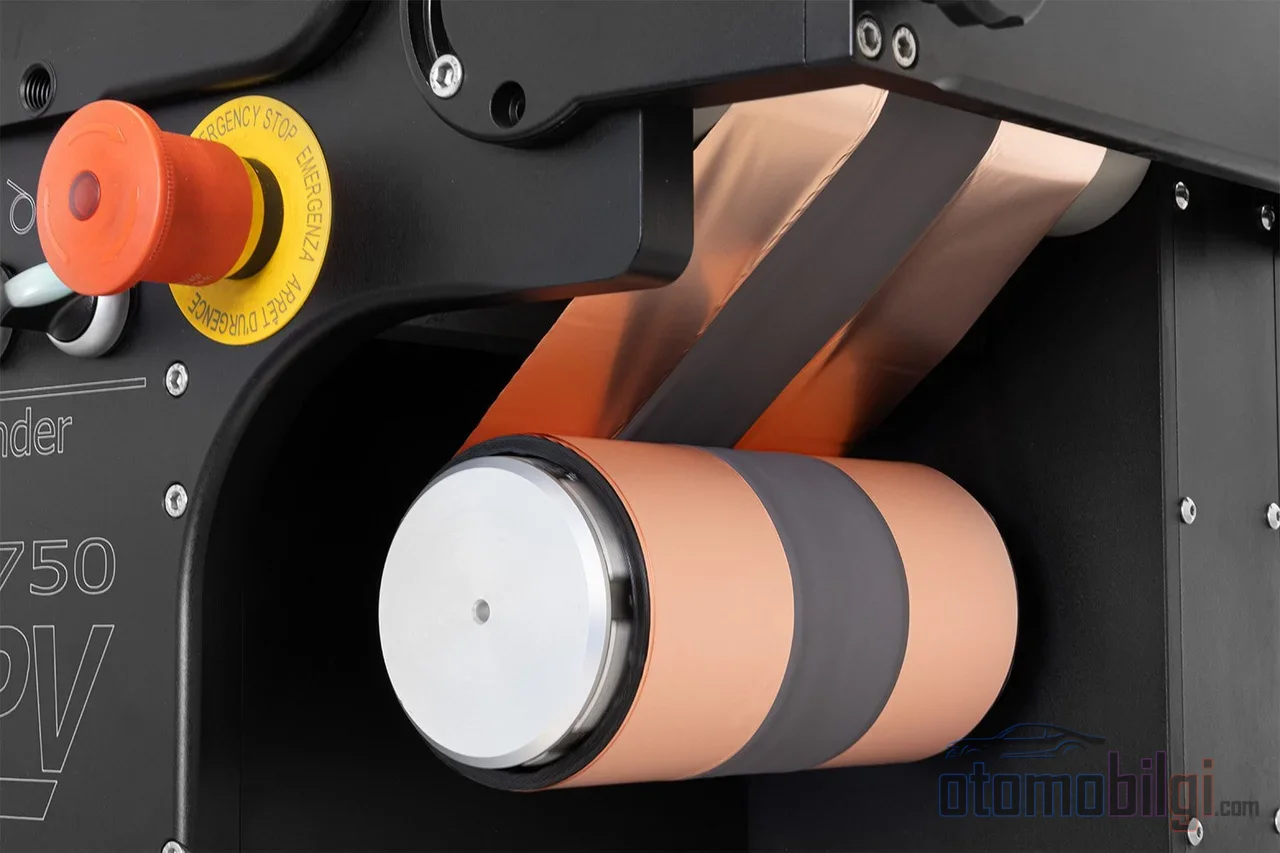
In the dry electrode process, there is no such thing as a solvent. The powders are mixed in dry form, PTFE is used as the binder, and under shear force this binder stretches into fibers, forming a network that binds the particles together. Its technical name is fibrillation, but here's my analogy: instead of making dough from flour, water, and salt, you can think of it as continuously kneading until it reaches dough consistency - without adding any liquid at all. Then this dry material is applied directly to the current collector and takes its final form through a compression step called calendering. Three steps: dry mixing, dry coating, compression. No ovens, no solvent recovery plant.
Key Takeaways
- Electrode drying consumes roughly 39% of battery manufacturing energy - the dry process eliminates this step entirely.
- Tesla, in Q4 2025, achieved fully dry-electrode 4680 production at Giga Texas; in January 2026, these cells began going into Model Y packs.
- Energy savings claims range between 30% and 71%; where the boundary is drawn changes the result.
- The dry process can produce electrodes thicker than 200 µm; the wet process can only go down to 100 µm.
- Dry coating's share in global electrode production is still very low, meaning the technology is still at an early commercial stage.
The Promised Gains: Are the Numbers Really That Exciting?
This is where the interesting part begins, because the numbers rumor deserves a somewhat more careful reading. When it comes to the energy savings rate, the figures that stand out are: some calculations give a modest 30%, while others, taking a narrow view of electrode production alone, talk of savings of up to 71%. The reason for the difference lies in where the calculation is made: if you base it on the entire cell production, the rate drops; if you look only at the electrode line, it rises. So there's no contradiction - just differences in measurement.
On the cost side, the picture gets even wider. While some manufacturers promise reductions of up to 50% in total cost, more cautious estimates remain in the 6-15% range. It is said that factory space requirements will decrease by between 22-60%, capital investment for a new facility will be roughly half that of the wet process, and operating expenses will be 60-70% lower. If these figures are correct, the rules for building a new gigafactory change completely. But be careful: most of these are manufacturers' own claims, and independently verified factory data is still very scarce. And in the market, dry electrode's share of total production is still far below single digits for now, meaning there is a clear distance between promise and reality.
The environmental side is also ambitious: with the widespread adoption of production processes benefiting from this technology across global battery manufacturing, annual savings of up to 7 million tons of CO₂ are even projected. Of course, this is based on a full-adoption scenario, not today's picture.
Tesla and the 4680: What Happened at the Factory After Eight Years of Waiting?

The star of the dry electrode story is, without a doubt, Tesla. By acquiring Maxwell Technologies in 2019, the company brought this process in-house and announced the dry cathode promise along with the 4680 cell. What happened afterward is a textbook example of the gap between a technology demo and mass production. In the early attempts, dry cathode loss rates reached 70-80%, equipment repair cycles stretched to 45 days, and initial product yield was only at the 20% level. Engineers struggled with adhesion problems, uneven layer thickness, and delamination. In other words, while dry film formation may look like three steps on paper, in real life it is a stubborn beast.
But here is the turning point: In the final quarter of 2025, Tesla confirmed that it had achieved production of fully dry 4680 cells at Giga Texas, where both the anode and cathode use dry electrodes. This means the long-promised vision has materialized at factory scale for the first time. And even more importantly, on January 28, 2026, the company began remanufacturing Model Y battery packs with its own produced 4680 cells. In the early stages, these cells are being used only in specific vehicles, with the scope expected to expand throughout 2026. Domestic cathode production in Texas and LFP lines in Nevada are planned to begin production this year; Giga Berlin's 4680 line, on the other hand, is on the agenda for 2027.
Let's take a critical look: Tesla's yield figures from the early years of its dry electrode journey show just how difficult the technology is. A point emphasized by Tesla's founder Elon Musk comes from a different angle: the real benefit of the dry electrode is not so much cell performance as reducing the capital cost of new battery factories. In other words, the story Musk tells is about capital savings, while the story some manufacturers tell is about product improvement. The fact that these two narratives contradict each other is, in my opinion, the most important detail to keep in mind when discussing the true value of this technology.
Where Are the Other Manufacturers: LG, Volkswagen, LiCAP and the Korean Saloon
Tesla is not alone, but its competitors are moving a bit more cautiously. LG Energy Solution has been working on dry electrode technology for about 10 years and has set up a pilot line at its Ochang Energy Plant, aiming to commercialize it in 2028. It is also one of the companies with the most patent applications in this field, meaning a serious long-term bet on this technology. Volkswagen claims significant progress in dry coating and had announced 30% energy savings, a figure that stays at the modest end of the wide range we described above.
On the equipment and process side, LiCAP Technologies stands out. LiCAP claims its solvent-free process reduces costs by up to 50%, and it is working with Cellforce (a Porsche subsidiary) and Nissan; together with Nissan, it is developing a solid-state EV battery targeting 2028 production. In addition, major equipment manufacturer Dürr has also licensed this technology, meaning dry electrodes are turning from a single company's internal secret into industrial infrastructure. While Korean manufacturers are still at the infrastructure-building stage and Tesla and Panasonic are gaining production experience, this period is seen as a kind of watershed moment in the industry.
Performance Advantages: Is It Only the Factory, or Is the Cell Better Too?
If you think dry electrode is only about factory economics, here's the surprise: the cell itself wins too. With the dry process, electrodes thicker than 200 µm can be produced; with the wet process, exceeding 100 µm is difficult, because during drying the binder migrates to the surface and compromises structural integrity. A thicker electrode means more active material in the same area and therefore higher energy density. The math is simple and sweet.
The process is also chemistry-agnostic, meaning it works seamlessly with high-nickel, LFP and ternary cathodes. But note: silicon-heavy anodes require a special binder formulation. Still, this connection is critical for the future, because silicon anodes offer 10 times higher capacity than graphite but experience significant volume change. That's exactly why solvent-free dry processing looks like a natural match for silicon anodes. Also, dry-processed electrodes are more flexible, more resistant to cracking during assembly, and show better cycle life thanks to homogeneous binder distribution. So the technology brings not only the factory's wallet but also the cell's lifespan into the game.
Challenges: The 1% Share and the Yield Nightmare Aren't Over
Now is exactly the time for the questioning side. Why isn't the dry electrode everywhere yet? The first problem is scaling. Issues like material agglomeration during the mixing stage, i.e. powders clumping together, still challenge the industrial scale. Checking uniformity and consistency in dry film formation is harder than with wet slurry; the process parameters require tight control and the right binder formulation. PTFE is still the primary binder, and alternatives are still under development.
The very high pressures in the Tesla/Maxwell process are also a technical point of debate: maintaining the quality and consistency of the extruded material over long production runs can be difficult. According to assessments within the industry, Tesla has solved the dry cathode in terms of volume between late 2025 and early 2026; the real remaining problem is yield and efficiency. Wet slurry still runs faster. In other words, the dry electrode is now possible but not yet fast.
Meanwhile, the market projection is also worth discussing: the global dry battery electrode market is expected to rise from the $1.57 billion level in 2026 to $6.50 billion in 2034, with annual growth of about 19.5%. So the growth story is strong, but today's share of production clearly reminds us that all these ambitious figures are still at a very early stage.
Where Does Dry Electrode Technology Actually Stand as of 2026?
Here is the clear answer you are looking for. As of 2026, the dry electrode process has moved beyond being a laboratory promise, but it is not yet a fully matured industry standard: Tesla managed to produce fully dry 4680 cells at Giga Texas and put them into Model Y packs, but this technology's share of global production is still very small, yield problems are not fully solved, and most of the striking energy and cost saving figures remain little more than manufacturer claims. The most honest summary is this: the technology is now on the factory floor and it works, but how much of the promised gains can be replicated at scale is something that can only be demonstrated over the next few years. Unlike chemistry promises, this is a manufacturing technology analysis, and as the technology matures, it is the kind of enduring topic worth updating this page for. Which manufacturer do you think will catch up with Tesla - the 2028 LG target, or the Nissan-LiCAP solid-state connection - which is the more aggressive move? Let's meet in the comments!
Sources
- Dry Electrode Process: How This Technology Is Changing Battery Manufacturing - Highstar
- Dry Electrode Process Guide: Battery Manufacturing Metrology - IEST
- Dry electrode battery manufacturing: LiCAP says its solvent-free process can cut costs up to 50% - Charged EVs
- How Tesla's Fully Dry 4680 Battery Finally Delivers on Eight Years of Promise - battery-tech.net
- Tesla puts 4680 battery cells back in Model Y - Electrek
- Tesla 4680 Battery "Complete Form": Full Dry Electrode Mass Product - EVLithium
- Challenges and Solutions in Dry Electrode Technology - IAC
- Sakuu Explores Challenges in Tesla's DBE Technology Production - Battery Tech Online
- Battery Pioneer: Innovative Dry Electrode Process - LG Energy Solution
- Dry Electrode Manufacturing Technology Landscape 2026 - PatSnap
- Comparing Energy Costs Of Dry Electrode Coating Vs Liquid Processes - PatSnap Eureka
- Anaphite's electrode dry coating technology can save 7 million tonnes of CO₂ annually - Anaphite
- Dry Battery Electrode Market Size, Share | Growth Report [2034] - Fortune Business Insights
- Material Challenges Facing Scalable Dry-Processable Battery Electrodes - ACS
- Silicon Anodes Breakthrough: Dry Electrode Processing - InfinityPV
- 4680 Battery Technology Development Trend - SNE Research