Will Lithium-Sulfur Batteries Really Deliver a 1000 km Range?
Share This Page
Lithium-sulfur batteries are a technology that, in theory, offers energy density far beyond lithium-ion by using a sulfur cathode and a metallic lithium anode; laboratory results support promises of range approaching 1,000 kilometers. But the real question is: Can this chemistry truly overcome the engineering challenges behind the promise - the polysulfide shuttle effect, volume expansion of up to 80%, and short cycle life? In short: Not yet, but for the first time it is seriously getting close.
Highlights
- Documented laboratory energy density: on a full cell mass basis 160-350 Wh/kg
- A research team after 500 charging cycles achieved 92% capacity retention
- The sulfur cathode swells during discharge with up to 80% volume expansion
- The first automated Li-S pilot production line in the US opened in 2023
- As of 2026, commercial distribution has only begun in niche areas began
What exactly is a lithium-sulfur battery?
In the lithium-ion battery as we know it, the cathode side contains metals such as nickel, cobalt and manganese. In a lithium-sulfur (Li-S) cell, sulfur takes the place of these metals; on the anode side, pure metallic lithium is used instead of graphite. This change sounds simple, but the results are tremendous: Sulfur is an extremely light cathode material, meaning it can store far more energy per unit weight. In battery engineering, this measure is expressed as Wh/kg, that is, gravimetric energy density.
And here is the beautiful part: Sulfur is far more abundant and far cheaper than metals like cobalt and nickel. So this is not just a performance story, but also a cost and supply chain story. This is why Li-S advocates position the technology as the natural successor to lithium-ion, which relies on expensive and environmentally problematic metals.
So what is the promise? Li-S cell density documented at laboratory scale ranges between 160-350 Wh/kg. A university team had announced a Li-S battery offering twice the density of conventional lithium-ion and promising 1,000 kilometers of range for electric vehicles. Some developments mention up to five times the capacity of Li-ion; but all of these figures come from laboratory environments, not showrooms.
The polysulfide shuttle effect: Sulfur's headache
The biggest obstacle in Li-S's path is called the polysulfide shuttle effect. Think of it this way: Lithium polysulfides formed as intermediates during charge-discharge dissolve in the electrolyte and wander back and forth from the cathode to the anode. Each time, active material is lost, capacity drops, and the battery quickly fatigues. You can think of it like a GPS error that sends you back at every red light - but here the price is the battery's life.
The shuttle effect also has a side effect: Self-discharge in Li-S cells is a more serious problem than in lithium-ion. In other words, when you leave the car in the garage, the battery loses energy on its own even if you are not watching. Researchers in the field summarize the problem very clearly:
The first cycle was great; by the 20th cycle it had become a useless pile of metal.
This quote actually tells the whole story of the technology in a single sentence. The first charge is magnificent, the tenth charge is not bad, the twentieth charge is garbage. Without fixing this, a 1,000-kilometer range cannot get past a store display window.
Volume expansion and other silent killers
The second major problem is more physical: During discharge, as sulfur deposits solid Li2S/Li2S2 products at the cathode, the cathode expands. The measured expansion reaches up to 80% . Do you know what that means? Sulfur particles swelling like balloons gradually break apart - this is called pulverization - and the fragmented material no longer contributes to electricity. Meanwhile, an interesting detail: while the cathode swells, the metallic lithium anode contracts, quite the opposite; both sides of the cell create problems on their own.
The list doesn't end there. Sulfur is already a weak electrical conductor; furthermore, the conversion from S to Li2S requires a large amount of electrolyte. On the anode side, metallic lithium carries the risk of dendrites, that is, needle-like growths that can cause short circuits. When all of these come together, the factors limiting cycle life emerge as a complete package. There is enormous potential for long range; but rapid capacity loss, short cycle life, and high self-discharge stand as well-known technological challenges.
How far along is the path to a solution?
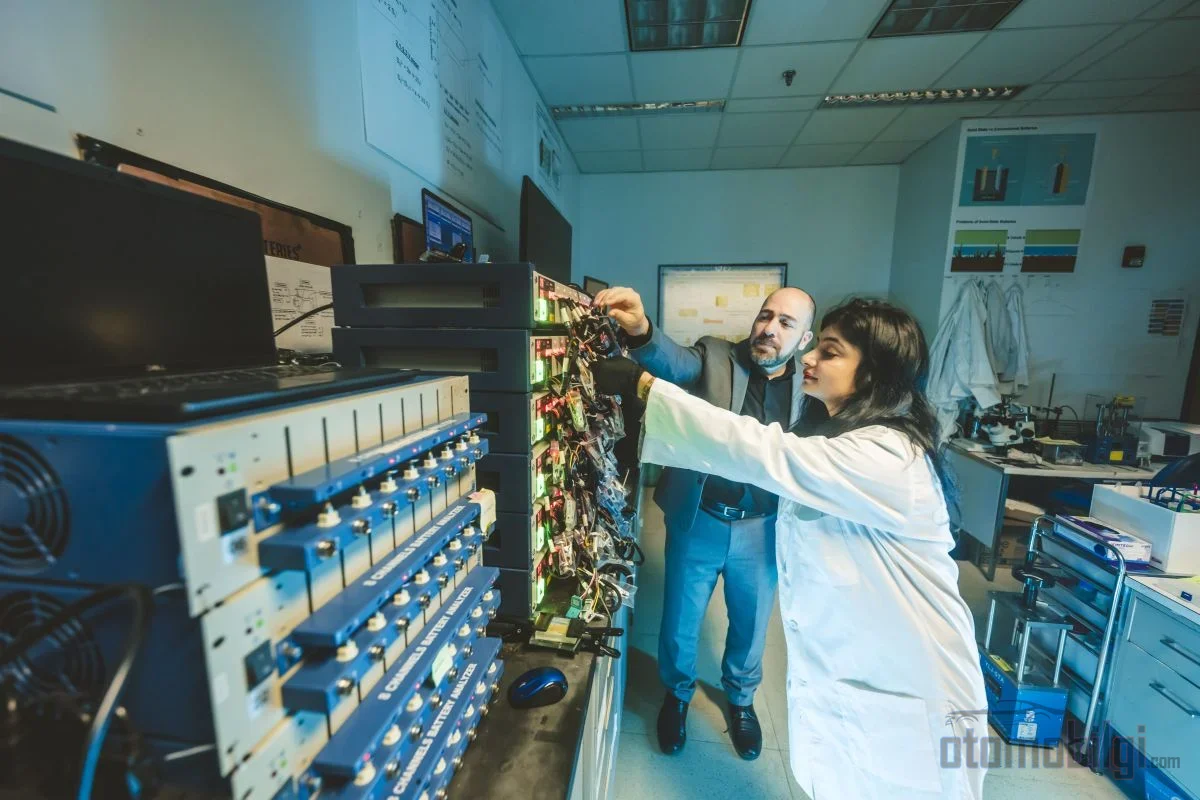
The good news is this: None of these problems stem from obscurity, but from active research. Three main approaches stand out:
- Cathode catalysts: One research lab stabilized performance by adding platinum nanoparticles to the sulfur electrode at only 0.02% of the battery's total composition; at the end of 500 cycles, 92% capacity retention was achieved, and the battery is currently undergoing third-party testing ahead of licensing.
- Polysulfide confinement: Hierarchically porous structures that keep polysulfides inside have become one of the most studied ways to suppress the shuttle effect and improve cycle life.
- Expansion-tolerant architectures: In Ah-level fully solid-state Li-S designs, structures that dynamically buffer the stress arising from volume expansion have been demonstrated; stable cycling with expansion-resistant architectures has also been proven.
On the catalyst side, bifunctional catalysts are pointed to as the next research direction, and the field's own assessment sees the coming decade as a fairly modest timeline for Li-S to reach commercial level. So no one is telling yesterday's story; but no one is selling tomorrow either.
How does it differ from solid-state and sodium-ion?
To evaluate Li-S, you need to know who is on the stage. Manufacturers talk about cells moving from the lab to the road, promising over 1,000 kilometers, even 800 miles of range with solid-state batteries; some solid-state lithium-metal cells can even use sulfur as the cathode. Sodium-ion, meanwhile, plays a different hand: it plays the cost and safety card with claims of more stable chemistry, lower risk of thermal runaway, fast charging, and roughly three times higher cycle life. Solid-state's card, on the other hand, is high energy density and long life.
| Technology | Strength | Weakness |
|---|---|---|
| Lithium-sulfur | Cheap and abundant sulfur, high theoretical energy density | Short cycle life, shuttle effect, volume expansion |
| Solid-state lithium | Promise of over 1,000 km range, high density | Still at the roadmap stage |
| Sodium-ion | Stable chemistry, safety, low cost, long life | Lower density target compared to lithium-ion |
So the difference with Li-S is this: it relies on cheaper raw materials than its rivals and promises the most impressive energy density per unit of weight; in return, it has the youngest and most fragile engineering challenges. If you ask which is the fastest car on a bumpy track: Li-S might break the speed record on a straight road; but finishing the race is another matter.
Commercialization: Where does the 1,000 km promise stand now?
The market side seems to be a reflection of just how early-stage the field is. Market size estimates for 2026 give quite different figures from one another; even this inconsistency is information in itself: the field is still speculative. The real tangible development lies with companies:
- Lyten, opened the first automated Li-S pilot production line in the United States in 2023 and began delivering cells to early customers including defense and automotive; it also positions Li-S as an alternative to the lithium-ion raw material chain passing through China.
- Gelion, aims to release its first commercial demonstration sulfur pouch cells in 2026; the NES cathode is being tested in a co-funded pilot program with one of the first five automakers as EV cells paired with a graphitic anode.
In the bigger picture, Li-S is said to be moving past the "always five years away" cliché and into early commercial deployment in the niche areas where its strength is most meaningful. In contrast, academic assessments emphasize that commercialization still faces significant challenges, and there are voices calling for restraint in the field: for now, Li-S remains in the background beyond the first niche vehicles. Meanwhile, the mainstream of the general EV battery market continues to be lithium-ion; although battery deployment has grown strongly in recent years, new chemistries have not yet reached the mass market.
Will lithium-sulfur batteries replace lithium-ion?
To get to the direct question: no in the short term, maybe in the medium term. Li-S's potential to triple EV range is being talked about seriously, and recent lab results show the promise is not entirely fantasy. But as of 2026, commercial deployment is only in niche areas, while lithium-ion is still everywhere. So the most realistic scenario is for Li-S to prove itself first in segments where long range truly pays off - aviation, defense, specialty vehicles - and then come down to cars.
There are three signs to watch, in my view: the release of third-party test results, whether Gelion can hit its pouch cell target, and whether the pilot automotive program advances to the next stage. If these fall into place, a 1,000-kilometer range turns from an announcement text into a reality on the roads. If it were you, on which road would you first trust this battery? For now, I'm watching from the back seat - but with excitement.
Sources
- Breakthrough Lithium-Sulfur Battery Could Extend EV Range and Lifespan
- Could lithium-sulfur batteries replace lithium-ion? - FIU News
- Long-distance electric cars of the future might be powered by lithium-sulfur batteries - AIP Scilight
- Lithium–sulfur battery - Wikipedia
- Volumetric expansion of Lithium-Sulfur cell during operation
- A Comprehensive Analysis of Lithium–Sulfur Batteries
- Suppression strategies for the polysulfide shuttle effect
- Dynamic volume compensation, Ah-level all-solid-state Li-S
- Advances in Li-S batteries for commercialization
- Lithium-Sulfur Battery Market Report 2026-2035
- Lithium-Sulfur Batteries: 2026 Guide
- Lyten Opens First Automated Battery Pilot Line in the U.S.
- Interview with Renewables Now - Gelion
- Gelion NES Cathode Pilot
- Will your next EV have a solid-state battery
- Solid-state EV batteries with 800 miles
- What's next for EV batteries in 2026
- Electric vehicle batteries - IEA Global EV Outlook 2026
- Sodium-Ion vs Lithium-Ion
- Li-S vs Li-ion difference