How Do F1 Drivers Avoid Passing Out from High G-Forces?
Share This Page
F1 drivers don't pass out in corners, because their bodies have been rebuilt through years of specialized training to carry this load: The neck and abdominal muscles work with isometric endurance against 5-6 G forces, the body has adapted to heat, and the heart has grown accustomed to beating at a marathon runner's level for 90 minutes. In short, it's not just the car racing in F1 - it's the human inside the car.
Highlights
- The head and helmet together weigh about 7 kg; at 6 G, this puts a load of 42 kg on the neck.
- Cockpit temperatures can rise to 50-60°C.
- Drivers lose an average of 2-3 kg of fluid per race, and 4-5 kg in extremely hot races.
- Throughout a race, heart rate is usually in the 140-170 bpm band, with peak values approaching 200.
- While an ordinary person holds their head against roughly 15 kg of force, an F1 driver can withstand up to 45 kg in a corner.
What happens to your head in a corner? How G-force crushes the body like this
You know that when you take a fast corner, the car pins you to the seat or throws you outward. But your torso isn't the only thing feeling that force: your head also needs to stay balanced. This is where things go wild. An F1 driver's head and helmet together weigh about 7 kg. When that head is subjected to a force of 6 G, the load on the cervical spine jumps to 42 kg. So you're taking the corner as if a human being were strapped to your neck.
An average person can resist a force of about 15 kg to support their head. An F1 driver, however, has to withstand up to 45 kg in a high-speed corner. Want to try it? Lie on the floor and place a watermelon on your head as you lift it to the side - then place two watermelons. That's the difference, and a driver repeats this over and over for 90 minutes.
The muscular work involved here is also different from what you'd think. The sternocleidomastoid at the front and side of the neck, along with the upper trapezius muscles connected to the shoulders, work for long periods in an isometric mode under G-force: the muscle neither shortens nor lengthens, it simply locks against a constant resistance. In a 90-minute Grand Prix, these neck stabilizers manage a cumulative load equivalent to thousands of kilograms. Add to that the vibrations from the engine and the road, plus the demanding seated position of the cockpit, and the neck work becomes truly brutal.
So why don't they pass out? Because the muscles act like a defensive wall against these forces that affect blood flow to the brain. Even if the head shifts just a few centimeters, visual focus drifts away from the corner entry and driving suffers - instead of making the driver pass out, it first costs them time at that moment. Safety equipment like the HANS device limits excessive forward head movement, but the first line of defense against lateral and rotational forces is the driver's own neck strength.
Why are drivers' necks so thick?
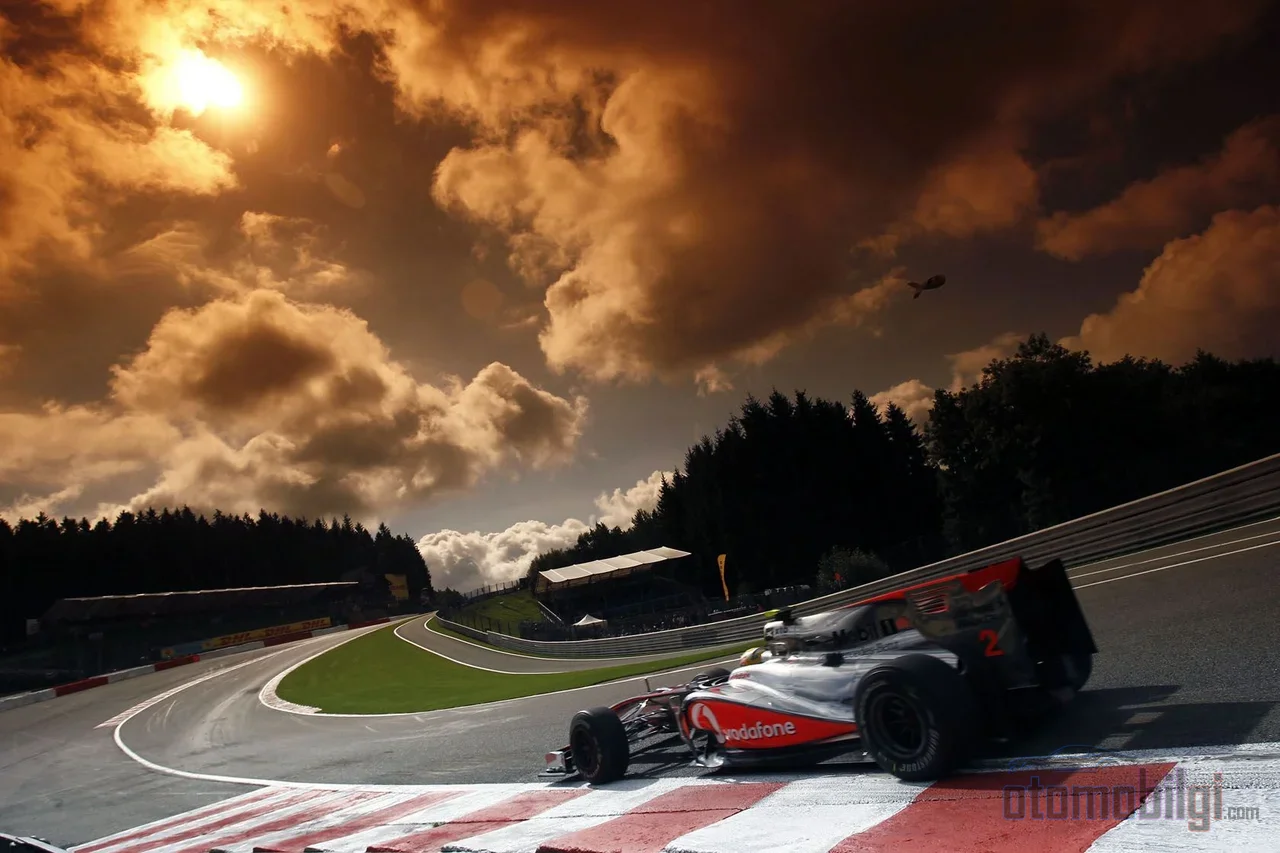
Over a race weekend, you recognize drivers' necks from photos: they're like tree trunks. This isn't an aesthetic detail - it's quite literally performance equipment. A head+helmet at 7 kg and loads exceeding 40 kg at 5-6 G would result in injury to an untrained neck within a few laps.
How is neck training done?
The classic method used to be hanging a weight plate from the head and moving it up and down. But elite coaches now consider this method insufficient: plate exercises work in a single plane and put compressive load on the cervical spine. That's why today multi-axis devices offering 360-degree resistance and isometric work are coming to the fore. Does a corner only push you from the side? No - forward under braking, backward under acceleration, and diagonally in a combined corner. Training therefore needs to build resilience in every direction too.
Tempo also matters: out of season, 3-5 neck sessions are done per week, while in season this drops to 2-3 maintenance sessions. Since training at high intensity every day increases the risk of injury, trainers prefer a balanced program. And an interesting detail: a strong neck is useful not only in racing but in daily life too. Every 0.45 kg increase in neck strength can reduce the risk of concussion from jolts by roughly 5%.
A cockpit like an oven: how do you race at 60 degrees?
Now let's move to the hot side - literally. The temperature inside the cockpit can climb to 50°C, and up to 60°C in harsh conditions. Imagine the engine working in a compartment covered in heat, and the driver sealed in a racing suit and helmet. While even sitting in a car without air conditioning on hot asphalt in summer is hard, here a 90-minute gym test is being done in that same environment.
The most tangible bill of this heat is sweat. Drivers lose on average 2-3 kg of fluid and weight in a race; in very hot and humid races this figure can rise to 4-5 kg, and in legendary degrees of oppressive races like Malaysia, up to 4 kg. Core body temperature can exceed 39°C in long races - meaning you're racing as if you have a mild fever.
So how much can they drink while sweating this much? FIA rules generally allow 0.5-1.5 liters to be carried in the in-cockpit fluid system. So the water you can take in is far less than what you lose. That's why preparation starts before the race: if 3 kg of sweat loss is expected, the driver is loaded with about 2 kg of extra fluid before the race. Since dehydration further aggravates heat stress and impairs driving performance independently, teams are also developing cooling solutions; strategies such as cold fluid intake and body-cooling garments are being tested.
Heart rate higher than a marathon runner's
If there are still those who say "the driver just sits there and turns the steering wheel," let me say this: the driver's pulse is higher than that of the person saying it while running. An F1 driver's heart typically beats at 140-170 bpm throughout a race - meaning a band of about 74-82% of maximum heart rate. Peak values can rise to 92-99% of maximum, that is, almost to the body's red line.
Translated into everyday life: a Grand Prix's heart rate profile is like running a half-marathon for 90 minutes non-stop. What's more, as you've probably noticed, the driver does this not by running, but with hand and foot reflexes in a cramped cockpit, constantly making decisions. Mental load alone can also raise the heart rate; in some measurements, the average heart rate has reached 170, with peak values of up to 200 bpm. During high-G sudden maneuvers, for example while chasing a rival, the heart instantly spikes.
Body and mind prepare together
To avoid being crushed under all this load, drivers don't just train their necks. On a typical pre-season day, the driver does 50-70 minutes of running or cycling endurance training with their trainer in the morning, followed by strength work. The purpose of cardio is clear: to keep the heart efficient in the high heart rate zone throughout the race and to increase heat tolerance.
Heat adaptation can also be learned
Heat adaptation is a method long studied in endurance athletes. A five-week heat training protocol has been shown to increase hemoglobin mass in elite cyclists; heat acclimation also reduces salt loss in sweat, lowers resting heart rate, and increases endurance in hot conditions. Sauna and hot bath protocols are also widely recommended for acclimatization. While its direct applicability to F1 isn't the same for every athlete, the logic is compelling: if the cockpit is already an oven, the smartest move is to pre-adapt the body to the oven.
Reaction and decision brain training
The mind trains as much as the body. Drivers do neurocognitive training that develops rapid decision-making and reaction time under pressure; teams applying these methods in motorsport develop drivers' eye-mind coordination with gamified programs. A review of psychological skills in F1 and F2 drivers also clearly reveals the mental dimension of this sport: drivers display extraordinarily high levels of concentration. Think about it: approaching at 300 km/h, you decide within milliseconds whether to brake or take the corner, take the inside line or the outside - and meanwhile your heart rate is 170.
Why is F1 not just a car, but a test of human performance?
When you put the numbers side by side, the picture tells its own story:
| Load | Value | Comparison |
|---|---|---|
| Cornering/braking G force | 5-6 G | A load of 40+ kg lands on your head |
| Cockpit temperature | 50-60°C | Above a heat wave |
| Fluid loss (per race) | 2-5 kg | Peaks in extremely hot races |
| Average heart rate during the race | 140-170 bpm | Half-marathon zone |
| Core body temperature | Above 39°C | Racing with a mild fever |
In my opinion, F1's least talked-about hero is exactly this: while engineers push the car's limits, drivers push the limits of their own bodies. Next time you're admiring how the car grips in a corner, pause for a second and think about the 40 kilograms pressing down on the driver's neck at that moment. I ask you: would you have made it through the first corner in that cockpit, or would we have given up mid-lap? I think the latter - and that's exactly why only 20 people in the world are sitting in those seats.
Sources
- Heart rate profiling in formula 1 race: A real-time case (Tornaghi et al., 2023, Science & Sports)
- Autopilot: 6 reasons F1 drivers are just like fighter pilots - Aston Martin F1
- Bull's Guide To: Keeping Drivers Cool - Red Bull Racing
- Neck workouts, cardio sessions and mental exercises - Formula1.com
- The Ultimate F1 Neck Training Workout - Iron Neck UK
- Cooling Strategies For Formula 1 Drivers - GSSI Sports Science Exchange
- How Cockpit Temperatures Affect Formula 1 Driver Hydration - AutoRacing1
- F1 drivers demonstrate superior concentration - Frontiers in Psychology (McKnight, 2026)
- Nissan Formula E Team Brain Training Program - Nissan Global Newsroom
- Why are F1 drivers' necks so thick? - RTR Sports
- They Lose 3 kg of Water in Every Race! - Sporsepeti
- Physical Stress in Formula 1 - Cosinuss